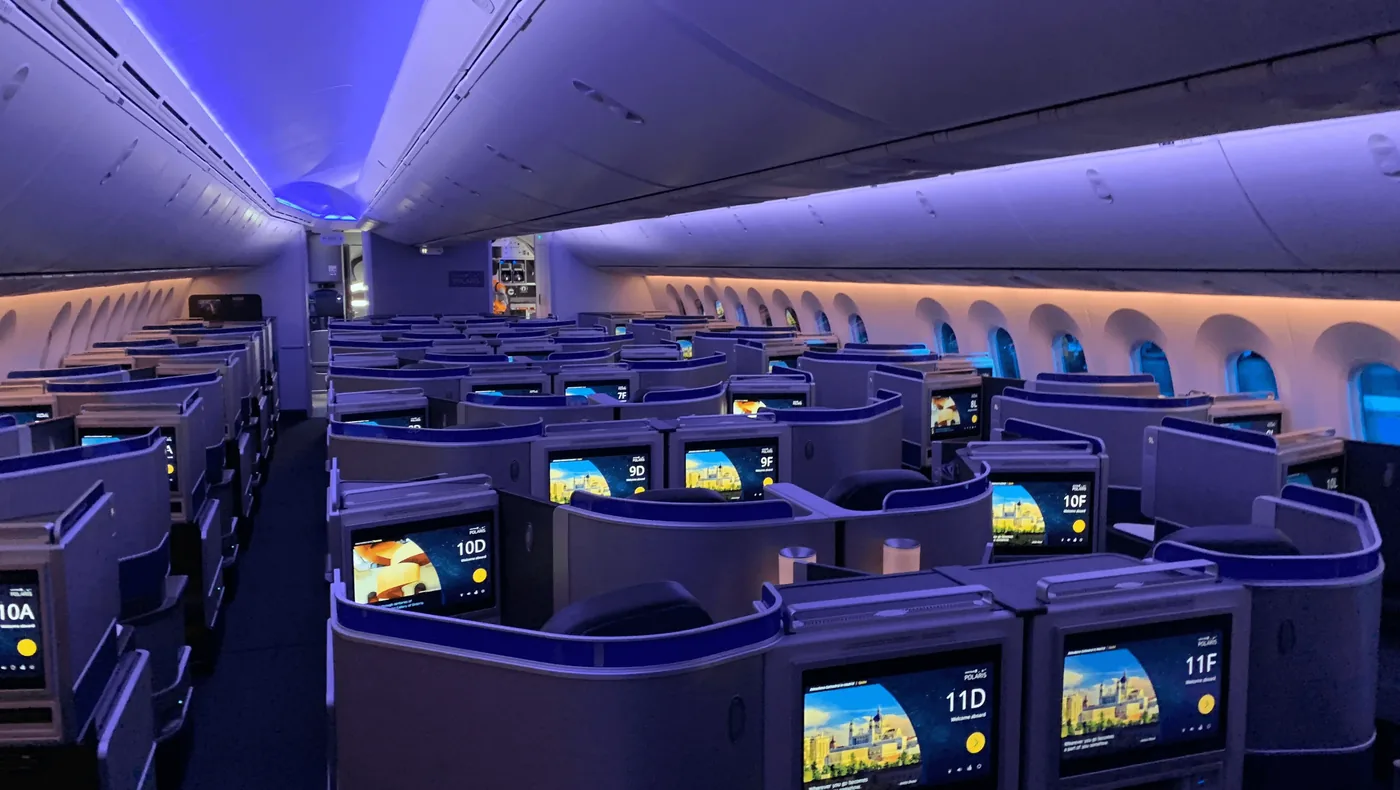
Quick specs
| Cabin | Layout | Seats | Pitch | Width | Bed | IFE |
|---|---|---|---|---|---|---|
| Business (Polaris) | 1-2-1 | 48 | 45in | 20.5in | 78in | 19 |
| Premium Economy (Premium Plus) | 2-3-2 | 21 | 38in | 19in | N/A | 16 |
| Economy | 3-3-3 | 149 | 31in | 17.3in | N/A | 13 |
| Cabin | Layout | Seats | Pitch | Width | Bed | IFE |
|---|---|---|---|---|---|---|
| Business (Polaris) | 1-2-1 | 48 | 45in | 20.5in | 78in | 19 |
| Premium Economy (Premium Plus) | 2-3-2 | 21 | 38in | 19in | N/A | 16 |
| Economy | 3-3-3 | 149 | 31in | 17.3in | N/A | 13 |
United's 787-8 and 787-9 pack 218 seats across three cabins, with Polaris business class offering a 78-inch lie-flat bed in a 1-2-1 layout and 45-inch pitch. The staggered window and aisle seating arrangement in business class creates privacy zones, but passengers report boarding confusion when elite frequent flyers board alongside first-class customers. Economy stretches to 149 seats at 31 inches of pitch across a 3-3-3 layout—tight for long-haul, but the cabin's wide windows and Dreamliner tech (quieter, lower cabin altitude, 16-hour humidification) ease the experience.
The 787-9 carries 48 Polaris business seats, 21 Premium Plus (Premium Economy) seats, and 149 Economy seats. Polaris is arranged 1-2-1 with alternating window and aisle positions; seats in the forward cabin rows offer the quietest experience. Choose Premium Plus over Economy on transatlantic flights if available—the 38-inch pitch and wider seat justify the upgrade on flights over 6 hours. Avoid the last rows of Economy near the rear galley; passengers report galley noise and lavatory queues. One surprising finding: passengers note confusion during boarding when elite frequent flyers board simultaneously with first-class passengers, creating gate congestion.
Polaris on the 787-8 and 787-9 is a 48-seat cabin arranged in a 1-2-1 configuration, with seats staggered so some sit closer to the aisle and others closer to the window. Passengers describe the seating as creating distinct privacy zones—window seats feel more secluded, while aisle seats offer easier galley access. The cabin is divided into a forward section and rear section. Each seat reclines to a fully lie-flat 78-inch bed, and the 45-inch pitch provides comfortable room to sleep or work. Polaris cabins feature mood lighting, individual air nozzles (passengers note this is helpful on long flights), and a sleek modern interior finish. One caveat: passengers report that crews frequently dim cabin windows throughout the flight, including during taxi and takeoff, even when the cabin is not preparing for sleep. Window control is a crew-operated feature, not individual passenger control.
The 21-seat Premium Plus cabin sits between Business and Economy, arranged in a 2-3-2 layout with a 38-inch pitch and 19-inch seat width. This cabin offers noticeably more legroom than Economy (7 inches more pitch) and a wider seat, making it a practical upgrade for transatlantic and transpacific flights. Premium Plus passengers sit in a dedicated cabin section with separate service. The 16-inch seatback screen provides in-flight entertainment. For flights over 6 hours, the extra pitch and elbow room justify the upgrade cost if your budget allows; for shorter flights, the marginal gain may not be worth the premium.
Economy spans 149 seats in the standard 3-3-3 configuration with 31 inches of pitch and 17.3-inch width. This is tighter than many competitors on long-haul routes, but the 787's cabin technology—lower cabin altitude, higher humidity, larger windows, and quieter engine noise—partially compensates. The Dreamliner's cabin pressure equivalent to 6,000 feet (versus 8,000 feet on older widebodies) and 16-hour moisture retention help reduce jet lag and dry skin. Before booking, verify the specific row numbers for exit rows, non-recline rows, and rear galley zones on United's official seat map, as these vary by aircraft configuration. Passengers should expect a snug experience on routes longer than 8 hours, but the cabin's window size and ambient lighting offer visual relief.
| Seat | Cabin | Why |
|---|---|---|
| Window seats, forward Polaris section | Business (Polaris) | Staggered layout places windows farther from the aisle, creating a private sleeping zone away from foot traffic and galley activity |
| Aisle seats, mid to rear Polaris section | Business (Polaris) | Easy access to lavatory and galley; sit farther from the window for reduced crew dimming disruption during cruise |
| Forward Premium Plus rows | Premium Economy (Premium Plus) | Closest to business-class service, quieter cabin section, and minimal turbulence from engines |
| Window seats, forward Economy section | Economy | Avoid middle-seat squeeze; the 787's oversized windows offer a significant visual and psychological advantage on long flights |
| Seat | Cabin | Why |
|---|---|---|
| Last two rows, Economy | Economy | Passengers report galley noise, lavatory queue congestion, and reduced legroom near the tail section |
| Middle seats throughout Economy | Economy | On a 3-3-3 layout, middle seats offer no window view and limited aisle access; request aisle or window during booking |
| Rear Economy rows near lavatories | Economy | Lavatory odors, door opening/closing noise, and passenger traffic disrupt sleep on long flights |
United's Premium Plus cabin on the 787-8 and 787-9 sits between Economy and Business, offering a meaningful upgrade in space and service without the business class price tag. The cabin seats 21 passengers across 7 rows in a 2-3-2 configuration, giving window and aisle seats direct access to the cabin without crossing the middle section.
Seat pitch is 38 inches—6 inches more than Economy's 31 inches—providing noticeably better legroom for passengers on routes longer than 4 hours. Seat width is 19 inches, narrower than Business's 20.5 inches but wider than Economy's 17.3 inches. The recline is motorized and seats fold into a lie-flat bed on some aircraft configurations, though on this aircraft verify current IFE and recline specs on United's seat map before booking.
Premium Plus includes a dedicated galley and priority meal service: hot meals are served on most domestic transcontinental and all international routes, with wine, beer, and spirits available at no extra charge. The meal quality is noticeably superior to Economy—plated service, larger portions, and fresh ingredients—though expectations should remain calibrated to airline rather than restaurant standards. Passengers on longer routes report the meal service, combined with extra legroom, transforms the experience significantly.
Lounge access depends on your ticket type and elite status; Premium Plus alone does not grant club access, but elite frequent flyers in this cabin enjoy access based on their elite tier. Check your fare rules and elite status before booking.
Best rows in Premium Plus: Rows 2–4 offer the shortest walk to the forward galley and lavatory and avoid proximity to the galley churn on longer flights. Window seats (A and J) are quieter and offer better privacy for sleeping. Aisle seats (B and I) provide easier restroom and galley access without disturbing a neighbor. Avoid row 1 if it exists on your specific aircraft; it may have limited recline or proximity to the cockpit bulkhead.
| Cabin | Seats | Layout | Pitch | Width | IFE |
|---|---|---|---|---|---|
| Premium Economy (Premium Plus) | 21 | 2-3-2 | 38 in | 19 in | 16 in |
United Airlines Boeing 787-8 and 787-9 Dreamliners are functional but not ideal for extended laptop work.
Tray Table: Business (Polaris) seats have tray tables suitable for standard laptop work—they are wide and stable enough for typing and video calls. Premium Plus and Economy tray tables are narrower and deploy from the armrest or seatback; they accommodate a standard laptop in landscape orientation, but sustained typing and multitasking are cramped, especially in Economy. For serious work, Business class is the only comfortable option; Premium Plus is serviceable for email and light tasks on routes under 3 hours.
WiFi: WiFi is available on United's 787-8 and 787-9 fleet. Details on current connectivity, provider, and performance vary by aircraft age and software updates. Verify available WiFi packages and speeds on United's website or your seat map before booking.
Power: Power outlet availability varies by cabin and aircraft delivery year. Business (Polaris) seats include personal power; Premium Plus and Economy power availability is inconsistent across the fleet. Check United's published fleet page for your specific aircraft registration to confirm power outlet locations in your assigned seat before boarding.
IFE (In-Flight Entertainment): Business class offers 19-inch screens, Premium Plus offers 16-inch screens, and Economy offers 13-inch screens. All screens support on-demand movies, TV, and music; Business and Premium Plus also include noise-canceling headset options. Productivity software is not available on seatback systems; use your own laptop or tablet for work applications.
The Boeing 787 Dreamliner is engineered for passenger comfort across multiple sensory dimensions, and the 787-8 and 787-9 variants benefit from advanced cabin pressure and humidity management.
Cabin Pressure & Altitude Simulation: The 787 maintains cabin pressure equivalent to 6,000 feet altitude, compared to 8,000 feet on older widebodies. This lower simulated altitude reduces ear pressure, sinus discomfort, and fatigue on transatlantic and transpacific routes, a meaningful advantage on overnight crossings and journeys over 8 hours. You will notice less jet lag and arrive fresher, particularly in Business and Premium Plus where you can recline and sleep.
Humidity: The 787 maintains cabin humidity at 30–40%, higher than the 10–20% standard on older aircraft. This reduces dry skin, sinus irritation, and throat fatigue, particularly on long flights. Bring a lip balm and travel-size moisturizer, but expect your eyes and sinuses to feel significantly better than on legacy widebodies.
Engine Noise: The 787's Rolls-Royce Trent 1000 engines are among the quietest in commercial service. Forward rows (Rows 1–8) experience minimal engine noise and are the quietest zones on the aircraft. Mid-cabin rows (Rows 9–16) experience moderate noise, especially if seated over or near the wing. Rear cabin rows (Rows 17+) experience the most engine noise, particularly directly over the engines. If noise sensitivity is a factor in your seat choice, opt for forward cabin assignments. Window seats are slightly louder than aisle seats due to proximity to the fuselage, but the difference is minor on this aircraft.
Deplaning from a Boeing 787-8 or 787-9 follows standard widebody patterns: Business class passengers deplane first (forward exit), followed by Premium Plus, then Economy. Forward aisle seats (rows 1–6 in Economy) deplane within the first 5–7 minutes; rear rows can take 15–20 minutes or more, particularly on flights with heavy carry-on baggage or international arrivals requiring bridge procedures.
If you have a tight connection, prioritize a forward aisle or window seat in Business or Premium Plus—these cabins deplane before Economy begins. For Economy connections, request a forward row at check-in or during online check-in; row positions 1–8 significantly reduce deplaning time.
Do not rely on specific deplaning times: gate assignments, bridge vs. stairs, passenger behavior, and airport procedures vary by destination and day. Before booking, cross-reference your connection time against United's published minimum connection time (MCT) for the relevant airport pair. If your connection is under 45 minutes on a domestic arrival or under 90 minutes on an international arrival, seat forward or upgrade to an earlier cabin. When in doubt, confirm gate information and estimated push-back time with a gate agent immediately upon arrival, and ask whether connecting passengers are being held for delayed inbound flights.
Business Class (Polaris): Book seat 2A or 2K—window seats in row 2. The bed is 78 inches long, flat and direct-aisle without a central divider, and row 2 is far enough from the forward galley to avoid crew and passenger traffic without being isolated at the rear. Request the cabin crew to dim your window shade after the main cabin lights dim (typically 90 minutes after takeoff on overnight routes); the 787's dimmable windows are responsive and block nearly all external light. Skip the hot dinner service if you plan to sleep within 2 hours of takeoff; accept water and a light snack instead, and ask the crew for a blanket and pillow. Bring a quality neck pillow (memory foam or inflatable, 4–5 inches thick) and a silk eye mask to block residual cabin light leakage. On arrival approach (final 90 minutes), ask the crew for a warm towel and coffee service 20–30 minutes before landing to transition to alert status; shower in the lavatory if the flight duration permits and facilities are available. Set your watch to destination time immediately after boarding and sync your sleep schedule to local night, not flight duration.
Premium Plus: Book seat 2A or 2J—window seats in row 2 for privacy and direct aisle access. Pitch is 38 inches and seats recline to near-flat on some aircraft; verify recline range on the seat map. Premium Plus lacks the full business class amenities, but the extra legroom and quieter cabin forward of the Economy zone allow genuine rest. Eat the hot meal service (it is markedly better than Economy and signals the cabin crew that you are settling in for sleep) and request a blanket and pillow. Bring an inflatable neck pillow and an eye mask. Avoid aisle seats (B and I) on overnight flights; the aisle traffic and lavatory proximity disrupt sleep, and the narrower seat width (19 inches) means aisle-side armrest reclines can feel cramped. Close the window shade after the meal is cleared, and ask the crew to dim cabin lighting on schedule. Request pre-arrival coffee and a warm towel 30 minutes before landing.
Economy: Overnight sleep in Economy is difficult but not impossible if you choose strategically. Book an exit-row window seat if available (typically rows 10–13 on the 787-9, row 9 on the 787-8)—exit rows offer 31-inch pitch plus an extra few inches of floor space, and the window wall blocks fellow passengers from bumping you. If no exit row is available, book a mid-cabin window seat in rows 14–18 to avoid forward lavatory traffic and rear-engine noise. Window seats allow you to rest your head against the wall and the shade blocks light. Request a blanket and pillow at boarding. Decline the meal service or eat lightly; a full meal digestion disturbs sleep, and the reduced legroom makes post-meal discomfort acute. Bring a quality neck pillow (4–5 inches, memory foam or inflatable), an eye mask, and earplugs or noise-canceling earbuds playing white noise or a sleep podcast. Do not expect a bed-quality sleep; expect 3–4 hours of disrupted rest. Set your goal as arriving rested enough to function, not waking refreshed. On arrival, walk the airport terminal briskly for 10–15 minutes before ground transportation to reset circulation; the low 6,000-foot cabin altitude reduces fatigue compared to legacy aircraft, so you will arrive in better shape than on older widebodies despite poor sleep.
Passengers report that the Polaris seats on the 787-8 and 787-9 are staggered in configuration, with some seats positioned closer to the aisles and others closer to the windows; this layout does not present a privacy concern, but some frequent flyers note it takes visual adjustment during boarding. The 78-inch bed draws consistent praise in passenger reviews for accommodating passengers under 6 feet 2 inches in a fully extended, lie-flat sleeping position without foot overhang.
Reviewers consistently highlight the 787's individual air nozzles as a significant cabin comfort feature, particularly on long-haul flights; passengers report that the ability to adjust personal airflow reduces the sense of cabin stuffiness that characterizes older widebodies. Frequent flyers note this is especially valuable on overnight routes when cabin temperatures can feel stale.
Passenger accounts describe the cabin mood lighting in Polaris as aesthetically sophisticated and conducive to sleep on overnight routes; however, reviews note frustration with the fact that cabin crew retain override control of window dimmers and sometimes dim shades during taxi, takeoff, and climb phases when passengers prefer natural light for orientation and connection confirmation. Passengers suggest requesting manual control of your personal window shade at boarding if you are sensitive to ambient light.
On domestic first-class branded flights (marketed as "first class" but operated with Polaris seats on 787 aircraft), passengers report confusion during boarding regarding elite frequent-flyer boarding priority—many elite members board after premium cabin passengers, creating queue uncertainty and frustration. Passengers suggest arriving at the gate early and confirming your boarding group with a gate agent rather than relying on seat assignment to signal boarding order.
Yes, Polaris business class seats recline fully to a 78-inch lie-flat bed. Premium Plus and Economy seats do not lie flat.
In Polaris, window seats in the forward section offer the most privacy for sleeping due to the staggered 1-2-1 layout. In Premium Plus and Economy, window seats in forward rows (away from the rear galley) minimize noise and foot traffic. Verify specific row locations on United's seat map before booking, as layout varies slightly between the 787-8 and 787-9 variants.
United offers WiFi on the 787 fleet. Check United's website for current coverage, availability by subscription tier, and pricing, as offerings and costs change regularly.
Economy's 31-inch pitch is tight for flights longer than 8 hours, but the Dreamliner's cabin technology—lower altitude simulation, higher humidity, larger windows, and quieter cabin—provides tangible comfort improvements over older widebody aircraft. If the fare difference is small, Economy is viable for transatlantic flights; for transpacific journeys (10+ hours), Premium Plus at 38 inches of pitch is a meaningful upgrade. The 787's window size alone improves the long-haul experience compared to narrowbody aircraft.
Passengers report confusion and congestion at the gate when first-class passengers and elite frequent flyers board simultaneously in multiple groups. This creates bottlenecks as both cohorts converge on the jet bridge at the same time, with some first-class passengers surprised that elite members board alongside them rather than after. United's official boarding order is available on its website; if you hold first-class or elite status, review the current rules before your flight to understand your boarding group.