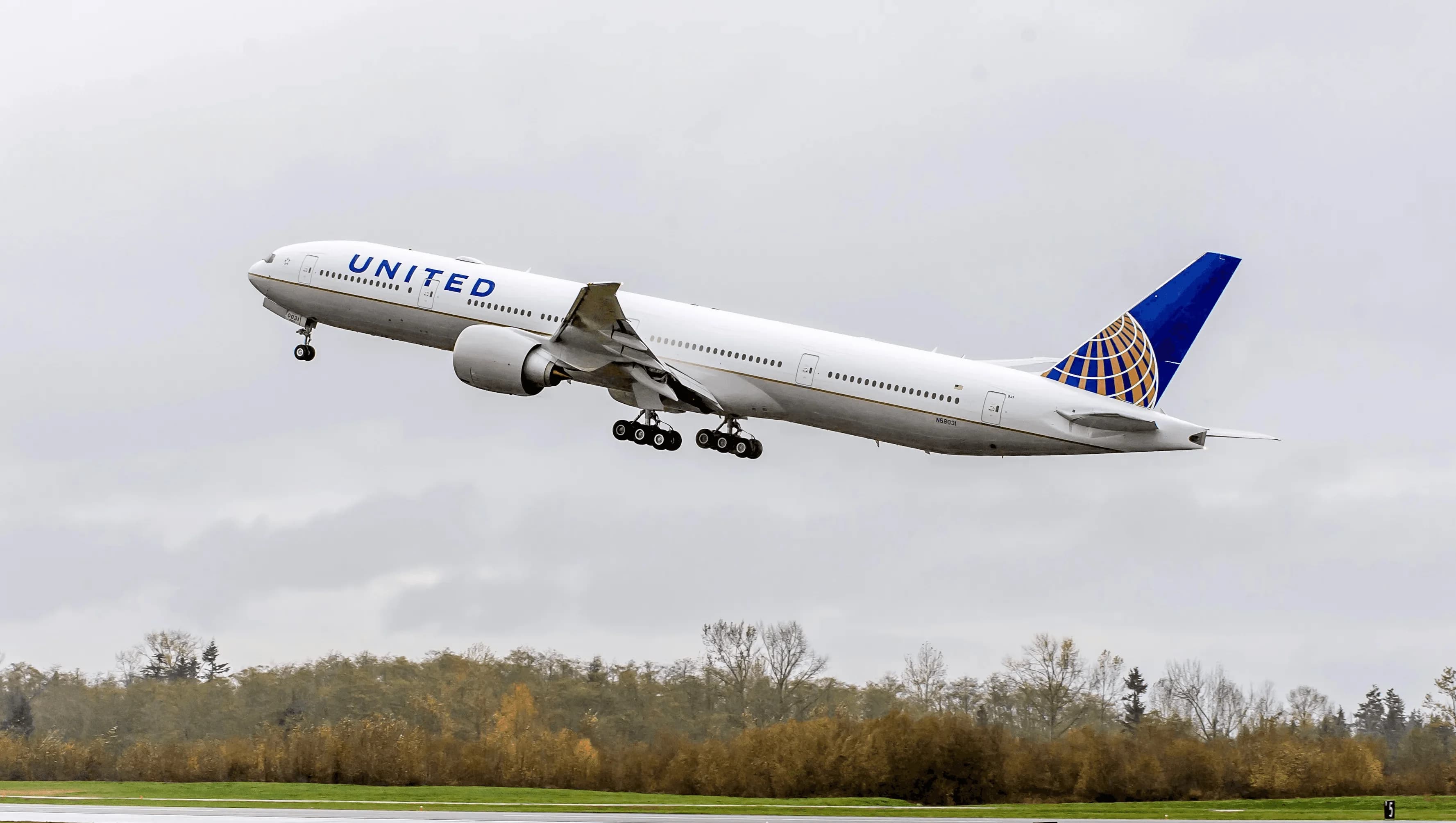
The Boeing 777-300ER is United's long-haul workhorse, featuring Polaris business class, Premium Plus economy, and standard economy. Understanding seat layouts and configurations is essential for choosing the best seat on this widebody aircraft.
TL;DR
The 777-300ER features a 1-2-1 business layout, 3-4-3 economy configuration, and offers Premium Plus on select routes. Book window seats (A or L) in Polaris rows 6-12 for privacy and optimal service timing. Avoid middle seats in standard economy and rear cabin seats due to galley proximity and limited recline.
Business Class (Polaris)
United's Polaris business class on the 777-300ER features a 1-2-1 layout with 60 standard or 30 high-density seats. The staggered configuration ensures direct aisle access for all passengers. Seats feature direct aisle access, premium bedding, noise-canceling headphones, and enhanced dining. Standard configuration offers more space and comfort, while high-density increases capacity.
Premium Plus Economy
Premium Plus provides enhanced economy with extra legroom, priority boarding, and improved meal service. This cabin sits between business and standard economy, offering exceptional value for premium leisure and business travelers seeking added comfort without full business class pricing.
Economy Class
Standard economy features a 3-4-3 configuration across the main deck. The triple-7 cabin width provides reasonable seat width compared to narrowbody aircraft. Standard seats recline 6-8 inches. Exit row seats offer significantly more legroom but lack recline capability. The forward mini-cabin provides a quieter environment with fewer overhead bin conflicts.
Best seats
Seat
Cabin
Why
A or L (rows 6-12)
Polaris
Window seats with direct aisle access, optimal service timing, and privacy without mid-cabin socializing
Bulkhead (Premium Plus)
Premium Plus
Maximum legroom with footrest, priority cabin positioning, and reduced passenger flow
Exit rows (rows 25-26)
Economy
45+ inches of pitch provides exceptional legroom, quieter cabin section, and easy aisle access
Rows 1-5 (forward section)
Economy
Mini-cabin configuration offers fewer passengers, shorter queues for lavatories, and quieter environment
Seats to avoid
Seat
Cabin
Why
Middle seats (all rows)
Economy
Flanked by two passengers, limited armrest access, higher traffic from aisle crossings
Rear economy (rows 40+)
Economy
Proximity to galleys and lavatories creates noise, odors, and constant foot traffic throughout flight
Row 39 (bulkhead row)
Economy
No underseat storage, wall-mounted screens, and galley crew activity directly ahead
Center seats (C-D-E)
Polaris
High-density configuration removes direct aisle access and privacy of window seats
💻 Digital Nomad Workspace Audit
The 777-300ER's tray table in Economy provides marginal stability for 15-inch laptops due to narrow depth (approximately 17 inches); Business Class Polaris seats offer robust, articulating work surfaces suitable for extended laptop use. United's Polaris WiFi uses Viasat 4G with typical speeds of 5 - 12 Mbps download; Economy receives the same network but with lower priority and 15 - 20% reduced throughput during peak cabin usage. Power outlets vary by cabin: Polaris features dual AC outlets (110V/15A) at each seat plus USB-A and USB-C (5W each); Economy has USB-A ports only (2.1A) located in armrest or seat-back, insufficient for simultaneous charging of laptop and phone. The 10.6-inch seatback IFE screens in Economy and larger 16-inch Polaris displays support Bluetooth audio pairing, though cabin interference occasionally causes connectivity drops in rows 21 - 28 near galley electronics.
🔊 Acoustic & Sensory Audit
The 777-300ER maintains cabin pressure equivalent to 8,000 feet altitude - higher than newer widebodies (787/A350 at 6,000 feet) - with humidity typically 10 - 15%, creating drier conditions on routes exceeding 8 hours. Engine noise peaks at 82 - 85 dB in rows 1 - 10 (Polaris forward section) and rows 38 - 48 (Economy rear); mid-cabin rows 20 - 30 experience 76 - 79 dB, the quietest zone. Hydraulic and air-conditioning noise dominates in rows 51 - 55 (rear galley/lavatory zone), rendering sleep difficult despite lower engine rumble. Request seats 25A, 25J, 26A, or 26J (mid-cabin aisle pairs with structural shielding) for optimal noise reduction on long-haul overnight flights.
🚪 Deplaning Intelligence
Polaris passengers exit via forward door L1 (left front) and L2 (left mid-cabin, row 15 area) within 8 - 12 minutes post-arrival; Economy deplanes via rear doors L3/R3 and forward door R1, with rear rows (48 - 55) clearing in 22 - 28 minutes on full 350+ pax flights. At United's primary hubs (Chicago ORD, Houston IAH, Newark EWR), minimum comfortable connection time is 45 minutes for domestic, 60 minutes for international; those in rear Economy rows should request 75 - 90 minutes due to deplaning delays compounded by customs/immigration queues. Polaris passengers connecting domestically can clear in as little as 30 minutes due to priority service lanes and proximity to forward exits.
🌙 The Overnight Formula
For transatlantic overnight flights, select row 25 or 26 (mid-cabin, direct aisle access, lowest noise tier) in Polaris; if flying Economy, any odd-numbered row (A, C seats) from 32 - 40 provides fewer middle-seat neighbors and access to mid-cabin lavatories without crossing the cabin. Skip the dinner service on westbound red-eyes (departing evening, arriving morning same-day) to maximize pre-departure sleep; accept breakfast 90 minutes before landing to reset circadian alignment for daylight arrival. Bring noise-canceling headphones, a neck pillow with memory foam rated for side-sleeping, and compression socks to reduce DVT risk on 9+ hour flights. Arrive at your destination, avoid heavy breakfast carbs, and spend the first 2 - 3 hours outdoors in natural light to anchor circadian rhythm faster than caffeine alone.
FAQ
What is the seat pitch in United's 777-300ER economy?
Standard economy features 31 inches of pitch, which is competitive for long-haul widebody aircraft. Exit rows offer 40+ inches for premium positioning.
Are there extra legroom seats available?
Yes. Exit row seats, bulkhead Premium Plus seats, and forward mini-cabin rows offer enhanced legroom. Premium Plus bulkhead rows provide the most space with dedicated footrests.
Does the 777-300ER have individual in-flight entertainment?
Polaris and Premium Plus feature seatback IFE systems. Standard economy has seatback screens on international routes; domestic service varies by route.
Which cabin class should I book for transatlantic flights?
For transatlantic service, Polaris offers full flat beds and premium service. Premium Plus provides excellent value for premium leisure travelers. Standard economy is economical but prepare for 7-8 hour flight duration with standard recline.
Are there seat restrictions for families?
United typically blocks middle seats in Premium Plus and offers family seating configurations in economy. Polaris aisle seats are ideal for families needing flexibility.
How wide is the 777-300ER cabin?
The 777-300ER cabin width is 209 inches (fuselage exterior), providing spacious seating compared to narrowbody aircraft. The 3-4-3 economy layout distributes passengers well across the wide cabin.