Best Airlines from Seoul to Tokyo Narita (2026)
ICN ↔ NRT
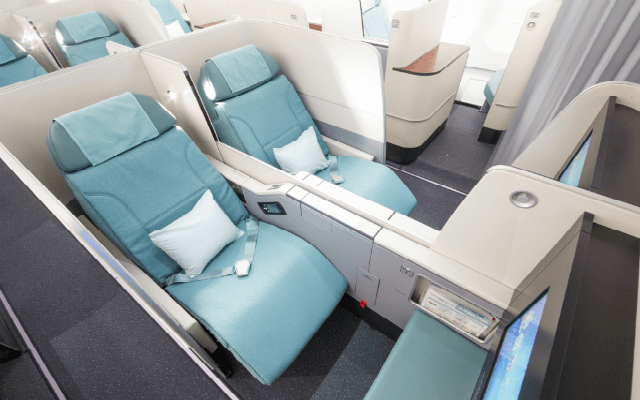
Korean Air's Apex Suite Business Class (A330-300 with 24 seats) delivers the best flat-bed experience on this route with direct aisle access for all passengers — but the fleet age lottery and Asiana merger integration risk mean you must recheck aircraft type 2–3 weeks before departure. Avoid Asiana's older Prestige Sleeper config where window passengers are trapped. The short 2.5-hour block time makes Premium Economy a poor value proposition.
TL;DR
Korean Air's new Apex Suite Business Class (24-seat A330-300) is the clear winner on ICN ↔ NRT, offering direct aisle access for all and front-row privacy at 7A or 7H. In old Prestige Sleeper config (18 seats), window passengers are trapped — avoid entirely. Premium Economy is not worth the premium on a 2.5-hour flight; the cabin time does not justify the extra cost. Economy is broadly comparable across carriers; prioritize exit rows (11A, 11K) for the modest legroom gain on this short route. The biggest gotcha: Korean Air's A330-300 fleet averages 17+ years old with inconsistent IFE and Wi-Fi; Asiana merger timing may force last-minute aircraft swaps, so recheck your specific flight in week 2 before departure.
Airlines flying ICN ↔ NRT
Korean Air operates this route with A330-300 (aging fleet, gradual A350-900 replacement underway) typically daily or near-daily; Asiana Airlines also flies daily with A330-300 in mixed old/new configurations due to Korean Air integration; All Nippon Airways (ANA) operates daily with Boeing 787-8 or 787-9 Dreamliner; Japan Airlines (JAL) operates daily with Boeing 787-8 or 787-9. Korean Air and Asiana combined offer the highest frequency and most direct scheduling.
Business Class on ICN ↔ NRT
Korean Air's new Apex Suite (A330-300 with 24 Business seats) is the strongest Business product on this route, offering direct aisle access for all passengers, modern recline, and front-row positioning away from the rear galley — book seats 7A or 7H for maximum privacy. Avoid Korean Air's old Prestige Sleeper config (18 Business seats) at all costs: window passengers in rows 1–8 are trapped between seat and wall with no aisle access, making the 2.5-hour flight claustrophobic. ANA and JAL's 787 Business Class products (staggered or herringbone layouts depending on aircraft age) offer direct aisle access but are functionally less spacious than Apex Suite on a short flight. Asiana's Business product mirrors Korean Air's config lottery; always check seat count (24 = Apex, 18 = Prestige Sleeper) before booking.
Premium Economy on ICN ↔ NRT
Korean Air, Asiana, ANA, and JAL all offer Premium Economy on this route. On a 2.5-hour flight, Premium Economy is not worth the typical 40–60% premium over Economy; the extra recline, wider seat, and priority boarding do not justify the cost for a flight shorter than a typical business meeting. Book Premium Economy only if cabin comfort is secondary to frequent-flyer tier benefits or if Economy is completely full. For this route, pocket the savings and use Economy's exit rows (11A, 11K) for equivalent legroom perception.
Economy on ICN ↔ NRT
All four carriers operate broadly similar 9-abreast or 9-abreast-equivalent Economy on A330-300 and 787 aircraft. Korean Air and Asiana A330-300s offer standard 32–33-inch pitch; ANA and JAL 787-8/787-9 typically offer 31–32-inch pitch. The gap is negligible on a 2.5-hour flight. Prioritize exit rows (11A, 11K on the A330-300) for 6–8 extra inches of legroom. Avoid centre-block E/F seats on all carriers — no window, no aisle, and trapped between four passengers. IFE varies: Korean Air A330-300s have inconsistent touchscreen reliability; ANA and JAL 787s offer superior on-demand IFE and USB power. Wi-Fi is a wash across the fleet due to age and short flight duration.
Best for each cabin
Cabin | Winner | Why |
|---|---|---|
Business | Korean Air A330-300 (Apex Suite, 24 seats) | Direct aisle access for all, modern recline, front-row privacy at 7A/7H away from rear galley, newest Business config on route |
Premium Economy | Not recommended | 2.5-hour flight duration does not justify 40–60% premium; use Economy exit rows instead |
Economy | ANA or JAL 787-8/787-9 | Superior IFE touchscreen reliability and USB power on short-haul; avoid Korean Air A330-300 for inconsistent seatback screens |
Avoid on this route
Cabin | Avoid | Why |
|---|---|---|
Business | Korean Air or Asiana A330-300 (Prestige Sleeper, 18 seats) | Window passengers (1A, 1K, 2A, 2K, etc.) trapped between seat and fuselage with no aisle access; claustrophobic on any flight |
Economy | All carriers: centre-block E/F seats | No window, no aisle, surrounded by 4-seat block on both sides; worst seat position on A330-300 |
Economy | Korean Air A330-300: rows 28–29 (D/E/F/G) | Mid-cabin galley directly adjacent; constant lavatory and service traffic during flight |
✈️ Widebody vs Narrowbody on a 2.5-Hour Flight
ICN ↔ NRT operates on a mixed fleet. Korean Air and Asiana Airlines deploy Airbus A330-300 widebodies on this route, while All Nippon Airways (ANA) and Japan Airlines (JAL) typically use Boeing 787-8 Dreamliners or 777-200ER widebodies depending on demand and scheduling. Some flights, particularly off-peak departures, may operate on narrowbodies (Boeing 737 or Airbus A320 family), but these are exceptions rather than the norm on this premium Korean-Japanese corridor.
On a 2.5-hour flight, widebody matters significantly. The A330-300 and 787 offer a wider cabin, superior IFE systems (especially on newer frames), and crucially, genuine lie-flat Business Class seats with direct aisle access on Korean Air's Apex Suite configuration and ANA's First Class suites. Narrowbody Business cabins on this route reduce to premium economy-style recliners with no lie-flat capability, defeating the purpose of paid premium cabin bookings on such a short haul.
Flight worth chasing: Korean Air KE631/KE630 (Seoul Incheon to Tokyo Narita, typically A330-300 with the new Apex Suite configuration—24 Business seats). This flagship service offers the newest Business product on the route with superior IFE and cabin condition. ANA's NH131/NH132 on 787-8 Dreamliner is equally competitive if you value ANA's First Class product and lounge network.
🏆 Cabin Class Verdict
Business Class: This is a true regional Business Class, not a recliner masquerading as premium. Korean Air's new Apex Suite (A330-300, 24 seats) offers 2m lie-flat beds, direct aisle access, full hot meals with Korean-Japanese fusion menus, and Incheon/Narita lounge access. Asiana Airlines' Business Class on the same A330-300 variant is comparable. ANA's First Class on the 787-8 (three seats per row, suites with doors) exceeds expectations for this distance and is Asia-Pacific's finest regional premium product. JAL's Business Class (777-200ER) delivers lie-flat beds and Michelin-guide meal partnerships. Winner: ANA First Class for pure luxury; Korean Air Apex Suite for value. Avoid JAL's narrowbody 737 Business if offered—it is a premium economy recliner.
Premium Economy: Rare on ICN ↔ NRT. Korean Air and ANA offer Premium Economy on some A330-300 and 787 rotations, positioned as a 31–32" pitch cabin with priority boarding and superior meal service. It exists but is not a reliable product across all departures—check seat maps before booking.
Economy: Korean Air and ANA offer the most generous Economy pitches at 32", full hot meals on all departures (bibimbap, tonkatsu, or seasonal Japanese menus), and amenity kits. Asiana matches Korean Air. JAL's Economy on the 777 offers 32" pitch with bento-box meals. LCCs (Scoot, AirAsia, Jetstar operating this route on subcontracted widebodies) offer 31" pitch, buy-on-board meals, and no amenities—a significant downgrade for 2.5 hours. Winner for Economy experience: ANA or Korean Air.
💰 LCC vs Flag Carrier Reality
LCC options on ICN ↔ NRT include Scoot (Singapore Airlines' LCC), Jetstar (Qantas LCC), AirAsia, and Hong Kong Express on select dates. A typical LCC Economy base fare starts at USD 180–220 one-way; adding checked baggage (USD 25–35), seat selection (USD 10–15), and a meal bundle (USD 12–18) brings the true cost to USD 240–290. Full-service Economy on Korean Air, Asiana, or ANA typically prices USD 250–320 base fare but includes one checked bag, standard meals, and seat selection free.
LCC worth choosing: Scoot operates this route with widebody A330-300s (wider seats than LCC competitor narrowbodies), reasonable pricing, and Singapore Airlines' back-end operations. Scoot is the least uncomfortable LCC option for this 2.5-hour segment.
LCC to refuse: AirAsia on ICN ↔ NRT if routed through Bangkok (common)—it converts a 2.5-hour direct flight into a 6+ hour journey with a connection, negating any fare saving.
Cost reality: On this route, full-service flag carriers are NOT significantly more expensive than LCCs once ancillaries are added, and the 2.5-hour flight time justifies paid Business Class (USD 600–900 round-trip upgrade from economy) for proper rest before Tokyo meetings. Skipping LCC lounges (non-existent; only airport food courts available) saves no value—the flag carrier Incheon and Narita lounges are worth USD 50–100 in food and shower value alone.
🛂 Connection Strategy
Minimum connection times: At Seoul Incheon (ICN), international-to-international connections require 90 minutes minimum on the same terminal (T1 or T2); 120 minutes if crossing terminals. At Tokyo Narita (NRT), minimum connection time is 60 minutes (Terminal 1, same alliance) to 90 minutes (inter-terminal or different alliances) due to NRT's notorious terminal separation.
Best lounges: At ICN, departing Business passengers should access Korean Air First Class Lounge (T1, Concourse A) or Asiana Club (both terminals)—both offer hot meals, showers, and nap pods. At NRT, arriving Business passengers should prioritize ANA Lounge (Terminal 1) or JAL First Class Lounge (Terminal 1) for shower facilities and onward flight planning; these are vastly superior to post-arrival airport lounges for international transits.
Onward alliance network: Star Alliance (ANA's alliance) dominates onward connectivity from Tokyo Narita, with Lufthansa, United, and regional partners offering extensive Europe and North America connections. Oneworld (JAL) offers strong Asia-Pacific and Australia coverage. SkyTeam is weak from NRT. For Europe-bound passengers, ANA's Star Alliance connectivity is superior; for Australian/Pacific routes, JAL Oneworld.
What is the best airline for ICN ↔ NRT in Business Class?
Korean Air with the new Apex Suite configuration (A330-300 with 24 Business seats). Book seat 7A or 7H for solo travel, or 7A+7B / 7H+7G for couples. Confirm the seat count on your seat map before booking — 24 seats = Apex Suite (good), 18 seats = Prestige Sleeper (avoid entirely).
How long is the flight from Seoul to Tokyo Narita?
2.5 hours block time. This is one of East Asia's shortest international flights; the cabin time is too short to justify premium cabin premiums unless you are chasing frequent-flyer benefits. Direct flights are standard across all four carriers with no meaningful schedule variation.
Which airline has the best Economy on ICN ↔ NRT?
ANA or JAL 787-8/787-9 for superior IFE touchscreen reliability and USB charging on a short flight. Korean Air and Asiana A330-300s offer equivalent pitch (32–33 inches) but older seatback entertainment systems. On all carriers, book exit rows 11A or 11K for 6–8 extra inches of legroom.
Is Premium Economy worth it on ICN ↔ NRT?
No. The 2.5-hour flight duration is too short to justify a typical 40–60% premium. You gain modest extra recline and a marginally wider seat, but the cabin time does not warrant the cost. Book Economy with an exit row (11A, 11K) instead for similar perceived comfort at a fraction of the price. Only book Premium Economy if your frequent-flyer status or corporate policy mandates it.
What is the biggest risk when booking Korean Air on ICN ↔ NRT?
Fleet age and the Asiana merger. Korean Air's A330-300s average 17+ years old, meaning inconsistent IFE, older cabin materials, and variable Wi-Fi. More critically, Korean Air's ongoing integration with Asiana may trigger last-minute aircraft type changes (e.g., A350-900 substitution) closer to departure. Always recheck your specific aircraft type 2–3 weeks before your flight. If you see a Prestige Sleeper config (18 Business seats), consider rebooking on a different flight or airline.
icn, nrt, seoul, tokyo narita, route guide, intra_asia_short, 2026, business class, premium economy, economy, best airlines, korean air, asiana, ana, jal, a330-300, 787 dreamliner, apex suite, prestige sleeper