Best Airlines from Bangkok to Seoul (2026)
BKK ↔ ICN
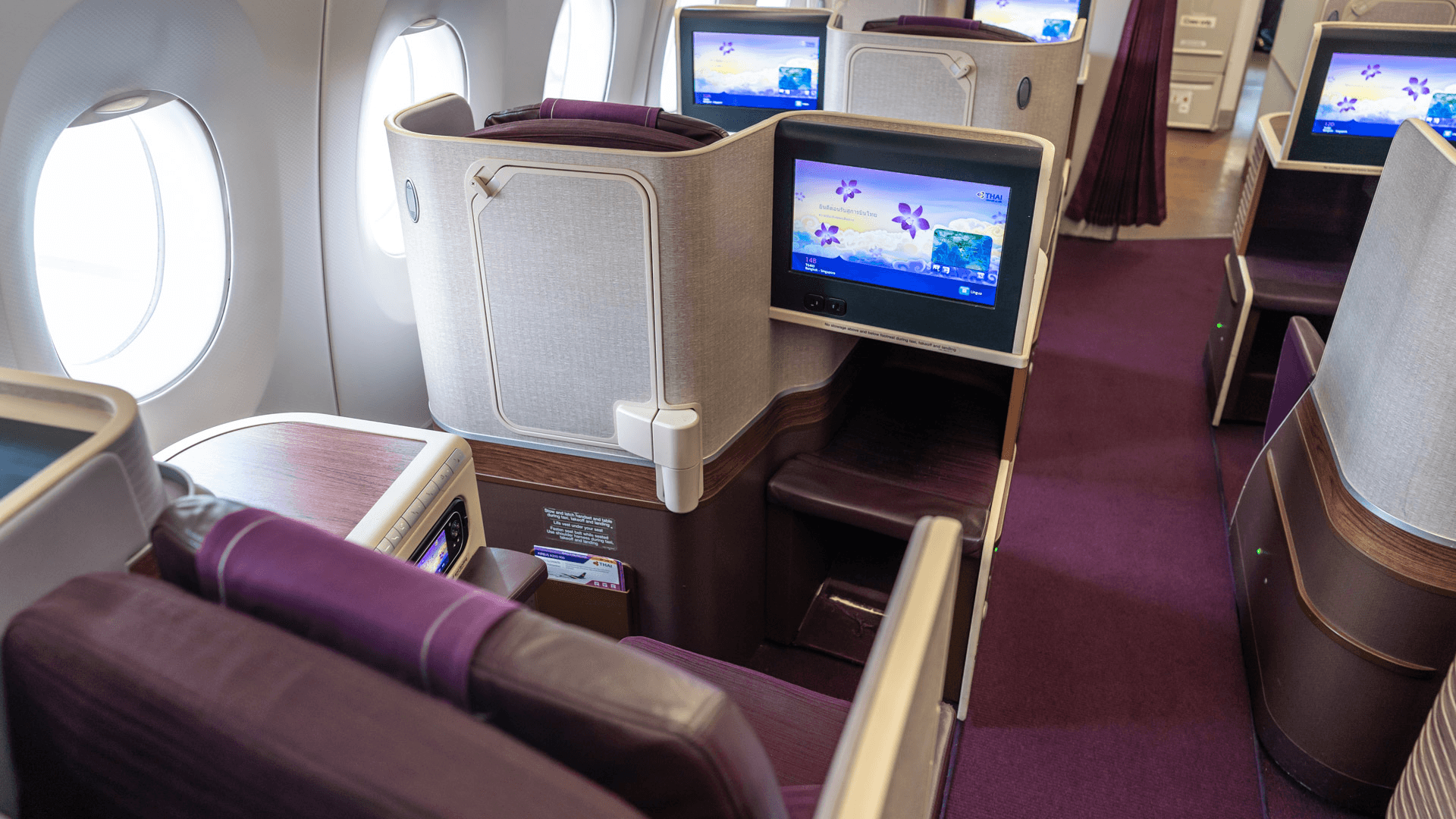
Thai Airways A350 dominates Business Class on BKK–ICN with the industry's best 1-2-1 staggered product, but avoid row 19 entirely due to disruptive crew storage overhead. Korean Air B777-300ER offers a solid alternative, though older reverse-herringbone seating. Economy is tight across all three carriers at 31–32" pitch; Thai A350 wins on cabin quiet and no WiFi downtime.
TL;DR
Thai Airways A350 Business Class (Stelia Solstys or Collins Super Diamond, 1-2-1 direct aisle access) is the clear winner on this route—book odd-row windows on Type 1, even-row on Type 2, and absolutely skip row 19. Korean Air B777-300ER is a competent backup with reverse-herringbone seating in Business but smaller windows. Premium Economy does not exist on this route; the 5.5-hour block time does not justify a premium cabin unless you need lie-flat. Economy is uniformly cramped; Thai A350 quietness in rows 1–5 is the best tactical choice. Overnight departures from BKK arrive Seoul early morning; daylight returns are more practical for connections.
Airlines flying BKK ↔ ICN
Thai Airways operates A350-941 with 1-2-1 Business (Stelia Solstys or Collins Super Diamond), daily service. Korean Air flies B777-300ER with 2-3-2 Business and 3-3-3 Economy, multiple daily frequencies. Asiana Airlines operates A350-900 with 1-2-2 Business (direct aisle access) and 3-3-3 Economy, daily to 5x weekly depending on season. All three are approximately 5.5 hours block time.
Business Class on BKK ↔ ICN
Winner: Thai Airways A350 with Stelia Solstys (Type 1, odd-row windows are most private) or Collins Super Diamond (Type 2, even-row windows are most private). Both offer true 1-2-1 with direct aisle access to every seat; neither reclines fully flat but both are superior to Korean Air's 2-3-2 reverse-herringbone on the B777-300ER, which forces middle-seat couples to share armrests. Avoid Korean Air B777-300ER Business—smaller windows, older product, and middle seats lack direct aisle access. Critical quirk: Avoid Thai Airways row 19 completely on all aircraft—overhead bins are crew storage with constant disruptive opening/closing. Book rows 11–18 or 20+ instead.
Premium Economy on BKK ↔ ICN
None of the three carriers (Thai Airways, Korean Air, Asiana) offer Premium Economy on this route. Thai explicitly does not offer Premium Economy on A350. For a 5.5-hour flight, the gap between Business Class lie-flat and standard Economy does not warrant a premium cabin unless you require recline and priority service; even then, Business Class is the only sensible uplift. Verdict: upgrade to Business or stay Economy; no middle option exists.
Economy on BKK ↔ ICN
Winner: Thai Airways A350 for cabin tranquility—rows 1–5 of Economy experience less foot traffic, earlier meal service, and quieter environment than rear sections. Pitch is industry-standard 31–32" across all three carriers. Avoid Korean Air and Asiana 3-3-3 Economy—middle seats (E, F) offer no aisle or window access; last three rows have minimal recline and lavatory queue noise. Thai A350 has no personal air vents or WiFi; download entertainment before boarding. Asiana A350 offers 1-2-2 Business comfort in Economy-sized pitch, but Economy cabin itself is no better than competitors. Best IFE/WiFi: Korean Air offers WiFi on some B777-300ER (not guaranteed on all departures); Thai and Asiana have no WiFi on A350.
Best for each cabin
Cabin | Winner | Why |
|---|---|---|
Business | Thai Airways A350 (Stelia Solstys or Collins Super Diamond) | 1-2-1 direct aisle access, larger windows, cabin quiet. Rows 11–18 or 20+ only (avoid row 19 crew storage). |
Premium Economy | N/A — not offered on route | No carrier offers Premium Economy BKK–ICN. Upgrade to Business or stay Economy. |
Economy | Thai Airways A350, rows 1–5 forward cabin | Least foot traffic, earlier service, quieter. All carriers match 31–32" pitch; Thai advantage is cabin tranquility and larger windows for distraction. |
Avoid on this route
Cabin | Avoid | Why |
|---|---|---|
Business | Thai Airways row 19 (all A350 variants) | Overhead bins above row 19 used for crew storage; constant opening/closing disrupts sleep and work. Move to 11–18 or 20+ instead. |
Business | Korean Air B777-300ER, middle seats | 2-3-2 reverse-herringbone; middle seats (D, E) lack direct aisle access. Couples must share armrests. Windows are also smaller than Thai A350. |
Economy | All carriers, last 3 rows and middle seats (E, F) | Minimal recline, lavatory odours and queue, no window or aisle access (E/F seats in 3-3-3). Thai A350 middle is better only marginally. |
✈️ Widebody vs Narrowbody on a 5.5-Hour Flight
Thai Airways, Korean Air, and Asiana Airlines all operate BKK ↔ ICN, but with different equipment. Thai Airways primarily uses the A350-900 widebody on this route, while Korean Air and Asiana deploy a mix of Boeing 787 Dreamliner (widebody) and Airbus A321neo (narrowbody). The widebody matters significantly at this distance: the A350 and 787 offer 18-inch-wide seats in Economy vs 17-inch on the A321, full lie-flat Business Class (not recliners), superior IFE systems with larger seatback screens, and genuinely separate Business cabins with privacy doors. On narrowbody routings, Business is often a glorified Economy recliner with minimal recline and shared galley space.
Worth chasing: Thai Airways TG 676 (BKK 15:00 → ICN 21:00) operates A350 year-round and includes lie-flat Business, premium catering, and the larger-window experience. Korean Air KE 631 (BKK 14:05 → ICN 20:15) also frequently uses 787 Dreamliner on this slot, offering comparable comfort. Avoid Asiana A321neo deployments if Business Class is your priority—you'll get a premium Economy seat that reclines to ~120 degrees, not a true bed.
🏆 Cabin Class Verdict
Business Class: Thai Airways A350 Business is a genuine regional product—1-2-1 lie-flat configuration, 6-foot-plus bed length, hot meals with wine selection, and attentive service. Korean Air 787 Dreamliner Business is equally strong: lie-flat 2-2-2 herringbone, premium Koryo airline catering, and business-class amenities (amenity kits, priority baggage). Asiana A321neo "Prestige" is the weak link—a 180-degree recliner with minimal recline and LCC-quality service despite premium pricing. Winner: Thai Airways and Korean Air tie.
Premium Economy: None of the three carriers offer Premium Economy on BKK ↔ ICN. You must choose between Economy (3-3-3 on narrowbodies, 3-3-3 on the A350) or Business. This gap is notable for the 5.5-hour flight; consider Business if your budget allows.
Economy: Thai Airways A350 Economy offers 31-inch pitch (standard widebody) with larger windows and superior IFE. Korean Air 787 Economy is 31 inches and includes complimentary soft drinks and snacks on all flights—not hot meals, but better than Asiana. Asiana A321neo Economy is 30 inches pitch (tightest), narrower fuselage feel, and only water/juice complimentary; snacks and meals are LCC-style buy-on-board. Winner for Economy: Thai Airways (spacious cabin, no crowding); avoid Asiana narrowbody if possible.
💰 LCC vs Flag Carrier Reality
LCC options on BKK ↔ ICN include Scoot (Boeing 787), Jetstar (Airbus A320), Hong Kong Express (A321neo), AirAsia X (A330), and IndiGo (A320). A typical LCC all-in price: base fare ~3,500–4,500 THB (~$95–125), checked baggage +1,500 THB (~$40), seat selection +500–1,000 THB (~$15–30), and meal +800–1,500 THB (~$20–40). Total: ~5,800–7,500 THB (~$160–210).
Thai Airways Economy all-in: base fare ~6,500–8,500 THB (~$180–235), complimentary checked baggage and seat selection, complimentary hot meal and soft drinks. Total: ~6,500–8,500 THB (~$180–235).
LCC worth choosing: Scoot 787 is the LCC sweet spot—modern aircraft, lie-flat bunks available (premium product), and consistent 5-6 hour flight times. LCC to refuse: Jetstar A320 is dated and cramped; Asiana LCC subsidiary Air Busan on A321 offers worse service than mainline Asiana.
Cost reality: LCC saves ~$20–50 vs Thai flag carrier, but you lose hot meals, lounge access, priority baggage, and seat comfort. For a 5.5-hour regional flight, the savings are marginal—Thai Airways or Korean Air Business is often cheaper on flash sales than LCC Economy + seat + meal + baggage.
🛂 Connection Strategy
Minimum connection times: BKK (Suvarnabhumi) requires 90 minutes for domestic-to-international and 120 minutes for international-to-international (Thai Airways and Korean Air typically honor 90 minutes for their own connections). ICN (Incheon) allows 60 minutes for domestic and 90 minutes for international on a single ticket, but Asiana and Korean Air often require 120 minutes for tight connections due to terminal distance.
Best lounges: At BKK, Thai Airways Orchid Lounge (Concourse A, international departures) is superior to Korean Air's Korean Lounge (smaller, older). For ICN arrivals, Korean Air Asiana Club (Concourse A) is excellent with shower facilities; Thai Airways has no dedicated lounge at ICN, so arriving Thai passengers must use airport lounges (paid access ~15,000 KRW / ~$11) or access partner lounges via priority pass.
Onward network strength: Star Alliance (Korean Air, Asiana) dominates Seoul's network with strong connections to Tokyo, Shanghai, Beijing, and US gateways. Thai Airways is one-world and has weaker onward options from ICN compared to its Bangkok hub. If you're connecting beyond Seoul, Korean Air or Asiana offer superior one-stop options.
What is the best airline for BKK ↔ ICN in Business Class?
Thai Airways A350 with Stelia Solstys or Collins Super Diamond offers the best Business Class product on this route. Both seat types are 1-2-1 with direct aisle access to every seat. Odd-row windows (A, K) are most private on Type 1 Solstys; even-row windows (A, K) on Type 2 Super Diamond. Book rows 11–18 or 20+ only; absolutely avoid row 19 due to crew storage overhead bins. Korean Air B777-300ER is a distant second—reverse-herringbone 2-3-2 with middle seats lacking direct aisle and smaller windows.
How long is the flight from Bangkok to Seoul?
Block time is approximately 5.5 hours. Overnight BKK departures arrive ICN early morning (6–7 AM local); daylight returns from ICN are typically 2–4 PM Seoul time and arrive Bangkok 4–6 PM, allowing onward connections. Morning BKK departures (7–9 AM) arrive Seoul midday (12–2 PM), useful for business travel. No seasonal schedule traps; all three carriers maintain steady frequencies year-round.
Which airline has the best Economy on BKK ↔ ICN?
Thai Airways A350 offers the most pleasant Economy experience—rows 1–5 forward cabin experience less foot traffic, earlier meal service, and quieter cabin environment than rear sections. All three carriers (Thai, Korean Air, Asiana) match 31–32" pitch and 3-3-3 or 1-2-2 configuration. Thai's A350 larger windows and cabin tranquility are the decisive factors; Korean Air has WiFi on some B777-300ER departures (not guaranteed), while Thai and Asiana have no WiFi. Download entertainment before boarding on Thai.
Is Premium Economy worth it on BKK ↔ ICN?
No—Premium Economy is not offered on this route by any carrier. For a 5.5-hour flight, the choice is Business Class (lie-flat, lie-flat-adjacent, or angled recline) or Economy. If you need recline and priority boarding, upgrade to Business Class on Thai Airways A350; the 1-2-1 direct aisle access is worth the premium. Economy is a tight 31–32" pitch across all carriers, making Premium Economy (if offered) a reasonable middle ground, but it does not exist here. Stay Economy, book exit rows or bulkhead for legroom, or pay for Business.
What should I avoid on Thai Airways A350 Bangkok–Seoul?
Row 19 on all Thai A350 variants. The overhead bins above row 19 are used for crew storage, with constant opening and closing throughout the flight. This is especially problematic on overnight flights or when you want to sleep. Overhead bin access is also more difficult for row 19 passengers. Book rows 11–18 or 20+ instead. Also avoid middle seats (E, F) in Economy—no window or aisle access in 3-3-3 configuration.
Does Thai Airways A350 have WiFi or power on BKK–ICN?
Thai Airways A350 has no WiFi and no individual air vents (cabin temperature is centrally controlled). There is no mention of USB or power at seats in Economy. Download all entertainment, communication, and productivity content before boarding. Bring a power bank if you need to charge devices. This is a notable disadvantage versus Korean Air B777-300ER, which offers WiFi on some flights (not all).
What is the difference between Thai A350 Type 1 (Solstys) and Type 2 (Super Diamond)?
Thai operates both Stelia Solstys (Type 1, staggered forward-facing) and Collins Super Diamond (Type 2, reverse-herringbone) on A350. Both are 1-2-1 Business with direct aisle access. On Solstys, odd-row windows (A, K) are most private (forward-facing stagger). On Super Diamond, even-row windows (A, K) are most private (reverse-herringbone stagger). Both are excellent products; choose based on window privacy preference and seat availability. Couples are equally well-served by either configuration.
Should I book a bulkhead or exit row in Economy on BKK–ICN?
Yes, if available and you prioritize legroom. Bulkhead row (first row of each Economy section): extra knee room, but IFE screen in armrest, tray table in armrest, and possible bassinet noise (if airline uses centre seats for bassinets). Exit rows: significantly more pitch (typically 34–36"), fixed armrests, may not recline fully. Avoid last three rows of any cabin section—minimal recline, lavatory queue and odours. For Thai A350, exit rows are the better choice for a 5.5-hour flight if you want to move legs; bulkhead is better if you have a laptop (easier tray table access than exit row fixed armrests).
bkk, icn, bangkok, seoul, route guide, intra_asia_medium, 2026, business class, economy, thai airways, korean air, asiana airlines, a350, b777, best airlines, seat selection