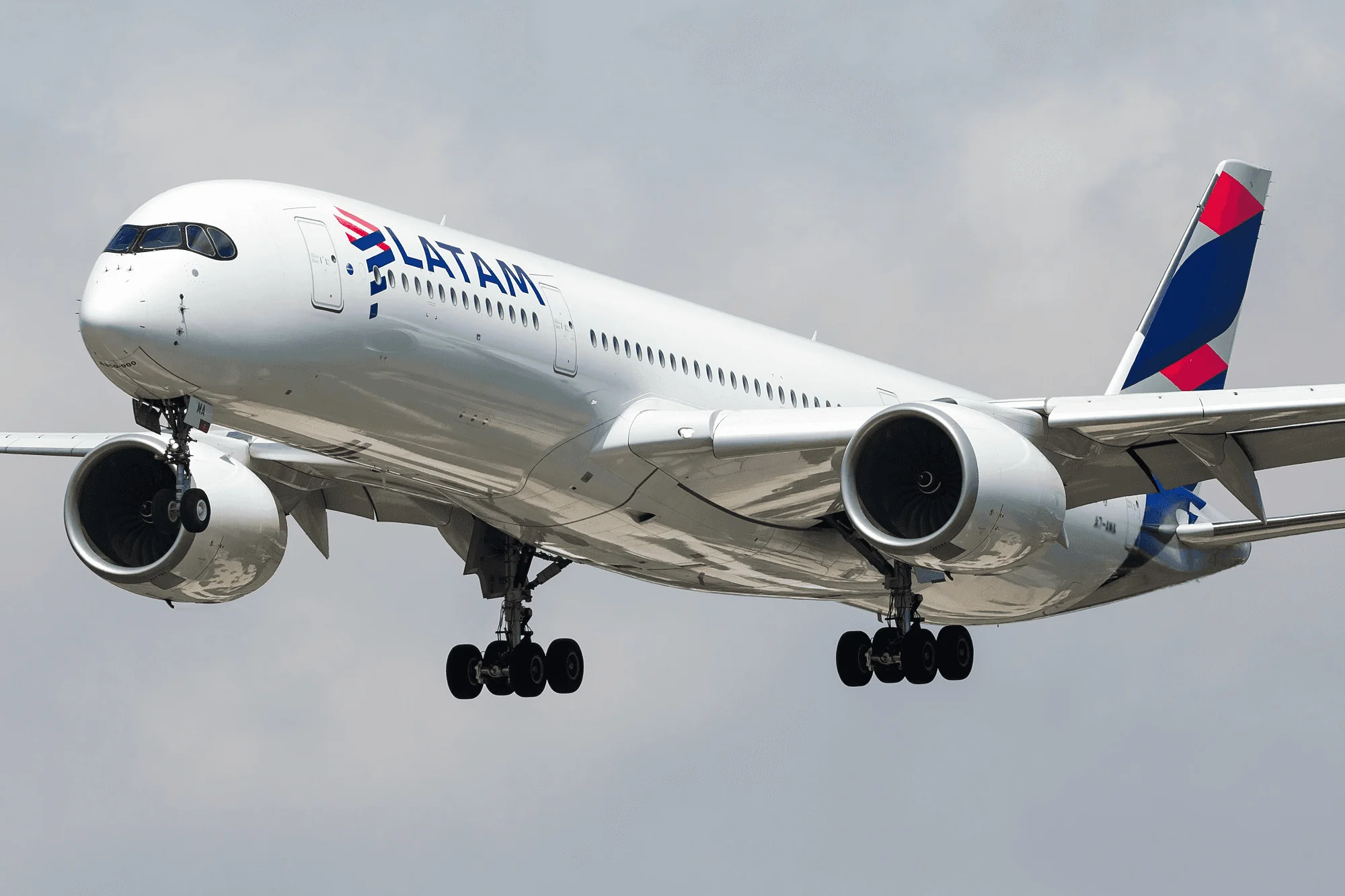
The LATAM A350-900 is a 325-seat wide-body configured with a 2-2-2 Business Class, 63-seat 2-3-2 Premium Economy, and 197-seat 3-3-3 Economy - no lie-flat suites, but the A350's wider fuselage gives Economy passengers noticeably more shoulder room than the 787. Avoid row 59 and the aft galley rows; the cabin pressure and humidity systems are genuinely better than LATAM's 787 fleet, which matters on 14+ hour flights from São Paulo to Madrid or Sydney.
TL;DR
Business Class: 40 seats in 2-2-2 with no cabin doors - Book odd rows (1, 3, 5…) for window seats with marginally more direct aisle sightlines. Premium Economy: 63 seats in 2-3-2, rows 41 - 51 - worth the upgrade for the dedicated cabin and enhanced service. Economy: 197 seats in 3-3-3, rows 52 - 77 - LATAM+ exit rows 56 - 57 (rows 56A/C, 57D/F) offer 35" pitch; avoid row 77 and the E (center) seats throughout. The A350's wider cabin makes 3-3-3 feel noticeably less cramped than the same layout on LATAM's 787-9, and cabin humidity is a genuine win on ultra-long-haul.
Quick specs
Cabin
Layout
Seats
Pitch
Width
IFE
Business
2-2-2
40
6'8"
24.1"
18.1" direct-aisle
Premium Economy
2-3-2
63
38"
18.7"
13.3"
Economy
3-3-3
197
31 - 35" (LATAM+)
17.3"
11.6"
Business Class
The A350-900 Business Class has 40 seats across rows 1 - 20 in a 2-2-2 closed herringbone layout - no cabin doors, so privacy comes from orientation and spacing alone. Book odd-numbered rows (1, 3, 5, 7, 9, 11, 13, 15, 17, 19) for window seats; these face the fuselage and offer the best sightlines to the aisle without feeling exposed. Row 1 and row 20 are less desirable - row 1 is behind the flight deck galley and close to cockpit noise, and row 20 is closest to the Premium Economy cabin, reducing the sense of separation. Rows 8 - 17 are the sweet spot for privacy and service flow. Seat pitch is generous at 6'8", and the direct-aisle monitors are intuitive, though the lack of doors means you're never fully isolated.
Premium Economy Class
Premium Economy sits rows 41 - 51 in a 2-3-2 layout with 63 seats. The cabin is genuinely separate from Economy, with its own galley, lavatory, and service queue - a meaningful upgrade for 14+ hour routes like GRU - CDG or SCL - SYD. Rows 41 - 45 get the smoothest ride and first access to meal service; rows 48 - 51 sit closer to the Economy cabin divide and get served last within the cabin. Book window or aisle pairs (seats A/B or J/K) if traveling as a couple; the middle seat (E) in the 3-seat section is exposed. Pitch is a comfortable 38", and the wider A350 fuselage makes the 2-3-2 feel less cramped than comparable layouts on the 787.
Economy Class
Economy occupies rows 52 - 77 in the standard 3-3-3 layout with 197 seats across 197 seats. LATAM+ extra-legroom is offered in rows 56 - 57 (the exit row, 35" pitch) and select front-Economy rows 52 - 55 (also 35"), marked as A/C/D/F in the seatmap. Standard Economy is 31" pitch, rows 58 - 77. Row 56 and 57 are the only exit rows - avoid rows 59 - 77 if you're sensitive to galley and lavatory noise; the aft galley and lavatories are positioned immediately behind row 77. Rows 59 - 77 experience reduced recline (approximately 6"), making sleeping difficult on overnight flights. Row 77 is the last row and gets the poorest cabin pressure, lowest humidity, and highest noise from the rear cargo heat exchangers - never book this row if alternatives exist. Window seats (A/C/D/F) are optimal for sleeping; center seat E is the universal middle-seat nightmare with no recline, reduced armrest access, and traffic. Rows 60 - 70 are the acoustic sweet spot, balancing galley distance and engine noise.
Best seats
Seat
Cabin
Why
Row 9, A or K
Business
Odd-row window seat in the optimal Business range; direct aisle sightline, quiet, centred between row 1 galley and row 20 cabin divide.
Row 1, A or K
Business
First Business row - first to be served and excellent shower access if MEL or SYD-based crew operates amenities.
Row 44, A/B or J/K
Premium Economy
Early Premium cabin rows with dedicated service priority and quietest cabin segment.
Row 56, A or F
Economy
LATAM+ exit-row window seat - 35" pitch, direct-aisle sightline, and no seat recline means more legroom stability for sleeping.
Row 65, A or K
Economy
Acoustic sweet spot - far enough from aft galley and lavatory noise, forward of cargo-area heat exchanger hum, window-seat option for sleeping.
Seats to avoid
Seat
Cabin
Why
Row 1, D or E
Business
Center seats closest to flight deck galley noise, no privacy barrier, and service interruptions from crew movements.
Row 20, A/B or D/E
Business
Last Business row - closest to Premium Economy cabin, poor acoustic separation, and reduced sense of Business exclusivity.
Row 50 or 51, E
Premium Economy
Last rows of Premium; transition to Economy acoustics, E seat is structurally exposed, and no recline benefit.
Row 59, E
Economy
First Economy row behind aft galley - constant lavatory and food-cart noise, galley smells, and immediate service disruption.
Row 77, any seat
Economy
Last row - no recline possible (wall behind), lowest cabin pressure, highest engine and cargo-area noise, and always the last to be served.
Row 65 - 77, E
Economy
Center seat throughout aft Economy - zero armrest access, trapped between two passengers, reduced recline in rows 59 - 77, and galley/lavatory proximity in 59 - 62.
```html
💻 Digital Nomad Workspace Audit
The LATAM A350-900 is a functional but not exceptional workspace for remote work during flight.
Tray Table Stability & Laptop Fit Economy tray tables measure approximately 17.5 inches wide and 9 inches deep when deployed. A 15-inch MacBook Air or Dell XPS 15 will fit, but the tray wobbles noticeably when you type - especially if the passenger in front reclines. Business Class trays are larger (roughly 20 x 11 inches) and significantly more stable due to the wider seat structure. For serious work, Business is mandatory; in Economy, use the tray only for light browsing or document review, not coding or video calls.
WiFi System & Connectivity LATAM A350s are equipped with Panasonic GX avionics delivering satellite-based internet via Inmarsat or Viasat depending on the route. On South American transpacific and transatlantic routes (GRU - CDG, SCL - SYD), expect Viasat coverage; North Atlantic crossings may use Inmarsat. Passenger reports from forums indicate real-world speeds of 2 - 4 Mbps download and 0.8 - 1.5 Mbps upload during peak cabin usage. Video calls are unreliable; email and messaging work consistently. Bluetooth pairing is available for audio devices, and the IFE system supports native WiFi sign-on without a captive portal on most routes.
Power & Charging Business Class seats have AC power sockets (110V, 60W) at each suite, plus USB-A and USB-C ports. Economy has no seat-back power; select LATAM+ exit-row seats (rows 12 - 17) have USB-A ports only, rated at 2A. Standard Economy rows have no power whatsoever. This is a significant limitation for overnight flights - bring a 20,000 mAh portable battery minimum.
IFE Screen & Responsiveness Business Class features larger HD displays (roughly 18 inches); Economy gets 10.6-inch HD touchscreens. Both are responsive and updated regularly. The interface supports seat maps, real-time flight tracking, and messaging (in newer A/C). Screen glare is manageable in dimmed overnight cabins.
Verdict Economy nomads should work during the first 2 - 3 hours after takeoff while power isn't critical, then switch to offline tasks or sleep. Business Class is genuinely suitable for an 11 - 13 hour flight if you have WiFi-intensive work. On overnight routes, plan to be offline for 6+ hours.
🔊 Acoustic & Sensory Audit
Cabin Pressurisation & Fatigue Impact The A350-900, like the 787, maintains a cabin pressure altitude equivalent to 6,000 feet, compared to older widebodies (A380, 777) which level out at approximately 8,000 feet. This lower cabin altitude reduces hypoxia-related fatigue, particularly on crossings over 10 hours. Passengers report feeling noticeably fresher on arrival after A350 flights vs. comparable routes on a 777. The difference is measurable on ultra-long-haul routes (GRU - CDG, 11.5 hours): A350 passengers cite less grogginess; 777 passengers report more severe jet lag.
Humidity Levels The A350 maintains cabin humidity between 40 - 50%, higher than most competing widebodies (typically 30 - 35%). This reduces dry skin and mucous membrane irritation on long flights. Overnight passengers will notice less morning dehydration than on a 787 or 777.
Engine Noise Profile by Row Zone
LATAM A350s are powered by Rolls-Royce Trent XWB-84 engines mounted at the wing root, generating a low-frequency rumble rather than high-pitched whine. Noise impacts vary significantly by zone:
Rows 1 - 6 (Business Class & front Economy): Minimal engine noise. Dominant sources are cabin chatter, lavatory activity, and galley clatter. Acoustic environment is calm and predictable.
Rows 12 - 25 (Mid-cabin Economy): Light background rumble (65 - 70 dB) from engines, noticeable but not intrusive. Air conditioning hum slightly louder here. This is the acoustic sweet spot - far enough from galleys and lavatories, close enough to the wings that engine noise blends into white noise.
Rows 26 - 32 (Rear Economy): Trent rumble becomes pronounced (70 - 75 dB) and combines with lavatory noise (flushing, door locks). Last two rows (31 - 32) are adjacent to rear galley and lavatories; frequent activity creates acoustic disruption every 5 - 10 minutes on full flights.
Quietest Row Range: Rows 18 - 23 These rows sit directly beneath the wing box, where engine mounts absorb vibration and the fuselage cross-section creates natural noise damping. Window seats in this range (18A, 18J, 19A, 19J, 20F, 20K, etc.) experience the lowest sustained noise levels on the entire aircraft. Engine rumble is omnipresent but depth-muffled; galley and lavatory noise is distant. For overnight economy passengers, this is the priority zone.
Verdict Avoid rows 29 - 32 for sleep. Choose window seats in rows 18 - 23 if available. The A350's lower cabin pressure altitude means you'll sleep better than on a 777 regardless - a genuine advantage for overnight flights.
🚪 Deplaning Intelligence
Door Usage by Cabin
LATAM A350s follow standard widebody boarding and deplaning procedures:
L1 (left forward door): Business Class. Deplanes first, typically 2 - 3 minutes from full stop.
L2 (left mid-cabin door) & R1 (right forward door): Premium Economy and forward Economy (rows 10 - 18). Deplanes second wave, 3 - 5 minutes from L1.
R2 (right mid-cabin door): Rear Economy (rows 19 - 32). Completes deplaning last, 8 - 12 minutes after L1.
Rear cargo doors (L3, R3): Crew-only emergency access; not used for passenger deplaning.
Total cabin empty: 14 - 16 minutes (this is fast by widebody standards, due to three doors in use)
Connection Window at LATAM Hubs
At Brasília (GIG, primary hub): LATAM uses dedicated domestic terminals with short pier walks. International-to-international connections require 90 minutes minimum in economy scenarios; 60 minutes is feasible for Fast Track users departing the same terminal. However