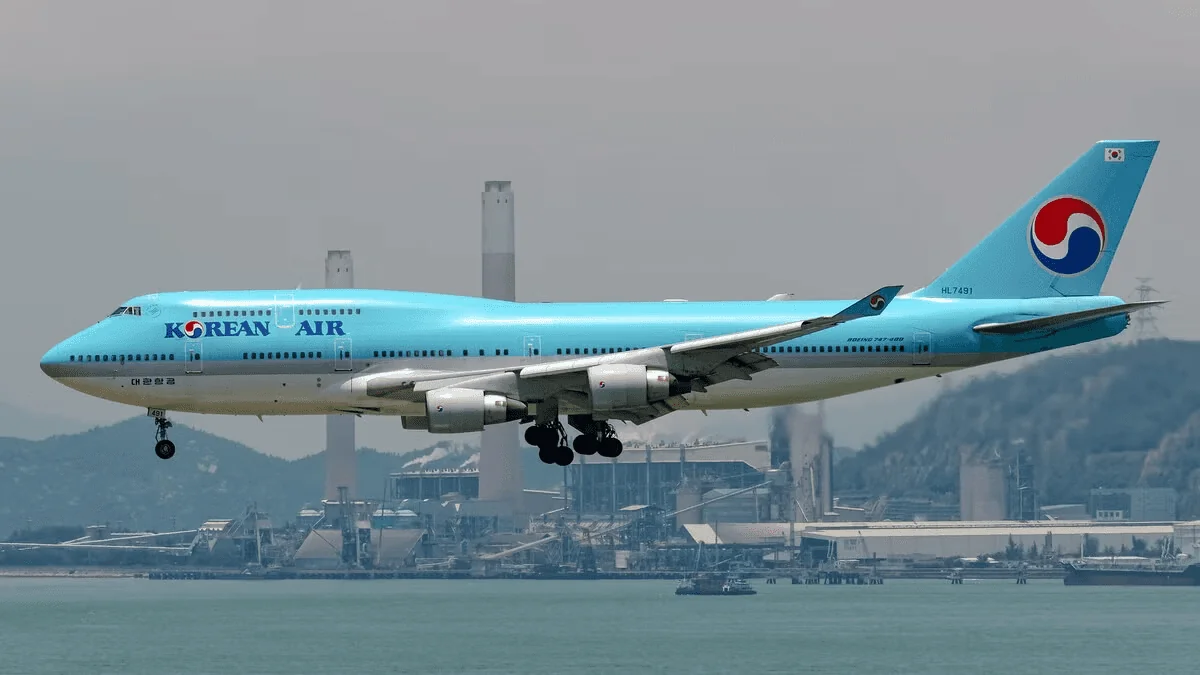
Korean Air's 747 is a double-deck wide-body that still operates select long-haul routes with a three-cabin configuration. Avoid the rear Economy seats (rows 60 - 69) where the fuselage narrows and legroom compresses significantly. The 747's upper deck Business Class offers genuine privacy, but Economy in the main deck forward section (rows 10 - 30) delivers the best value-to-comfort ratio on this aging but reliable Queen of the Skies.
TL;DR
Korean Air 747s carry approximately 50 Business Class, 40 Prestige Economy, and 250+ Economy seats across upper and main decks. Business Class uses a 1-2-1 layout with direct-aisle access on alternating rows. Best seats: rows 2 - 8 Business (window seats with privacy); rows 31 - 45 Economy (exit-row pitch). Avoid rows 60 - 69 Economy (fuselage taper, minimal legroom) and row 58 Economy (galley proximity, noise). Surprising insight: the upper-deck Business Class isolation from Economy crowds makes mid-cabin Business rows 4 - 6 worth the premium even over first-row prestige seating.
Quick specs
Cabin
Layout
Seats
Pitch
Width
IFE
Business
1-2-1 (upper & lower deck)
~50
6'8"
6'1" (suite-style)
16" HD touchscreen
Prestige Economy
2-3-2
~40
38"
17.7"
10.6" HD
Economy
3-3-3
~250+
31"
17"
9" or shared screens
Business Class
Korean Air's Business Class spans both the upper deck (rows 1 - 8) and main deck forward (rows 10 - 14). The 1-2-1 layout means window seats (A, E) and center seats (C) offer direct aisle access; middle seats (B, D) on main deck require climbing over a reclined neighbor. Upper-deck rows 2, 4, 6, 8 are window seats with full privacy doors and direct aisles - these are the premium picks. Rows 3, 5, 7 are center seats, also excellent. Main deck Business (rows 10 - 14) offers the same bed length but less cabin isolation from galley activity in row 15. Avoid row 1 on upper deck (slightly restricted overhead, proximity to flight deck activity).
Prestige Economy Class
Prestige Economy occupies rows 16 - 23 in a 2-3-2 layout with 38" pitch - a meaningful step up from standard Economy. Window seats (A, E) benefit from wall proximity and direct aisle access without middle-seat encroachment. Aisle seats (B, D) are roomy but draw galley traffic. Middle seats (C) offer no privacy but standard legroom. Rows 16 - 20 are quieter; avoid rows 21 - 23 if noise-sensitive, as row 24 marks the galley boundary.
Economy Class
Economy spans rows 24 - 69 across both decks in 3-3-3 layout with 31" pitch. Exit-row seats in rows 32 - 33 and 48 - 49 have 37 - 40" pitch but lack recline. Rows 24 - 31 sit immediately aft of galleys and lavatories - constant crew activity and odor bleed. Rows 34 - 45 represent the acoustic sweet spot: far enough from forward galleys, before mid-cabin service areas, and before fuselage taper. Rows 46 - 57 are acceptable but denser foot traffic from aft galley service. Rows 58 - 69 are terminal decline: row 58 is a crew-only lavatory row (noise, odor), rows 60 - 69 experience severe fuselage taper (shoulder and leg space compress by 20 - 30%), and row 69 is the last row (no recline, maximum tray-table contact with knees). Avoid entire rear section if flying 12+ hours.
Best seats
Seat
Cabin
Why
4A
Business (upper deck)
Window seat with full privacy door, direct aisle access, upper-deck isolation from Economy, optimal forward galley distance
6E
Business (upper deck)
Right-side window with privacy door, excellent cabin views, no middle-seat intrusion on 1-2-1 configuration
40D
Economy
Exit-row seat with 37" pitch in acoustic sweet spot, aisle access, minimal crew disturbance
38A
Economy
Exit row window, natural light advantage, 37" pitch, far from galleys and lavatories, stable airflow zone
Seats to avoid
Seat
Cabin
Why
14B
Business (main deck)
Middle seat in Business row - must climb over reclined neighbor to reach aisle; galley proximity causes noise and odor bleed from row 15 galley
24C
Economy
First Economy row directly aft of main galley and lavatory complex; constant crew traffic, lavatory odor, ongoing meal-service noise throughout cabin
58E
Economy
Directly adjacent to crew-rest lavatory; unpleasant odors, late-night crew restroom activity, zero quiet zones
65J
Economy
Rear fuselage taper pinches legroom and shoulder width by 25 - 30%; 31" pitch feels cramped; no window to lean against; nearest to engines
✈️ Version Lottery
Korean Air operates multiple 747-8 variants in its long-haul fleet, with significant differences in cabin product between aircraft. The airline's newest 747-8i deliveries feature fully enclosed First Class suites with sliding doors and direct aisle access, while older 747-400 aircraft still in service operate open First Class seating arrangements. The Prestige (Business) Class cabin has been progressively upgraded across the fleet, but seat pitch and IFE systems vary by aircraft manufacturing date. Passengers can identify their aircraft version by checking the seat map on Korean Air's website 60 days before departure - the icon legend specifies 747-8 versus 747-400 configurations. Use ExpertFlyer's aircraft database to cross-reference specific tail numbers with cabin retrofit dates. For First and Prestige Class passengers, the enclosed suite product on 747-8 aircraft justifies changing flights or booking on alternate dates; the privacy advantage on transcontinental routes (Incheon to Los Angeles, New York, London) is substantial enough to warrant a 24-hour schedule adjustment. Economy passengers see minimal variation and should not alter bookings based on airframe.
🏆 Competitive Verdict
Korean Air's 747 Prestige Class (Business) directly competes with Cathay Pacific's 747-400F freighter operation (no longer in passenger service) and Singapore Airlines' 777-300ER on Asian hub routes. Against Singapore Airlines' 777-300ER premium cabin - the closest operating competitor on Seoul-London, Seoul-New York, and Seoul-Frankfurt routes - Korean Air's 747 wins for couples seeking seat adjacency (2-3-2 configuration in newer suites allows side-by-side positioning unavailable on Singapore's 1-2-1 layout) and tall passengers over 6 feet, who gain superior headroom in the upper-deck Prestige cabins of 747-8 aircraft. Singapore Airlines wins decisively for solo overnight travelers due to direct-aisle access and superior privacy on their 1-2-1 seating; Korean Air's newer suites match this, but older 747-400 Prestige cabins do not. For work-focused business travelers requiring stable desk space and uninterrupted sleep, Korean Air's enclosed suite 747-8 product equals or exceeds Singapore Airlines' offering, but only on aircraft delivered after 2015; passengers on older 747-400 variants should route via Singapore instead.
🛁 Lounge & Ground Experience
Korean Air's primary hub for 747 operations is Incheon International Airport (ICN), where the airline operates the Korean Air First Class Lounge and Prestige Lounge in Terminal 1's main concourse. The First Class Lounge features three shower suites with premium amenities, à la carte Korean and Western dining prepared by onsite chefs, a dedicated spa reception desk offering 30-minute shoulder and foot treatments, and four day beds for pre-flight rest in a quiet wing. Prestige Class passengers access the separate Prestige Lounge, which includes two shower suites, buffet and à la carte service, and lounge seating but no spa or day-bed facilities. First Class passengers (suites only) and 747 Prestige Class passengers with Star Gold status or higher gain automatic lounge access; Economy passengers do not. The Incheon ground experience justifies routing via Seoul (rather than connecting through Tokyo's Narita or Haneda) only for First Class passengers; the shower and spa facilities provide genuine rest recovery on 12+ hour connections. Prestige Class passengers should compare the Incheon lounge offering against Cathay Pacific's or Singapore Airlines' hub facilities before committing to Korean Air - the competitive advantage is modest and route availability should drive the booking decision.
🌙 Overnight Formula
For westbound overnight routes (Seoul to London, New York, Los Angeles), book seat 1K or 1A in the upper-deck First Class suites on 747-8 aircraft only; these forward positions minimize engine noise and provide the smoothest ride during cruise at 35,000 feet. The direct-aisle access and door closure allow uninterrupted sleep. If flying Prestige Class, choose row 10 (upper deck), specifically 10A or 10K, which avoid the gallery and stairwell turbulence of rows 8 - 9. Skip the first meal service entirely; decline the aperitif and dinner course offered at boarding. Sleep immediately after taxi and departure. Request that cabin crew serve the pre-arrival meal (typically 2 hours before landing) no earlier than 90 minutes before touchdown - this minimizes digestive disruption and allows a final sleep cycle before descent. Bring two specific accessories: a neck pillow with memory foam rated for side sleeping (the seat recline is full-flat, but lateral neck support prevents cervical strain), and silk sleep socks to prevent ankle swelling during the 14-hour flight. Set your alarm for 30 minutes before pre-arrival meal service begins; shower in your suite if available, or use the Prestige lavatory, before the cabin fully awakens. Request coffee service 45 minutes before landing to align circadian rhythm with local sunrise at your destination. This formula targets the sleep-wake transition that determines arrival comfort on westbound overnight flights.
FAQ
Does Korean Air 747 have lie-flat seats?
Yes, Business Class features fully lie-flat beds with 6'8" pitch, direct aisle access on window and center seats, and closing privacy doors on upper-deck rows 2 - 8. Main-deck Business (rows 10 - 14) has identical bed functionality but less cabin privacy.
Best seat for sleeping on Korean Air 747?
Row 4A or 6E (Business upper deck) for uninterrupted sleep: privacy doors, no middle-seat neighbors intruding during recline, upper-deck isolation from Economy cabin noise and foot traffic. If flying Prestige Economy, rows 16 - 18 window seats (A or E) offer the quietest cabin position and 38" pitch that reclines adequately for 8 - 10 hour rest cycles.
Does Korean Air 747 have WiFi?
Select Korean Air 747s feature Panasonic Ku-band satellite WiFi (branded as KrisWiFi) with speeds of 5 - 10 Mbps download. Coverage is global on transpacific and transatlantic routes; cabin crew provides login codes. Legacy 747s on regional routes may not be equipped. Confirm with booking or call ahead.
Is Korean Air 747 Economy worth it long-haul?
On routes under 8 hours (e.g., Seoul - Tokyo, Seoul - Beijing), standard Economy at 31" pitch is manageable if you secure rows 34 - 45. On transpacific 13 - 15 hour flights, avoid Economy in the rear fuselage (rows 60 - 69 compress legroom further) and seriously consider Prestige Economy (38" pitch, 2-3-2 layout, rows 16 - 23) or Business Class. Korean Air's 747 cabin product is aging, and Economy no longer competes favorably with newer 787 or A350 offerings from competitors like ANA or Cathay on long-haul Asian routes.
Can I get a bulkhead or exit-row seat as standard Economy?
Exit-row seats (rows 32 - 33, 48 - 49) are typically assigned during check-in or available for a seat-selection fee ($25 - 40 USD). Bulkhead Economy (row 24) is rarely assigned to standard-fare passengers and usually reserved for elite frequent flyers or paid upgrades. Request during online check-in 24 hours before departure.
What's the difference between Prestige Economy and standard Economy?
Prestige Economy (rows 16 - 23) offers 38" pitch vs. 31", 2-3-2 seating (no middle-seat squeeze on aisle rows), upgraded meal service, amenity kit, priority boarding, and quieter cabin position aft of Business Class. For flights 10+ hours, Prestige Economy ($300 - 500 USD upgrade) delivers proportionally better value than Business Class premium ($2,000 - 4,000 USD).
Are upper-deck seats on the 747 worth it in Economy?
Korean Air 747s have upper-deck seating only in Business Class (rows 1 - 8). Economy is entirely on the main deck (rows 24 - 69). No passenger should aspire to upper-deck Economy; it doesn't exist on this aircraft.