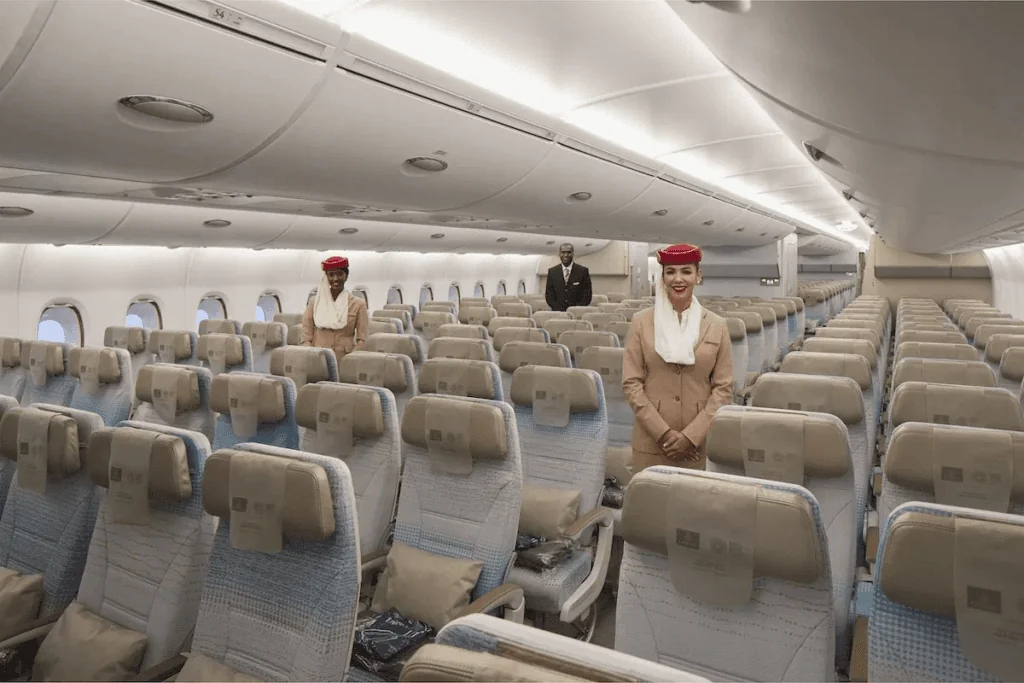
The A380 is the world's largest passenger airliner, and Emirates' version splits 468 seats across an upper-deck First and Business deck and a lower-deck Premium Economy and Economy deck. Seat 14A in Business Class is a window-adjacent winner with genuine privacy, but staggered seats like 15B near the aisle feel cramped and exposed to cabin traffic. Book the envelope-pushing window seats in A or K positions and avoid the center and aisle-proximate D, E, F, G, and J seats if you value personal space.
First Class (Upper Deck)
Emirates' First Class cabin occupies the forward upper deck with 14 seats in a 1-2-1 staggered configuration. The cabin is accessed via the front upper-deck door and features a 75-inch lie-flat bed and 86 inches of pitch, providing maximum personal space and privacy on the A380. Window seats alternate between full-window positioning and center-aisle proximity, mirroring the Business Class stagger. Verify current First Class cabin décor and availability on Emirates' seat map before booking, as cabin refresh cycles may affect the aesthetic you see in this aircraft.
Business Class (Upper Deck)
Business Class comprises 76 seats split across two cabins: a large forward cabin with 58 seats and a smaller rear cabin with 18 seats. The layout is a staggered 1-2-1 configuration with a 75-inch lie-flat bed and 45 inches of pitch. Passengers report the window seats (A and K positions) are positioned snugly against the cabin wall with a console separating the seat from the aisle, delivering greater privacy. By contrast, passengers describe seats in B and J positions (also window-side but on the opposite side of the console) as closer to aisle foot traffic, with reduced seclusion. Center seats D, E, F, and G in the middle of the 2-seat cluster are reported by frequent flyers to feel more exposed, especially D and F, which face the aisle console directly. Solo travelers and couples may find the privacy divider in the center row useful for modulation of shared space. The cabin features a purple-toned upholstery palette that passenger reviews describe as aged and less refined than newer Emirates aircraft; however, the seat product itself—the lie-flat bed, the 18-inch IFE display, the direct-aisle access—remains consistent across all A380 units. Boarding occurs via the second door from the aircraft's front on the upper deck.
Premium Economy (Lower Deck)
Premium Economy occupies the lower deck forward section with 56 seats in a 2-4-2 layout. The cabin offers 40 inches of pitch and 19.5-inch seat width, providing a meaningful step up from Economy. Verify specific row locations, exit-row restrictions, and galley proximity on Emirates' published seat map before booking, as these factors influence legroom and passenger flow patterns on long-haul routes.
Economy (Lower Deck)
Economy fills the lower deck with 322 seats in a 3-4-3 configuration, generating a 10-abreast cabin on the A380's fuselage width. The cabin delivers 32 inches of pitch and 17.9-inch seat width. On a flight of 7+ hours (such as Dubai to Singapore), the middle four-seat cluster in the center section can feel congested, especially for solo travelers without an armrest wall. Exit-row seats, non-recline rows near galleys or lavatories, and any aft cabin positioning should be verified on Emirates' official seat map before booking, as these rows materially affect comfort and sleep quality. The A380's lower deck typically loads via mid-fuselage or rear doors, which can extend boarding and deboarding time compared to narrowbody aircraft.
Best seats
| Seat | Cabin | Why |
|---|
| Seat 14A | Business (Upper Deck) | Window-aisle seat in the forward cabin, positioned near the aircraft window with console-based separation from foot traffic, delivering maximum privacy in a staggered 1-2-1 layout. Passengers report these A and K positions as the most secluded in Business Class. |
| Window seats A or K, forward cabin rows | Business (Upper Deck) | All A and K positions benefit from the staggered configuration's privacy console. Forward cabin (rows 1–approximately mid-cabin) minimizes rear-cabin proximity and galley noise compared to rear Business seats. |
| Forward bulkhead or early rows, Economy | Economy (Lower Deck) | Lower-deck Economy rows forward of the main deck wing box offer extra legroom relative to mid-to-rear positions. Verify exact row numbers and exit-row status on Emirates' seat map before booking. |
| Window seats, Premium Economy | Premium Economy (Lower Deck) | Window positions in the 2-4-2 layout provide direct fuselage contact, natural light, and psychological separation from the central 4-seat cluster on this wide-body deck. |
Seats to avoid
| Seat | Cabin | Why |
|---|
| Seat 12D and similar D and F center positions | Business (Upper Deck) | Passenger reviews describe the center cluster as separated by large consoles, making in-flight interaction awkward for couples and exposing both seats to aisle foot traffic. These positions lack the privacy console of the window seats. |
| Seats E and G in center row | Business (Upper Deck) | Passengers report these seats sit close together when the privacy divider is lowered. While the divider can be raised for privacy, sharing a mini-suite with a stranger may feel uncomfortable for solo travelers. |
| Seats B and J, window positions | Business (Upper Deck) | Although window-side, these staggered seats have their consoles positioned on the aisle side, making them more exposed to cabin traffic and offering lower privacy than A and K window seats. |
| Center 4-seat cluster, mid-to-rear rows | Economy (Lower Deck) | The 3-4-3 layout places four middle seats without an armrest wall between them on one side, creating congestion and limited personal space on a 7+ hour flight. Avoid unless solo and flexible on personal boundary. |
✈️ Version Lottery
Emirates operates a single primary cabin configuration across its A380-800 fleet for the routes covered by this aircraft type. However, passengers should be aware that the aircraft undergoes periodic cabin refreshes — the most significant being the colour and upholstery refresh, which transitions business class from the purple-toned seats of older frames to more understated tones on newer deliveries. Seat structure, pitch, width, and bed dimensions remain consistent across the fleet.
To identify which version operates your flight, check the Emirates seat map on their website or ExpertFlyer by aircraft registration number. The aircraft's tail number (visible on the booking confirmation or aircraft details page) reveals the frame's age: older A380s (registered before 2012) carry the dated purple business class cabin, while newer frames feature refreshed interiors. The seat configurations themselves — 1-2-1 stagger in business, privacy divider placement, and console positioning — do not change between versions.
Whether to switch flights or dates depends on your cabin preference. If business class cabin aesthetics matter to you, securing a newer frame is worth a date change; the experience and sleep quality remain identical, but the visual environment feels less aged. For first and economy passengers, cabin refresh status is purely a cosmetic consideration — no functional difference exists.
🏆 Competitive Verdict
Emirates's A380-800 business class (1-2-1 layout, 45-inch pitch, 75-inch bed, 18-inch width) competes directly with Singapore Airlines A380 and Cathay Pacific A350, with Emirates holding a clear edge for solo overnight travellers and tall passengers. The 45-inch pitch, full-aisle access on window seats, and direct aisle proximity for centre seats make navigation and sleep easier than on Singapore Airlines' competing product. For couples, Emirates loses: the centre seats (D and F/G) are separated by two large consoles on opposite sides, making shared travel awkward; Singapore Airlines's 1-2-1 configuration allows genuine pairs to face each other. For work-focused business travellers, Cathay Pacific's newer A350 suite (direct aisle doors, superior ife systems) edges Emirates on productivity features, but Emirates's 75-inch bed and stagger layout win for actual sleep. The honest verdict: choose Emirates A380 for sleeping alone or as a single occupant; choose Cathay for work trips or cabin modernity; avoid Emirates for couples on long routes where you want to interact during the flight.
🛁 Lounge & Ground Experience
Emirates operates the Al Maha First and Business Class Lounge at its primary hub, Dubai International Airport (DXB), for long-haul A380 operations. The lounge features multiple shower suites with premium toiletries, à la carte dining with live cooking stations, a dedicated spa with massage treatments, private day beds for rest, and a caviar and champagne bar. Business class passengers and oneworld/Star Alliance frequent flyers (who have tier agreements with Emirates) gain access; first class and premium economy passengers do not. Oneworld emerald and higher tier members, alongside Star Alliance gold and platinum tier members, also access the lounge, though access rules are occasionally subject to change — verify your tier eligibility on Emirates's website before assuming entry.
Whether routing via Dubai hub is worth the layover versus a direct competitive service depends on your overnight schedule and total journey time. If your city pair allows direct travel (e.g., London to Singapore), Dubai adds 4–8 hours of journey time; the lounge experience, while luxurious, does not justify the cost in extra travel. If your origin city lacks a direct Emirates route and you are booking business class on a connecting flight anyway, Dubai hub routing becomes neutral — the lounge experience is genuinely superior to most competitor hubs and makes the layover feel productive. For first class passengers, the lounge experience alone justifies the routing decision against competitors who lack equivalent facilities at their hubs.
🌙 Overnight Formula
Best overnight seat: 14A or any A-column or K-column seat in the forward business class cabin (rows 1–30). Window seats in the A and K positions offer maximum privacy due to console placement on the aisle side, minimising disruption from cabin traffic during sleep. Avoid B, D, F, and J seats on overnight routes — these sit closer to the aisle and draw more passing foot traffic, interrupting rest cycles.
On overnight routes, skip the main meal service if you board in the evening (after 6 p.m. local time at departure). Ask cabin crew to serve breakfast only, four to five hours before arrival; this avoids a heavy meal digestion cycle and allows your sleep window to align with the aircraft's night. On daytime departures into night arrivals (e.g., Dubai to Singapore departing 10 a.m., arriving 10 p.m. local), accept the full meal service but time it to conclude at least three hours before descent.
Bring a noise-cancelling headset (even if you do not listen to music — the ambient noise isolation alone improves sleep depth) and a small compression pillow shaped to support the neck without bulking your carry-on. Do not rely on the airline pillow alone; the supplied pillow is thin and offers poor neck support for side sleepers.
For arrival optimisation: set your alarm for 90 minutes before landing (this wakes you before the pre-arrival cabin lighting kicks in, allowing a natural toilet visit and face wash). When cabin crew announces 90 minutes to arrival, do not get up immediately — use the first 45 minutes to remain reclined and let your body adjust to the waking state. Request the pre-arrival service (beverage, light snack) 60 minutes before landing, not at the first announcement; this gives you time to freshen up and sit upright, avoiding the bloated feeling from a meal right before descent. If you have a tight connection, ask crew for a priority disembark pass at 30 minutes to arrival — Emirates typically holds a few per flight for connecting passengers.
💬 What Passengers Say
Frequent flyers note that the 76-seat business class cabin split — 58 seats forward, 18 seats rear — creates a noticeably quieter experience in the rear cabin, with significantly fewer passengers and crew traffic, making rear business seats (rows 50+) preferable for sleep-focused overnight travellers despite their distance from the upper-deck entry door.
Passenger accounts describe the window seats in the A and K positions as dramatically more private than aisle-adjacent seats; reviews consistently highlight the console-and-window positioning as creating a personal cocoon that makes solo travel feel luxurious, whereas seats in the B and J columns — despite being window seats — draw frequent cabin traffic and provide little privacy.
Passengers report that the centre seats (D and F/G) separated by dual consoles create an awkward shared space for couples; frequent flyers note that the large console on each side of the row makes leaning toward a companion difficult, and couples often resort to raising the privacy dividers entirely to avoid the discomfort of staring across two armrest-height barriers.
The 75-inch bed earns consistent praise in passenger reviews for full recline comfort for passengers under 6 feet 2 inches; taller passengers report that feet either touch or come very close to the foot rest panel, reducing the sense of a true lie-flat experience despite the spec measurement.
Reviews describe the cabin colour scheme — particularly the purple seating on older frames — as noticeably dated compared to newer business class products from competitors, with passengers noting that Emirates's newer A380s with updated upholstery feel significantly more contemporary, even though the physical layout and comfort features remain identical.