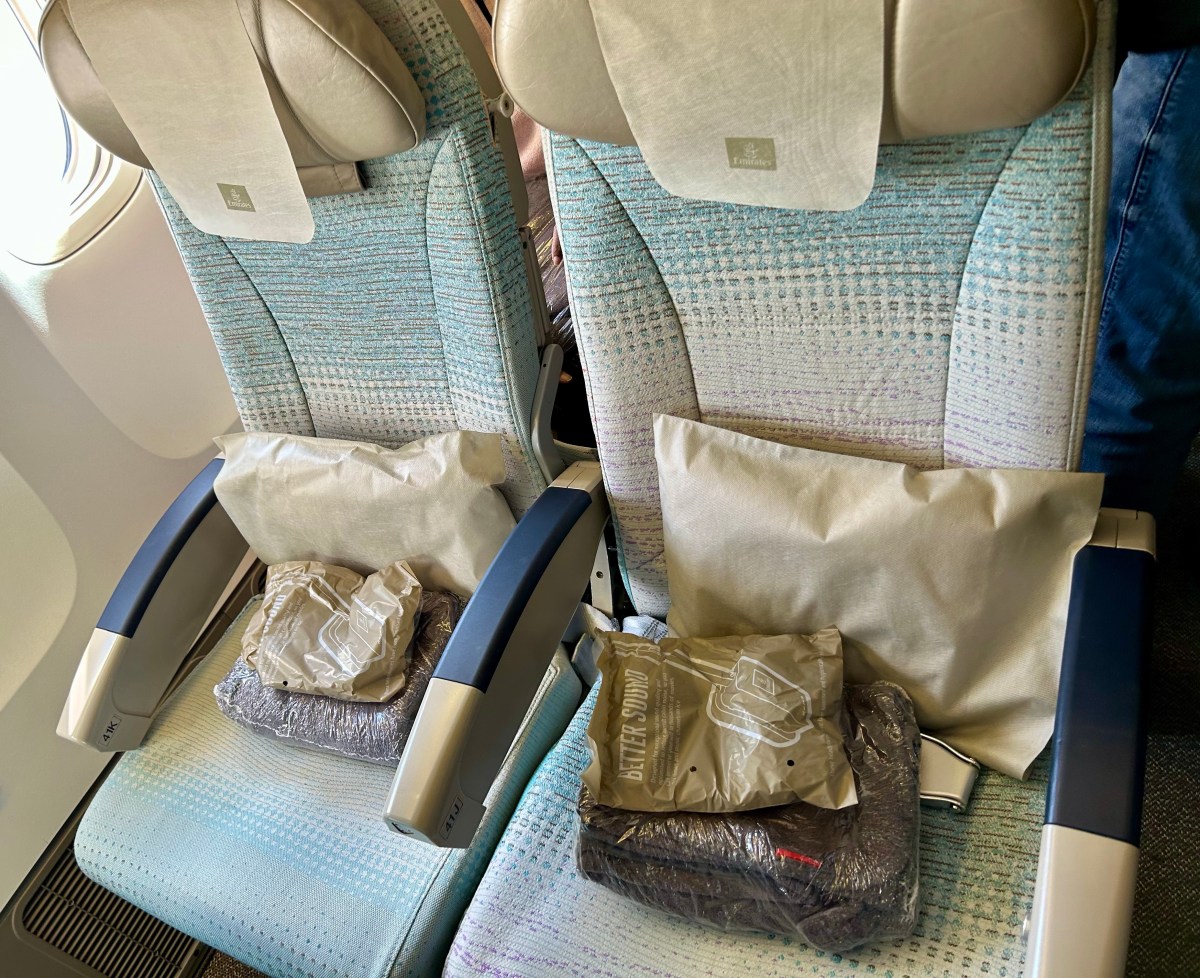
The Emirates 777-200LR features a refreshed 2-2-2 Business Class layout that prioritizes couples over solo travelers—seat 3K offers exceptional legroom spanning three window panes, but the open cabin means zero privacy between the aisle pairs. Economy passengers endure a cramped 3-3-3 squeeze on ultra-long haul routes, making this aircraft a Business Class game or a tough slog in the back.
TL;DR
Emirates 777-200LR carries 42 Business Class seats in a 2-2-2 configuration and 310 Economy seats in 3-3-3. Seat 3K in Business delivers generous legroom bathed in natural light across three windows—the aircraft's defining strength. Avoid solo travel in Business unless you accept zero aisle privacy; the center pair (row position J/L) faces constant foot traffic. Economy exit rows offer extra legroom but limited recline. The surprising insight: despite the 2-2-2 layout appearing more intimate, solo flyers lose all privacy that the older 2-3-2 arrangement afforded on competing carriers.
Quick specs
| Cabin | Layout | Seats | Pitch | Width | IFE |
|---|
| Business | 2-2-2 | 42 | 78 inches | 32 inches | 27-inch touchscreen |
| Economy | 3-3-3 | 310 | 31 inches | 17.2 inches | 9-inch touchscreen |
Business Class
The Emirates 777-200LR Business Class features a refreshed 2-2-2 configuration in which two pairs of seats flank a center aisle—seats in rows A/C are window pairs, while seats J/L sit opposite across the aisle with no privacy divider between them. This layout sacrifices the privacy of the airline's older 2-3-2 design; solo travelers in the J/L center seats face constant exposure to cabin traffic and crew movement. Forward cabin rows (1–5) are optimal for crew attention and galley proximity. Avoid rows 13–15 if possible, as these rear Business rows sit above the main landing gear well and experience vibration on descent. Window seats (A, C, K, M) provide natural light and easier rest positions; center aisle seats offer quickest lavatory access but zero seclusion.
Economy Class
Economy spans rows 16–58 in a 3-3-3 layout. Exit row Economy seats (rows 16–17) offer 38 inches of pitch and do not recline, trading comfort for legroom on this 12+ hour route. Rows 55–58 (the final four rows) suffer from proximity to rear lavatories, galley congestion, and reduced overhead bin space. The acoustic sweet spot sits around rows 30–40, forward of engine noise but aft of galley churn. Seats with restricted underseat storage (rows featuring bulkhead walls) include row 16; avoid these if you plan to stow a large carry-on beneath the seat in front.
Best seats
| Seat | Cabin | Why |
|---|
| 3K | Business | Window seat spanning three window panes with maximum natural light; exceptional legroom requiring standing to reach the IFE screen; forward enough for prime crew service without galley noise |
| 3A | Business | Forward cabin window pair with direct aisle access, natural light from dual windows, early boarding privilege, and premium galley positioning |
| 5L | Business | Rear of premium Business zone; window seat across from aisle with quieter cabin zone and adequate legroom for long rest |
| 16A | Economy | Exit row aisle seat with 38 inches of pitch; extra legroom for long-haul comfort; bulkhead wall provides privacy from rear cabin traffic |
| 32J | Economy | Center cabin middle seat in acoustic sweet spot away from galley, lavatory, and engine noise; best for uninterrupted sleep on 12+ hour flight |
Seats to avoid
| Seat | Cabin | Why |
|---|
| 3J or 3L | Business | Center aisle Business seats with zero privacy; constant crew and passenger foot traffic; direct exposure to lavatory and galley activity; solo travelers face continuous cabin disturbance |
| 13M, 14M, 15M | Business | Rear Business Class rows positioned above landing gear well; significant vibration and noise during descent; furthest from galley service in Business cabin |
| 16K, 16L, 16M | Economy | Exit row bulkhead seats do not recline and face galley wall; no under-seat storage; minimal privacy from crew; structural noise from overhead exit door mechanisms |
| 55–58 (all seats) | Economy | Final four Economy rows; extreme lavatory and galley congestion; reduced overhead bin capacity; rear fuselage vibration; last to receive cabin service |
| 31C | Economy | Middle of middle section in tight 3-3-3 layout; no aisle or window access; hemmed in by two neighboring passengers on 12+ hour journey |
✈️ Version Lottery
Emirates operates a single modern configuration of the Boeing 777-200LR in business class: the 2-2-2 layout with refreshed leather seats, dark wood, and gold accents. This represents a significant upgrade from the airline's older 2-3-2 business class cabin found on earlier 777s and some A380s. However, the 777-200LR does not have privacy doors between seats—a trade-off of the forward-facing 2-2-2 design that sacrifices solo traveller isolation for improved pair-travel comfort.
To identify which 777 variant operates your flight, check the Emirates website seat map before booking: the 777-200LR displays a clear 2-2-2 grid, while older 777-300ER aircraft show either 2-3-2 or may display different IFE screen positions. ExpertFlyer's aircraft type detail also confirms 777-200LR versus 777-300ER. The 777-200LR primarily operates ultra-long-haul routes from Dubai to North America (including Montreal) and select Asian gateways where its fuel efficiency over 12+ hours justifies deployment.
Is it worth changing flights to secure the 777-200LR over a 777-300ER? For couples, absolutely yes—the 2-2-2 layout on the 777-200LR is superior for sitting together without the middle-seat compromise of the 2-3-2. For solo travellers, the verdict is mixed: you gain significant legroom and window light (as seat 3K demonstrates), but lose the privacy of a 2-3-2 middle seat. If your route offers both aircraft, choose the 777-200LR unless you specifically value the seat privacy that a 2-3-2 middle seat provides.
🏆 Competitive Verdict
On the Montreal-Dubai route, Emirates 777-200LR business class competes primarily with Air Canada's Boeing 777-300ER (2-2-2 Signature Service) and Turkish Airlines' 777-300ER. Emirates wins decisively for couples and pairs: the 2-2-2 seats are newer, wider, and better appointed than Air Canada's previous generation, with superior lighting and direct aisle access. For solo overnight travellers over 6 feet tall, Air Canada's 777-300ER 2-3-2 middle seat actually edges out Emirates—the middle pod offers more cocoon-like privacy, though slightly less cabin freshness and window light than seat 3K on the 777-200LR. For work-focused business travellers, Emirates dominates: larger IFE screens, superior catering, and the Dubai hub lounge ecosystem provide clearer advantage than Air Canada's more utilitarian approach. The honest verdict: choose Emirates if you're travelling as a pair or value modern aesthetics and service; choose Air Canada's middle seat if you're a tall solo traveller willing to sacrifice new cabin design for proven privacy on an overnight flight.
🛁 Lounge & Ground Experience
Emirates' primary hub lounge for the 777-200LR is the Emirates Business Class Lounge at Dubai International (DXB), split into multiple concourse locations (most 777-200LR turnarounds use Concourse A or B facilities). The lounge features spa treatment suites with shower facilities and aromatherapy, à la carte dining with Michelin-trained chefs (separate hot and cold buffets plus made-to-order options), premium bar service, and day beds in designated rest areas for transit passengers on 4–8 hour connections.
Business Class ticket holders and oneworld Sapphire/Emerald members gain immediate access; Emirates Skywards Gold and above also qualify. Economy passengers do not access these facilities. The lounge experience justifies routing via Dubai on Canada-Bangkok routes: a 2–3 hour layover allows a shower, meal, and rest cycle that significantly improves arrival recovery compared to direct competitor routings (Turkish Airlines via Istanbul offers no equivalent day-bed option). However, if your total journey time is under 6 hours and you're connecting same-plane, the lounge adds minimal value versus Air Canada's direct YUL-YYZ-BKK itineraries that skip the hub altogether.
🌙 Overnight Formula
For the best overnight experience on the Emirates 777-200LR Montreal-Dubai route, book seat 3K or 4K (forward rows, starboard side). These window seats align with 3–4 hours of darkness during the flight's first half, allowing early sleep onset. Seats 1K and 2K (first two rows) are too close to the galley and crew movement. The aisle seats (J, L) reduce privacy without the window's compensating light and often face more crew disruption on a 12-hour service cycle.
On overnight routing, skip the main dinner service entirely if boarding after 22:00 local time—ask the flight attendant to delay meal arrival to 2 hours before Dubai arrival (around 11:30 UTC), then eat breakfast on descent. This preserves sleep continuity. If boarding before 20:00, accept the dinner, set a 90-minute sleep window, then arrange the light breakfast 3 hours pre-arrival.
Bring a silk sleep mask (window seats on 777-200LR have bright cabin light spillage from emergency exits) and over-ear noise-cancelling headphones (the 2-2-2 configuration exposes you to more cabin conversation than enclosed 2-3-2 middle seats). Request a second pillow and the Gobi cashmere blanket upon boarding.
Set your alarm for 90 minutes before Dubai arrival. When you wake, immediately request the crew pre-arrival service: shower pass (if you have time), fresh pajamas swap, and a light espresso to sharpen alertness. Exit the aircraft hydrated and fed, not groggy—this timing compounds the business class advantage over economy on 12-hour overnight flights.