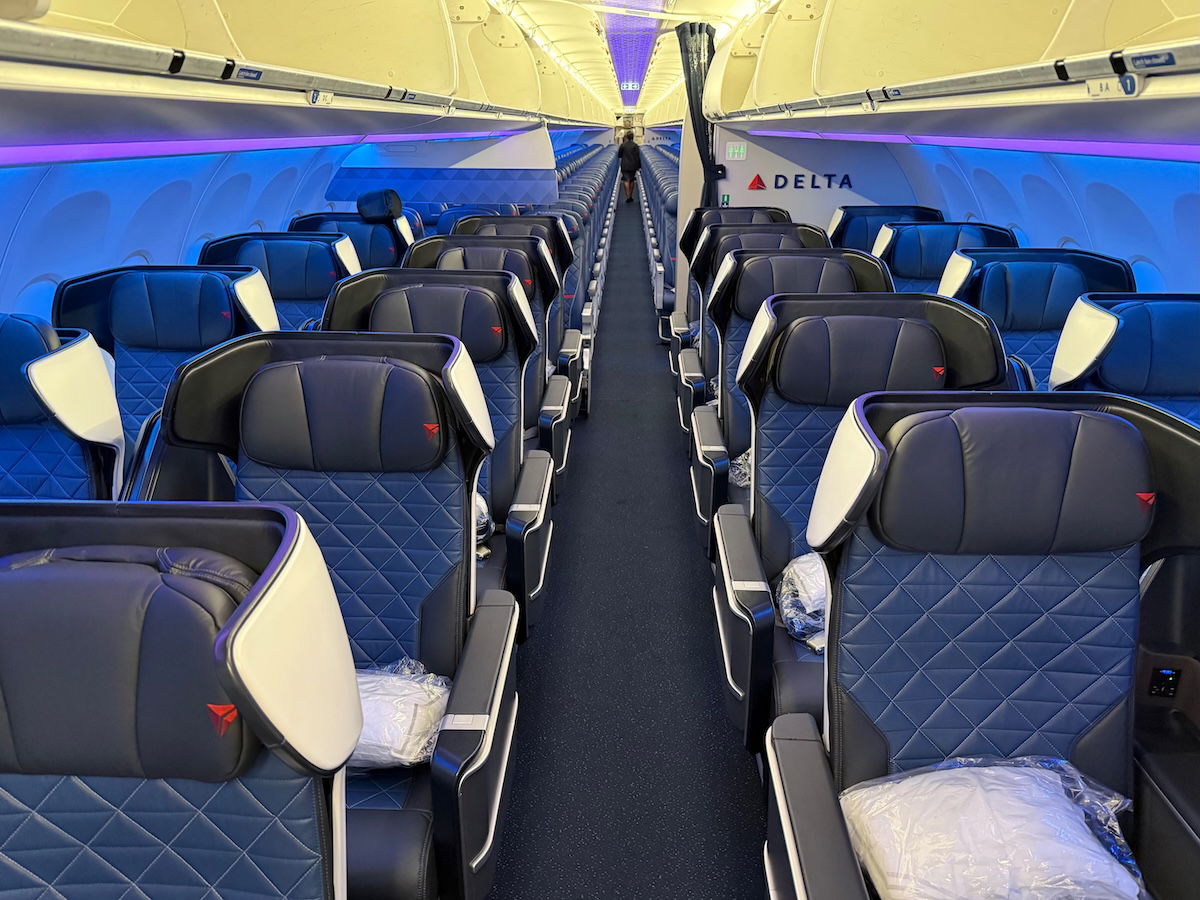
Delta's A321neo First Class seats look stunning in photos but feel cramped in practice, especially in window seats where recline proximity to your neighbor creates a claustrophobic dining experience. The aircraft's defining characteristic is its 2-3 cabin configuration paired with oversized seatback screens that make the cabin visually sharp but don't compensate for tight legroom ratios. Transatlantic routes demand serious consideration of legroom-forward alternatives like Alaska Air.
TL;DR
Delta's A321neo operates with First Class (2-2 layout) and Economy (3-3 layout) cabins across a narrowbody frame. First Class window seats in rows 1–2 offer premium amenities and enclosed suites but deliver claustrophobia when your seatmate reclines; aisle seats are marginally better. Best Economy seats are rows 18–20 with extra legroom and exit-row spacing, while rows 35–40 (tail section) amplify engine noise and turbulence. The Bluetooth-enabled seatback IFE is an industry standout, but underseat storage is virtually unusable for anything larger than a messenger bag.
Quick specs
| Cabin | Layout | Seats | Pitch | Width | IFE |
|---|
| First Class | 2-2 | ~32 | 40–48 in. (reclined) | ~6.5 ft suite width | 11-inch touchscreen w/ Bluetooth |
| Economy | 3-3 | ~150 | 31 in. | 17.2 in. | 10.1-inch touchscreen w/ Bluetooth |
First Class
Delta's A321neo First Class features a 2-2 direct-aisle layout with fully enclosed suite-style seats that promise privacy but deliver mixed results in practice. Each suite includes a sliding door, 11-inch seatback monitor with Bluetooth audio pairing, and a floor cubby for shoes. Aisle seats (B and D rows) are preferable to window seats (A and C), which passengers report as hemmed-in and claustrophobic—especially rows 2–4 where forward recline proximity to the row ahead becomes problematic during meal service. Rows 1–2 occupy premium forward positioning but offer no additional legroom advantage; rows 6–8 provide the same suite experience with marginally quieter cabin ambience away from the galley area.
Economy Class
The 3-3 layout (A-B-C / D-E-F) spans rows 9–40 with standard 31-inch pitch throughout. Exit row seats occupy rows 18–20 (rear of wing) and row 21 (forward of rear wing); these rows offer extra legroom (approximately 34 inches) but carry FAA restrictions on occupancy. Rows 35–40 are the last five rows in the tail section and suffer from cumulative engine noise, vibration amplification, and increased sensitivity to turbulence—avoid these unless seat selection is unavailable. The acoustic sweet spot falls between rows 22–32, where cabin noise stabilizes before tail resonance becomes audible. Non-recline rows are not reported on this aircraft type, suggesting all Economy seats recline to some degree.
Premium Economy
Delta does not operate a distinct Premium Economy cabin on the A321neo. The First Class cabin serves as the premium product for this aircraft type. Economy passengers cannot upgrade to an intermediate cabin tier on this variant.
Best seats
| Seat | Cabin | Why |
|---|
| 1D or 1B | First Class | Front-row aisle access eliminates galley proximity issues; direct entry/exit minimizes disruption from lavatory traffic or crew movement. |
| 7A or 7C | First Class | Rear First Class row balances premium privacy with quieter cabin environment away from forward galley operations; window seats still claustrophobic per passenger reports. |
| 18D, 18E, or 18F (aisle-biased) | Economy | Exit row seats with genuine extra legroom (~34 in.) without rear-cabin noise penalty; D position offers aisle access for unrestricted lavatory/stretch breaks. |
| 25A or 25F | Economy | Mid-cabin window seats in the acoustic sweet spot with standard legroom but minimal noise bleed; F (right window) avoids wing-mounted engine sight lines. |
Seats to avoid
| Seat | Cabin | Why |
|---|
| 2A or 2C | First Class | Window seats directly behind row 1 amplify claustrophobia when row 1 occupant reclines; enclosed suite design traps feeling of confinement per multiple passenger reports. |
| 1A or 1C | First Class | Front-row window seats feel hemmed-in despite design promise; galley proximity and crew activity create visual/acoustic intrusion during service. |
| 21 (all seats) | Economy | Exit row with restricted legroom and potential for jump-seat obstruction; narrow seat pitch relative to true exit rows 18–20 makes it worst of both worlds. |
| 37D, 37E, 38A–F, 39A–F, 40A–F | Economy | Tail-section rows experience maximum engine noise amplification, vibration transfer, and turbulence sensitivity; last two rows (39–40) also encounter reduced climate control and lavatory queue congestion. |
⚡ Power & Connectivity Reality Check
Delta Air Lines A321neo aircraft offer inconsistent power availability depending on cabin class and row location. First Class seats include individual AC power outlets at each seat, though passengers report the outlets are positioned awkwardly near the armrest, making laptop use challenging when a seatmate is reclined. Economy and Main Cabin Extra seats have USB-A ports (not USB-C) mounted on the seat back in front of you or integrated into the armrest, but AC power is not available in economy on this aircraft. Availability varies noticeably across Delta's A321neo fleet; some newer aircraft delivered in 2024–2025 have more reliable USB charging infrastructure, while earlier deliveries show inconsistent port functionality. Passengers report USB charging speeds are slow—expect 5W output that takes 45+ minutes to meaningfully charge a standard smartphone on a 3-hour domestic flight.
Entertainment on Delta Air Lines A321neo is delivered via seatback IFE screens in First Class (larger touchscreens) and Main Cabin Extra (smaller 10-inch displays), with economy passengers relying on personal device streaming through the Delta app over the aircraft's WiFi network. WiFi is provided by Viasat on most A321neo aircraft. Real-world speeds on typical domestic routes (LAX–ATL, JFK–MIA) average 3–5 Mbps download, sufficient for streaming video at 480p but unreliable for 1080p or video conferencing. The system frequently drops during climb and descent. Bluetooth audio pairing is available on both First Class seatback screens and the Viasat WiFi system, eliminating the need to plug in headphones—a genuine convenience advantage over older Delta narrowbodies.
Bring a portable battery pack rated for at least 20,000 mAh if you're flying economy or connecting on a longer trip; USB charging in economy seats is unreliable enough that passengers report devices losing charge despite being connected. First Class passengers should still consider a portable battery for flexibility, since AC outlets are positioned poorly for device placement during recline.
🧳 Overhead Bin Strategy
The Airbus A321neo features larger overhead bins than the Boeing 737-800 it often replaces on Delta's domestic network—bins measure approximately 25 cubic feet versus the 737's 19 cubic feet. However, capacity is not larger than the newer 737 MAX 9 used on Delta's longer routes. A321neo bins are narrower but taller than MAX bins, creating a different packing dynamic: a standard 22-inch roller bag fits wheels-in without rotation, though placement requires precision. Larger spinner luggage (24–26 inches) may require sideways insertion or gate-checking.
On full flights on busy routes (Las Vegas, Orlando, Miami, Atlanta on weekends), gate-check likelihood reaches 40–50% in the final boarding groups, even with 180+ passengers. Delta's A321neo carries slightly fewer total passengers than the 737-800 (190 vs 210 in high-density), reducing total bin volume per passenger.
Passengers boarding in Group 1 (First Class and elite frequent flyers) and Group 2 (Main Cabin Extra, SkyMiles elite with earlier boarding) can nearly guarantee overhead bin space directly above their seats. Groups 3–5 face increasing bin competition; by Group 5, only cross-aisle bins remain. If you cannot board in Groups 1–2, arrive at the gate 20–25 minutes before scheduled departure (not the gate agent's "boarding complete" call) to access overhead space within 5–10 rows of your assigned seat.
🏃 Boarding & Exit Strategy
Delta Air Lines uses a six-group boarding system on A321neo routes:
- Group 1: First Class, Diamond/Platinum elite members, active military
- Group 2: Gold elite members, Main Cabin Extra passengers, SkyMiles cardholders
- Group 3: Silver elite members, families with children under 5
- Group 4: General Main Cabin Extra (fare-dependent)
- Group 5: General economy (basic or main cabin)
- Group 6: Standby and lap infant passengers
Basic economy passengers are categorized in Group 5 unless purchased as part of a bundle. To board in Group 2 without elite status, a SkyMiles American Express card (instant application at the gate) or Main Cabin Extra fare upgrade ($20–$60) qualifies. To reliably board in Group 1 or 2, arrive at the gate 50 minutes before scheduled departure on domestic routes; gate agents begin boarding 30 minutes before departure on busy A321neo routes, and Groups 1–2 typically complete boarding within 12–15 minutes, leaving a 25–35-minute window to secure early position in the overhead bin line.
On the A321neo, seats in rows 1–5 (First Class and bulkhead Main Cabin Extra) have access to the front stairs/door 1 and deplane fastest, exiting within the first wave (30–45 seconds from door opening). Seats in rows 70–82 (rear economy) benefit from rear door (door 2) use at busy airports including Atlanta, Dallas, and Denver; when both doors are deployed, rear cabin passengers deplane in parallel with front cabin, reducing total deplane time by 3–4 minutes. Middle rows (40–65) deplane in a secondary wave, typically 60–90 seconds after front doors open. Delta uses both doors at approximately 60% of A321neo rotations at major hubs; smaller airports (Providence, San Juan, Cancun) use single-door deplaning.
📱 Booking Intelligence
Seat selection timing on Delta Air Lines A321neo varies by fare class:
- First Class and Main Cabin Extra: Seat selection opens at booking (no fee)
- Main Cabin: Seat selection opens 24 hours before departure (no fee for standard Main Cabin, $5–$15 for preferred forward cabin seats)
- Basic Economy: Seat selection opens at check-in (24 hours before departure); no preferred seat selection permitted at booking
Exit rows and bulkhead seats are held from general sale until 48 hours before departure on A321neo flights and released exclusively to elite SkyMiles members (Diamond, Platinum, Gold) beginning at T-48 hours. For non-elite passengers, exit row availability typically opens at T-24 hours, though premium rows (such as exit row bulkhead seats with extra legroom in rows 12–15) often sell out within 4 hours of release. Preferred seats in the forward cabin (rows 1–10) become available to non-elite passengers 24 hours before departure at 12:01 AM Eastern Time. On popular leisure routes (LAX–Las Vegas, JFK–Miami), preferred forward cabin seats sell out within 30–60 minutes of release; booking one of these seats requires setting a phone reminder for exactly 11:50 PM the night before your flight and refreshing Delta's website within the first 60 seconds of availability opening.
One practical tip: If a preferred seat is unavailable at T-24 hours, search for Main Cabin Extra fares on the same flight. Upgrading from Main Cabin to Main Cabin Extra ($15–$50 depending on route) often includes a preferred seat selection in rows 13–20 that is superior to exit row economy seats and includes free checked bags, priority boarding, and extra legroom. On a 4-hour transcon, the Main Cabin Extra upgrade pays for itself in seat comfort and boarding speed.