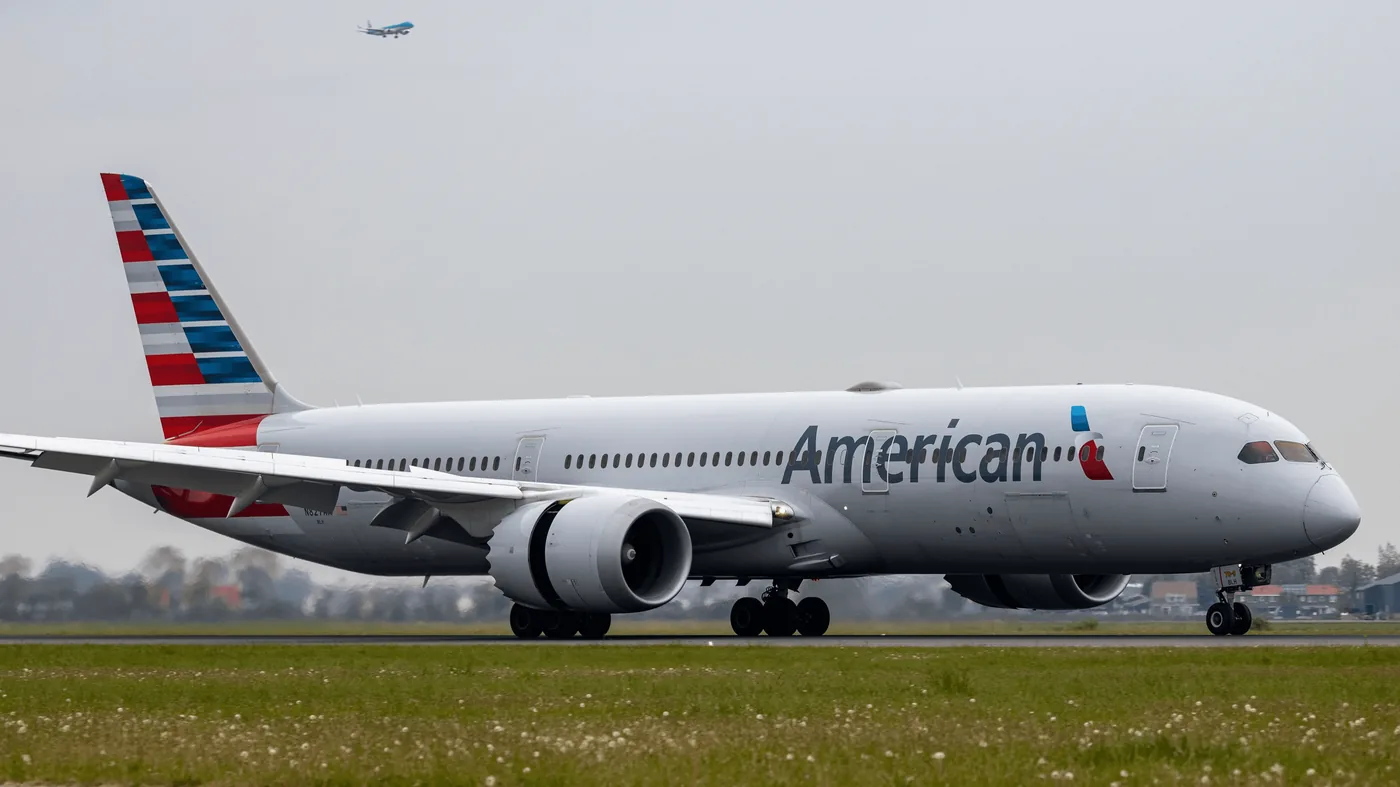
Quick specs
| Cabin | Layout | Seats | Pitch | Width | Bed | IFE |
|---|---|---|---|---|---|---|
| Business (Flagship Suite) | 1-2-1 | 43 | 42in | 22in | 78in | 17 |
| Premium Economy | 2-3-2 | 32 | 38in | 19.5in | N/A | 13.3 |
| Economy (Main Cabin) | 3-3-3 | 143 | 31in | 16.5in | N/A | 12 |
| Cabin | Layout | Seats | Pitch | Width | Bed | IFE |
|---|---|---|---|---|---|---|
| Business (Flagship Suite) | 1-2-1 | 43 | 42in | 22in | 78in | 17 |
| Premium Economy | 2-3-2 | 32 | 38in | 19.5in | N/A | 13.3 |
| Economy (Main Cabin) | 3-3-3 | 143 | 31in | 16.5in | N/A | 12 |
The 787-9 carries 43 Flagship Suites in a 1-2-1 lie-flat configuration, 32 Premium Economy seats, and 143 Economy seats across a wide-body that trades intimate cabin density for long-haul efficiency. Passengers report the Flagship Suite window seats are nearly as private as standalone suites, though the center seats angle toward one another for easier conversation with a travel partner. The shoulder belt during takeoff feels constrictive, and the abundant cubbyholes invite you to leave something expensive behind.
Flagship Business Class: 43 lie-flat suites in 1-2-1 layout with 42-inch pitch and 78-inch beds; window seats offer near-private cabin experience while center seats face each other. Premium Economy: 32 seats in 2-3-2 layout with 38-inch pitch and 19.5-inch width. Economy: 143 seats in standard 3-3-3 with 31-inch pitch. Best Flagship Suite: forward cabin Preferred suites offer additional space. Seats to avoid: middle Economy in 3-3-3 rows unless you enjoy frequent aisle traffic. Surprising insight: the fixed (non-moving) video screen in Flagship is massive and bright enough to view from any angle, and passengers praise the lie-flat bed for its minimal bumps and lumps.
American Airlines' Flagship Suite on the 787-9 is a Teague-styled 1-2-1 lie-flat bed built on the Adient Ascent platform. Each suite converts to a flat 78-inch bed or chaise longue and features a sliding privacy door that isolates you entirely from adjacent cabins. Passengers report window seats are extraordinarily private—nearly impossible to see anyone else in flight, comparable to standalone suites on other carriers. If you're traveling with a partner, center seats are worth considering: they angle toward one another, making meals and conversation easier than facing forward alone. The video screen is large and bright, fixed in position but viewable from all angles. Passengers describe the lie-flat bed as magnificently comfortable with very few protruding bumps or lumps. Suites located at the front of each cabin are designated Flagship Suites Preferred and offer additional space. Note: the shoulder belt required during takeoff and landing passengers report feels tight and constrictive. The many cubbyholes for storage invite absentmindedness—reviewers warn of leaving expensive items behind.
Premium Economy seats are arranged in a 2-3-2 layout with 38-inch pitch and 19.5-inch width. This cabin bridges Economy comfort and Business luxury without the lie-flat commitment or lie-flat price. Specific row positions, exit rows, or galley-proximity details are best verified on American Airlines' official seat map before booking.
Economy spans a 3-3-3 layout with 31-inch pitch and 16.5-inch width. On a wide-body like the 787-9, middle seats in the standard three-seat rows see the most aisle traffic and neighbor activity. Exit rows and bulk-head rows, where present, may offer extra legroom or restricted recline; verify specific row numbers on the airline's seat map before purchasing. Rear galley proximity can affect noise and light; confirm row locations on the airline's official configuration before booking.
| Seat | Cabin | Why |
|---|---|---|
| Forward rows, Business (Flagship Suite Preferred) | Business | Preferred suites at the front of each cabin offer additional space compared to standard Flagship suites |
| Window seats, Business (Flagship Suite) | Business | Passengers report window seats are incredibly isolated and private, with almost no view of other passengers in flight |
| Center seats, Business (Flagship Suite) | Business | Suites angled toward one another, ideal for travel partners wanting to share meals and conversation |
| Aisle seats, Premium Economy (forward rows) | Premium Economy | Direct access to galley and lavatories without climbing over a seatmate |
| Seat | Cabin | Why |
|---|---|---|
| Middle seats, Economy (3-3-3 layout) | Economy | Positioned between window and aisle, middle seats endure the most aisle traffic and neighbor activity |
| Rows near rear galley, Economy | Economy | Galley proximity creates noise, light, and crew movement throughout the flight—verify exact row locations on the airline's seat map |
| Rows with restricted recline, Economy | Economy | Bulkhead and exit-row seats may not recline fully; check the airline's seat map for recline restrictions before booking |
The American Airlines Boeing 787-9 Dreamliner offers mixed suitability for remote work depending on cabin choice.
Tray Table Stability. Business class tray tables are robust and provide a stable work surface suitable for a laptop during cruise. Premium Economy and Economy tray tables are smaller and more prone to movement when the seat in front reclines; they are adequate for brief tasks but not ideal for sustained typing or video calls.
WiFi. This aircraft is equipped with WiFi. Visit American Airlines' website or check your booking confirmation for current connectivity details, availability by route, and any subscription or pass options.
Power. Power outlet availability varies across the fleet and by aircraft age. Check American Airlines' fleet page or contact the airline directly before booking if power access is essential to your itinerary.
In-Flight Entertainment Screens. Business class features a 17-inch IFE screen. Premium Economy is equipped with a 13.3-inch IFE screen. Economy has 12-inch screens. All three cabins allow you to stream content to your own device via the airline's app on select flights; verify this feature on your specific flight before departure.
The Boeing 787-9 pressurises to a cabin altitude of 6,000 feet—notably lower than legacy widebodies that maintain 8,000 feet. This reduced altitude exposure lessens fatigue markers (headache, dehydration, sleep disruption) on transatlantic and transpacific flights, offering a meaningful comfort edge on journeys over 10 hours.
Humidity. The 787 actively maintains cabin humidity at 15% or higher during cruise—substantially above the 5–10% on conventional widebodies. Passengers with sensitive sinuses or dry skin will notice the difference, particularly on overnight segments.
Engine Noise Zones. Forward cabin rows (rows 1–10) experience the quietest acoustic environment. Over-wing and forward-engine rows produce moderate noise. Rear cabin rows, especially those aft of the engines, encounter the highest noise levels. If sleep quality is the priority on an overnight flight, prioritise a forward Business or Premium Economy seat.
Forward aisle seats (Business class rows 1–8, particularly the center 2-seat sections) deplane first on the American Airlines 787-9, typically clearing within 8–12 minutes of the aircraft door opening. Mid-cabin and rear-cabin passengers wait longer as the forward galley and lavatories empty first, and the single-aisle design creates a natural bottleneck aft of the wing.
If you have a tight connection—under 45 minutes for a domestic link or under 75 minutes for an international transfer—strongly consider booking a forward Business or Premium Economy aisle seat. Check American Airlines' published minimum connection time for your specific airport pair before booking; it typically ranges from 30 minutes (domestic same-terminal) to 90 minutes (international with customs screening).
Rear window seats in Economy may force you to wait 20+ minutes for the aisle to clear, risking a missed connection. If a tight connection is unavoidable, book a forward seat or request gate-adjacent parking from the airline during check-in.
Business Class: Book a window seat in rows 1–4 (Flagship Suites Preferred, which offer additional space). The fully flat bed converts to a 78-inch sleeping surface. After dinner service concludes, request extra pillows and a blanket from crew—most 787-9 flights stock premium bedding. Close the sliding privacy door completely and dim the cabin lights via the seat-back controls 2 hours before your planned sleep window. Avoid the meal service on overnight flights; instead, ask the crew for a light snack (yogurt, fruit, nuts) upon boarding, then sleep through dinner and breakfast. Bring a neck pillow designed for flat-bed sleeping and silk pillowcase to minimise friction and skin irritation. 90 minutes before landing, open your window shade to gradually adjust to cabin light and the external time zone, then shower in the lavatory if the flight has an onboard spa (not all 787-9s do—verify beforehand). Breakfast service typically begins 2 hours before arrival; accept it to align with your destination morning.
Premium Economy: Book a window seat in rows 11–15. The 38-inch pitch and 19.5-inch width seat reclines to a near-flat angle (not fully flat). Skip dinner; request a light meal on boarding instead. Use the airline's supplied pillow and blanket, plus your own neck support. Close the window shade 2 hours before sleep. Wake naturally 90 minutes before arrival by opening the shade; do not use an alarm if possible, as the cabin light cue is gentler. Accept the breakfast service to re-synchronise your appetite to the destination time zone.
Economy: Window seat in the mid-cabin (rows 25–35) offers the best balance of quiet and stability. Recline is limited (typically 6–7 inches); bring a full-body pillow to prop yourself sideways. Skip dinner service and ask crew for a light snack instead. Bring compression socks to manage ankle swelling and a larger neck pillow designed for upright sleeping. Use the window shade to block light for 6–7 hours of your flight duration, then open it 90 minutes before landing. Exit row seats in Economy (if available) offer more legroom but are noisier and have immobile armrests; only book exit row if legroom is your sole priority.
Passengers report that window seats in Business class are incredibly isolated and private, creating an almost cabin-mate-free experience that rivals premium long-haul competitors. Frequent flyers note that center Business seats are angled towards one another, making them preferable for couples or companions who want to share meals and conversation during the flight.
The 78-inch fully flat bed earns consistent praise in passenger reviews for its comfort and minimal protruding lumps or edges, though passengers caution that the shoulder harness during takeoff and landing is tight and constrictive. Passenger accounts describe the large, bright video screen as easy to view from all angles despite being fixed in position.
Travellers reviewing the cabin note a practical downside: the numerous cubbyholes and storage containers throughout the suite tempt absent-minded passengers to leave behind expensive personal items; crew do not automatically announce the final minutes of service, so double-check your seat before deplaning.