Quick specs
| Cabin | Layout | Seats | Pitch | Width | Bed | IFE |
|---|---|---|---|---|---|---|
| Business (Signature Class) | 1-2-1 | 30 | Pending | 21in | 79in | 18 |
| Premium Economy | 2-3-2 | 21 | 38in | 19in | N/A | 11 |
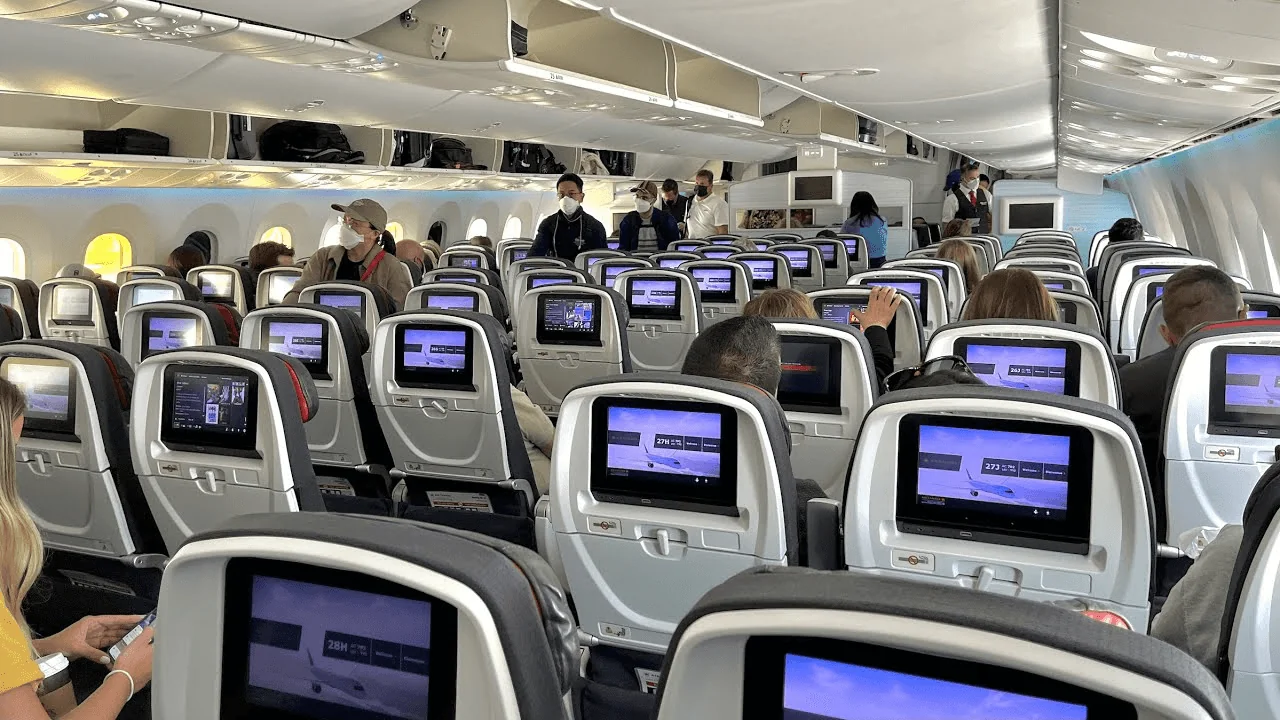
| Economy | 3-3-3 | 247 | 31in | 17in | N/A | 9 |
| Cabin | Layout | Seats | Pitch | Width | Bed | IFE |
|---|---|---|---|---|---|---|
| Business (Signature Class) | 1-2-1 | 30 | Pending | 21in | 79in | 18 |
| Premium Economy | 2-3-2 | 21 | 38in | 19in | N/A | 11 |
| Economy | 3-3-3 | 247 | 31in | 17in | N/A | 9 |
Air Canada's 787-8 and 787-9 carry 30 Business seats in a 1-2-1 reverse-herringbone layout with a 79-inch bed, 21 Premium Economy seats in a 2-3-2 configuration, and 247 Economy seats across three columns. Passengers report that the Business Class footwell is narrow and the tray table location can constrain side sleepers, but the cabin is stable and well-appointed. The 787's lightweight frame and efficient cabin pressure make it a comfortable choice for long-haul transatlantic and North American routes.
Air Canada operates 30 Business Class seats (1-2-1 reverse herringbone, 79-inch bed), 21 Premium Economy seats (2-3-2, 38-inch pitch), and 247 Economy seats (3-3-3, 31-inch pitch) on the 787-8 and 787-9. Forward Business window seats offer privacy and direct aisle access without a neighbor. Avoid mid-cabin and rear Economy rows near galleys and lavatories. The 79-inch bed in Business is excellent for passengers under 6 feet 2 inches, though passengers report the footwell is tight and the tray table can interfere with side sleeping. Premium Economy at 38-inch pitch is a meaningful step up from Economy's 31-inch pitch on flights over 6 hours.
Air Canada Signature Class offers a 1-2-1 reverse-herringbone layout with 30 seats total, each converting to a 79-inch lie-flat bed. The cabin is split into two sections with privacy doors between forward and aft clusters. Passengers report that the reverse-herringbone configuration creates a tray table underneath the television screen that can restrict movement for side sleepers, and the footwell is narrow, limiting legroom for larger passengers. A small seat control screen allows adjustment of the seat position. Check Air Canada's detailed seat map before booking to confirm your preferred aisle position (odd-numbered seats typically offer forward-facing privacy, while even-numbered seats face aft).
The 21 Premium Economy seats span a 2-3-2 layout with 38-inch pitch and 19-inch width, positioned in a dedicated cabin section forward of Economy. This represents a meaningful step up from Economy's 31-inch pitch, particularly valuable on flights exceeding 6 hours. Verify the exact cabin position and proximity to the Economy section on the airline's seat map before booking.
Economy spans 247 seats in a 3-3-3 configuration with 31-inch pitch and 17-inch width. Standard Economy rows are distributed throughout the aft fuselage. Exit row seats, non-recline rows, and seats near rear galleys and lavatories offer less comfort or privacy; verify specific row locations on Air Canada's published seat map before purchase, as these designations vary by aircraft configuration.
| Seat | Cabin | Why |
|---|---|---|
| Forward window seats, Business | Business | Direct aisle access without a middle neighbor; lie-flat bed converts to 79 inches, offering full-height clearance for passengers under 6 feet 2 inches |
| Forward aisle seat, Business | Business | Privacy door access and direct galley proximity for service convenience |
| Forward rows, Premium Economy | Premium Economy | Earlier service, minimal galley noise, 38-inch pitch provides comfortable recline for long-haul |
| Window seats, Economy forward section | Economy | Wall-supported napping, natural light, and distance from rear galley activity |
| Seat | Cabin | Why |
|---|---|---|
| Aisle seats near tray table position, Business | Business | Passengers report the tray table located underneath the television screen makes side sleeping difficult and restricts movement |
| All seats, Business | Business | Passengers report the footwell is narrow and does not accommodate wider leg positioning comfortably |
| Rear rows, Premium Economy | Premium Economy | Proximity to Economy cabin and galley noise; narrower sense of privacy |
| Seats near rear galley and lavatories, Economy | Economy | Noise, odors, and traffic from lavatory queues and service carts throughout flight |
Air Canada operates both the Boeing 787-8 and 787-9 on its long-haul network, and the two aircraft carry identical cabin configurations: 30 Business (Signature Class) seats in 1-2-1 layout, 21 Premium Economy seats in 2-3-2 layout, and 247 Economy seats in 3-3-3 layout. The 787-9 is a stretched version seating 17 additional Economy passengers, but the hard product—seat pitch, width, bed length, IFE screen size—remains constant across both variants.
The primary operational difference is range and frequency: the 787-9 operates most of Air Canada's flagship transatlantic routes (London, Paris, Frankfurt), while the 787-8 handles medium-haul long-distance flights (Caribbean, South America, some European points). Both aircraft carry the reverse-herringbone Signature Class product with 79-inch beds and privacy doors.
To identify which aircraft operates your flight, check Air Canada's seat map at the time of booking—the map will display aircraft type in the flight details, or use ExpertFlyer's seat chart library to cross-reference. The 787-9's slightly higher frequency on premium routes (London, Paris) makes it marginally easier to secure preferred Signature Class positioning, but the seat product is identical. Switching flights or dates to secure one variant over the other is not necessary; book the best available Business seat regardless of aircraft type.
On transatlantic routes (London, Paris, Frankfurt), Air Canada's 787-9 Signature Class (1-2-1, 79-inch bed, 21-inch width) competes directly with British Airways Club Suite, Lufthansa First, and SWISS Business. Honest verdict: Air Canada wins for solo overnight travellers—the 79-inch flat bed and privacy door create genuine isolation and full-length sleep. BA's Club Suite (aisle-forward, enclosed suite) edges Air Canada marginally for couples seeking privacy, but Air Canada's side-by-side 2-seat configuration in some rows offers an alternative. For tall passengers over 6 feet, the 79-inch bed may feel constrained; BA and Lufthansa's roomier suites (with greater width and footwell depth) are superior. For work-focused business travellers, SWISS' Business Class (direct aisle access, larger work surface) outperforms Air Canada's reverse-herringbone design, which trades work comfort for sleep optimization. Verdict: choose Air Canada for overnight rest; choose BA, SWISS, or Lufthansa if you value daytime working space or couples' privacy.
Air Canada's primary hub for 787 operations is Toronto Pearson (YYZ). Business (Signature Class) and Premium Economy passengers access the Air Canada Maple Leaf Lounge (multiple locations in Terminal 1), which features shower suites with luxury amenities, a à la carte dining kitchen with hot and cold service, and quiet work zones with private seating. Some Maple Leaf Lounge locations (Terminal 1 Concourse A/C) include spa services (massage by appointment) and day beds for rest; availability varies by terminal and time of day. Status and fare class access: all Signature Class passengers receive lounge entry; Premium Economy access requires Star Alliance Gold status or premium fare codes. Economy passengers do not receive lounge access.
For transatlantic passengers connecting via Toronto, the Maple Leaf Lounge justifies a routing via YYZ—the shower suites and dining quality exceed many European hub lounges, and the quiet environment aids sleep recovery on turnarounds. However, for direct YYZ-London or YYZ-Paris flights, lounge access is a minor factor; compare total journey time and seat availability across direct and one-stop routings before prioritizing the ground experience.
Seat choice: Book a window seat (A or K) in rows 4–8 of Signature Class. Window seats offer direct wall access for shoulder sleep, and rows 4–8 place you forward enough to minimize lavatory and galley noise while avoiding the galley itself (typically aft of row 10). Aisle seats (D, E, F) invite crew and passenger traffic; avoid unless you require frequent lavatory access.
Meal service: On overnight flights of 6+ hours (e.g., London–Toronto), eat the dinner service promptly (within the first 45 minutes post-departure) and ask the crew to hold breakfast service until 90 minutes before arrival. This rhythm protects sleep continuity and allows you to wake naturally or to a flight attendant's gentle notification of final service. On shorter overnight routes (5–6 hours), skip dinner entirely; take a light snack from the cabin bar instead and sleep immediately after pushback.
Sleep accessories: Bring a noise-isolating earplugs set (Mack's Pillow Soft Silicone or Loop Earplugs) and a weighted sleep mask. Air Canada provides a pillow and blanket of standard hospitality quality; the blanket is often insufficient insulation on a 79-inch bed at altitude—bring a personal 2-tog merino throw or fleece layer.
Arrival optimization: Set an alarm for 90 minutes before landing (flight crew will announce ETA and descent initiation at around the 60-minute mark). Request pre-arrival service (a light breakfast, coffee, or juice) 75 minutes before touchdown. Shower before landing if the flight duration allows and crew can accommodate (most can on flights over 7 hours); this resets your circadian cue. Avoid heavy meal service in the final 30 minutes; a plain coffee or sparkling water with 15 minutes to go is ideal for arrival alertness.
Passengers report that the reverse-herringbone Signature Class seat layout creates both advantages and trade-offs. The 79-inch bed draws consistent praise in passenger reviews for full-height sleep for passengers under 6 feet, and the privacy door is widely appreciated for isolation during rest phases. However, frequent flyers note that the tray table positioned beneath the television screen constrains side-sleeping comfort—side sleepers report limited room to reposition during the flight. Reviews also describe the footwell as narrow relative to competing products (BA Club Suite, Lufthansa First), which some passengers find restrictive for extended leg stretching or comfort positioning during waking hours. On the positive side, passenger accounts highlight the individual seat control screen for bed and chair adjustments, the responsive cabin crew, and the overall refinement of the cabin environment. One passenger noted that pre-departure beverage service (champagne or sparkling water offered immediately upon boarding) and individual purser welcome set a high service tone, even if the seat geometry itself is not cutting-edge compared to the newest generation reverse-herringbone designs from competitors.
Yes. Business Class (Signature Class) features a 79-inch lie-flat bed that converts from the 1-2-1 reverse-herringbone seat. Premium Economy and Economy offer reclining seats only, not lie-flat beds.
Forward window seats in Business Class provide the 79-inch bed and a wall to rest against, though passengers report that the tray table located underneath the television screen can restrict side sleeping. Side sleepers may find the aft Business seats more comfortable, with less interference from the tray table. Check the airline's seat map to compare tray table positions across the Business cabin before booking.
Air Canada offers WiFi service on its 787 fleet, though availability and pricing vary by route and passenger tier. Verify current coverage, speeds, and subscription options directly on Air Canada's website before your flight.
Economy offers 31-inch pitch and 17-inch width—within industry standard but tight for extended flights over 7 hours. Premium Economy's 38-inch pitch and 19-inch width represent a meaningful improvement for long-haul transatlantic routes. Window seats in the forward Economy section offer a superior sleeping position and earlier meal service. Upgrade to Premium Economy if you are over 5 feet 10 inches or plan to sleep significantly during your flight.