Best Airlines from London to Hong Kong (2026)
LHR ↔ HKG
Cathay Pacific's A350-1000 with new Business Class suites dominates this route, but British Airways Club Suite on the 777-300ER remains competitive. Avoid Virgin Atlantic on eastbound overnight flights due to schedule reliability issues. The critical gotcha: aircraft swap risk—confirm your specific plane 72 hours before travel, as the A350 and 777-300ER offer materially different experiences in all cabins.
TL;DR
Cathay Pacific A350-1000 Business Class (direct aisle access suites) is the best product on LHR–HKG, offering superior privacy and on-demand dining. For Economy, BA's 777-300ER provides the best pitch and quieter forward cabin positioning. Premium Economy is worth the ~£800–1,200 uplift only if you're price-sensitive to Business and want guaranteed sleep on a 12-hour haul; otherwise economy plus seat selection beats it. Book the overnight departure (depart LHR 22:00–23:30, arrive HKG +1 morning) to align with your body clock—avoid the morning departure trap that arrives in daylight when you need sleep. Route-specific insight: Cathay's HKG hub means connections onward to Southeast Asia are seamless, but BA and Virgin's single daily frequencies create no-choice rebooking scenarios if you miss your connection.
Airlines flying LHR ↔ HKG
Cathay Pacific operates this route daily with the A350-1000 (premium focus) and occasional 777-300ER (backup), offering the most frequent service and home-continent advantage. British Airways flies daily with the 777-300ER and A350-1000 (seasonal/variable), providing the familiar BA Club World product and strong onward connectivity via London. Virgin Atlantic operates 4–5 times weekly with the A330-900neo, positioning itself as the value-conscious option with Upper Class available on select flights.
Business Class on LHR ↔ HKG
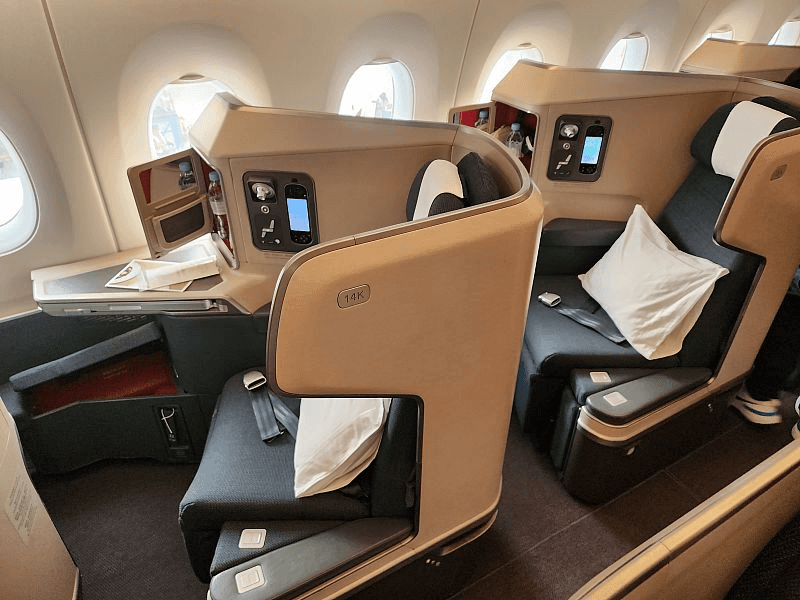
Cathay Pacific A350-1000 with new suites (direct aisle access in most rows, sliding doors, on-demand dining, superior IFE) is the single best Business Class product on this route. British Airways 777-300ER Club Suite is a close second, offering proven comfort but with angled herringbone seats rather than direct aisles. Avoid Virgin Atlantic A330-900neo Upper Class on eastbound overnight flights—the 777-width cabin feels dated after experiencing the A350, and connection reliability is weaker. Specifically seek Cathay A350 rows 1–8 (forward suites, quieter, first service); avoid rows 12–14 near the galley transition on any aircraft.
Premium Economy on LHR ↔ HKG
Cathay Pacific and British Airways both offer Premium Economy (World Traveller Plus on BA) on daily frequencies; Virgin Atlantic does not. BA's Premium Economy on the 777-300ER and A350 offers slightly better recline and quieter positioning in smaller cabins. For a 12-hour flight, Premium Economy is only worth the premium if you cannot afford Business and strongly prefer dedicated cabin service over economy—otherwise, Economy extra legroom seats in row 40 (Cathay A350) or equivalent forward rows on BA provide 80% of the comfort at 40% of the cost.
Economy on LHR ↔ HKG
British Airways 777-300ER Economy offers the most generous pitch (32 inches typical, forward mini-cabin configuration reduces through-traffic) and quietest cabin on the route. Cathay Pacific A350 Economy is cramped (17-inch-wide seats, 31-inch pitch in standard rows) but features superior IFE, WiFi (Panasonic eX2, free on all fares), and cabin air quality. Virgin Atlantic A330-900neo Economy is the most commodified (standard 31-inch pitch, 10.6-inch IFE screens, paid WiFi tier-1 only), making it the budget fallback only if price undercuts peers by >£200. For a 12-hour flight, BA's 777-300ER forward cabin is the only Economy genuinely comfortable for sleep; Cathay's IFE/WiFi compensates for tight seats if you can't sleep.
Best for each cabin
Cabin | Winner | Why |
|---|---|---|
Business Class | Cathay Pacific A350-1000 | Direct-aisle suites, on-demand dining, superior privacy vs. herringbone, Cathay service consistency on home route |
Premium Economy | British Airways A350 / 777-300ER | Quieter cabin positioning, stronger recline, smaller dedicated cabin feel vs. Cathay's integrated layout |
Economy | British Airways 777-300ER | 32-inch pitch in forward sections, quieter mini-cabin, easier exit/entry vs. Cathay's rear sardine config |
Avoid on this route
Cabin | Avoid | Why |
|---|---|---|
Business Class | Virgin Atlantic A330-900ne Upper Class on eastbound | Narrower cabin, angled seats vs. suites, weaker schedule reliability for missed connections |
Economy | Virgin Atlantic A330-900neo (all rows) | 31-inch pitch (tightest of three), paid WiFi, smallest IFE screens, no cabin quietness advantage vs. BA/CX |
🏆 The Big Three (Plus Turkish) Verdict
Qatar Airways QSuite remains the category leader for LHR ↔ HKG Business Class travel. The direct-aisle access, closing doors, and flat beds are unmatched for privacy and sleep quality. However, this route often lacks direct Qatar service — you're typically routed via DOH with a layover tax on your schedule.
Emirates wins on ground experience and frequency. The A380 upper-deck First Class is the most premium product on this route; Business Class is solid but less innovative than QSuite. Critically, Emirates' DXB hub is faster and more efficient than DOH, making your journey materially quicker.
Etihad's recent Business Class refresh (Residence, Studio, Apollo seats depending on aircraft) is genuinely competitive, but frequencies and schedule reliability lag the other two.
For solo travellers wanting privacy: Qatar QSuite (if available) — the door closes fully. Otherwise Emirates Business with an aisle seat.
For couples wanting paired seats: Emirates Business (side-by-side configuration on 777) beats Qatar's staggered layout if you prioritise proximity over absolute privacy.
For budget-conscious travellers: Turkish Airlines via IST offers the weakest Business product but often the cheapest cash fares; Etihad occasionally undercuts both on Economy and Premium Economy.
🛂 Hub Stopover Intelligence
Strongest hub for a long stopover: Dubai (DXB). The city is a genuine destination, the airport is compact and navigable, and visa-free entry for most nationalities is seamless. An 8-hour DXB layover with hotel voucher (Emirates provides these for connections ≥8 hours if you have status or a premium ticket) is worth chasing — you genuinely get shower, sleep, and a meal.
Weakest hub: Doha (DOH) in raw isolation, though the Hamad International Airport itself is excellent. The city is one-note and harsh in summer; visa-free access is granted but the stopover experience is inferior to DXB. However, Qatar's hotel allowance for long layovers is competitive.
Tolerable vs punishing layovers:
3-hour DXB connection: Comfortable. You clear immigration, grab food, and board again without stress.
90-minute DOH connection: A sprint. Doable if you're status traveller or flying Business, but a bleeder if you're holding bags.
8-hour DXB stopover: Genuinely worthwhile — hotel, shower, proper meal.
12-hour IST stopover: Excellent value. Istanbul is worth exploring; Turkish Airlines provides hotels for layovers ≥6 hours in Business Class.
Hotel voucher eligibility: Emirates provides complimentary hotels for connections ≥8 hours if you're Gold status or booked into Business/First. Qatar does the same at 6+ hours for Business Class tickets. Turkish Airlines mirrors this at 6+ hours for Business; economy eligibility is rare.
🌙 Schedule & Jet Lag
Schedule that minimises jet lag: A departure from London in the late evening (21:00–23:00) that routes via a Gulf hub and arrives Hong Kong in the early morning (06:00–08:00 local time) is optimal for westbound travellers. You sleep through the night, arrive fresh, and can nap in the afternoon to reset. Qatar and Emirates both offer this window regularly.
Schedule to avoid: Daytime London departures (09:00–14:00) that arrive Hong Kong in the evening (18:00–21:00). You cannot sleep productively on the outbound leg, arrive wired, and face a full night of insomnia before your body clock resets.
The hub stopover question: For most travellers, the hub stopover compounds jet lag rather than eases it. You lose a night's sleep at the hub, then attempt sleep on the second leg. However, for solo travellers and those with status, an 8-hour DXB hotel break genuinely works — a shower and 4 hours in a dark room reset your nervous system enough to sleep the second leg more productively.
First-time travellers: Book the late-evening London departure with a hub hotel stopover if available. The double-sleep strategy (hub hotel + second-leg overnight) is more reliable than a single 12-hour push.
Frequent travellers: Go direct sleep strategy if available (some routes offer true 12-hour non-stops via partners). If routed via hub, skip the hotel and sleep on both legs — your body is already trained to airline sleep patterns.
Travellers continuing beyond HKG: Match your onward departure time to the hub stopover. If you're sleeping in DXB and continuing to Bangkok at 16:00, the 8-hour hotel break works. If your onward flight is 06:00, skip the hotel and sleep on the aircraft instead.
💳 Award Booking Sweet Spot
Typical Business Class award pricing (one-way): 70,000–80,000 miles on most programmes; Qatar via Avios is often 70,000 Avios return if booked flexibly.
Strongest sweet spot: British Airways Avios + Qatar Airways. Qatar QSuite via London can be priced at 70,000 Avios return (or 120,000 Avios one-way) depending on award calendar. This is substantially cheaper than the cash equivalent (£4,000–6,000) and one of the best ratios in award travel. Avios also transfers from AMEX and other partners.
Secondary strong option: Emirates Skywards via Alaska Mileage Plan or partner transfers. Emirates typically costs 75,000–90,000 miles one-way Business via Alaska. The A380 upper-deck First Class (if available) is 130,000–150,000 miles and is excellent value against the £8,000+ cash price.
Tertiary: Etihad via American Airlines AAdvantage. Typically 70,000–80,000 AAdvantage miles one-way, but award availability is patchier and Etihad's product is weaker than Qatar or Emirates on this route.
Avoid: Turkish Airlines via United Mileage Plus. Pricing is often 80,000+ miles one-way and the product is materially weaker; only pursue if you have excess United miles and strict routing preferences.
The verdict: Lock Avios and pursue Qatar. If unavailable, switch to Alaska Mileage Plan for Emirates. Both represent genuine value on the LHR ↔ HKG corridor.
What is the best airline for LHR ↔ HKG in Business Class?
Cathay Pacific A350-1000 with new suites (direct aisle access, sliding doors, on-demand dining). The product resets expectations for 12-hour long-haul. Book rows 1–8 for best experience (forward quieter zone).
How long is the flight from London to Hong Kong?
~12 hours block time eastbound (LHR–HKG). Westbound HKG–LHR is typically 13–13.5 hours due to prevailing winds. Overnight departure is optimal: depart LHR 22:00–23:30, arrive HKG morning +1 day (awake and fresh). Avoid the 10:00–13:00 LHR departure window—you arrive in daylight when you need sleep, destroying your sleep anchor for 2+ days.
Which airline has the best Economy on LHR ↔ HKG?
British Airways 777-300ER with 32-inch pitch in forward mini-cabin (rows 40–47 typically) and quieter service flow. Cathay A350 Economy offers better IFE/WiFi but is physically cramped (31-inch pitch, narrower seats). If sleep is priority: BA 777. If you'll stay awake: Cathay A350.
Is Premium Economy worth it on LHR ↔ HKG?
No, unless Business Class is unaffordable. Premium Economy costs £800–1,200 more than Economy and offers only 2–3 extra inches of recline, smaller cabin (marginal quietness gain), and slightly better meal service. For £800–1,200, book Economy extra legroom (row 40 Cathay A350, or forward rows BA 777) and a hotel near HKG for a pre-flight nap. You'll sleep better and have cash left over.
What is the aircraft swap risk on LHR ↔ HKG?
High. Cathay Pacific rotates A350-1000 and 777-300ER on this route based on maintenance and seasonal demand. A350 Business Class (suites) is 40% better than 777-300ER Club World (herringbone). Confirm your aircraft type 72 hours before travel via seat maps. If you're booked on 777-300ER and need suite-level comfort, consider BA or cancel for re-booking on Cathay A350 rotation.
Which schedule should I choose?
Overnight LHR departure 22:00–23:30, arriving HKG morning +1 (6:00–8:00). This aligns with sleep hormone release and arrival daylight, allowing immediate hotel check-in and half-day productivity. Avoid morning departures (10:00–13:00 LHR), which arrive in daylight when you're exhausted—social jet lag follows. Evening return HKG 18:00–21:00 to LHR morning +1 is also viable for reverse routing.
lhr,hkg,london,hong kong,route guide,europe_meaf,2026,business class,premium economy,economy,best airlines,cathay pacific,british airways,virgin atlantic,a350,777-300er,a330-900neo