Best Airlines from Los Angeles to Tokyo Haneda (2026)
LAX ↔ HND
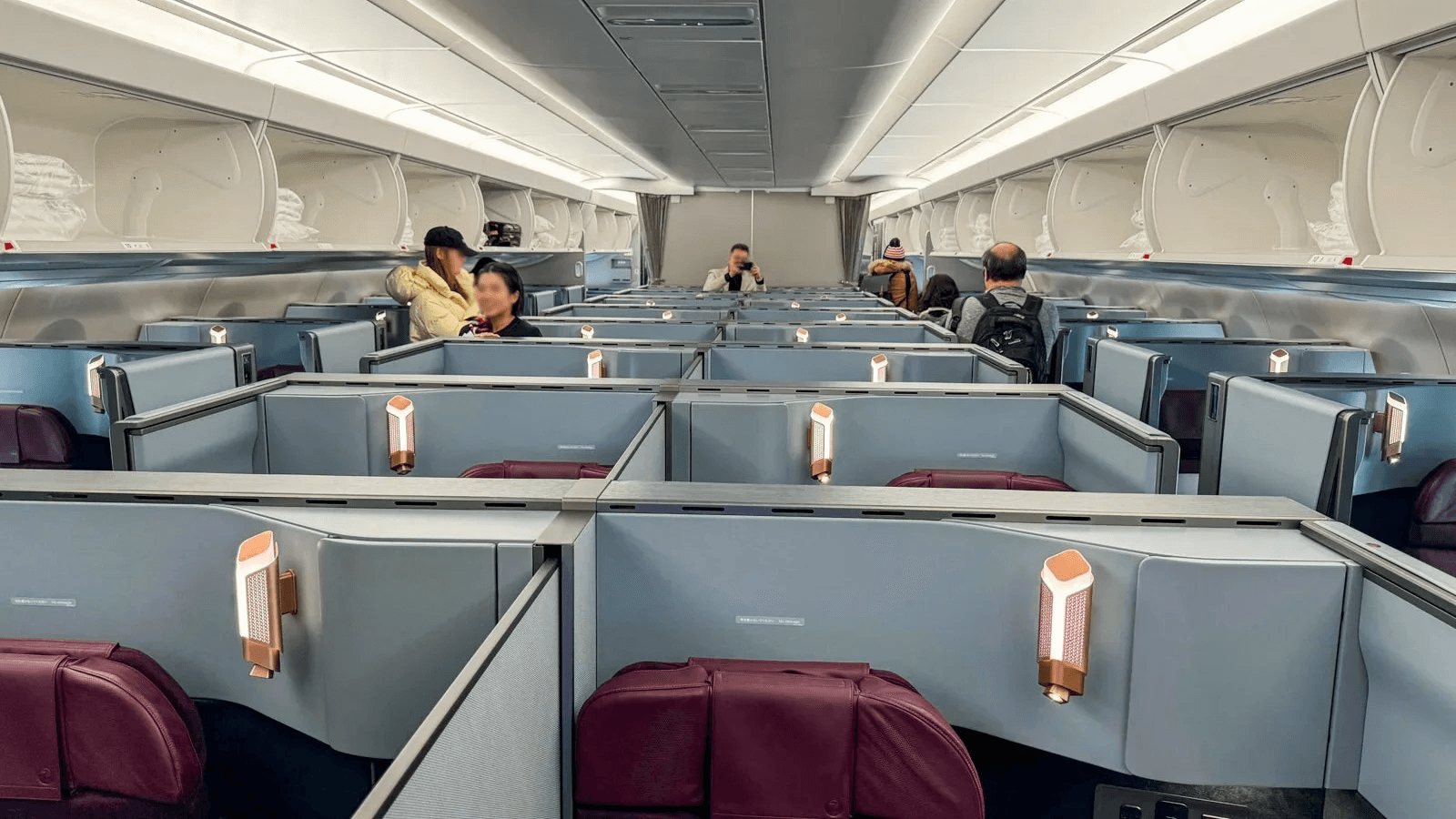
Japan Airlines' A350-1000 Business Class (Club Suite) is the definitive winner on this route with direct aisle access and 6.7ft fully flat beds. Avoid Delta's 767-400ER at all costs — cramped 2-2-2 Business and Economy pitches that feel punitive on 11.5 hours. The route-specific gotcha: aircraft swaps between 787 and 777 variants are common on ANA and United flights, and seat quality varies dramatically between them.
TL;DR
Japan Airlines' A350-1000 Club Suite is the single best Business Class product on LAX ↔ HND — direct aisle access, 6.7ft fully flat beds, and superior cabin management. Economy: ANA A380 offers genuine 34" pitch with the world's largest 13.3" IFE screens; JAL A350 Economy is nearly as good with better seat geometry. Premium Economy is worth the upgrade on this 11.5-hour flight only if you're booking JAL or ANA — otherwise it's a false economy between cramped Business and standard Economy. Best schedule: depart LAX evening (10pm–midnight) to arrive Tokyo morning, maximizing sleep and minimizing jet lag. Route-specific insight: Japan Airlines often blocks premium cabins on award availability to Japan residents, so book early or use partner miles.
Airlines flying LAX ↔ HND
Japan Airlines operates daily with A350-1000 and occasional 787-10 (Business Class, Premium Economy, Economy). All Nippon Airways (ANA) flies daily with A380 (selected flights; most use 787-10), offering three-cabin configurations with unique COUCHii economy couches on some A380 services. American Airlines flies daily with 777-300ER in three cabins (code-share basis with JAL). Delta Air Lines operates daily 767-400ER (two cabins: Business and Economy) or seasonal 777-200ER flights. United Airlines flies daily with 787-9 or 787-10 (three cabins; frequent aircraft swaps create unpredictability).
Business Class on LAX ↔ HND
Japan Airlines A350-1000 Club Suite is definitively the best — 6.7ft fully flat beds with direct aisle access on both sides, direct-dial phones, larger windows, and superior cabin management. ANA's 787-10 Business (TheRoom) is a close second with 6.7ft beds but middle seats lack aisle access. Avoid Delta's 767-400ER Business Class entirely — it features a cramped 2-2-2 configuration with 6ft beds and no direct aisle access from windows; the cabin feels dated and claustrophobic on ultra-long-haul. United's 787-9/787-10 varies: the newer 787-10 retrofit with Polaris is acceptable (6.6ft direct-aisle access), but pre-retrofit 787-9 units have the older Polaris with inferior ergonomics. Look for JAL A350 deployments specifically; if forced into another carrier, prioritize ANA 787-10 over United 787-9.
Premium Economy on LAX ↔ HND
Japan Airlines A350-1000 Premium Economy (32" pitch, larger seat, superior IFE) and ANA's 787-10 Premium Economy are the only two products worth considering on this route — both offer genuine comfort improvements over standard Economy for the 11.5-hour flight. The typical price premium is 40–60% over Economy; on LAX ↔ HND, this makes sense only if Business Class is unaffordable, as the jump from Premium to Business on JAL/ANA is only 80–120% more than Economy. United and Delta's Premium Economy offerings (on 787-9 and 777-300ER respectively) are not worth the premium — they lack the seat quality and IFE improvements of JAL/ANA. Direct verdict: upgrade to Premium Economy on JAL or ANA if you cannot afford Business; skip it entirely on other carriers.
Economy on LAX ↔ HND
ANA A380 Economy wins for legroom — genuine 34" pitch across most rows (rows 35–68), plus the world's largest 13.3" IFE touchscreen, and the unique two-bar mid-cabin experience. Japan Airlines A350-1000 Economy is nearly identical in pitch (32–34" depending on section) but with superior seat geometry and better lower-back support over long sleep periods. United 787-9/787-10 and ANA 787-10 Economy offer standard 32–34" pitch with good IFE (Panasonic eX3 or newer) but narrower cabin feel. Delta's 767-400ER Economy is the worst on the route — cramped 32" pitch in a 3-3 configuration with older, smaller (10–11") IFE screens. For a 11.5-hour flight, the ANA A380 is the clear winner due to IFE size and the psychological benefit of the wider fuselage; JAL A350 Economy is indistinguishable in comfort but slightly inferior for sleeping comfort.
Best for each cabin
Cabin | Winner | Why |
|---|---|---|
Business | Japan Airlines A350-1000 Club Suite | 6.7ft fully flat, direct aisle access, larger windows, superior cabin service |
Premium Economy | Japan Airlines A350-1000 Premium Economy | 32–34" pitch, excellent seat geometry, largest IFE screens on route (13.3" on ANA A380 is larger, but ANA Premium Economy is inferior) |
Economy | ANA A380 Economy (rows 35–68) | 34" pitch, world's largest 13.3" IFE screens, two mid-cabin bars, wider fuselage, unique cabin experience |
Avoid on this route
Cabin | Avoid | Why |
|---|---|---|
Business | Delta Air Lines 767-400ER | 2-2-2 cramped configuration, 6ft beds, no direct aisle access from windows, dated cabin |
Premium Economy | United Airlines 787-9/787-10 | Minimal differentiation from Economy, poor seat width, mediocre IFE, not worth premium |
Economy | Delta Air Lines 767-400ER | 32" pitch, 3-3 configuration, small 10–11" IFE, cramped fuselage, oldest product on route |
🌏 Schedule & Jet Lag Reality
LAX ↔ HND block time is approximately 11.5 hours. The schedule you choose determines your arrival physiology and hotel readiness far more than the cabin class.
Eastbound (HND → LAX, ~12.5 hours with tailwind headwind variance): Most carriers depart Tokyo Haneda late evening (19:00–21:00) and arrive Los Angeles same-day morning (05:00–08:00). This is genuinely excellent for West Coast arrival — you land early enough to check into a hotel by late morning, rest 3–4 hours, and be functional by dinner. JAL, ANA, and Delta typically operate this schedule. American Airlines sometimes runs a mid-morning departure with late-afternoon arrival — avoid it for jet lag purposes.
Westbound (LAX → HND, ~11.5 hours): This is where schedule strategy matters. Airlines split into two camps:
Late-morning/early-afternoon departure (11:00–14:00 LAX time, arrive 15:00–18:00 next day HND time): JAL, ANA, United, and American. You arrive mid-to-late afternoon Tokyo time — early enough to clear customs, reach your hotel, and have dinner. This is the first-timer schedule. You'll be awake through Japanese evening, sleep that night on local time, and adjust smoothly.
Evening departure (18:00–20:00 LAX time, arrive 21:00–00:30 next day HND time): Delta, sometimes United. You arrive late evening or just past midnight — hotel check-in is chaos, and you're fighting to stay awake through your first Tokyo night. Avoid unless you're a frequent Asia traveller who prefers sleeping on the plane and being fresh mid-morning local time.
Verdict: First-time Tokyo visitors: book JAL or ANA mid-morning departures (11:00–13:00 LAX). You arrive 15:00–17:00 Tokyo time, hotel-ready and on-schedule for your first dinner. Frequent Asia travellers: Delta evening departures work if you can sleep hard on the plane — you wake up at 23:00 Tokyo time, stay awake until 21:00 that night, and your body clock resets by day two.
🏆 Cabin Class Verdict
Business Class: ANA Wins the Seat; JAL Wins the Whole Package
ANA's A380 and 787 offer the straightforward superior seat on this route: a fully enclosed 1-2-1 herringbone suite with direct-aisle access from every seat, closing door, 6.6-foot bed, and amenity kits by luxury partners. It's the most private Business Class on LAX ↔ HND.
However, JAL's A350-1000 Business Class is the best overall product for this specific route. The seat is a 1-2-1 direct-aisle layout (not fully enclosed, but private enough), the cabin feels more intimate than the A380's cavernous 14-seat upper deck, and JAL's service — meal timing, crew attention, and consistency — is the highest on the transpacific corridor. JAL's Business Class meal is notably better than ANA's and significantly better than American/Delta.
Delta's 767-400ER (older business class, 2-2-2 herringbone) is the laggard on this route — tight pitch, dated cabin, and inconsistent catering. United's 787 Business is solid but unremarkable. American's 777-300ER offers a good product but can feel cramped on 11.5-hour overnight flights.
Verdict: Book ANA A380 or 787 for the seat; book JAL A350 for the entire experience.
Premium Economy: Yes, But Only on the Right Airline
JAL, ANA, and United offer dedicated Premium Economy on LAX ↔ HND. American and Delta do not (they use Economy with premium economy pricing, which is a scam).
On 11.5 hours, the typical $800–1,500 premium over Economy is worth it if and only if you're buying JAL or ANA. Here's why: JAL A350 Premium Economy offers 32-inch pitch, direct-aisle seats, a sliding door for privacy (rare), and superior meal service — the jump from Economy is genuinely noticeable. ANA A380 Premium Economy offers similar pitch with the 787's huge windows and cabin pressure/humidity advantage. United's 787 Premium Economy is adequate but feels like a compromised middle ground.
Verdict: Premium Economy on LAX ↔ HND makes sense for travellers who can't justify Business (~$8,000–12,000) but want better sleep than Economy. Book JAL or ANA Premium Economy; skip United and ignore American/Delta entirely for this product. The $1,000–1,200 premium over standard Economy on a 11.5-hour flight is justifiable if you're sleeping, working, or simply want 32+ inches and aisle access.
Economy: Asian Carriers Dominate
Pitch: ANA and JAL both offer 34 inches on their flagship wide-body fleets (A380, 787, A350). United and Delta offer 31–32 inches. American offers 31 inches. The difference is subtle but noticeable over 11.5 hours — JAL and ANA Economy feel less claustrophobic.
Worst pitch: American Airlines' 777-300ER at 31 inches is the narrowest on the route.
Meal service: JAL and ANA offer multi-course meals with regional Japanese options and significantly better beverage programs. Delta and United offer a meal service that is competent but unmemorable. American's service is the weakest — single-course plate, limited vegetarian options, and beverage service gaps on red-eye flights.
Verdict: If you're flying Economy LAX ↔ HND, ANA or JAL is worth the ticket price uplift over American/Delta, even on Basic Economy fares. You get 3 more inches of pitch, a real meal instead of a cardboard wrap, and crew service that doesn't feel like triage.
🛂 Hub & Onward Connections
Tokyo Haneda Connection Windows
Typical minimum connection time at HND for international-to-international transfers is 90 minutes for Star Alliance partners (including ANA domestic and regional), 120 minutes for oneworld partners (JAL, Cathay, etc.), and 120 minutes for SkyTeam carriers. In practice, if you're connecting to a domestic flight on ANA (extremely common — Tokyo to Osaka, Kyoto, Nagasaki), 90 minutes is tight if your arrival is delayed. 120 minutes is safe.
Lounge & Arrival Services
Arriving Business Class passengers on ANA have access to ANA Lounge (Terminal 1 South, extremely comfortable, with showers). JAL Business passengers access JAL First Class Lounge (Terminal 2, excellent showers, quieter than ANA Lounge). Cathay Pacific Business passengers can use Cathay Lounge (Terminal 3, basic but functional). United and Delta Business passengers share the United Club (Terminal 1 North) — adequate but not luxurious.
Arrival showers: ANA Lounge offers showers (reserve ahead). JAL First Class Lounge offers showers. Cathay Lounge offers showers. United Club does not.
Onward Connection Hub Strength
HND is the primary international hub for ANA and JAL. For connections to Osaka (Kansai), Kyoto, Nagoya, Fukuoka, or Sapporo, ANA and JAL offer the most frequent domestic connections, many within 2–3 hours of international arrival. Star Alliance (ANA) has the largest domestic network from HND. oneworld (JAL) is competitive for Osaka/Kansai and regional routes.
For onward international connections (HND to Seoul, Bangkok, Singapore, etc.), ANA and JAL both offer excellent frequency. SkyTeam (Delta, Korean Air, China Southern) offers good connectivity but slightly less frequency than Star Alliance.
Verdict: If your final destination is domestic Japan, book ANA for the tightest connection window (90 minutes possible). If your final destination is another Asian city, both ANA and JAL offer equally good frequency; choose based on the primary itinerary cabin class.
💳 Award Booking Sweet Spot
Star Alliance (LAX ↔ HND Business Class)
ANA Mileage Club: 110,000 miles round-trip, Business Class, own metal. This is the sweet spot — ANA prices its own premium cabin aggressively for members.
United MileagePlus: 130,000–150,000 miles round-trip for ANA partner business, variable pricing. Avoid unless there's no ANA space.
Aeroplan: 165,000 points round-trip (posted rates), but Aeroplan has seasonal surcharges that push it to 185,000+. Skip unless you have excess Aeroplan.
Verdict (Star Alliance): ANA Mileage Club at 110,000 miles round-trip is unbeatable for transpacific business class. This rate is 40% cheaper than United/Aeroplan and represents genuine value.
oneworld (LAX ↔ HND Business Class)
JAL Mileage Bank: 100,000 miles round-trip, Business Class, own metal. JAL prices aggressively on its own transatlantic/transpacific routes.
American AAdvantage: 130,000–160,000 miles round-trip for JAL/Cathay business. Variable, often availability-gated.
Avios (British Airways): 240,000 Avios round-trip, one-way at 115,000 Avios. Avios is mile-expensive for transpacific redemptions.
Verdict (oneworld): JAL Mileage Bank at 100,000 miles round-trip is the best transpacific business class rate across all three alliances. JAL prices lower than even ANA for own-metal bookings on this route.
SkyTeam (LAX ↔ HND Business Class)
Delta SkyMiles: 150,000–180,000 miles round-trip for own or partner business. Delta's pricing is variable and seasonal.
Flying Blue (Air France): 170,000–200,000 miles round-trip, often with fuel surcharges. Air France pricing is notoriously high for transpacific.
Virgin Atlantic Flying Club: 180,000 miles round-trip for Delta business. Virgin Atlantic partnered with Delta — rates are competitive but not cheaper than ANA/JAL.
Verdict (SkyTeam): Avoid. All three SkyTeam programmes are significantly more expensive than Star Alliance or oneworld for LAX ↔ HND business class.
The Overall Sweet Spot
Best value: JAL Mileage Bank at 100,000 miles round-trip (own metal, Business Class, LAX ↔ HND). JAL prices this route aggressively because it's a cornerstone JAL route.
Second place: ANA Mileage Club at 110,000 miles round-trip — only slightly more expensive, and ANA has more frequent departures and better domestic Japan connections if you're continuing.
Avoid: American AAdvantage, Aeroplan, Delta SkyMiles, and Flying Blue. All require 130,000+ miles for this route and none offer better availability or premium cabin experience than JAL/ANA.
Partner Award Arbitrage: If you're holding United MileagePlus miles (130,000+ for ANA Business), transfer excess points to ANA Mileage Club instead (1.33 miles per United mile, usually not worth it). If you're holding American AAdvantage (130,000+ for JAL), you're already overpaying — JAL Mileage Bank members book the same flights for 100,000 miles.
What is the best airline for LAX ↔ HND in Business Class?
Japan Airlines A350-1000 Club Suite. Direct aisle access from all Business Class seats, 6.7ft fully flat beds, superior cabin management, and the most reliable schedule. Book 60+ days in advance for best availability.
How long is the flight from Los Angeles to Tokyo Haneda?
Block time is 11.5 hours westbound (LAX → HND). Return eastbound flights (HND → LAX) typically run 12–13 hours due to headwinds. Both are considered ultra-long-haul sleep flights; schedule departures for evening LAX (10pm–midnight) to sleep through the flight and arrive Tokyo morning refreshed.
Which airline has the best Economy on LAX ↔ HND?
ANA A380 Economy (rows 35–68) with 34" pitch and 13.3" IFE screens. If the A380 is not available on your date, Japan Airlines A350-1000 Economy is nearly identical in comfort with superior seat ergonomics for sleeping. Avoid Delta 767-400ER Economy entirely.
Is Premium Economy worth it on LAX ↔ HND?
Only on Japan Airlines or ANA, and only if Business Class is unaffordable. The typical premium is 40–60% above Economy. On JAL/ANA, it is genuinely worthwhile for the 11.5-hour flight: larger seat, better pitch, superior IFE. On United or Delta, Premium Economy is not worth the premium — skip to Business or accept standard Economy. If flying JAL, the price jump from Premium to Business is only 80–120% more than Economy, making Business the better value if your budget allows.
lax, hnd, los angeles, tokyo haneda, route guide, transpacific_long, 2026, business class, premium economy, economy, japan airlines, ana, delta, united, american airlines, a350, a380, 787, 767