Best Airlines from Los Angeles to Hong Kong (2026)
LAX ↔ HKG
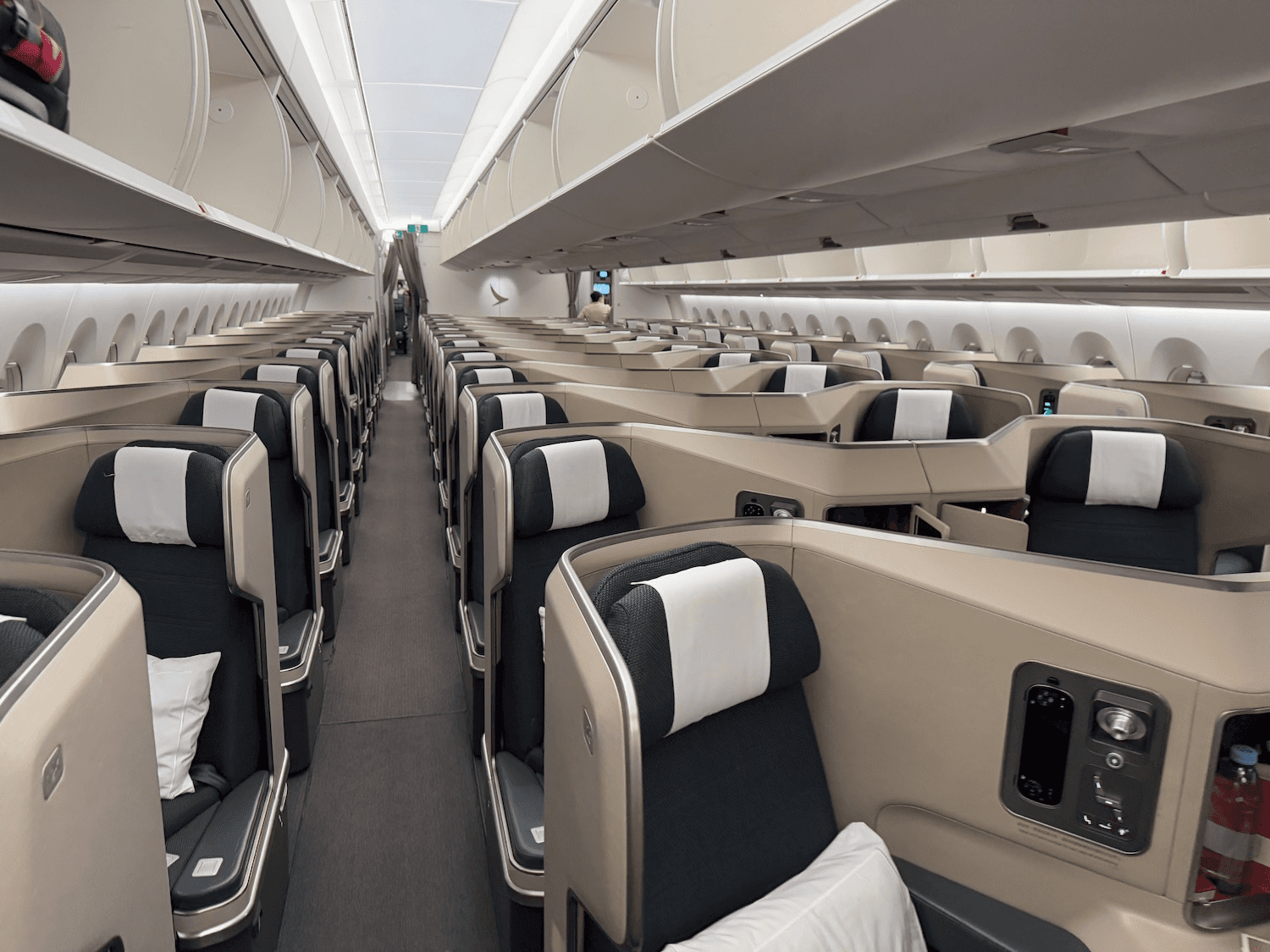
Cathay Pacific dominates this route with superior Business Class hard product, but United's 787 offers competitive premium economy value. Actively avoid American Airlines' 777-200 configuration on LAX-HKG due to outdated IFE and cramped economy. The critical gotcha: Cathay Pacific frequently swaps aircraft between A350 and 777-300ER—always verify your specific deployment before booking, as the A350 Business Class (Aria seats) is materially superior to the 777's older product.
TL;DR
Cathay Pacific's A350-1000 Aria Business Class is the best hard product on this route, featuring fully enclosed suites with direct aisle access—worth the premium over United's business. Cathay Pacific Premium Economy is the only genuine product here and justifies the spend for the 15-hour leg if you can't access Business on award inventory. Economy is tight across all three carriers (3-3-3 on 777s, 3-3-3 on Cathay's A350); prioritize row 40-43 (bulkhead legroom without bassinets proximity) or rows 65-69 (back-of-cabin, bumpier but escape screamer seats near galleys). Schedule matters enormously: overnight departures LAX (CX 880 departing 2100-2200) land Hong Kong breakfast/midday and waste less vacation time; daylight LAX departures arrive late evening HKG. One surprise: Cathay Pacific's 777-300ER economy seats (especially 40A/K bulkhead in 2-seat configuration on some deployments) offer unexpectedly generous legroom compared to United's 787 middle seats, though the 787's cabin pressure and humidity are superior for 15-hour comfort.
Airlines flying LAX ↔ HKG
Cathay Pacific operates this route year-round with multiple daily frequencies, rotating between A350-1000 (newer, preferred) and 777-300ER (legacy but still solid). United Airlines flies daily with 787-9 Dreamliner, offering excellent cabin environment and newer IFE. American Airlines operates seasonal service (peak winter/summer) and sometimes LAX-HKG-LAX via code-share, typically deploying 777-200 or 777-300ER with older hard products in premium cabins. Cathay Pacific offers 3-4 departures daily; United typically 1-2 daily; American varies by season.
Business Class on LAX ↔ HKG
Cathay Pacific's A350-1000 Aria Business Class is the single best product on this route: fully enclosed suites with direct aisle access (both sides), 6ft 8in bed length, sliding doors, and modern IFE. Avoid American Airlines' 777-200 Business Class at all costs—older herringbone layout (not direct aisle access on all seats), cramped suite dimensions, and outdated Panasonic IFE. Cathay Pacific's 777-300ER Business Class (reverse herringbone, 6ft 6in beds) is respectable but noticeably dated versus the A350; still superior to United's 787 Business (lie-flat but slimmer seats). Always verify your aircraft assignment: A350 = book it; 777-300ER = acceptable; 777-200 or American = reconsider or upgrade to First if available.
Premium Economy on LAX ↔ HKG
Only Cathay Pacific and United offer Premium Economy on LAX-HKG; American does not. Cathay Pacific Premium Economy (A350 or 777-300ER) offers 38in pitch, direct aisle access, amenity kit, and priority boarding—genuinely differentiated from economy. United's 787 Premium Plus matches the pitch (38in) but feels more like enhanced economy. For a 15-hour flight, Premium Economy is worth the typical $800-1,200 premium over economy if Business Class is unavailable or unaffordable; the pitch difference is meaningful on ultra-long-haul, and Cathay's product is superior. Skip if you have status or aisle-seat economy access; prioritize if you're economy-booked and struggling with 15 hours in a middle seat.
Economy on LAX ↔ HKG
Cathay Pacific 777-300ER economy (3-3-3, 31in pitch) and A350-1000 economy (3-3-3, 31in pitch) are identical in pitch but the A350 cabin pressure (8,000ft equivalent vs 7,000ft) and humidity control make the flight less exhausting. United's 787-9 (3-3-3, 32in pitch) wins by 1 inch and superior cabin environment, newer IFE, and free WiFi on all flights. Avoid American Airlines' 777-200 economy (31in pitch, older Panasonic IFE, inconsistent WiFi). For seat selection on 15-hour flights: bulkhead rows 40A/K (Cathay 777) offer excellent legroom but risk bassinet proximity (mix of screamer seats and excellent isolation depending on deployment); rows 41-43 (standard economy, not bulkhead) offer legroom without bassinet risk; rows 65-69 (back of cabin) escape the galley screamer-seat risk but ride is choppier. Avoid middle seats (D/G on 3-3-3) unless you have status and can secure an aisle upgrade.
Best for each cabin
Cabin | Winner | Why |
|---|---|---|
Business | Cathay Pacific A350-1000 Aria | Fully enclosed suites, direct aisle access both sides, 6ft 8in bed, modern design, superior comfort on 15-hour flight |
Premium Economy | Cathay Pacific A350-1000 | 38in pitch, direct aisle access, dedicated amenities, cabin pressure/humidity superior to competitors |
Economy | United Airlines 787-9 | 32in pitch (1in advantage), superior cabin pressure, newer IFE, free WiFi on all flights, most comfortable overall environment |
Avoid on this route
Cabin | Avoid | Why |
|---|---|---|
Business | American Airlines 777-200 Business | Herringbone layout without universal direct aisle access, 6ft 6in bed length, outdated Panasonic IFE, not competitive on ultra-long-haul |
Premium Economy | United 787 Premium Plus | Not meaningfully differentiated from economy beyond pitch; Cathay Pacific's dedicated cabin is superior |
Economy | American Airlines 777-200 Economy | 31in pitch matched by others but older IFE, inconsistent WiFi, overall dated product |
🌏 Schedule & Jet Lag Reality
LAX ↔ HKG operates on a ~15-hour block time across three carriers with notably different schedules:
Cathay Pacific typically departs LAX late afternoon (3–5 PM), arriving Hong Kong late afternoon next day (4–6 PM). This is the jet lag sweet spot for Asia-first timers: you arrive daytime, check into your hotel, stay awake through local evening, and sleep at a normal HKG bedtime. You'll adjust within 24–36 hours.
United Airlines operates primarily overnight departures (10 PM–midnight), landing HKG early morning (6–8 AM next day). Experienced Asia travellers prefer this: sleep on the aircraft, arrive refreshed for immediate business or sightseeing, and avoid the afternoon arrival slump.
American Airlines schedules vary seasonally but typically run mid-morning to early afternoon LAX departures, arriving HKG next-day evening (7–9 PM)—the worst option. You arrive tired, hotels may not have early check-in, and you'll struggle to adjust for 48+ hours.
Verdict: First-time Asia visitors should book the Cathay Pacific afternoon departure. Frequent travellers and business passengers should hunt the United overnight slot for maximum productivity on arrival. Avoid American's evening arrival window entirely unless connection timing forces your hand.
🏆 Cabin Class Verdict
Business Class: Cathay Pacific's A350 wins this route decisively. The 1-2-1 herringbone layout with direct-aisle access from every seat, 6'8" beds, and on-demand dining at 15 hours makes it the gold standard. United's 777-200 features an older 2-3-2 configuration with middle seats that will frustrate premium passengers. American's 777-300ER uses a dated 2-3-2 layout as well. For LAX–HKG specifically, CX Business Class is worth the premium over competitors; the other two carriers' Business cabins are functional but not class-leading.
Premium Economy: Only Cathay Pacific and American Airlines offer dedicated Premium Economy on LAX–HKG (United does not). For a 15-hour flight, the verdict is nuanced: CX Premium Economy (38–40" pitch, enhanced meals, separate cabin) justifies the $1,200–1,500 premium over economy if you're sensitive to space or leg comfort and cannot access Business through status or miles. American's Premium Economy (38" pitch) is less compelling given CX's product advantage on this exact route. The honest take: Premium Economy is worth $600–800 of the premium; beyond that, either upgrade to Business or stay in economy and buy good noise-cancelling headphones and compression socks.
Economy: Cathay Pacific leads on pitch (32–33 inches, best-in-class for the route) and meal service (multi-course regional Asian options, superior to US carriers). United matches CX on pitch (32 inches) but trails on catering quality and cabin condition on aging 777-200s. American's economy pitch is 31 inches on the 777-300ER—the stingiest on route—and meal service is noticeably lighter. For a 15-hour haul in economy, Cathay Pacific is the clear winner; if forced onto United or American, book bulkhead row 40 (if available on CX/United's 777-300ER) or rows 41–43 to avoid rear-cabin turbulence and lavatory queues.
🛂 Hub & Onward Connections
Minimum connection time at HKG for international-to-international transfers: 2 hours for same-alliance connections, 2.5 hours for interline. Cathay Pacific hub operations run with precision; connections under 2 hours are risky unless your inbound flight is on-time and you're travelling light.
Lounge & Arrival Facilities: Cathay Pacific Business passengers access The Pier First Class Lounge (the finest airport lounge in Asia—spa facilities, showers, à la carte dining). United and American Business passengers access partner lounges with shower facilities but far inferior quality. Arrival showers are available to all Business passengers through HKG's paid shower spa (US$10–15) if lounge access is unavailable; CX Business gets complimentary shower access through The Pier.
Onward connections from HKG: Cathay Pacific dominates the HKG hub with same-day connections to Bangkok, Singapore, Manila, Ho Chi Minh City, and Taipei on short/medium-haul with 1.5–2 hour minimums. Star Alliance (United) offers weaker onward connectivity via Asian partner airlines (EVA Air, ANA, Singapore Airlines). For LAX passengers continuing to Southeast Asia via HKG, Cathay Pacific's network density is superior; expect 2–3 hour layovers comfortably accommodated within The Pier's premium lounge.
💳 Award Booking Sweet Spot
Star Alliance (Aeroplan, United MileagePlus, ANA Mileage Club): United Airlines LAX–HKG Business Class redemptions price at 90,000–110,000 miles one-way (Aeroplan and MPX rates similar). ANA Mileage Club offers the best value: round-trip LAX–HKG–LAX in Business often prices at 140,000–160,000 miles if booked as a single round-trip ticket, undercutting one-way bookings of 90,000 × 2. Aeroplan's sweet spot is 115,000 miles round-trip during off-peak (Sept–Nov, Jan–Feb).
oneworld (AAdvantage, Avios, JAL Mileage Bank): American Airlines LAX–HKG Business through AAdvantage costs 95,000–130,000 miles one-way depending on fuel surcharges and cabin availability. Cathay Pacific award space on oneworld partner bookings (via Avios or JAL) is scarce and expensive. JAL Mileage Bank offers exceptional value: 80,000–95,000 miles one-way to HKG on Cathay Pacific, significantly cheaper than booking the same Cathay flight through BA Avios (150,000+) or AA. JAL is the oneworld sweet spot for transpacific Asia redemptions.
SkyTeam (Flying Blue, Virgin Atlantic for partner Delta): Flying Blue redemptions on Cathay Pacific LAX–HKG Business typically price 85,000–100,000 miles one-way with moderate fuel surcharges (US$150–300). This is competitive with Star Alliance but SkyTeam is less dominant on transpacific routes; inventory can be thin during peak seasons.
Best-value programme for Business Class LAX–HKG: ANA Mileage Club for round-trip bookings (140k–160k round-trip beats all competitors on miles per segment). JAL Mileage Bank for one-way flexibility and Cathay Pacific access (80k–95k one-way, 40–50% cheaper than cash-paid Business). For North American members, ANA is optimal if your travel date is flexible; JAL wins if you need guaranteed availability and lower per-mile cost. Avoid AAdvantage and standard Flying Blue redemptions on this route—too expensive relative to the Japanese carrier options.
What is the best airline for LAX ↔ HKG in Business Class?
Cathay Pacific A350-1000 with Aria Business Class suites. Direct aisle access, 6ft 8in bed, sliding doors, modern interior. If A350 is unavailable and you're allocated 777-300ER, the reverse herringbone is still respectable for 15 hours. Avoid American Airlines 777-200 entirely.
How long is the flight from Los Angeles to Hong Kong?
~15 hours block time westbound (LAX to HKG). Account for 2-3 hour time zone change recovery; overnight LAX departures (2100-2200) land breakfast/early afternoon HKG. Eastbound HKG to LAX flights are typically 16-17 hours block time due to prevailing winds.
Which airline has the best Economy on LAX ↔ HKG?
United Airlines 787-9: 32in pitch (versus 31in on competitors), superior cabin pressure (8,000ft equivalent), newer IFE, free WiFi on all flights. For 15 hours, the 787's environment is materially more comfortable. Cathay Pacific A350 is second choice if you need Cathay status benefits; 777-300ER slightly less preferred due to older IFE.
Is Premium Economy worth it on LAX ↔ HKG?
Yes, if Business Class is unavailable and you're economy-booked on a middle seat. The $800-1,200 premium is justified for 15 hours: 38in pitch is a meaningful upgrade, and Cathay Pacific's dedicated cabin (only operator offering genuine premium economy on this route) includes amenity kit, priority boarding, and cabin environment. Skip if you have status (likely to clear aisle seat in economy) or if the Business Class premium is under $1,500—in that case, stretch for Business on Cathay A350.
What is the aircraft lottery risk on LAX ↔ HKG?
Cathay Pacific rotates A350-1000 and 777-300ER on this route unpredictably. A350 is materially superior in all cabins (newer IFE, cabin pressure, seat design). Always verify your specific aircraft before booking and consider purchasing ticket flexibility in case you're allocated 777-300ER. United's 787-9 is consistent. American's aircraft varies (777-200 vs 777-300ER) with no transparency; this inconsistency alone is a reason to avoid unless forced by schedule/price.
What is the route-specific seating gotcha on economy LAX ↔ HKG?
Bulkhead rows (40A/K on 777s, occasionally row 59) are proximate to bassinets and galley areas; opinions divide on 'screamer seats' risk. Passenger reports confirm row 40 bulkhead (specifically A/K seats with IFE in seat back, not armrest) offer excellent legroom and isolation, but row 59-60 bulkhead is claustrophobic with armrest IFE. Safest bet: rows 41-43 for standard economy with legroom, or rows 65-69 to escape galley traffic. Avoid middle seats (D/G) on 3-3-3 unless you clear an aisle seat via upgrade or status.
lax, hkg, los angeles, hong kong, route guide, transpacific_long, 2026, business class, premium economy, economy, best airlines, cathay pacific, united airlines, american airlines, a350, 787, 777