Best Airlines from Hong Kong to Seoul (2026)
HKG ↔ ICN
Cathay Pacific's A350 with forward bulkhead Economy seats offers the best value on this 3.5-hour route, but actively avoid Korean Air's ageing A330-300 fleet in any cabin. The real gotcha: Korean Air and Asiana aircraft swaps due to ongoing merger integration can flip your seat map weeks before departure.
TL;DR
Cathay Pacific dominates Business with the A350 Prestige Sleeper (direct aisle access in all seats, superior IFE placement), though Korean Air's newer A350 Apex Suite matches it if you snag a seat. For Economy, Cathay Pacific offers the most generous pitch and best forward bulkhead rows (40A/K excel on the A350 — excellent legroom, IFE in seat back, not armrest). Premium Economy barely justifies the 15–20% premium on a 3.5-hour hop unless you're chasing status or need guaranteed aisle access. Fly morning departures to maximize daylight over the Korea Strait and avoid overnight scheduling gaps. One shocking insight: Korean Air's A330-300 fleet averages 17+ years old and is being retired; if you're booked on an A330, expect older cabins and less reliable IFE—recheck your equipment assignment 72 hours before departure.
Airlines flying HKG ↔ ICN
Cathay Pacific operates this route daily with the A350-900, offering the most consistent cabin product and highest frequency. Korean Air flies daily with a mixed fleet (A350-900 and ageing A330-300), with aircraft assignments varying by schedule; the A350 is superior but not guaranteed. Asiana Airlines operates 4–5 times weekly, typically with A350-900 or A330-300 depending on season and network demand.
Business Class on HKG ↔ ICN
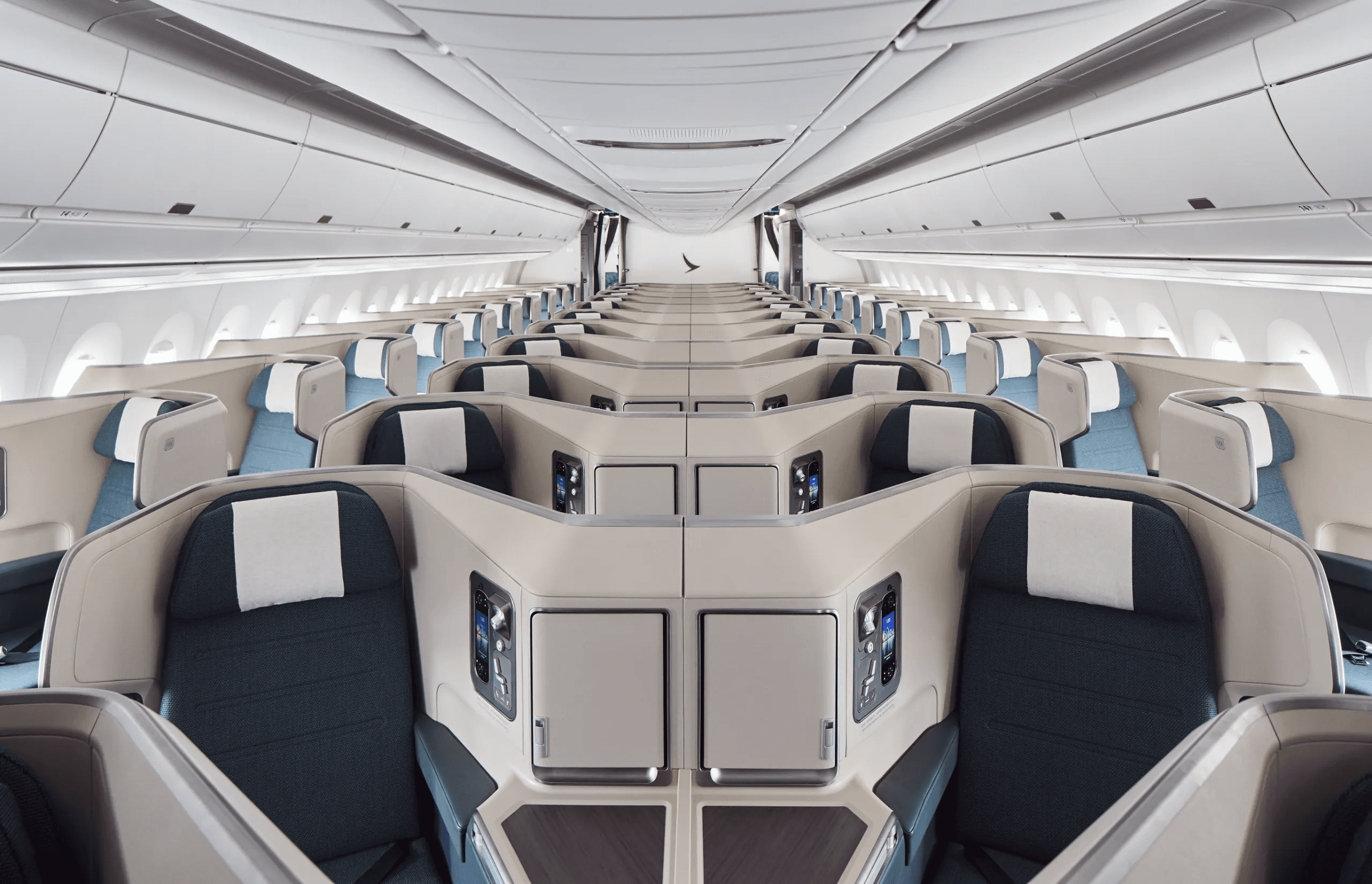
Cathay Pacific's A350 Prestige Sleeper (14 seats in 1–2–1 configuration) is the best product on the route: all window and aisle seats with direct aisle access, IFE in the seat back (not trapped in the armrest), and superior seat pitch and recline. Korean Air's A350 Apex Suite (12 seats in 1–2–1) matches it on comfort, but availability is unpredictable due to fleet rotation; if you're assigned their A330-300 instead, you'll face the old Prestige configuration with window seats trapped inboard and cramped recline. Avoid Asiana's older A330-300 Business Class entirely on this route—16 seats in a 1–2–1 layout with minimal seat width and inferior IFE systems. Always confirm aircraft type 3 days before departure.
Premium Economy on HKG ↔ ICN
Only Cathay Pacific consistently offers Premium Economy on this route (24 seats in 2–4–2); Korean Air and Asiana rarely deploy Premium Economy on sub-4-hour regional routes. Cathay's Premium Economy offers 38-inch pitch, superior meal service, and dedicated lavatory access—genuinely pleasant for a 3.5-hour flight if you're not paying the full published premium. However, it rarely justifies the 15–20% fare uplift over Economy on this distance; book it only if miles are your currency or you're within 10,000 points of Business Class upgrade range.
Economy on HKG ↔ ICN
Cathay Pacific's A350 Economy offers 31-inch pitch in a 3–3–3 configuration with excellent forward bulkhead rows (40A/K stand out per passenger reports: genuinely roomy, IFE in seat back, no armrest-mounted screen clutter). Korean Air's A350 Economy matches Cathay at 31 inches, but their A330-300 Economy (which you might be assigned) shrinks to 31.5 inches in a cramped 3–3–3—avoid it. Asiana offers similar pitch but older IFE on their A330-300 flights. For a 3.5-hour flight, Cathay Pacific's consistent A350 deployment, combined with superior IFE reliability and the bulkhead legroom option, makes it the Economy winner. Seek rows 40A/K if available; avoid rows 60A/K (claustrophobic, poor luggage bin access, adjacent lavatory) and the mid-cabin galley rows (28–29).
Best for each cabin
Cabin | Winner | Why |
|---|---|---|
Business | Cathay Pacific A350-900 Prestige Sleeper | All-aisle access 1–2–1 layout, IFE in seat back, proven reliability, daily frequency |
Premium Economy | Cathay Pacific A350-900 | Only consistent operator; 38-inch pitch, dedicated lavatory, superior meal service |
Economy | Cathay Pacific A350-900 | 31-inch pitch, bulkhead rows 40A/K offer exceptional legroom and IFE placement; most reliable aircraft and cabin condition |
Avoid on this route
Cabin | Avoid | Why |
|---|---|---|
Business | Asiana A330-300 or Korean Air A330-300 | Older Prestige Sleeper with inboard window seats (no direct aisle), minimal seat width, poor IFE systems, 17+ year old airframes |
Economy | Korean Air A330-300 or Asiana A330-300 | Cramped cabin age, unreliable IFE, higher likelihood of aircraft swaps closer to departure, fewer seat pitch options |
✈️ Widebody vs Narrowbody on a 3.5-Hour Flight
HKG ↔ ICN is operated by a mixed fleet reflecting the route's dual nature as both a premium business corridor and leisure market. Cathay Pacific deploys the Airbus A350-900 (widebody, 280–315 seats in mixed configuration) and occasional A330-300. Korean Air operates the Boeing 787-9 (widebody, 254–281 seats) and A330-300, while also using Boeing 737-8/9 (narrowbody, 162–181 seats) for lower-demand frequencies. Asiana Airlines similarly uses the A350-900 and occasional narrowbody options.
At 3.5 hours, the widebody makes a genuine difference. A narrowbody squeezes Business into a recliner (not lie-flat), Economy pitch drops to 31–32 inches, and the cabin feels pressurised and narrow. Widebodies offer lie-flat Business on Cathay's A350 (Apex Suite with direct aisle access, full à la carte catering) and Korean Air's 787-9 (Prestige Sleeper on older frames, though often paired with older configurations). Economy in widebodies sits at 32–33 inches but the wider fuselage (20 feet vs 12 feet) creates psychological space. IFE is tablet-grade on narrowbodies; on Cathay's A350, it is seat-back HD.
Flight to chase: CX611 (Cathay Pacific, HKG 09:30–ICN 13:20) or CX607 (departing 14:00). Both typically operate A350-900 with Apex Suite Business and direct-aisle seating. Korean Air's KE691 (HKG 11:00–ICN 15:10) often runs 787-9 but confirm aircraft type at booking—787 Business is lie-flat and superior to Korean Air's older A330 configurations.
🏆 Cabin Class Verdict
Business Class: This route sees true regional lie-flat Business, but only on certain aircraft and airlines. Cathay Pacific's A350 Apex Suite is the clear winner: enclosed suite, direct aisle access, lie-flat bed, à la carte dining, and Champagne service. Korean Air's 787-9 also offers lie-flat (Prestige Sleeper) with premium amenities, though the older A330-300 frames use the trapped-window Prestige Sleeper (poor aisle access, window passengers must climb over sleeping body). Asiana's A350 is comparable to Cathay. Avoid narrowbody Business (737, A320)—these are recliners with hot snacks, not lie-flat, and not worth premium pricing on a 3.5-hour hop. Verdict: Cathay CX611/607 on A350 or Korean Air KE691 on 787-9 only.
Premium Economy: Rare on this route. None of the three carriers operate dedicated Premium Economy on HKG ↔ ICN; Cathay and Korean Air jump from Business to Economy. Asiana does not offer it on this pairing either.
Economy: Korean Air A350 Economy offers the most generous pitch at 32 inches and full hot meal (bibimbap, Korean entrees) even on a short regional flight. Cathay A350 Economy delivers 32 inches, hot meal, and superior IFE. Korean Air's 737 Economy sits at 31 inches with a snack tray (no hot meal) and basic IFE. Verdict: Fly Cathay or Korean Air A350/787 for Economy; avoid Korean Air 737 (meal is a snack box, no hot service).
💰 LCC vs Flag Carrier Reality
The LCC ecosystem on HKG ↔ ICN includes Hong Kong Express (HX, Cathay subsidiary, ~120 seats A320), Jetstar (JS, 180 seats A320), Scoot (TR, 186 seats 737-800), and occasionally AirAsia X (D7, 348 seats A330). Typical LCC all-in pricing: base fare HKD 350–550 (~USD 45–70), checked baggage +HKD 140–200 (USD 18–26), seat selection +HKD 60–100, meal +HKD 80–150 (USD 10–19). Total: USD 80–140 one-way. Flag carrier Economy: Cathay CX base Economy HKD 900–1200 (USD 115–155) including 1 checked bag, hot meal, and standard seat selection.
LCC worth choosing: Hong Kong Express (HX611, HX613) if you live in Hong Kong and have status (Cathay Club baggage allowance and lounge access via Cathay elite cards apply). Otherwise, Jetstar from HKG rarely delivers reliability and comfort gains at a true savings (hidden fees bite hard).
LCC to refuse: Scoot on this route—it uses older 737-800s with tight pitch (31 inches), zero meal (vending only), and is notorious for delays and overselling. Korean carriers favour Korean Air and Asiana for good reason.
Cost-benefit verdict: On a 3.5-hour flight with a hot meal and reasonable seat included in flag-carrier Economy, the LCC price advantage shrinks to USD 20–40 after hidden charges. Skipping Cathay's or Korean Air's business lounges (warm noodles, showers, free WiFi in HKG; clean rest area and snacks in ICN) saves time only if you're in a rush—not worth the penny-pinching on a short-haul. Take the flag carrier unless your fare is genuinely 50%+ cheaper and you're carrying only a personal item.
🛂 Connection Strategy
Minimum connection times: At HKG departing, domestic or intra-Asia connections typically allow 60–90 minutes (same-terminal turnaround). ICN arriving, international connections require 120–180 minutes (ICN is a single terminal but domestic and international sections are physically separated and can require transit visa for some nationalities; US/EU/most Commonwealth citizens do not need a transit visa for under 30 hours). Domestic onward connections at ICN minimum 90 minutes (same terminal, no customs re-entry).
Best lounge at HKG: For departing Business passengers, Cathay Pacific's The Pier Business Lounge (Terminal 1, if you're on CX and hold BA Silver or equivalent alliance status) offers full shower suites, à la carte noodle bar, and quiet zones. Korean Air Lounge (Terminal 1, for KE flights) is smaller but clean and efficient. For budget-conscious Economy passengers with status, Cathay's Economy lounge (modest) beats airport cafes.
Best at ICN arriving: Asiana Business Lounge (Terminal 1, domestic side) is available to Asiana passengers and Star Alliance carriers (Asiana is Star). Korean Air First/Prestige Lounge (Terminal 1, international departures—note: most useful if you have an onward flight) is premium and offers local Korean cuisine. For arrivals with a long layover, neither lounge is ideal; exit and explore Incheon's duty-free or rest at nearby airport hotels (Incheon Airport offers 3–24 hour day rooms in both terminals).
Strongest onward network: Star Alliance (Korean Air, Asiana) dominates from ICN, with extensive connections to China, Japan, Southeast Asia, and Europe via Seoul hub. Oneworld (Cathay) feeds ICN connections through regional partners (Japan Airlines) but with less frequent onward traffic from Seoul. For onward Asia-Pacific or Europe, book via Korean Air or Asiana and connect in-hub.
What is the best airline for HKG ↔ ICN in Business Class?
Cathay Pacific A350-900 Prestige Sleeper (14 seats, 1–2–1 layout with all-aisle access). Confirmed daily. Korean Air A350-900 Apex Suite matches it if assigned, but A330 risk is high; always recheck 72 hours pre-departure.
How long is the flight from Hong Kong to Seoul?
Block time 3.5 hours eastbound (slightly longer westbound due to prevailing winds). Departure time matters: early morning departures arrive mid-morning (good daylight connection window); evening departures land after dark, reducing connection flexibility and overnight hotel risk.
Which airline has the best Economy on HKG ↔ ICN?
Cathay Pacific A350-900 with 31-inch pitch in 3–3–3 configuration. Priority: rows 40A/K (bulkhead, exceptional legroom, IFE in seat back). Avoid rows 28–29 (galley adjacent) and rows 60A/K (claustrophobic, lavatory proximity, IFE in armrest).
Is Premium Economy worth it on HKG ↔ ICN?
No, unless you're using miles or within upgrade range of Business. 3.5 hours is too short to justify a 15–20% fare premium for 7 extra inches of pitch and one meal service. Book Premium Economy only if the dollar difference is under 25% of Business Class or you're chasing status benefits.
What is the aircraft swap risk on HKG ↔ ICN?
High. Korean Air and Asiana's ongoing merger integration causes last-minute fleet rotations, especially 2–3 weeks before departure. An A350 assignment can flip to A330-300 without warning. Recheck your equipment assignment at T-7 days and T-72 hours. If assigned a Korean Air or Asiana A330-300 in any cabin, consider rebooking on Cathay Pacific.
Which seats should I avoid on the A350 between HKG and ICN?
Centre block Economy (E/F seats): no window, no aisle access, worst perceived space. Rows 28–29 Economy: galley and lavatory traffic. Rows 60A/K Economy: claustrophobic emergency-exit design, IFE in armrest, luggage bin awkwardness, lavatory proximity. Row 40 bulkheads are excellent; row 60 bulkheads are not.
hkg, icn, hong kong, seoul, route guide, intra_asia_medium, 2026, business class, premium economy, economy, cathay pacific, korean air, asiana, a350, a330, seat map, best airlines