Best Airlines from Hong Kong to Bangkok (2026)
HKG ↔ BKK
Cathay Pacific's A350 dominates this 3-hour sprint with superior Business Class hard product, but Thai Airways offers competitive pricing. Avoid Emirates on this route due to inferior economy seat pitch and older aircraft. Watch for unexpected A330 deployments on CX that lack the A350's premium lavatory access.
TL;DR
Cathay Pacific A350 Business Class with forward-facing suites is the clear winner, though Thai Airways A350 offers better value on sales. Premium Economy barely justifies the cost on a 3-hour flight—skip it unless you have status or a deep discount. Economy is tight across all carriers (32-inch pitch standard); Hong Kong Express offers the best value fares but tightest cabins. Book early morning CX flights to avoid afternoon turbulence over the Gulf of Thailand. Route-specific gotcha: A350 bulkhead seats (row 40) vastly outperform emergency exit rows (row 60) in comfort—seat selection matters more than airline choice in Economy.
Airlines flying HKG ↔ BKK
Cathay Pacific operates this route multiple daily with A350-900 and occasional A330-300; Thai Airways International matches with daily A350-900 and A380 services on peak days; Hong Kong Express (Cathay's budget arm) serves 1-2 daily with A320 family; Emirates operates daily with Boeing 777-300ER and A380, focusing on connecting traffic. CX and TG dominate with 4-5 combined daily frequencies, while HX and EK are secondary options.
Business Class on HKG ↔ BKK
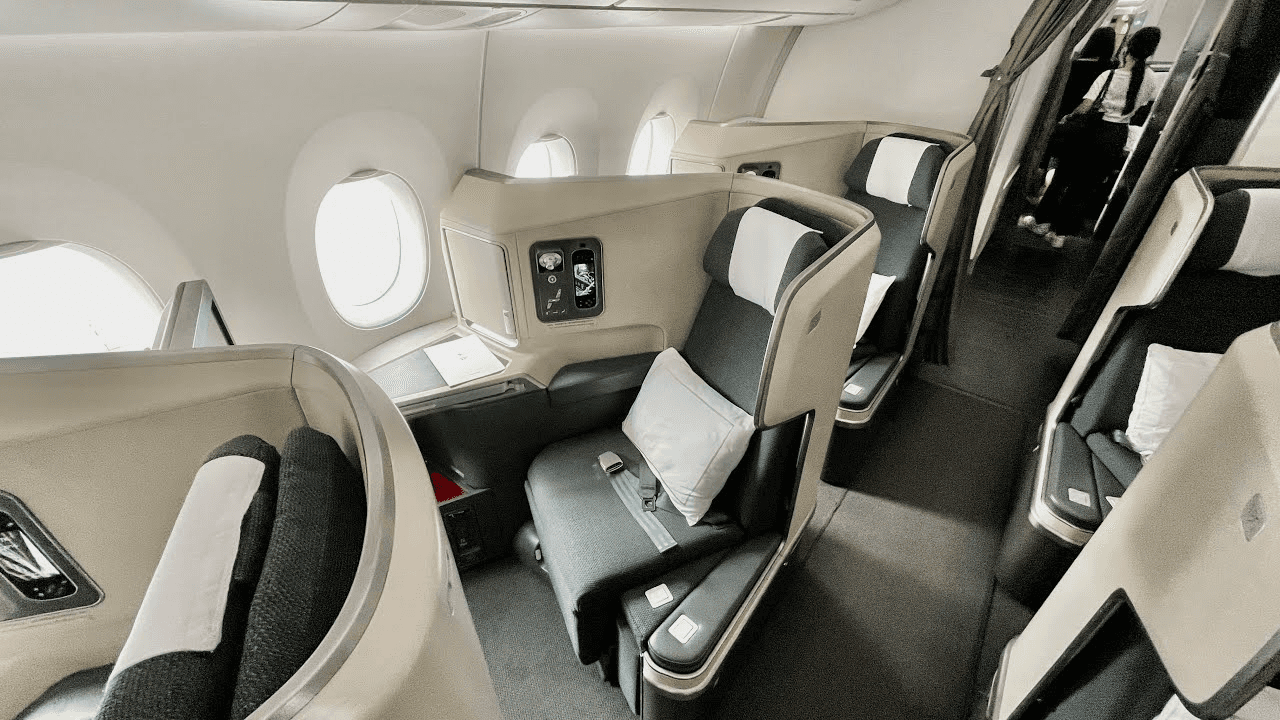
Cathay Pacific A350-900 Business Class is the strongest product on route, featuring direct-aisle access forward-facing suites with closing doors, superior IFE systems, and consistent on-time performance. Thai Airways A350 Business is comparable in hard product but inconsistent crew service on short-hauls. Avoid Emirates 777-300ER Business on this route—older seats with limited privacy and hot galleys near cabins. On CX, specifically request A350 aircraft in booking; an A330-300 swap downgrades lavatory access and seat width by 2 inches.
Premium Economy on HKG ↔ BKK
Cathay Pacific and Thai Airways both offer Premium Economy on this route with 38-inch pitch and 18-inch-wide seats. For a 3-hour flight, Premium Economy is not worth the typical $150-300 premium over Economy—the flight is too short to justify the cost differential. Only book if you have elite status pricing or are combining it with a longer journey; Economy bulkhead seats offer similar legroom at a fraction of the price.
Economy on HKG ↔ BKK
Hong Kong Express A320 offers 32-inch pitch with the most generous legroom among budget carriers and best IFE-to-cost ratio, though cabin density is highest. Cathay Pacific A350 Economy has identical 32-inch pitch but wider aisles and superior lavatories; Thai Airways A350 matches CX specifications. Avoid Emirates 777 Economy—31-inch pitch with older 11-inch IFE screens and frequent WiFi outages on this short route. Specific seat selection is critical: Row 40 bulkhead on CX A350 offers exceptional legroom and forward-facing screen placement; Row 60 emergency exit is claustrophobic and should be actively avoided despite exit-row marketing.
✈️ Widebody vs Narrowbody on a 3-Hour Flight
Cathay Pacific operates this route primarily with the Airbus A350-900 (widebody, 3-3-3 economy layout) and occasionally Boeing 777-300ER (widebody, 3-3-3 economy). Thai Airways uses Boeing 787-8 Dreamliner (widebody, 3-3-3 economy) and Airbus A350-900. Hong Kong Express and Emirates deploy Airbus A320 (narrowbody, 3-3 economy layout) for this route on a frequency basis.
On a 3-hour flight, widebody matters significantly. The wider fuselage (21 feet vs 11.5 feet on narrowbody) means genuinely spacious aisles, wider seats (8.6 inches vs 7.7 inches), and two aisles instead of one—critical for lavatory access and crew movement. Both Cathay Pacific and Thai Airways offer full Business Class with lie-flat seats (6.5-7 feet recumbent length) on widebody equipment, transforming the journey into genuine rest rather than a 3-hour upright endurance test. IFE systems on widebodies include larger seatback screens (15+ inches vs 10-inch on A320s) and premium audio.
Best widebody option: Cathay Pacific CX 600 (HKG 07:30–09:45 BKK) operates A350-900 with full Business Class; the morning departure also avoids red-eye fatigue on arrival. Thai Airways TG 601 (A350-900, HKG 09:30–11:45 BKK) is a close alternative with comparable hard product.
🏆 Cabin Class Verdict
Business Class: This is true regional Business Class, not a recliner masquerade. Cathay Pacific and Thai Airways both deploy full lie-flat seats (1.8m length, direct aisle access on alternating rows, full meal service with premium wine, noise-cancelling headsets, amenity kits). Winner: Cathay Pacific A350 Business offers superior seat width (8.3 inches vs Thai Airways' 8 inches) and quieter cabin due to A350 noise insulation. Business Class is absolutely worth the upgrade on this route if upgrading from economy or flying premium economy pricing—at 3 hours, you'll land refreshed instead of stiff.
Premium Economy: Rare on this route. Cathay Pacific offers Premium Economy (18-inch seat width, 38-inch pitch, enhanced meal service) on select A350 flights but availability is sparse. Thai Airways does not operate Premium Economy on HKG–BKK. Verdict: Skip it. The price premium over economy (typically $150–250 one-way) is not justified for 3 hours when Business Class upgrades often price competitively.
Economy Class: Cathay Pacific and Thai Airways offer full meal service (hot entree, beverage, snack) on all departures, with 31-inch seat pitch on A350s. Hong Kong Express (subsidiary of Cathay Pacific, A320 narrowbody) offers 30-inch pitch with buy-on-board food only, and limited drink service. Winner for comfort: Cathay Pacific A350 Economy—widebody cabin, proper meal, 31-inch pitch. Best value LCC: Hong Kong Express at 20–30% cheaper, acceptable for a 3-hour haul if traveling light. Avoid: Budget carriers (Scoot, Jetstar, AirAsia) charge hidden fees for seat selection ($8–15), checked bags ($15–25), meals ($6–12), and deliver 28-inch pitch—net cost approaches full-service economy.
💰 LCC vs Flag Carrier Reality
Typical LCC cost (Scoot/Jetstar): Base $45–70 + checked bag $20 + seat selection $12 + meal/drink $8–15 = $85–117 all-in. Departure/arrival often outside peak hours (red-eyes), narrowbody seating, no lounge, no priority boarding.
Flag Carrier cost (Cathay Pacific/Thai Airways): Base economy $65–120 + included checked bag + no seat selection fee + included meal/beverage = $65–120 all-in. Off-peak flights may discount to match LCC, peak flights premium to $150–180.
Honest verdict: On routes under 4 hours, LCC pricing advantage disappears once ancillary fees are added. Choose Cathay Pacific or Thai Airways full-service unless your schedule forces a Scoot departure. LCC worth choosing: Hong Kong Express (Cathay Pacific subsidiary, actual service standards, included carry-on + personal item, no hidden fees on bags under 7kg)—roughly 10% cheaper than Cathay Pacific Economy with acceptable product. LCC to refuse: Scoot and Jetstar—neither operates this route frequently, and when they do, add-on fees exceed full-service pricing, plus 28-inch pitch on older 737-800s. Time savings from skipping Cathay Pacific lounge (70-minute pre-departure lounge access in LCC) are minimal on a 3-hour flight; if you have status or companion tier benefits, lounge access delivers more value than LCC savings.
🛂 Connection Strategy
Minimum connection time: HKG (Hong Kong) to onward international flight: 90 minutes through-checked baggage (same terminal), 2 hours if rechecking baggage. Most HKG–BKK flights use Terminal 1; international onward flights typically same terminal (Terminal 1: Cathay Pacific, Thai Airways; Terminal 2: budget carriers). BKK (Bangkok Suvarnabhumi) inbound to onward domestic or Southeast Asian flight: 60 minutes for same-day connection (single terminal, efficient transfer), 90 minutes if rechecking baggage or connecting to Domestic Terminal (Don Mueang, 30km away—requires 45 minutes ground transport).
Best lounge at HKG for departing Business passengers: The Pier / Cathay Pacific The Pier (Terminal 1, Gate 70–90 area) — dedicated to Business Class, open 5:30am–23:30, hot shower suites (16), noodle bar, premium bar, quiet zones. Comparable: Thai Airways Royal Silk Lounge (Terminal 1), smaller, adequate if CX lounge full. Best lounge at BKK for arrivals: Thai Airways Royal Silk Lounge (Suvarnabhumi, Concourse G/International Arrivals, Mezzanine Level)—open 06:00–22:00, shower facilities, light meal, allows arrivals passengers 90 minutes pre-departure on onward same-day flight. Cathay Pacific has no dedicated arrival lounge at BKK; oneworld arrival customers use Thai Airways reciprocally.
Strongest onward network from Bangkok: Oneworld Alliance (Thai Airways TG) operates the densest regional network—Chiang Mai, Phuket, Pattaya, Cambodia (Siem Reap, Phnom Penh), Laos (Vientiane), Vietnam (Ho Chi Minh, Hanoi), Myanmar (Yangon). Alternative: Star Alliance (Thai AirAsia, Thai Smile) covers secondary cities (Chiang Rai, Krabi, Udon Thani) but with longer connection times and lower frequency. For onward to India, South Asia, or Middle East, Cathay Pacific connections are rarer from BKK; book Thai Airways HKG–BKK–onwards for reliability on same ticket.
hkg,bkk,hong kong,bangkok,route guide,intra_asia_medium,2026,business class,premium economy,economy,cathay pacific,thai airways,a350,bulkhead seating,best airlines