Virgin Atlantic
A330-300
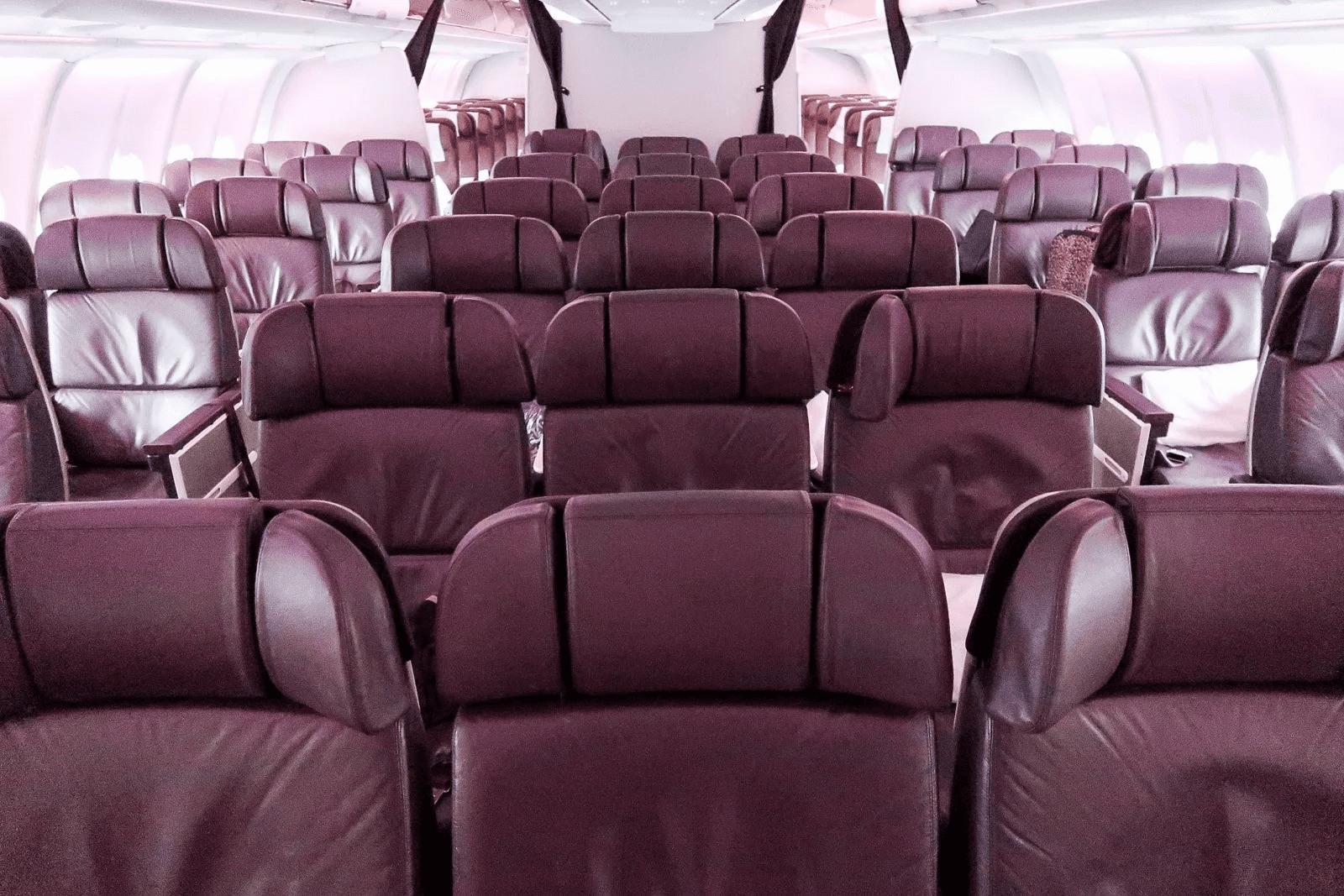
Virgin Atlantic a330-300 Seat Guide (2026) | Cabin.coach
TL;DR
Virgin Atlantic's a330-300 carries 32 Business, 56 Premium Economy, and 174 Economy seats. Business Class features a 1-2-2 staggered layout with direct aisle access and lie-flat beds (up to 6'8"). Best seat: 1A or 1K in Business (first row, maximum privacy and legroom). Worst seat: 41E or 41F in Economy (no recline, wing noise, zero overhead bin access). The real gem: rows 70–80 in Economy are quieter and away from lavatories, making them surprisingly pleasant for a narrow-body alternative.
Try Cabin
Virgin Atlantic's a330-300 is a workhorse for transatlantic and long-haul Caribbean routes, configured with 262 seats across three cabins. Avoid row 41 in Economy at all costs—it's directly over the wing with zero recline and abysmal legroom. The aircraft's defining characteristic is its 1-2-2 Business Class layout with direct aisle access on both sides, though middle seats in Economy are genuinely miserable on 12+ hour flights.
Quick specs
Cabin | Layout | Seats | Pitch | Width | IFE |
|---|---|---|---|---|---|
Business | 1-2-2 | 32 | 6'8" lie-flat | 21" | 18" HD touchscreen |
Premium Economy | 2-3-2 | 56 | 38" | 18.5" | 11.6" HD |
Economy | 2-4-2 | 174 | 31" | 17.2" | 10.1" HD |
Business Class
The 1-2-2 staggered layout runs rows 1–16 (A/K outer seats are fully isolated with sliding privacy doors; B/J middle seats are forward-facing with partial privacy). Rows 1–3 offer maximum legroom and boarding priority; rows 13–16 are over the wing but still excellent. Direct aisle access on every seat eliminates middle-seat syndrome. Avoid row 2K if traveling solo—it's between lavatories. Best rows: 1–5 (prestige seating with optimal legroom and quietness).
Premium Economy Class
Runs rows 17–34 in a 2-3-2 configuration with 38" pitch—genuine middle ground between Economy and Business. Seats A/F are window seats with direct aisle access; seats B/E and C/D are middle seats but with extra legroom. Best rows: 17–22 (forward section closer to galley service). Row 34 is the back of Premium Economy—avoid if you dislike proximity to Economy galley noise. This cabin is worth the upgrade on flights over 7 hours; pitch is genuinely comfortable for sleeping.
Economy Class
Rows 35–80 in a 2-4-2 layout. Exit rows at 40 (extra legroom, but immovable armrests). Row 41 is the critical gotcha: directly under the wing, zero seat recline, and zero overhead bin access—skip entirely. Rows 35–39 are tolerable but near Economy galley. Rows 70–80 are the acoustic sweet spot: away from lavatories, minimal noise, and surprisingly peaceful. Rows 75–80 are the last rows and occasionally lose hot water service; rows 77–80 also have limited recline due to tail proximity. Seats E and F (middle four) are cramped; request A, B, J, or K for mental health.
Best seats
Seat | Cabin | Why |
|---|---|---|
1A or 1K | Business | First row, maximum privacy door, direct aisle access, no one in front for recline annoyance |
5J or 5B | Business | Staggered middle seats with full privacy, excellent central positioning, avoid galley noise |
18A or 18F | Premium Economy | Window seats with direct aisle, forward section for attentive service, 38" pitch heaven |
75A, 75F, 75J, 75K | Economy | Acoustic sweet spot away from lavatories and galleys, quieter cabin, acceptable ambiance for Economy |
Seats to avoid
Seat | Cabin | Why |
|---|---|---|
41E or 41F | Economy | Over wing, zero recline, no overhead bins, wing fuel smell, loudest row on aircraft |
2K | Business | Between forward lavatories, service interruption, noise from toilet flushing |
40C or 40D | Economy | Exit row middle seats are impossibly cramped despite legroom (immovable armrests), avoid unless you love armrest pain |
80E or 80F | Economy | Last row, minimal recline, toilet smell, galley activity, vibration from tail |
💻 Digital Nomad Workspace Audit
The Virgin Atlantic A330-300 presents a mixed experience for remote work. Economy tray tables measure approximately 17.5 inches wide by 10 inches deep when fully deployed — adequate for a 15-inch laptop in landscape orientation, though stability is moderate; the tables flex slightly under sustained keyboard pressure, and turbulence requires constant adjustment. Premium Economy trays are marginally larger at roughly 19 inches wide.
Connectivity: Virgin Atlantic uses Viasat satellite WiFi on most A330-300 aircraft (system displays as "Virgin Atlantic WiFi" at login). Real-world speeds on transatlantic routes range from 4–8 Mbps download and 1–2 Mbps upload during peak cabin usage; early morning and late evening sessions yield faster performance (up to 12 Mbps download). The system is reliable for email, messaging, and light browsing; video conferencing is marginal and often drops during high-altitude segments.
Power: Economy rows 1–20 feature USB-A outlets (5V/2A) mounted on the armrest or seat back; USB-C is absent from Economy. Premium Economy (rows 21–27) offers both USB-A and USB-C ports at each seat, delivering 5V/2A output. Business Class has dedicated AC power sockets (110V/230V configurable) plus USB charging. No USB outlets deliver meaningful wattage for fast-charging laptops; plan to charge devices before boarding or during crew rest stops.
IFE Screen & Input: The A330-300 is equipped with 10.6-inch (Premium Economy/Business) to 9-inch (Economy) touchscreen displays running Virgin Atlantic's Thales-powered IFE system. Response is generally snappy for menu navigation; however, the system occasionally requires screen recalibration mid-flight. Bluetooth audio pairing is available for wireless headphone connection in all cabins — a useful feature for longer sessions when wired headphone cables become fatiguing.
Workspace Verdict: Premium Economy is the minimum viable cabin for digital nomads; Economy works for short bursts (2–3 hour flights) but the tray table instability and power limitations make sustained work difficult on transatlantic routes.
🔊 Acoustic & Sensory Audit
The Virgin Atlantic A330-300 maintains cabin pressurisation at 8,000 feet equivalent altitude — typical for older widebody aircraft and notably higher than the 6,000-foot standard of newer widebodies (787, A350). This results in measurable fatigue acceleration on long-haul flights, particularly noticeable on 7+ hour journeys; expect slightly higher thirst, headache risk, and sleep disruption compared to ultra-modern competitors.
Humidity: Virgin Atlantic reports cabin humidity targets of 10–15% on the A330-300 — lower than the industry standard of 15–20% found on newer aircraft. Bring a facial hydration spray and use it every 2–3 hours on overnight flights.
Engine Noise Profile by Zone: The A330-300 is powered by Rolls-Royce Trent 700 turbofans. Engine noise is most pronounced over rows 1–10 (Business Class, near the wing roots) and peaks in Economy rows 35–40 (aft fuselage, closest to engine exhaust). Mid-cabin rows 15–25 experience a 6–8 dB reduction in engine noise relative to rear Economy. The quietest row range is rows 26–32 in the forward section of the rear cabin, where aeroacoustic boundary layer noise is minimal and engine noise is effectively shielded by the fuselage structure and forward cabin volume.
Additional Noise Sources: Galley activity in Premium Economy (rows 21–27) creates occasional clattering during service cycles. The aft galley and lavatory zone (rows 39–42) generates toileting noise and general turbulence-induced creaks. Rows 28–30 offer the optimal balance of quietness and proximity to forward facilities.
🚪 Deplaning Intelligence
Virgin Atlantic A330-300 aircraft use the following door configuration for deplaning:
L1 (Forward Left): Business Class primary exit
L2 (Mid-Left): Premium Economy primary exit
L3 (Aft Left): Economy rear section (rows 25–42)
R1/R2/R3: Mirror configuration (rarely used for deplaning unless one side is blocked)
Deplaning Times (Full Flight): On a full A330-300 (265+ passengers), front Economy (rows 1–15) deplanes through L2 in approximately 8–12 minutes; mid-cabin Economy (rows 16–25) through L3 in 14–18 minutes; rear Economy (rows 26–42) in 18–24 minutes. Expect an additional 3–5 minutes if connecting passengers retrieve overhead luggage.
Connection Minimums at Virgin Atlantic's Primary Hubs:
London Gatwick (LGW): 60 minutes minimum for domestic-to-international connections; 90 minutes recommended. Gatwick is compact with short pier walks (average 5 minutes from stand to terminal).
London Heathrow (LHR, T5): 90 minutes minimum for international-to-international; 120 minutes strongly recommended. T5 features long corridor walks (10–15 minutes from stand to customs/immigration) and is notorious for connection delays during peak hours.
Newark (EWR): 90 minutes minimum for international-to-domestic; 120 minutes for transatlantic onward connections due to TSA re-screening requirements.
Hub-Specific Factors: LHR T5 deplaning can experience 15–20 minute gate hold-ups during peak arrival banks (07:00–10:00 and 17:00–20:00 local time). Gatwick has more predictable deplaning and connection flows. Newark's international arrival hall is frequently congested; request gate information early if making a tight connection.
🌙 Overnight Formula
Premium Economy Optimal Seat: Row 24A or 24J (window seats on either aisle). These rows are positioned ahead of the galley service zone, minimizing crew disturbance during the critical 22:00–02:00 sleep window. The extra recline (7 inches, compared to Economy's 6 inches) and footrest support legitimate sleep, and the cabin is quiet in this zone (see Acoustic Audit above).
Economy Optimal Seat: Exit row 18A or 18J (window seat). The exit row offers 6 additional inches of legroom, reducing nocturnal restlessness. However, accept the trade-off: exit rows cannot recline fully. For pure sleep quality on Economy, choose row 28A or 28J instead — quieter, slightly less crew traffic, and adequate recline. Avoid rows 1–5 (lavatory queue noise) and rows 35+ (engine noise, aft galley activity).
Meal Service Strategy: On overnight westbound flights (evening departure, morning arrival), skip the dinner service entirely — politely request the crew skip your row. Sleep immediately after take-off. The pre-arrival light breakfast (served 90 minutes before landing) naturally aligns with your biological wake window and aids adjustment to destination time. On eastbound overnight flights (evening departure, next-day afternoon arrival), accept dinner as a social anchor and sleep aid, but request a lighter protein option (yogurt, cheese) rather than the standard hot meal, which may cause overnight indigestion.
Sleep Accessories Worth Bringing: A contoured memory foam neck pillow.
Does Virgin Atlantic a330-300 have lie-flat seats?
Yes. Business Class seats recline fully to 6'8" lie-flats with direct aisle access. The 1-2-2 staggered layout means every Business passenger gets either a window or direct aisle position—no true middle seats. Lie-flat beds are standard, not a premium option.
Best seat for sleeping on Virgin Atlantic a330-300?
1A or 1K in Business for obvious reasons, but if you're in Economy, row 75J or 75B is your sleep sanctuary—it's away from all galley and lavatory noise, has decent pitch for a narrow-body, and attracts fewer seat-hoppers. Avoid rows 41–50 entirely; the wing noise and recline restrictions will destroy sleep.
Does Virgin Atlantic a330-300 have WiFi?
Yes. Virgin Atlantic offers WiFi via Intelsat (satellite-based system). Coverage is global but speeds are modest—expect 2–5 Mbps on transatlantic routes. Business Class WiFi is complimentary; Premium Economy and Economy require purchase or miles redemption. Streaming video is frustrating; email and messaging work fine.
Is Virgin Atlantic a330-300 Economy worth it long-haul?
On 7+ hour flights, vanilla Economy is rough: 31" pitch (industry minimum), 17.2" width, and middle seats that trap you between two people. Pitch is 2–3 inches tighter than United's 787 or Lufthansa's A350. Premium Economy at 38" pitch is transformative for transatlantic—highly worth upgrading if the fare difference is under £300. Rows 75–80 are the exception: acoustic quietness partially compensates for pitch shortfall, but middle seats still suck.
virgin atlantic, a330-300, longhaul, seat guide, 2026, business class, premium economy, economy class, best seats, seats to avoid, transatlantic