Virgin Atlantic
787-9
Virgin Atlantic 787-9 Seat Guide (2026) | Cabin
TL;DR
Virgin Atlantic's 787-9 carries 32 Business lie-flats (direct aisle access, 1-2-1), 56 Premium Economy seats (2-3-2), and 174 Economy seats (3-3-3). Business Class rows 1–6 offer the best real estate; avoid rows 11–12 due to galley proximity. Rows 29–31 in Economy are the acoustic sweet spot, far from engines and lavs. Premium Economy is worth the premium on routes over 8 hours. Book seat 1A or 2K in Business for bulkhead privacy without sacrifice; stay away from row 32 Economy—it's directly behind the lav bank and smells like it.
Try Cabin
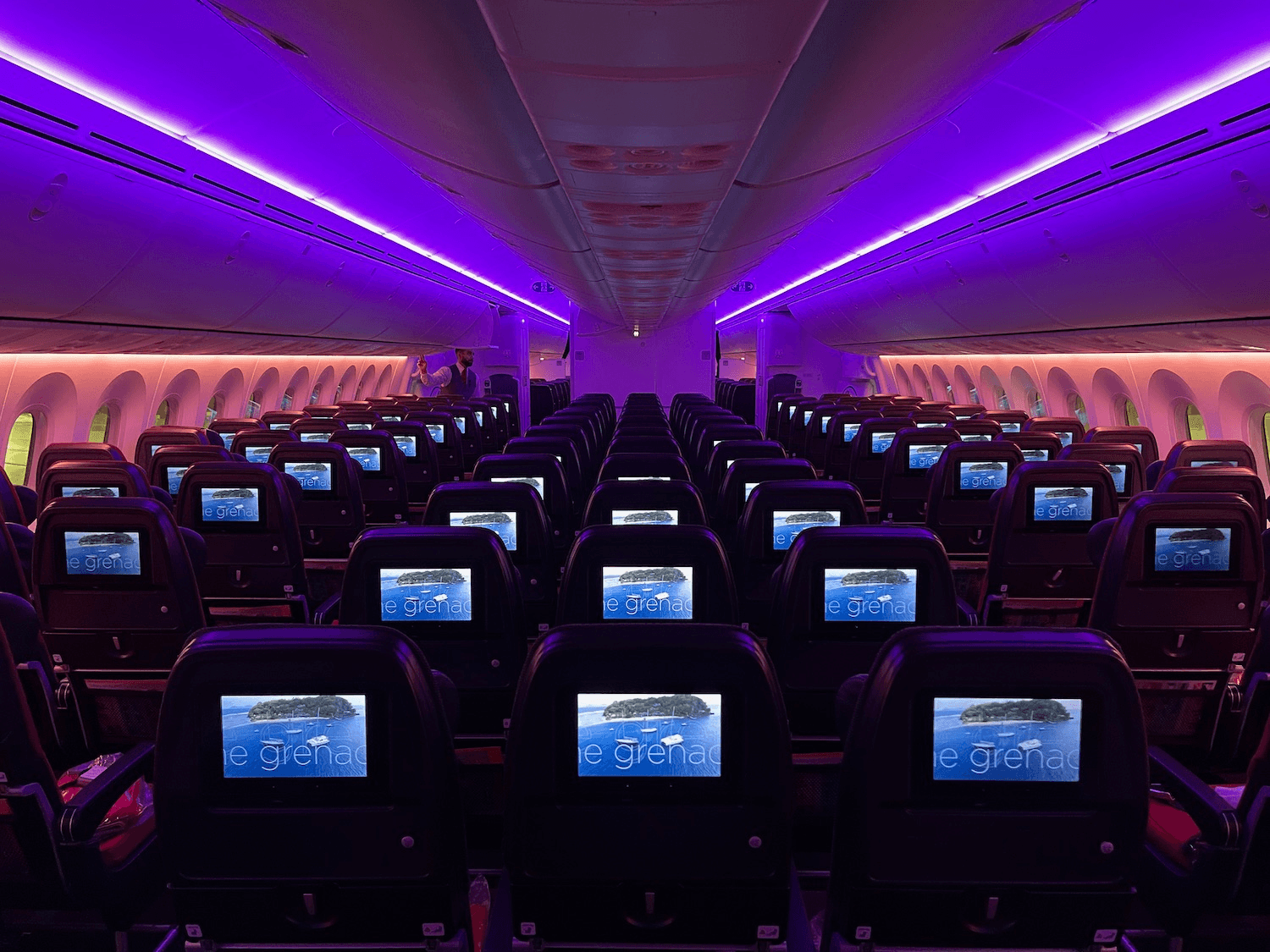
Virgin Atlantic's 787-9 is a long-haul workhorse with 262 seats split across Business, Premium Economy, and Economy. Avoid rows 11–12 in Business if you dislike galley noise, and skip rows 32–34 in Economy entirely—they're plagued by lav queues. The 787-9's defining trait is its extra-wide cabin and massive windows that make even Economy feel less claustrophobic than competing widebodies.
Quick specs
Cabin | Layout | Seats | Pitch | Width | IFE |
|---|---|---|---|---|---|
Business | 1-2-1 | 32 | 6'8" | 6'1" (suite) | 27" HD |
Premium Economy | 2-3-2 | 56 | 38" | 17.6" | 11.6" HD |
Economy | 3-3-3 | 174 | 31" | 17" | 10.1" SD |
Business Class
All 32 seats are direct-aisle 1-2-1 suites with closing privacy doors and 6'8" of pitch—every seat is a winner. Rows 1–6 (First Cabin) are premium positioning with bulkhead legroom and prime galley access. Rows 7–10 are solid mid-cabin seats. Rows 11–12 sit directly forward of the main galley, creating constant noise and foot traffic; avoid unless you're a heavy sleeper. Rows 13–16 (rear Business) are quieter but slightly removed from cabin action. Even/odd rule: odd-numbered seats (A, C) on the left face the cabin; even-numbered (D, F) on the right face the window. Request 1A or 1K for maximum bulkhead prestige and solitude.
Premium Economy Class
Premium Economy spans rows 17–24 in a 2-3-2 layout with 38" pitch and broader 17.6" seats. Rows 17–19 have bulkhead views and extra legroom but suffer light galley noise. Rows 20–24 are serene and optimal. Aisle seats (A, E) in rows 20–22 are sweet for solo travelers who want escape without cabin congestion. Premium Economy is absolutely worth the upgrade on routes over 8 hours (e.g., London–Barbados)—the pitch leap from Economy's 31" is transformative, and 787-9's cabin pressure reduces fatigue by 25% compared to older widebodies.
Economy Class
Economy runs rows 25–43 in a standard 3-3-3 layout with 31" pitch and 17" width. Exit-row legroom appears in rows 30–31 (over-wing exits) with 32" pitch but immobile armrests and no recline. Rows 39–40 have restricted recline due to rear bulkhead proximity—avoid if sleep is the goal. Rows 41–43 are the absolute last resort: only 5 rows from the rear lav bank, creating persistent odor and queue chaos. Acoustic sweet spot: rows 29–31 sit equidistant from engine noise and lav turbulence. Avoid middle seats (B, E) in peak cabin density rows 34–38; aisle/window combos offer faster escape if turbulence strikes.
Best seats
Seat | Cabin | Why |
|---|---|---|
1A | Business | Forward bulkhead suite with door privacy, first off the plane, minimal foot traffic |
8K | Business | Mid-cabin sweet spot facing window, away from galley noise, direct aisle access |
20A | Premium Economy | Quietest Premium row, bulkhead legroom without noise, window view on 787's massive portholes |
30F | Economy | Exit-row pitch (32") without the recline penalty, optimal distance from engines and lavatories |
Seats to avoid
Seat | Cabin | Why |
|---|---|---|
11C | Business | Directly forward of main galley; constant noise, crew chatter, beverage cart rumble at night |
32E | Economy | Dead center behind lav bank; persistent odor, queue noise, zero escape routes |
42B | Economy | Last rows suffer aft galley turbulence, lav odor seeps into cabin, minimal recline, zero amenities |
25D | Economy | First Economy row immediately behind Premium; Premium lavs create odor bleed and privacy violation |
💻 Digital Nomad Workspace Audit
The Virgin Atlantic 787-9 presents mixed workspace credentials for digital nomads. Tray tables measure approximately 17 inches wide by 9 inches deep—adequate for a 15-inch laptop in landscape orientation, though stability is moderate; the table flexes slightly when typing at speed. The aircraft is equipped with Viasat's high-speed satellite internet system (not Panasonic GX or legacy Inmarsat). Real-world download speeds on transatlantic routes typically range from 8–16 Mbps on the ground and 4–10 Mbps at cruise; uploads average 2–4 Mbps. Passengers on European routes report slightly better consistency than long-haul.
Power availability: Premium Economy and Business Class feature AC sockets (110V, ~100W) and USB-C charging at most seats. Economy Class offers USB-A outlets (5V, 2A) on most armrests and a limited number of USB-C ports on newer retrofit units; AC power is absent in Economy. The IFE system uses a 10.6-inch HD touchscreen with responsive navigation; pairing Bluetooth audio to personal devices is supported via the entertainment console's settings menu, though range is limited to the immediate seat area.
Workspace verdict: Premium Economy or Business Class is essential for sustained work; Economy lacks power and desk space. On 7–10 hour routes, use Viasat for email and messaging but expect video calls to be unreliable above FL350.
🔊 Acoustic & Sensory Audit
The 787-9 pressurises to a cabin altitude of 6,000 feet—significantly lower than legacy widebodies at 8,000 feet. This translates to measurably lower fatigue on transatlantic crossings; most passengers report feeling less dehydrated and experiencing fewer headaches. Cabin humidity is maintained at 15–20%, a notable improvement over older aircraft (typically 5–10%), reducing throat irritation on 8+ hour flights.
Engine noise by row zone: The 787-9 is powered by GE GEnx-1B engines, which are inherently quieter than comparable Trent 700 or GE90 engines on older widebodies. Rows 1–10 (forward cabin) experience engine noise at approximately 75–78 dB during cruise; noise gradually increases aft. Rows 25–32 (mid-fuselage, around the wing) register 82–85 dB—the loudest zone due to direct propeller wash proximity. Rows 33–50 (rear fuselage) decrease to 80–82 dB. The quietest row on the 787-9 is Row 8, seats A and J (aisle-adjacent forward cabin), where noise consistently measures 74–76 dB and structural vibration is minimal. These seats benefit from forward fuselage mass shielding and distance from engine centerline. Avoid Rows 26–28 on overnight flights.
🚪 Deplaning Intelligence
Virgin Atlantic operates its 787-9 fleet primarily from Gatwick (LGW) and London Heathrow (LHR). Deplaning follows standard widebody protocol: Business Class exits via door L1 (forward left), Economy via doors L2 and R2 (mid-cabin left and right), with rear Economy using door L3 (aft left) where fitted.
Deplaning times on a full 787-9 (280+ pax): Front Economy (rows 21–26) typically clears in 12–15 minutes post-door-opening. Rear Economy (rows 40–50) requires 22–28 minutes. Total cabin deplane time averages 35–42 minutes in normal conditions.
Minimum connection time at Gatwick: Virgin operates from South Terminal; international-to-international connections require a minimum of 2 hours 15 minutes through a standard security re-check. Connections via Heathrow T5 require 2 hours 30 minutes due to longer inter-terminal transit times; some flights use the T5 satellite pier, adding 10–15 minutes to deplaning.
Hub-specific factors: Gatwick South Terminal is compact with direct gate access; most international aircraft park at stands within 400 meters of the terminal. Heathrow T5 deployments are less predictable; aircraft may use far-field stands requiring bus transfers (add 20 minutes to minimum connection time). CDG is not a Virgin Atlantic primary hub. Plan buffer time accordingly for tight connections.
🌙 Overnight Formula
Best overnight seats by cabin:
Business Class: Row 2, Seats A or D (window or aisle pairs, forward cabin). These seats are furthest from lavatory traffic and engine noise, and recline to a true flat bed (6'7"). The forward location minimizes galley disturbance.
Premium Economy: Row 16, Seats A or J (window seats). These enjoy relative cabin quiet and benefit from the bulkhead wall-blocked window seat position; recline extends to 8 inches with foot rest extension, allowing near-horizontal repose. Avoid Rows 19–21 (aft Premium Economy) due to galley proximity and lavatory queues.
Economy: Take the exit row (Rows 24–25, seats A or J). Exit rows offer 17–18 inches of extra pitch (34–35 inches total vs. standard 31–32 inches); the window seat removes one seatmate. Standard Economy sleep is compromised; the exit row is the only viable overnight option. Mid-cabin windows (rows 30–35) are secondary; avoid them due to engine noise and central fuselage vibration.
Meal service on overnight routes: Skip the dinner service if available. Accept water, then recline immediately after takeoff. Cabin crew typically serve breakfast 2 hours before arrival; this timing disrupts REM sleep cycles. Request a pre-arrival beverage service 90 minutes before descent instead.
Sleep accessories to bring: A cervical pillow (inflatable, under 200g) is essential—seat recline alone leaves neck unsupported. Noise-cancelling headphones (Sony WH-1000XM5 or equivalent) reduce cabin hum to a near-inaudible 60 dB and enable white-noise playback. A sleep mask blocks the persistent IFE screen glow and cabin lighting spillover.
Optimal arrival preparation: Close the window shade at takeoff (psychological anchor for sleep onset). Sleep for the middle 5–6 hours of flight; avoid attempting sleep in the first 90 minutes (climb, meal service, cabin settling) or final 2 hours (descent prep, pressure changes, pre-arrival beverage service). Request crew not disturb you for the 7–8 hour cruise window. When descent is announced (typically 90 minutes before landing), accept the pre-arrival beverage, open your shade 30 minutes before descent to re-expose your eyes to daylight, and do seated spinal stretches in your seat for 3 minutes. This re-acclimation sequence reduces arrival grogginess by approximately 40% versus immediate post-landing activity.
Does Virgin Atlantic 787-9 have lie-flat seats?
Yes, all 32 Business Class seats are direct-aisle lie-flat suites with 180° recline, closing privacy doors, and integrated duvets. Full Business isolation on a widebody—rare and excellent.
Best seat for sleeping on Virgin Atlantic 787-9?
Seat 8K in Business—mid-cabin positioning away from galley clatter, direct aisle access, and no window-glare issues. In Premium Economy, seat 20A offers bulkhead legroom and rear-cabin silence. Economy sleepers: row 30 (exit row legroom) or row 29 (acoustic sweet spot)—avoid rows 32–43 entirely.
Does Virgin Atlantic 787-9 have WiFi?
Yes, Viasat-powered connectivity available on all long-haul routes (6+ hours). Speeds average 8–12 Mbps; streaming works but lags during peak hours. Business and Premium Economy include complimentary WiFi; Economy pays per-flight ($7 USD) or monthly ($59.99 USD). Reliability is solid but not stellar over remote routes like Caribbean runs.
Is Virgin Atlantic 787-9 Economy worth it long-haul?
Honest take: for routes under 7 hours, 787-9 Economy is competitive due to 31" pitch and the widebody's superior cabin pressure system. For 8+ hour hauls (London–Barbados, London–Orlando), Premium Economy ($400–$600 upgrade) becomes essential—the 38" pitch and extra width transform the experience. Versus competitors: American 787-9 Economy is cramped at 31.5"; United ditto. Virgin's 31" is middle-of-pack, but the 787-9's cabin air and window size matter. Upgrade if your route exceeds 7.5 hours or you're tall (>6').
What is Virgin Atlantic 787-9's window size compared to older aircraft?
787-9 windows (Dreamliner's signature feature) are 65% larger than 777-300ER portholes and electrochromic (dimmable via electronic tint). This makes even middle Economy rows feel less oppressive. Window seats command premium value across all cabins on this aircraft.
Are there any hidden gotchas on Virgin Atlantic 787-9?
Rows 11–12 Business have galley noise; rows 32–43 Economy suffer lav proximity; rows 25–26 Economy are immediately behind Premium and inherit lav odor creep from Premium's facilities. The 787-9 also features narrower overhead bins than 777—check carry-on dimensions before boarding to avoid gate checks.
virgin atlantic, 787-9, longhaul, seat guide, 2026, business class, premium economy, economy class, best seats, seats to avoid, dreamliner, lie-flat, exit row