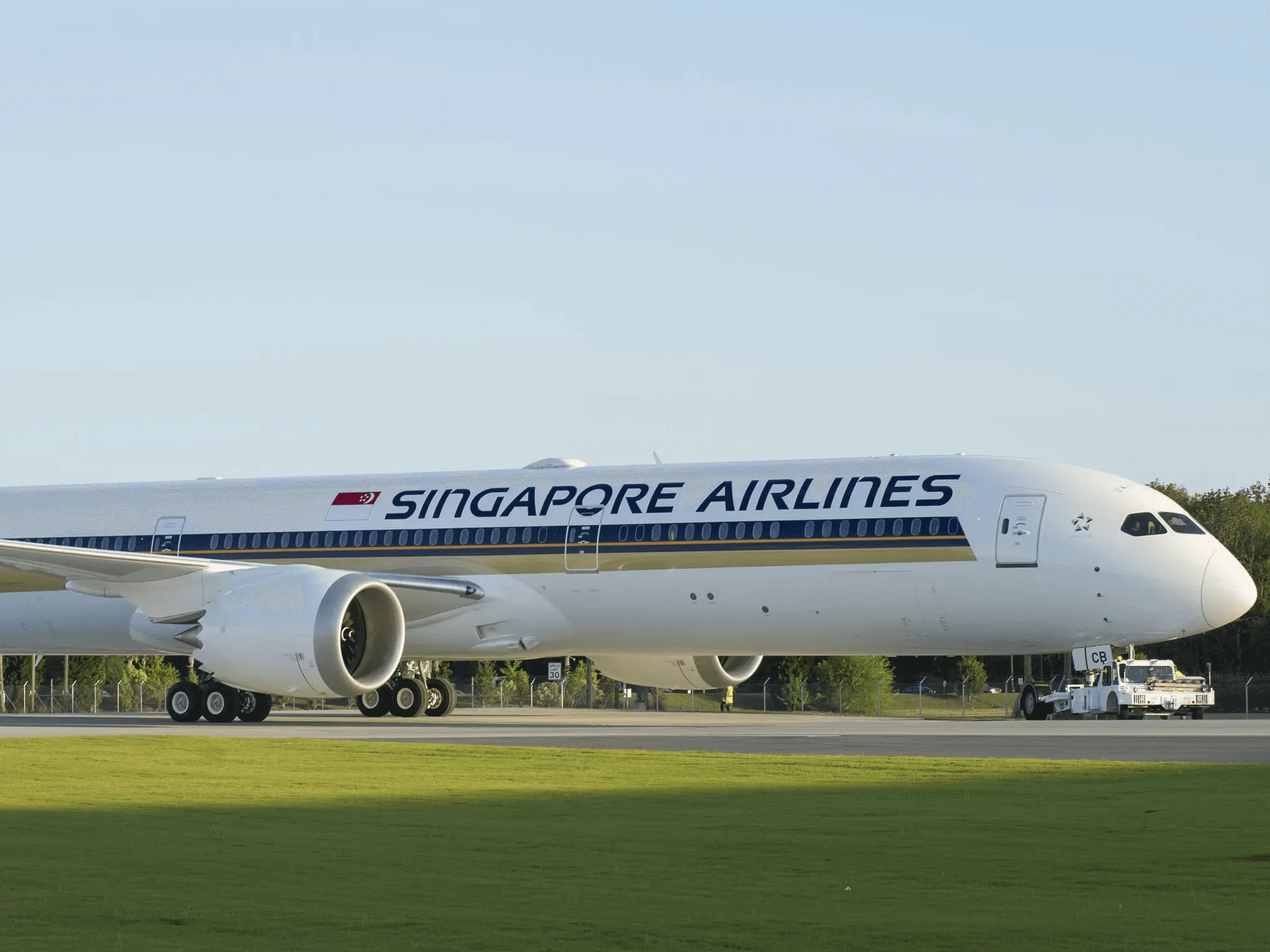
Singapore Airlines' 787-10 is the stretched Dreamliner deployed on regional and medium-haul routes where the 777-300ER is too large and the A350-900 is earmarked for longer sectors. The Business Class product is a different generation from the flagship Suites - understanding which cabin you're getting, and where to sit in it, is the intelligence that matters here.
TL;DR
Singapore Airlines' 787-10 carries 36 Business Class seats in a 1-2-1 layout, 36 Premium Economy seats, and 187 Economy seats in a 3-3-3 layout. The Business Class seat is the older reverse herringbone product - direct aisle access and a flat bed, but not the new-generation product found on the A350 retrofit or the Suites on the 777. The 787-10's Dreamliner advantages (lower cabin altitude, higher humidity, quieter cabin) make a genuine difference on Singapore's 6-9 hour regional routes to Tokyo, Sydney, and Mumbai. Economy in 3-3-3 is competitive; the exit rows are the primary legroom target.
Singapore Airlines operates the Boeing 787-10 - the longest Dreamliner variant - on medium and regional long-haul routes from Singapore Changi that fall between the capacity and range profiles best suited to the A350-900 and the 777-300ER. Routes include Singapore to Tokyo Narita, Singapore to Sydney, Singapore to Melbourne, Singapore to Mumbai, and select other destinations where the 787-10's efficiency and passenger comfort profile make it the optimal deployment tool.
Understanding what the 787-10 means for Singapore Airlines passengers
The 787-10 is not the same as the Singapore Airlines product on its flagship routes. Passengers who have flown Singapore Airlines' 777-300ER Suites or the A350-900 configured for ultra-long-haul will encounter a different, older Business Class on the 787-10. This is not a criticism - the product is competitive within its generation - but it is the most important piece of intelligence for passengers booking Singapore Airlines for the first time who may expect the full Suites experience. The 787-10 Business product is a 1-2-1 reverse herringbone without a privacy door. It is good. It is not the flagship product.
Business Class
Singapore Airlines Business Class on the 787-10 uses a 1-2-1 staggered reverse herringbone layout with 36 seats across 9 rows. Every seat has direct aisle access and reclines to a fully flat 78-inch bed. Seat width is 28 inches - one of the wider dimensions in the 787-10 Business class globally, and noticeably more generous than the 22-inch standard on United Polaris or the 21-inch on most European Business products. There is no privacy door.
The cabin is split into two sections. The forward mini-cabin (rows 1-4) is positioned ahead of the main Business galley and is the quieter, more private zone - the correct booking for solo overnight travelers on the Singapore to Sydney or Singapore to Tokyo sector. The rear Business section (rows 5-9) is larger and backed by the Premium Economy galley. The last Business row (row 9 on most configurations) should be avoided for the standard galley adjacency reason.
The odd/even row rule applies in full. In odd-numbered rows, window seats (A and K positions) are flush against the fuselage - the better solo sleeping position, with the wide side console providing a partial visual screen from the aisle. In even-numbered rows, window seats face the aisle more directly. Center D and G seats in odd rows face each other - the best couples configuration. Singapore Airlines' Business Class soft product on the 787-10 includes the Book the Cook pre-order program - available 24 hours before departure, it allows main course selection from a curated menu that is prepared to order rather than trolley-reheated. On a 7-8 hour sector, the quality differential versus standard catering is the most immediately noticed soft product advantage.
Premium Economy
Singapore Airlines Premium Economy on the 787-10 is a 2-4-2 layout with 36 seats across 6 rows and 38 inches of pitch. This is the same Premium Economy product as on the A350-900 long-haul configuration - a genuine dedicated cabin with proper tableware, multi-course meal service, and a dedicated leg rest. Window pairs on either side of the aircraft (2-seat sections) have no middle neighbor. The bulkhead row of Premium Economy is the standout pick for legroom. The last row has restricted recline and should be avoided.
On Singapore Airlines' 787-10 routes - particularly Singapore to Tokyo (7 hours) and Singapore to Sydney (8 hours) - Premium Economy represents very strong value. The price gap between Economy and Premium Economy on these medium-haul routes is typically smaller than on longer transatlantic sectors, and the 38-inch pitch with no middle neighbor in the window pair is a meaningful upgrade on a 7-8 hour sector where you might not need a lie-flat bed but do want more space than standard Economy.
Economy Class
Economy on the Singapore Airlines 787-10 uses a 3-3-3 layout with 187 seats at 32 inches of pitch and 18 inches of width - slightly wider than the 17-17.5 inch standard on most competitor 787 Economy configurations. IFE screens are 11.6 inches with Singapore's KrisWorld system - one of the better Economy entertainment libraries available, with a content selection that reflects Singapore's position at the intersection of Asian and Western media markets. Singapore Airlines' Economy seat padding is consistently rated above the global average and the meal quality on the 787-10 regional routes maintains the standard associated with the airline's brand.
The 787-10's lower cabin altitude (6,000 feet) and higher humidity make a genuine difference on 7-8 hour regional sectors. On the Singapore to Tokyo route specifically, arriving with less fatigue and better hydration than on an older aircraft type is measurable - particularly on daytime sectors where passengers remain awake throughout. Exit rows provide the standard legroom uplift. The forward exit row is slightly quieter than the aft exit due to the engine noise profile. The last three Economy rows should be avoided - no recline, rear galley noise, and the fuselage tapers at the tail.
The Dreamliner environment on Singapore Airlines' regional routes
The 787's cabin environment advantages are most often discussed in the context of 14-17 hour ultra-long-haul flights. On Singapore Airlines' 787-10 routes - 7-8 hours to Tokyo or Sydney - they are equally relevant but differently experienced. On a daytime sector, the lower cabin altitude reduces the headache and fatigue that many passengers associate with regular flying without realizing it's a function of cabin pressure. On an overnight sector, the higher humidity reduces the dehydrated-on-arrival feeling. Both effects are consistent across Economy and Business cabins - the Dreamliner advantages are not a premium cabin feature, they are aircraft-wide.
Route-specific intelligence
On the Singapore to Tokyo Narita sector (approximately 7 hours): evening departures from Singapore arrive in Tokyo in the early morning. Economy passengers should target the window pair seats (A/B or H/K in the outer blocks) for a manageable overnight crossing. Business passengers should book the forward mini-cabin odd-row window seats for maximum sleep quality on this specific sector - the 7-hour duration means a well-positioned Business seat and good sleep management can result in arriving rested for a Tokyo business day.
On the Singapore to Sydney sector (approximately 8 hours): this route operates as a mix of day and overnight departures depending on the schedule. For overnight departures, the same Business and Economy intelligence applies. For daytime departures, the forward mini-cabin Business seats remain the quietest zone, and Economy passengers should prioritize window pair seats for the most comfortable daytime crossing.
💻 Workspace audit
Business Class features a stable, wide tray table that accommodates a 16-inch laptop comfortably - the 28-inch seat width creates more lateral workspace than on narrower Business Class products. Singapore Airlines uses Panasonic Avionics satellite Wi-Fi on the 787-10; coverage is consistent on the regional Asian routes and adequately fast for email, messaging, and light video streaming. Every Business seat has an AC outlet and USB-A. Economy has USB-A at each seat.
🚪 Deplaning intelligence
Singapore Airlines uses Door L1 for Business Class and Door L2 for Economy on most 787-10 deployments. At Changi Airport, the transit infrastructure is world-class - connections of 60 minutes or more are comfortable even from the rear Economy cabin. At Tokyo Narita and Sydney Kingsford Smith, Business Class passengers typically clear the aircraft in under 5 minutes from the seatbelt sign.
Best seats
Seat
Cabin
Why
1A & 1K
Business
Bulkhead suites in the forward mini-cabin. Widest footwells, quietest position, first to deplane at all destinations.
Odd-row A & K (rows 3, 5 - forward mini-cabin)
Business
True window seats with 28-inch width and fuselage wall privacy. Best solo overnight position on Singapore-Tokyo and Singapore-Sydney.
Odd-row D & G (any Business row)
Business
Facing center seats. Best couples configuration - close enough to share the crossing, divider raises for sleep.
Bulkhead row A & B (or H & K)
Premium Economy
Maximum legroom with no middle neighbor. First meal service. Strong value on 7-8 hour regional sectors.
Forward exit row A or K
Economy
Best legroom in Economy. Slightly quieter than the aft exit due to engine position on the 787-10.
Window pair A & B (or H & K) - forward rows
Economy
18-inch width and one neighbor maximum. The 3-3-3 outer block on the 787-10 is among the more comfortable in this layout class.
Seats to avoid
Seat
Cabin
Why
Row 9 Business (last row)
Business
Premium Economy galley directly behind. Light and noise during service - particularly relevant on the 7-hour Singapore-Tokyo overnight sector where service timing overlaps with the sleep window.
Last Premium Economy row
Premium Economy
Restricted recline and Economy galley proximity. The one row to specifically avoid in an otherwise strong Premium Economy cabin.
Last 3 Economy rows
Economy
No recline, rear galley activity, fuselage taper. On an 8-hour overnight Singapore-Sydney sector, the rear cabin is the hardest place to sleep.
Even-row Business A & K
Business
Face the aisle rather than the fuselage. Less enclosed sleep environment. Odd-row window seats are always preferable for solo overnight travel.
FAQ
Is Singapore Airlines Business Class on the 787-10 the same as on the 777-300ER?
No. The 787-10 carries the older generation reverse herringbone Business product without a privacy door. The 777-300ER carries either the Suites (First Class) or an updated Business Class depending on configuration. Both products have direct aisle access and flat beds, but the 777-300ER Suites product is a significantly more premium experience. The 787-10 Business product is good - it is not the flagship.
Does Singapore Airlines 787-10 Business include Book the Cook?
Yes. Book the Cook is available on 787-10 Business Class services - pre-order your main course at least 24 hours before departure through the Singapore Airlines website or app. It is recommended on both the Tokyo and Sydney sectors where the menu quality differential over standard catering is most pronounced.
Is Singapore Airlines Premium Economy on the 787-10 worth it on the Singapore to Tokyo route?
On a 7-hour sector, yes - particularly at the price differential typically available on Singapore Airlines' regional routes. The 38-inch pitch, window pair no-middle-neighbor benefit, and dedicated meal service represent a meaningful upgrade over Economy for a route length where you may not need a lie-flat bed but will notice the extra space.
What is the seat width in Singapore Airlines 787-10 Business Class?
28 inches - notably wider than the 21-22 inch standard on most European and US carrier Business Class products. This is a genuine comfort advantage, particularly for sleeping on the side on overnight sectors.
Does Singapore Airlines 787-10 have Wi-Fi?
Yes. Panasonic satellite Wi-Fi is available across all 787-10 routes. Coverage is consistent on Singapore's regional Asian and Australian routes. Paid packages are available; some fare types and KrisFlyer elite tiers include complimentary access.