LATAM
A321
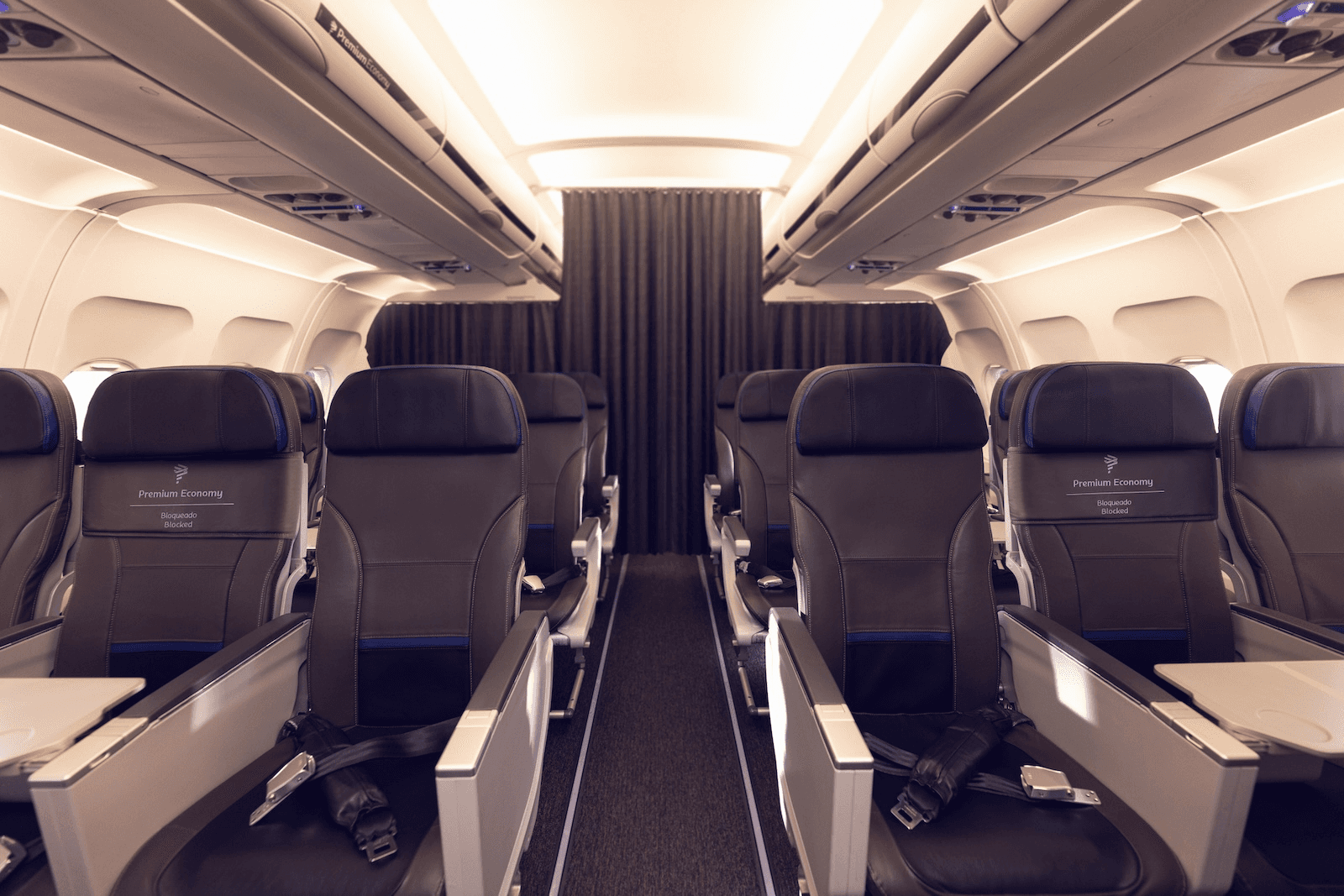
LATAM A321 Seat Guide (2026) | Cabin.coach
TL;DR
LATAM's A321 typically carries 16–20 Business seats in a 1-2-1 or 2-2 layout and 160–180 Economy seats in a standard 3-3 configuration. Best Business seat: row 2 (forward cabin, best service priority and least engine noise). Best Economy seat: row 12 (exit row with extra legroom, after the main cabin door). Worst seat: row 32F (last row, no recline, galley proximity). The real insight: this aircraft is short-haul optimized—if you're flying it long-haul, prioritize exit-row LATAM+ seats in Economy over standard pitch.
The LATAM A321 is a workhorse narrowbody configured with a small Business cabin (up front) and standard Economy behind it—typically used on regional and shorter transpacific routes from South America. Avoid row 32, the last row, where recline is severely limited and you'll be meters from the rear galley and lavatories. The A321's real advantage is its length: it carries more passengers than older 737 or A320 variants, which means better load factors and slightly more breathing room in Economy if you pick the right seat.
Quick specs
Cabin | Layout | Seats | Pitch | Width | IFE |
|---|---|---|---|---|---|
Business | 1-2-1 or 2-2 | 16–20 | 60–64 in | 21.5 in | Thales 10.1–12.1 in |
Economy | 3-3 | 160–180 | 31–32 in | 17.3 in | Seatback or none |
Business Class
LATAM's A321 Business is configured in rows 1–3, typically in a 1-2-1 layout (one seat on each aisle, two in the middle). Each seat reclines to a near-flat bed, and direct aisle access is available from all window seats—this is a genuine advantage over the A350's 2-2-2 layout on longer routes. Privacy doors are present on newer deliveries. Row 2 is the sweet spot: forward enough for first food and beverage service, back far enough to avoid the cockpit noise and any galley activity. Row 1 is closest to the flight deck and occasionally experiences noise from engine start-up and cockpit doors opening. Row 3 is acceptable but closer to the Economy cabin boundary.
Economy Class
Economy spans rows 4–32 in a 2-3-1 or 3-3 configuration depending on the specific aircraft. Exit rows are located at rows 12–13 (over-wing emergency exit), offering an extra 6–8 inches of legroom—these are sold as LATAM+ seats and worth the fee on any flight over 4 hours. Row 32 has severely restricted or no recline and sits directly adjacent to the rear galley, lavatories, and crew rest area; avoid it entirely. Rows 30–31 have similar issues but are marginally better. The acoustic sweet spot is rows 16–22, roughly mid-cabin, where engine noise is lowest and galley activity is minimal. Avoid centre seat E in any row—the universal middle seat problem is amplified on narrowbody aircraft.
Best seats
Seat | Cabin | Why |
|---|---|---|
2A or 2F | Business | Direct aisle access, optimal forward positioning for crew service priority, away from cockpit noise, near-flat recline, privacy door available |
12A, 12C, 12D, 12F | Economy | Exit row LATAM+ seats—extra 6–8 inches legroom, first Economy meal service, reasonable galley distance, direct window access or aisle access |
18D, 18E | Economy | Mid-cabin sweet spot—lowest engine noise zone, equidistant from lavatories, minimal foot traffic, suitable for sleep on medium-haul |
1A or 1F | Business | Premium forward position with priority boarding and lavatory access, though slightly closer to cockpit activity than row 2 |
Seats to avoid
Seat | Cabin | Why |
|---|---|---|
32A–32F | Economy | Last row—zero or severely limited recline, direct adjacency to rear galley and lavatories, foot traffic from crew and passengers, last to be served, worst odours and noise |
30–31 (any seat) | Economy | Second-to-last rows—reduced recline, high galley proximity, foot traffic, odour bleed from lavatories, still last to be served |
4E, 5E, 6E | Economy | Centre seats immediately behind Business Class—galley noise, crew activity from Business service, middle-seat confinement, overhead bin congestion |
13E | Economy | Centre seat in exit row—despite extra legroom, the middle seat isolation and galley proximity negate the benefit |
⚡ Power & Connectivity Reality Check
Power availability on the LATAM A321 is inconsistent across the fleet. Newer A321neo aircraft have USB-A outlets at most seats and AC power in Business Class and premium Economy rows; older A321-200 variants have USB-A at select rows only, typically concentrated in the forward cabin and exit rows. There is no seatback AC power in standard Economy on either variant. The airline uses a seatback IFE system on legacy A321-200 aircraft with limited content; newer A321neo deliveries are transitioning to LATAM's streaming-to-device system via the airline's mobile app, though seatback screens remain available as a fallback. WiFi is provided by Viasat on domestic and regional routes, with typical real-world speeds of 2–4 Mbps on busy routes during peak hours — adequate for messaging and light browsing, not reliable for video streaming. Bluetooth audio pairing is available on newer aircraft; older variants require 3.5mm headphone jacks. Passengers should carry a portable 20,000 mAh battery pack, particularly on A321-200 older aircraft where USB availability is spotty and flight duration can exceed 5 hours on regional South American routes.
🧳 Overhead Bin Strategy
The LATAM A321 has two generations in service with notably different overhead capacity. A321neo aircraft feature larger bins (approximately 2,400 litres total) than the older A321-200 (approximately 1,900 litres), making a meaningful difference on full flights. On busy routes like GRU–SSA or SCL–IPC during peak hours, gate-checking is realistic on any A321 above 85% load factor; A321-200 aircraft hit bin saturation more consistently. Boarding groups 1–3 (Business, LATAM Plus, and the first Economy block) typically board early enough to guarantee overhead space directly above their seats; rows 1–15 on the A321 will almost certainly secure bin space. A standard 22-inch roller bag fits wheels-in on both variants, though A321neo bins are slightly more forgiving if you need to angle it. The A321-200 requires wheels-to-side placement more often. Arrive at the gate at least 40 minutes before departure on full flights to board in groups 1–2 without elite status and secure prime bin real estate.
🏃 Boarding & Exit Strategy
LATAM's boarding system on the A321 typically uses 5–6 groups: Business Class and LATAM Infinity members (group 1), LATAM Plus and Elite frequent flyer members (group 2), Economy Plus and advance-seat-selected passengers (group 3), remaining advance-seat-selected Economy (group 4), and general boarding by row from front to back (groups 5–6). To board in the first two groups without elite status, arrive at the gate 45 minutes before departure and have an advance seat selection or LATAM Plus fare; gate assignments are usually posted 30–40 minutes before departure. Standard Economy without advance selection boards in groups 5–6 and will queue substantially. Seats 1A, 1B, 1D, and 1F (Business Class) deplane first; followed by rows 2–10 (premium cabin); Economy passengers in rows 11–21 exit via the forward door in row order and typically clear the jetway in 6–8 minutes. On busy terminals (GRU, MEX, SCL), LATAM uses both front and rear doors on A321 service; rows 25–36 benefit significantly from rear door access and can exit 3–4 minutes faster than those waiting on the forward queue. Check your boarding pass for door assignment at check-in.
📱 Booking Intelligence
Seat selection timing on LATAM A321 depends on fare class. Business and LATAM Plus fares open seat selection at booking; standard Economy fares unlock free seat selection 24 hours before departure via LATAM's website or app, and at check-in as a last resort. Exit rows (12A, 12F, 16A, 16F, 20A, 20F) and bulkhead seats (11A–11F, 21A–21F) are held back for LATAM Infinity and elite frequent flyer members until 72 hours before departure; they then release to the general passenger pool. Premium cabin window seats (rows 2–10) with overhead bin access and forward galley proximity typically become available 5–7 days before departure on popular GRU–BSB and SCL–CTS routes, even on full flights, because many elite passengers upgrade within 48 hours. The single most practical tip: on sold-out flights, book your seat exactly 24 hours before departure the moment the app refreshes. LATAM's inventory system releases unclaimed elite allocations at this checkpoint, and front-cabin seats (rows 11–15) often become available for 30–60 minutes before selling out again. Set a phone reminder and refresh immediately.
Does LATAM A321 have lie-flat seats?
Yes. All Business Class seats on the A321 recline to near-flat or fully flat configurations (depending on the specific seat model and delivery year). This is a significant advantage over Economy and makes the A321 viable for overnight regional transpacific routes like SAO–SCL or GRU–MIA.
Best seat for sleeping on LATAM A321?
Row 2A or 2F (Business Class). These offer direct aisle access, near-flat recline, privacy doors on newer aircraft, and optimal crew service timing. If confined to Economy, row 18D or 18E provides the quietest cabin zone and reasonable legroom at standard pitch, though sleeping will still be difficult on flights over 6 hours.
Does LATAM A321 have WiFi?
WiFi availability varies by aircraft age and retrofit status. Newer A321 deliveries may carry Inmarsat or Panasonic systems, but many LATAM A321s operate without seatback IFE or WiFi. Check your specific flight on the LATAM app—do not assume connectivity.
Is LATAM A321 Economy worth it long-haul?
Only if you book a LATAM+ exit-row seat (rows 12–13). Standard Economy at 31–32 inches pitch is tight for flights over 5 hours, and the 3-3 aisle configuration means the middle seat experience is poor. The A321 is optimized for 3–6 hour regional flights, not long-haul. If your route is 8+ hours, consider upgrading to Business or taking a connecting flight on a widebody (A350 or 787) instead.
Which LATAM A321 routes should I expect?
The A321 is primarily used on intra-South American routes (GRU–SCL, GRU–MIA, SCL–BRC, EZE–MIA) and some shorter transpacific legs. It is not typical on transatlantic or Australasian routes, which use the A350 or 787.
Are there windows at rows 13–15?
Yes, but some window seats in the rear cabin may have misaligned windows (the frame falls between two seats or behind your shoulder), leaving you with a wall view. Check the LATAM seat map before committing. This is less common on the A321 than on larger widebodies, but it can occur.
latam, a321, airbus, narrowbody, seat guide, 2026, business class, economy class, best seats, seats to avoid, exit row, latam+