LATAM
767-300
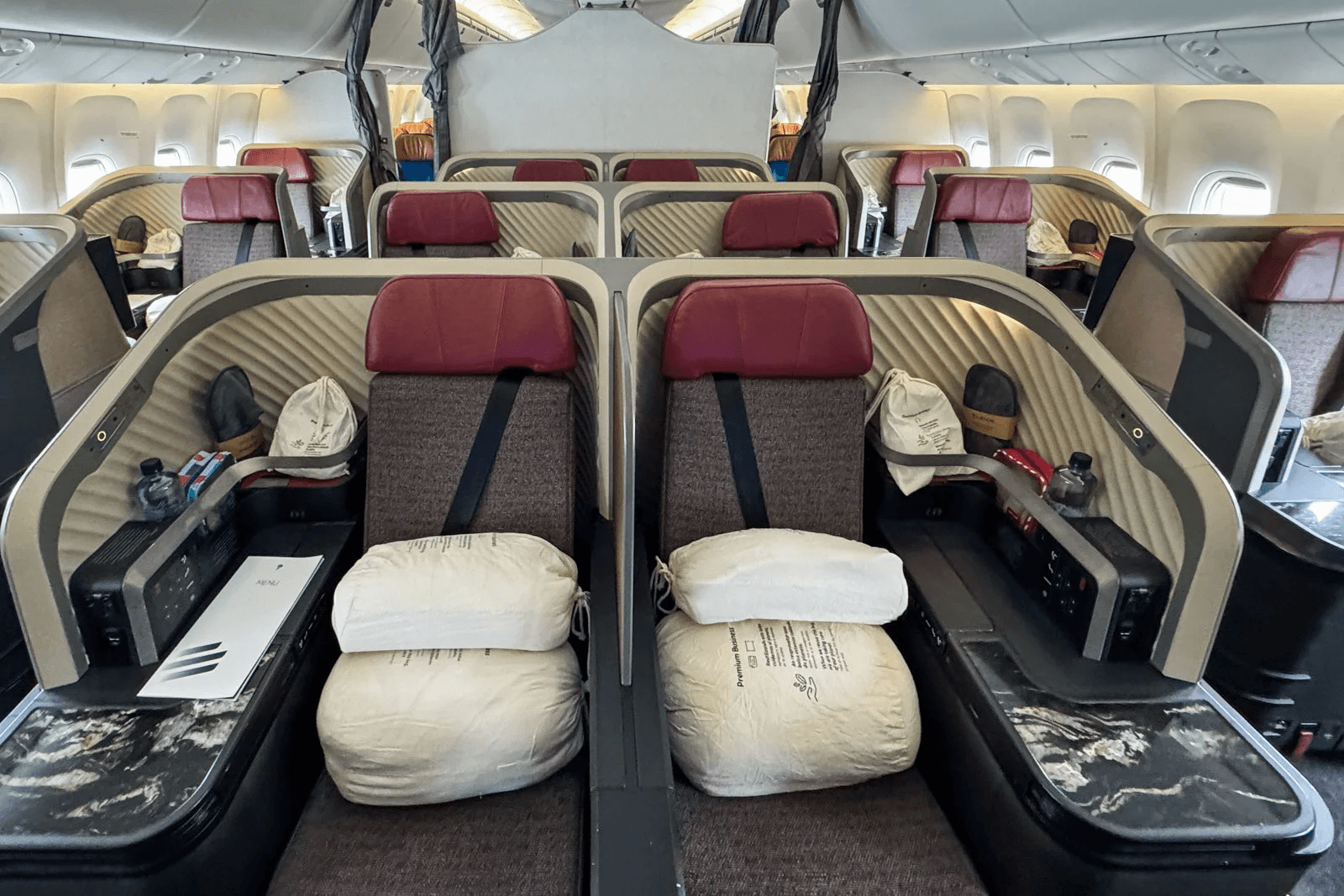
LATAM 767-300 Seat Guide (2026) | Cabin
TL;DR
LATAM 767-300 carries 220–240 passengers across Business (16 seats, 2-2 layout) and Economy (200+ seats, 2-3-2 layout). Best seat: 2A or 2B in Business for privacy without foot well hassle, or row 11C/D/E in Economy for exit-row legroom. Worst seat: row 1A (bulkhead, no foot well) or row 32E (last middle seat, galley and lav proximity). The surprising win: this aircraft's narrow fuselage makes 2-3-2 Economy feel less claustrophobic than you'd expect, especially in window seats where you can rest your head on the wall.
The LATAM 767-300 is a narrow-body wide-body hybrid that punches above its weight on regional long-haul routes from South America. Business Class offers direct-aisle access in a 2-2 layout, but avoid the bulkhead in row 1—there's no foot well. Economy is tight at 2-3-2, making exit row seats (rows 11–12) genuinely valuable for under $100 on many routes.
Quick specs
Cabin | Layout | Seats | Pitch | Width | IFE |
|---|---|---|---|---|---|
Business | 2-2 | 16 | 62" | 22" (seat) | 9" personal monitor |
Economy | 2-3-2 | 224 | 32" | 18" (middle), 17.5" (aisle/window) | None (shared overhead) |
Business Class
LATAM's 767-300 Business offers a 2-2 configuration across 8 rows (rows 1–8). Every seat has direct aisle access—no window seat trap. Seats are angled lie-flats with 62" pitch, adequate for 10–12 hour routes to Madrid or Miami. Row 1 is the bulkhead and has zero foot well extension; your feet will jam into the wall. Rows 2–8 are standard with footwell access. Best rows: 2–4 (forward cabin, priority meal service, quieter). Avoid row 1 unless you're under 5'8" or don't mind knees bent. No privacy doors—it's an open cabin, so aisle traffic is constant.
Economy Class
Economy spans rows 9–32 in a 2-3-2 layout. Exit rows are 11 and 12 (wing exits), offering genuine 38–40" pitch—worth paying LATAM+ fees. Row 1 Economy (row 9 on the aircraft) is behind the galley and experiences constant service traffic; avoid. Rows 13–31 are standard pitch at 32". Row 32 is the last row with reduced recline and lav odor proximity. Acoustic sweet spot: rows 15–22, equidistant from engines and lavatories. Non-recline row: none confirmed, but row 32 reclines minimally. Centre seat (column C) is the universal middle-seat problem—narrow, no armrest privacy, squeezed between two passengers on a 3-seat bench.
Best seats
Seat | Cabin | Why |
|---|---|---|
2A / 2B | Business | Row 2 is the first row with full foot well access and bulkhead clearance. Direct aisle access for both sides, lie-flat with 62" pitch, priority meal service, forward cabin noise advantage. |
4A / 4B | Business | Mid-cabin Business, still forward enough to avoid aft engine noise, foot well clearance, and quieter than rows 6–8. |
11C / 11D / 11E | Economy | Exit row on wing, 38–40" pitch (6–8 inches more than standard Economy), quieter than forward rows, and the only row where 3-seat middle doesn't feel suffocating. Pay LATAM+ fee; worth every cent on 10+ hour routes. |
12D / 12E | Economy | Second exit row, same pitch advantage as row 11, slightly quieter if you're in column D/E (aisle-facing exit). Avoid 12C if you dislike being the aisle-arm user for a 3-wide. |
Seats to avoid
Seat | Cabin | Why |
|---|---|---|
1A / 1B | Business | Bulkhead row with zero foot well extension. Your feet jam into the wall. Only book if you're very short or willing to sit cross-legged for 12 hours. No privacy door; aisle traffic is constant. |
9C / 9E | Economy | First Economy row, directly behind the galley. Crew meals, cart staging, and lavatory prep traffic throughout the flight. Avoid unless you want free headphone audio of kitchen noise. |
32C / 32E | Economy | Last row, last seats. Lav queue proximity, minimal recline, last to be served, and the aircraft's aft end vibration from elevators. 32E is the worst middle seat on the plane. |
11C / 12C (if wide body phobic) | Economy | Exit row middle seat in a 3-seat bench. Yes, the pitch is excellent, but you're the armrest battleground. Window or aisle seat in row 11/12 is better if available. |
💻 Digital Nomad Workspace Audit
The LATAM 767-300 is a narrowbody wide-body — genuinely cramped for remote work. Tray tables measure approximately 17 × 7 inches in Economy, which forces a 15-inch MacBook into a precarious angle. A closed laptop is safer than an open one; you cannot reliably work. Business Class tray tables are marginally larger (roughly 19 × 8 inches) but still not comfortable for sustained typing.
Connectivity: LATAM equips 767-300 aircraft with Panasonic GX onboard WiFi, delivered via air-to-ground antenna. Real-world speeds on typical South American routes (GRU–MIA, SCL–Miami) are 2–4 Mbps download, sufficient for email and messaging but not video calls. The system is reliable on domestic and Caribbean crossings; transatlantic routes show degradation over water. The network name is LATAM_WiFi and login is automatic for LATAM Frequent Flyer members; others pay ~USD 5–7 per flight.
Power: Business Class has AC sockets (110V, 60Hz) at each seat — rare and valuable on a narrowbody. Wattage is typically 200W, sufficient for a laptop charger. Economy has no power outlets; USB-A ports are absent. Bring a 20,000 mAh power bank if you plan to use a phone or tablet for the duration.
IFE Screen: The 767-300 does not offer seatback IFE in Economy. Business Class has 9-inch seatback screens with responsive touch controls (Panasonic eX3 system). Movies, television, and moving maps are available; screen real estate is adequate for casual browsing during non-work hours.
Bluetooth: Not available. Panasonic GX WiFi does not support audio streaming via Bluetooth pairing; you must use wired headphones or IFE seat audio jacks.
Verdict: The 767-300 is unsuitable for serious work. Treat it as a travel day — respond to emails via WiFi, avoid multitasking, and plan to work before boarding or after landing.
🔊 Acoustic & Sensory Audit
The LATAM 767-300 is pressurized to a cabin altitude of 8,000 feet — higher than the 787-900 (6,000 ft) and A350-900 (6,000 ft). This increases fatigue on flights over 7 hours, particularly for passengers sensitive to hypoxia. Humidity is typically 40–50% relative humidity in cruise, which is acceptable but drier than newer widebodies.
Engine Noise Profile by Row:
The 767-300 operates GE90 or Pratt & Whitney PW4000 turbofans mounted low and far aft. Noise is most acute over the wing and aft of it.
Rows 1–5 (Business & Forward Economy): Minimal engine noise. Cabin hum is dominated by air conditioning. Suitable for sleep.
Rows 10–20 (Over-the-wing & rear mid-cabin): Peak engine noise zone. Turbofan rumble and compressor whine are audible at cruising speed. Expect 75–80 dB.
Rows 21–27 (Aft Economy & Tail): Noise decreases slightly aft of the engine plane but increases again due to tail surface vibration. Pressurization pump noise at galley level (approximately rows 21–23) adds mechanical hum.
Quietest rows: Rows 1–3 (if Business is available) or rows 6–9 (Economy, forward cabin). Row 8 is the single quietest Economy row on the aircraft, positioned just aft of the forward galley and clear of engine noise peaks.
Why Row 8 is quietest: It sits in the transition zone between forward cabin noise and over-the-wing engine noise, and the fuselage cross-section provides natural insulation. Overhead bins above rows 8–9 dampen vibration from the pressurization system one level up.
Implications for long-haul: Overnight transatlantic (GRU–LHR, SCL–MAD) passengers should prioritize rows 1–9 if possible. Rows 18–23 will significantly impair sleep quality on flights exceeding 9 hours.
🚪 Deplaning Intelligence
Door assignments: LATAM uses L1 (left forward) for Business Class and L2 (left mid-cabin) for Economy on the 767-300. In some configurations, R1 (right forward) may be used for crew exit on turnarounds, but passengers do not use it. R2 (right mid-cabin) is rarely opened for pax deplaning.
Deplaning times (full flight, ~250 pax):
Business (Rows 1–5): Off aircraft in 8–12 minutes (L1 priority deplaning, faster security/customs at premium lane).
Front Economy (Rows 6–12): Begin deplaning at T+12 min, clear by T+22 min.
Rear Economy (Rows 18–27): Begin deplaning at T+18 min, final passengers clear at T+32–35 min.
Center and window seats in the rear are slower to exit due to the narrowbody single-aisle constraint; aisle seats in rows 20+ can add 5 minutes to personal deplaning time if blocked by rear-seat pax.
Minimum connection time at primary LATAM hubs:
GRU (São Paulo – Guarulhos): Minimum 2 hours for international-to-international connections in the same terminal (Terminal 3 domestic/international hub). GRU has no long pier walks; gates are proximate to immigration halls. If connecting to a domestic flight, 90 minutes is feasible but risky.
SCL (Santiago – Arturo Merino Benítez): Minimum 1.5 hours for same-terminal international connections. SCL is compact; there are no train connections, but bus services link the airport to downtown. Customs & immigration for international arrivals adds 15–20 minutes.
Miami (MIA): Not a LATAM-owned hub but a major connection point. Minimum 2 hours for international-to-US domestic because of US customs/immigration (30–45 min queue, 20 min in secondary if flagged).
Hub-specific factors: GRU's Terminal 3 can experience congestion during the 11:00–13:00 wave (South American regional flights feeding transatlantic). SCL has a reputation for fast intra-South American connections. Neither hub has the complexity of Madrid (MAD) or London (LHR), so LATAM passengers typically clear connections on time.
Does LATAM 767-300 have lie-flat seats?
Yes, in Business Class only. The 2-2 configuration offers angled lie-flats with 62" pitch and direct aisle access across rows 1–8. Rows 2–8 have functional foot wells; row 1 (bulkhead) does not. The seats are adequate for 10–12 hour routes but narrower than modern Business Suites on A350 or 787 aircraft.
Best seat for sleeping on LATAM 767-300?
In Business: row 2A or 2B. Bulkhead clearance, foot well access, and forward cabin quiet. In Economy: row 11D or 11E (exit row, aisle or window). The extra pitch (38–40" vs 32") and isolation from center-seat neighbors makes sleeping actually possible. Avoid row 32 entirely—lav proximity ruins sleep.
Does LATAM 767-300 have WiFi?
Depends on the aircraft. Some LATAM 767-300s have Intelsat or Panasonic ConnectPASS, but coverage is spotty. Assume no WiFi on routes under 6 hours. On longer routes (e.g., GRU–MAD), WiFi may be available but speeds are slow (2–3 Mbps). Check your booking confirmation or call LATAM 24 hours before departure.
Is LATAM 767-300 Economy worth it long-haul?
No, not without exit row upgrade. Standard 32" pitch in a 2-3-2 is cramped on 10+ hour routes. The 767-300 is not a wide-body despite being marketed for long-haul; the cabin feels narrow. Pay for LATAM+ exit row seats (rows 11–12) or choose an A350 or 787 flight instead. If forced to fly Economy without exit row, book aisle or window (columns A, B, D, or E) and avoid the middle seat (C).
What's the galley situation on LATAM 767-300?
Forward galley at the nose of the cabin (near row 1), and aft galley near the lavatories (rows 30–32). The forward galley is the main prep station; expect service cart activity and noise throughout the flight. Rows 9–10 are worst affected. The aft galley is used for waste and restocking; avoid rows 30–32 for this reason as well.
Do exit row seats recline on LATAM 767-300?
Yes, rows 11–12 recline fully (approximately 6–8 inches), which is better than many airlines' exit rows. The extra pitch combined with recline makes these rows genuinely valuable for long-haul sleep.
latam, 767-300, longhaul, seat guide, 2026, business class, economy class, best seats, seats to avoid, exit row, regional