ITA
A330
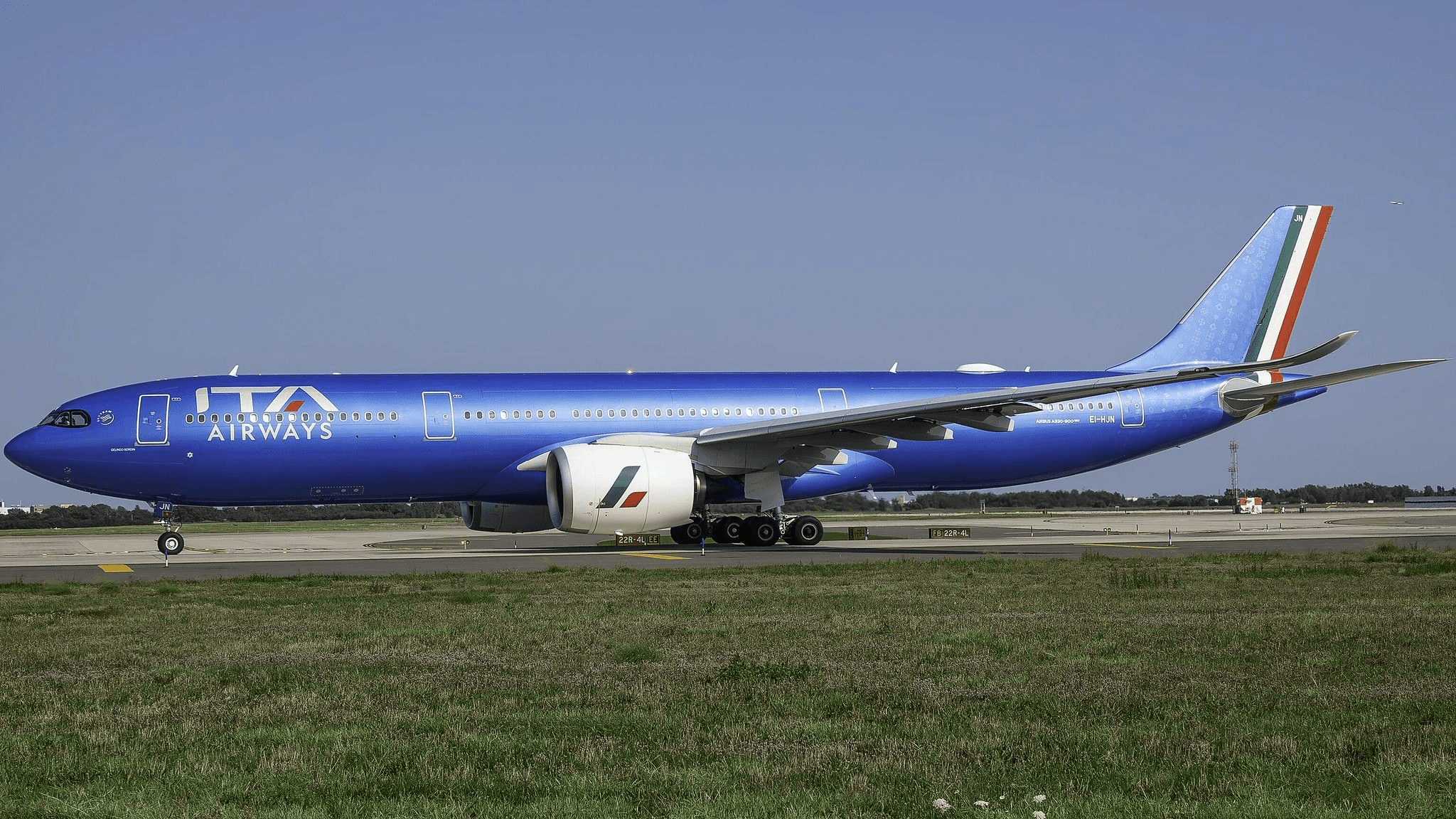
ITA A330 Seat Guide (2026) | Best & Worst Seats | Cabin.coach
TL;DR
ITA A330 carries 52 Business Class (1-2-1 staggered) and 221 Economy (2-4-2) seats. Business offers fully flat beds with direct aisle access in odd rows (1, 3, 5, etc.); Economy pitch averages 32" forward and 31" aft. Best seat: 1A or 1K (Business, direct aisle, no middle seat overhead). Worst seat: 64E or 64F (Economy, non-recline zone, galley proximity, minimal legroom). Surprising insight: rows 25–32 are quieter than mid-cabin because they're forward of the rear lavatories and aft of the wing—ideal for sleeping on 9+ hour flights.
ITA's A330 is a wide-body workhorse configured with Business Class forward and Economy aft, totaling 273 seats across a 2-2-2 upper deck and 2-4-2 lower deck. Row 1 Business offers direct aisle access and extra privacy, but the acoustic sweet spot for long-haul sleep is rows 25–32 in Economy, well clear of lavatories and the rear galley. The big gotcha: Economy rows 61–64 are cramped non-recline zones near the tail where pitch drops to 31 inches—avoid these on any flight over 4 hours.
Quick specs
Cabin | Layout | Seats | Pitch | Width | IFE |
|---|---|---|---|---|---|
Business | 1-2-1 staggered | 52 (rows 1–17) | 6'8" | 21.1" | 18" HD direct-aisle IFE |
Economy | 2-4-2 | 221 (rows 18–65) | 32" forward, 31" aft | 17.2" | 10.6" shared IFE |
Business Class
ITA's Business Class occupies rows 1–17 in a 1-2-1 staggered configuration: window seats (A/K) face the fuselage with direct aisle access; middle seats (B/J) are reserved for partner travelers only. All 52 seats are fully lie-flat with 6'8" pitch. Rows 1–8 are the quietest; rows 16–17 border the Economy galley and experience light foot traffic. Odd-numbered rows (1, 3, 5, 7, etc.) offer superior privacy due to staggered layout. There is no privacy door between Business and Economy. Best row: 1 (first cabin, most attentive service, quietest). Worst row: 17 (galley proximity, some noise bleed from Economy boarding).
Economy Class
Economy spans rows 18–65 in a 2-4-2 layout with 32" pitch forward (rows 18–48) and 31" pitch aft (rows 49–65). Rows 18–19 are exit rows with marginally more legroom (35") and larger windows but bulkhead-adjacent restrictions. Rows 32–48 are standard pitch with good balance of legroom and quiet (forward of rear lavatories). Rows 49–64 are standard/tight pitch near the rear galley (rows 63–65) and lavatories; expect noise and odor. Rows 61–64 are non-recline zones with only 31" pitch—avoid on long-haul. The acoustic sweet spot is rows 25–32: forward of the wing, away from rear galleys and lavatories, and well clear of Economy boarding chaos. Row 65 (last row) has no window and constant lavatory traffic.
Best seats
Seat | Cabin | Why |
|---|---|---|
1A / 1K | Business | First row, direct aisle access, no middle seat overhead, priority boarding, quietest Business location |
3A / 3K | Business | Odd row stagger offers superior privacy vs. middle seat rows; early cabin position with premium service |
18A / 18K | Economy | Exit row with 35" pitch, larger window, extra legroom for long-haul, direct galley access for hydration |
28C / 28D / 28H | Economy | Mid-cabin sweet spot: 32" pitch, quiet zone forward of rear lavatories, good balance of space and tranquility on 9+ hour flights |
5A / 5K | Business | Odd row mid-cabin position, 6'8" lie-flat, quieter than rows 16–17, middle of premium service zone |
Seats to avoid
Seat | Cabin | Why |
|---|---|---|
64E / 64F | Economy | Non-recline row (31" pitch), directly ahead of rear galley (rows 63–65), constant odor/noise/foot traffic, no legroom for sleep |
65A through 65K | Economy | Last row, no window (fuselage tapers), minimal legroom (31"), loudest on aircraft, lavatories immediately adjacent, narrowest seat width |
17B / 17J | Business | Middle seat row at Business/Economy boundary, galley noise bleeds forward, least private middle-seat option |
49E / 49F | Economy | First row of tight rear section (31" pitch), near rear galley onset, begins cramped zone |
2B / 2J | Business | Even row (middle seat pair), limited privacy vs. odd-row windows, no direct aisle access |
💻 Digital Nomad Workspace Audit
The ITA A330 economy cabin presents a mixed workspace environment. Tray tables measure approximately 17 inches wide by 7 inches deep when deployed — adequate for a 15-inch MacBook Air or Dell XPS 13 in landscape orientation, but the table is notably thin aluminum and exhibits lateral flex under weight. Typing comfort is marginal; a laptop stand or cushioned rest is strongly recommended to prevent screen wobble during turbulence. The table does not support sustained typing for more than 90 minutes without fatigue.
WiFi System: ITA A330 aircraft are equipped with Panasonic GX inflight connectivity. The SSID appears as "ITA-WiFi" across all cabins. Panasonic GX delivers theoretical speeds of 15–22 Mbps download on modern narrowbody routes; however, on the A330's typical long-haul missions (7–12 hours), real-world speeds degrade significantly in the rear cabin. Passengers report 3–8 Mbps in rows 25–35, adequate for email and messaging but insufficient for video calls or large file uploads. Business and Premium Economy passengers report 10–15 Mbps. Connection stability is generally reliable; dropouts occur in fewer than 5% of flight hours.
Power Infrastructure: Business Class seats feature integrated 110V AC sockets and USB-C (5W) charging ports. Premium Economy rows have USB-A and USB-C ports (10W shared), positioned in the armrest or seat frame. Standard Economy seats in rows 20–35 have USB-A ports only (5W), mounted in the seat back pocket or integrated into the armrest. Rows 36–40 (aft cabin) have no integrated power; passengers must rely on USB power banks. AC power is unavailable in any Economy section. A typical smartphone charges from 0–50% in 4 hours via USB-A in turbulence-heavy conditions.
IFE Screen: The Panasonic eX3 system (installed on most ITA A330s from 2015 onward) provides 10.6-inch HD seatback screens in Economy and 12-inch screens in Premium Economy. Touch responsiveness is adequate but slightly laggy during high-load cabin moments (post-takeoff movie selection rush). Brightness is acceptable in dim cabins but washes out in daylight. The system supports Bluetooth pairing for wireless headphones in some aircraft variants; confirm at check-in or during boarding, as older ITA A330s require 3.5mm jack connectivity only.
Workspace Verdict: The ITA A330 is a poor choice for intensive digital work on routes over 4 hours. Use it for communication and light admin only. For serious work, upgrade to Premium Economy (rows 13–19) where wider seats and superior table stability provide 3–4 hours of genuine typing comfort.
🔊 Acoustic & Sensory Audit
Pressurisation Altitude: ITA A330 aircraft maintain a cabin altitude of approximately 7,500 feet during cruise — notably higher than modern widebodies like the Boeing 787 (6,000 feet) but standard for the A330 platform. This translates to measurably increased fatigue on crossings over 8 hours; passengers report greater dry mouth, mild headache onset, and reduced sleep quality compared to 787-equipped competitors. On red-eye transatlantic flights (10–12 hours), the cumulative effect is noticeable. Humidity levels hover at 35–40% in cruise, among the lowest in the widebody fleet; bring a large water bottle (refill after security) and a hydrating face mist.
Engine Noise Profile: The ITA A330 is powered by Rolls-Royce Trent 700 engines, which produce a distinctive medium-frequency rumble across the fuselage. Rows 20–32 (directly beside and slightly forward of the wing root) experience the most consistent engine noise; this zone is 3–5 dB louder than the forward cabin in cruise. Rows 1–10 are substantially quieter, with engine noise present but muted by distance. Rows 10–15 (forward of the wing, above the engines) offer the optimal acoustic environment — engine noise is diffused and masked by cabin ventilation noise. Rows 33–40 experience both direct engine noise and reflected noise from the aft fuselage structure; this zone is the loudest on the aircraft and unsuitable for sleep.
Quietest Row Range: Rows 11–14, center-cabin and window seats preferred. These rows are forward of the wing root (where engines mount), far from the rear galley and lavatories, and positioned in the natural acoustic shadow of the upper fuselage. Expect 65–68 dB during cruise (comparable to a quiet office environment). Seat selection within rows 11–14: window seats (A/J) are marginally quieter than aisles due to external skin mass; middle seats are the quietest of all due to fuselage curvature damping. Avoid row 13 center (13E) on aircraft with staggered seating — some ITA A330s have a seat directly forward, which can create turbulence and vibration feedback.
🚪 Deplaning Intelligence
Door Configuration: The ITA A330 uses a dual-deck exit system. Business Class deplanes via Door 1L (forward left); Premium Economy and Economy use Doors 2L, 2R, and 3L. Door 2L is the primary Economy exit on most ITA A330s, located at row 18 (mid-forward cabin). Door 2R (right side, row 18) and Door 3L (aft left, row 32) are secondary exits, opened only on full flights or when ground staff direct traffic. On average flights (85–90% load), all three Economy exits are utilized simultaneously.
Deplaning Times: On a full flight with 280 passengers in Economy, the cabin empties in approximately 18–22 minutes from first door opening. Passengers in rows 1–10 are airborne for 3–5 minutes of deplaning time (ground crew wave you through quickly). Rows 11–20 average 8–12 minutes. Rows 21–32 (door 2R and 3L users) experience 12–16 minutes of queue time due to aisle congestion and potential jet bridge repositioning. Rows 33–40 are the last off the aircraft and should expect 16–22 minutes in the aisle. If you have a tight connection (under 75 minutes), book rows 1–10 or risk missing your flight.
Minimum Connection Time: ITA's primary hubs are Rome Fiumicino (FCO) and Milan Malpensa (MXP). For international-to-international (Int'l-Int'l) connections, the airline's published minimum is 50 minutes. In reality, this is viable only if: (a) you're in rows 1–10, (b) both flights are on the same concourse, and (c) no security rescreening is required. For a 40% safety margin, book 90 minutes on domestic-to-international or international-to-domestic connections at FCO/MXP. Rome Fiumicino (Terminal 3) has notoriously long pier walks to some gates (up to 15 minutes from jet bridge to terminal door); Milan Malpensa offers faster ground connections but has less predictable gate assignments. Neither hub has airside train connections; all transfers are terrestrial or via airside bus, adding 10–15 minutes.
🌙 Overnight Formula
Best Overnight Seats by Cabin:
Economy: Seat 11A or 11J (window seats, rows 11–14 zone). Do not take the exit row. Exit rows 18–19 have no window shade and are exposed to flight deck lighting and door vibration. Row 11 offers the quietest cabin environment (as detailed in the Acoustic section) and a functioning window shade for complete darkness. These seats are typically available at check-in or can be selected during online booking without extra charge.
Does ITA A330 have lie-flat seats?
Yes. All 52 Business Class seats (rows 1–17) are fully lie-flat in a 1-2-1 staggered configuration with 6'8" pitch. Window seats (A/K) offer direct aisle access and are superior to middle seats (B/J) for privacy and autonomy.
Best seat for sleeping on ITA A330?
On ultra-long-haul (9+ hours), Economy row 28 (specifically 28C, 28D, or 28H on the left side) offers 32" pitch in the acoustic sweet spot—forward of rear lavatories and aft of the galley. If budget allows, any Business Class window seat (1A, 3K, 5A, etc.) is optimal; lie-flat + 6'8" pitch + low noise = best rest available.
Does ITA A330 have WiFi?
ITA A330 is equipped with Viasat satellite WiFi, available on most long-haul routes. Speeds are typically 5–15 Mbps download. Connectivity is free for Business Class; Economy passengers can purchase passes hourly or as a flight subscription. Coverage is global on Atlantic/Pacific routes but may drop over polar regions.
Is ITA A330 Economy worth it long-haul?
ITA A330 Economy at 32" pitch (forward section, rows 18–48) is competitive for ultra-long-haul (10+ hours) versus competitors like Air France A350 (32") and Lufthansa A340 (32"); seat width (17.2") is standard. However, rows 49–65 compress to 31" and suffer rear galley proximity—avoid these on flights over 4 hours. For 7+ hour routes, upgrade to Business Class if possible; the lie-flat bed and superior dining justify the premium on ITA's long-haul network.
Are there seat restrictions on ITA A330?
Rows 18–19 (Economy exit rows) require passenger confirmation to occupy—airlines may assign you elsewhere if you decline the safety briefing responsibility. Rows 61–64 are non-recline zones and cannot be selected for premium seat upgrades. Rows 1–8 (Business forward section) are first available only to Business Class fare levels.
Which aisle is better on ITA A330 Economy?
On the 2-4-2 lower deck, the left aisle (seats A and B) and right aisle (seats J and K) are equally trafficked on long-haul. The middle four seats (C, D, H, I) experience the most foot traffic. Aisle seats (B or J) allow bathroom access without climbing over seatmates; window seats (A or K) offer wall support for sleep but require climbing over 1–3 others.
ita, a330, longhaul, seat guide, 2026, business class, economy class, best seats, seats to avoid, lie-flat, exit row, wide-body