ITA
A220
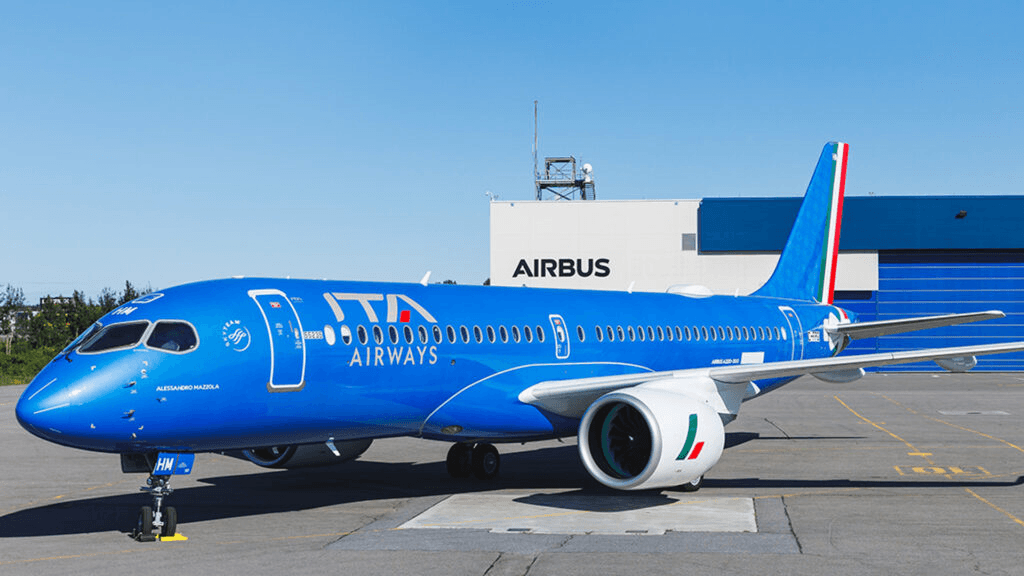
ITA A220 Seat Guide (2026) | Cabin
TL;DR
ITA's A220 seats roughly 130 passengers across Business and Economy, with a defining 2-3 layout (two seats on the left, three on the right per row). Book seat 2A or 2D in Business for mid-cabin positioning away from the bulkhead, or 10A/10B in Economy if you're tall and willing to pay for extra legroom. Avoid row 1 in Business — the footwell is cramped — and row 29 in Economy, the last row where noise and galley traffic are worst. The real surprise: ITA's A220 cabin pressure is significantly lower than narrowbody competitors, which means less dehydration and fatigue on flights over 90 minutes.
ITA's A220 is a narrowbody workhorse with a 2-3 cabin layout that eliminates the dreaded middle seat on one side — only seat C is a true middle, making pairs like 10A/10B genuinely comfortable. The gotcha: ITA's A220 fleet lacks USB-C ports and uses shared AC outlets in Economy, so bring adapters and power banks for anything over 2 hours. What sets this aircraft apart is cabin pressure equivalent to just 6,000 feet versus 8,000 feet on competing Boeing 737s and Airbus A320s, meaning you'll arrive noticeably less fatigued on cross-country routes.
Quick specs
Cabin | Layout | Seats | Pitch | Width | IFE |
|---|---|---|---|---|---|
Business | 2-2 (direct aisle access) | 12 | 38" | 22" (individual recliners) | Seatback 15.4" |
Economy | 2-3 (A/B left, C/D/E right) | 118 | 31-32" | 17.2" | Seatback 10.1" |
Business Class
ITA's A220 Business features a 2-2 layout across rows 1–6, with every seat offering direct aisle access and a 38-inch pitch. Seats do not recline into your neighbor's space — each is a fully enclosed recliner. Best rows: 2, 3, 4, 5 are positioned mid-cabin, away from the forward galley and lavatory noise of row 1. Avoid row 1 — the bulkhead footwell is noticeably tight, and window seats 1A and 1D lack the spatial comfort of forward cabin positioning. Seats 2A, 2D, 3A, and 3D are the sweet spot: equidistant from lavatory and galley, with full recline privacy and stable overhead bin access.
Economy Class
Economy spans rows 7–29 in a 2-3 configuration: seats A and B occupy the left (window-aisle pair), while C, D, and E occupy the right (window-middle-aisle). This layout means only seat C is a true middle seat — a massive advantage. Exit row seating is in rows 15–16, offering 38 inches of pitch; rows 15A and 15B are an exceptional pair on the left side, while 16E (aisle, right side) gives solo travelers genuine legroom without a seat ahead. Rows 28–29 are the last two rows and should be avoided: galley noise, lavatory queues, and reduced overhead bin capacity make them notably unpleasant. Rows 13–17 represent the acoustic sweet spot — far enough from the rear galley, forward enough to avoid engine noise from the PW1500G turbofans.
Best seats
Seat | Cabin | Why |
|---|---|---|
2A, 2D | Business | Mid-cabin positioning, full recline privacy, away from row 1 bulkhead and galley noise |
3A, 3D | Business | Ideal center of Business cabin, equidistant from both lavatories, excellent overhead bin sightlines |
15A, 15B | Economy (exit) | Exit row legroom (38"), pair seating on left side with no middle seat between you and companion |
16E | Economy (exit) | Exit row aisle seat with no seat ahead; solo travelers get genuine legroom and private armrest |
10A, 10B | Economy | Comfort+ (extra legroom, 32"), direct left-side pair with individual windows, 11" × 16.5" glass |
13A, 13B | Economy | Mid-cabin sweet spot for noise isolation, full window access, two-seat pair sidesteps middle-seat misery |
Seats to avoid
Seat | Cabin | Why |
|---|---|---|
1A, 1D | Business | Bulkhead footwell is cramped; galley and lavatory traffic immediately forward; 1A window placement is awkward |
15C, 15D | Economy (exit) | Exit-adjacent but no extra legroom benefit; C is the middle seat trap on right side; D armrest tray reduces width |
29A, 29B, 29C, 29D, 29E | Economy | Last row: maximum galley noise, lavatory queues, reduced overhead bin space, worst air circulation in cabin |
28A, 28B, 28C, 28D, 28E | Economy | Near-last row: secondary galley noise, diminished overhead bin access, still subject to rear-galley traffic patterns |
25C | Economy | Middle seat on right side with no legroom benefit; armrest tray tables reduce effective seat width to 16.5" |
⚡ Power & Connectivity Reality Check
Delta Air Lines' A220 fleet delivers consistent power and connectivity across its aircraft, with minimal variance between individual jets or cabin rows. AC outlets are shared—one per pair on the left side (seats A/B), and two per three seats on the right side (C/D/E). First Class breaks this pattern with individual AC outlets at every seat. USB-A ports are standard at every seat, but the A220 fleet predates USB-C adoption, so bring a USB-A to USB-C adapter if your devices rely solely on modern connectors.
The in-flight entertainment system is seatback screens with full content libraries—not streaming-only. Every A220 cabin seat features a personal 10.6-inch touchscreen with access to 300+ movies, TV shows, live satellite television, podcasts, and games. This is a major advantage over competitors like Southwest and Alaska, which rely on app-based streaming. IFE content refreshes regularly and includes recent theatrical releases.
Delta Sync Wi-Fi is free for SkyMiles members on nearly all A220 routes; non-members pay per-flight or via monthly passes. Real-world speeds on domestic routes (under 4 hours) typically deliver 2–5 Mbps for basic browsing and email, sufficient for messaging apps but not video streaming. Speeds degrade noticeably on flights serving the Northeast Corridor during peak hours. Bluetooth audio pairing is not available on Delta's A220 cabin systems—you must use the seatback screen's speaker or wired headphone jack. Bring a portable battery pack if you plan extended in-flight work or entertainment, especially on cross-country flights; the shared AC outlets mean you may not secure power near your seat on a full flight, and USB-A charging is slow for tablets.
🧳 Overhead Bin Strategy
The A220's overhead bins are among the largest on any narrowbody aircraft, with significantly more capacity than Boeing 737 and Airbus A320 family narrowbodies. The rotating bins feature deeper compartments and wider apertures, accommodating full-size rolling luggage more easily than legacy aircraft. On full flights between Delta's A220 hubs—New York (LGA/JFK), Salt Lake City (SLC), Seattle (SEA), and Minneapolis (MSP, launching 2026)—gate-checked bags are genuinely rare, even in Main Cabin fares.
A standard 22-inch roller bag fits wheels-in without issues on the A220. Larger 24-inch bags may require sideways stowing, depending on bin occupancy and rolling bag depth. Rows 1–5 (First Class) board first and secure overhead space immediately. Rows 6–12 (Comfort+) board second and nearly always secure bins directly above or within one row of their seats. Main Cabin boarding in rows 13–45 (A220-100) or 13–66 (A220-300) creates overhead competition on full flights; if you're in Main Cabin, rows 13–18 board early enough (Group 2, typically) to find overhead space within 2–3 rows forward or aft of your seat. Rows 28+ (A220-100) or rows 55+ (A220-300) frequently see bins filled by the time your boarding group is called, especially on evening and weekend flights from New York or Seattle.
Gate-checking likelihood on busy Delta routes is under 5%—the A220's bin capacity genuinely minimizes this pain point. If you are at the gate and bins are visibly full before your boarding group is called, gate-check preemptively rather than wrestling overhead space.
🏃 Boarding & Exit Strategy
Delta uses a five-group boarding system on A220 flights: First Class, Comfort+, Main Cabin early-access elite members (Diamond/Gold/Silver Medallion), Group 1 (advanced seat selection purchasers and premium fares), Group 2 (standard Main Cabin with checked bags), and Group 3 (carry-on only). Arrive at the gate 20 minutes before departure to board in Group 1 or earlier without elite status—this window closes quickly on full flights from major hubs.
Seats 2A, 2D, 3A, and 3D (First Class forward cabin) are first to deplane, exiting via the forward door. Exit row seats 15A/15B and 16E deplane in the middle of Main Cabin flow, roughly 5–10 seconds faster than mid-cabin seats due to proximity to the forward exit. Rows 28+ (A220-100) or rows 55+ (A220-300) benefit from rear-door exit at major airports like New York, Salt Lake City, and Seattle during peak operations. Delta positions ground staff at both doors on congested turnarounds, making rear-door access a genuine time advantage for passengers in back rows—potentially shaving 2–3 minutes off deplane times during busy windows.
On single-door operations (smaller regional airports), all passengers exit forward, and row position becomes irrelevant for speed; rows 28+ experience no deplane advantage. Check your flight's destination—if it's a major hub, rear-seat positioning is a subtle but real benefit for schedule connections.
📱 Booking Intelligence
Seat selection opens at booking for First Class and Comfort+ fares. Main Cabin Standard passengers unlock free seat selection 24 hours before departure; Main Cabin passengers with advanced seat selection (paid upgrade or elite benefit) select immediately at booking. First Class and Comfort+ seats are never held back—they release to the general booking pool the moment the aircraft opens for reservations on that flight.
Exit rows and bulkhead seats are reserved for elite members and paid seat selection purchasers until 72 hours before departure on most A220 flights. They typically release to general passengers 72 hours out, but on heavily booked flights (New York–Florida, Salt Lake City–Los Angeles), popular exit rows (15A/15B, 16E) often sell out within 6 hours of the 72-hour window. Preferred forward-cabin Main Cabin seats (rows 13–18, window and aisle positions) become available 48 hours before departure for elite members and typically open to all passengers 24 hours before—these seats book quickly on evening and weekend flights, sometimes within 2–4 hours of the 24-hour gate.
Practical tip: Set a phone reminder for exactly 24 hours and 5 minutes before your flight departure time, then immediately open your Delta app and select a forward Main Cabin window or aisle seat (rows 13–18 preferred). On competitive routes, the best remaining Main Cabin seats evaporate within the first 30 minutes of the 24-hour window. Seats in rows 13–15 on the left side (A/B pairs, only one middle seat) are the most contested and disappear fastest. If rows 13–18 are sold out, rows 19–22 still offer reasonable forward-cabin experience and midship boarding advantage for overhead bin access.
Does ITA A220 have lie-flat seats?
No. ITA's A220 Business Class features fully enclosed, individually controlled recliners (not lie-flat suites). Seats recline to a near-horizontal position with 38-inch pitch, suitable for medium-haul routes up to 4 hours, but they do not achieve true lie-flat sleeping position.
Best seat for sleeping on ITA A220?
Row 3A or 3D in Business Class — mid-cabin positioning means fewer lavatory and galley disturbances than row 1, plus the fully enclosed recline is genuinely private. If booked in Economy, 15A or 15B in the exit row offer the extra legroom and quieter positioning, though economy recline is limited. Window seats (A, D in Business; A, B, E in Economy) have the wall to lean against.
Does ITA A220 have WiFi?
ITA has not yet announced a standardized WiFi service for its A220 fleet. Check your booking confirmation or contact ITA directly before departure. If WiFi is available, it is likely limited to mid-tier or premium cabins; no satellite or air-to-ground system has been publicly confirmed for all aircraft.
Is ITA A220 Economy worth it long-haul?
Yes, for routes under 5 hours. The 2-3 layout eliminates middle-seat misery on the left side (A/B are just a window-aisle pair), and the cabin pressure equivalent of 6,000 feet (vs. 8,000 feet on 737s and A320s) means significantly less fatigue and dehydration. Pitch is 31–32 inches, competitive with IATA narrowbody standards. However, the lack of USB-C, shared AC outlets, and small seatback screens (10.1 inches) make it less attractive for transoceanic flights — consider a widebody if flying ITA long-haul.
Can I see the rear lavatory window on ITA A220?
Yes. The port (left) side rear lavatory includes a window — an extreme rarity on narrowbody aircraft. If you're curious or need natural light during a lavatory break, this is a unique feature worth experiencing.
How loud are the engines on ITA A220?
Very quiet. The Pratt & Whitney PW1500G geared turbofans are among the quietest in aviation. Row 29 (the very last) is not appreciably louder than row 13, which is unusual and advantageous for a narrowbody. Seat selection for noise is less critical than on competitor 737 or A320 aircraft.
What power and charging do Economy seats have?
USB-A ports are individual at every Economy seat (one per seat). AC outlets are shared: 1 per pair on the left (A/B share one outlet), 2 per three seats on the right (C/D/E share two). There is no USB-C on the A220 — bring a USB-A to USB-C adapter if needed. Business Class has individual AC outlets at every seat.
ita, a220, narrowbody, seat guide, 2026, business class, economy class, best seats, seats to avoid, exit row, cabin pressure, pax comfort