Etihad Airways
Boeing 787-10
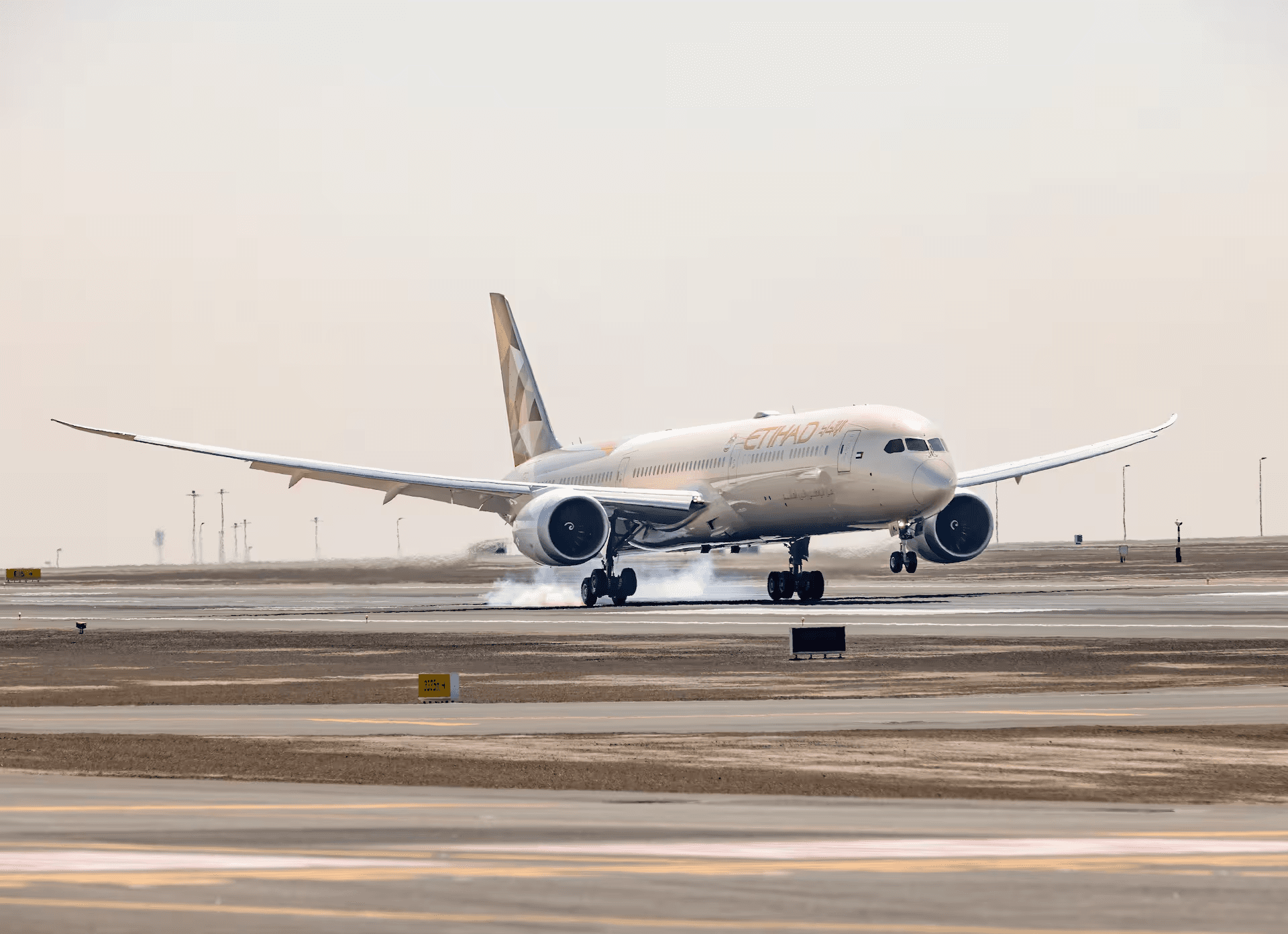
Etihad 787-10 Seat Guide (2026) | Cabin
TL;DR
Etihad 787-10 operates with 48 fully flat Business Class seats (1-2-1 alternating pattern) and 299 Economy seats in 3-3-3 configuration across 60+ rows total. Best seat: 1A or 1K (Business Class nose bulkhead with direct aisle access and maximum privacy). Worst seat: 58F or 59F (rear Economy middle seats with no recline, minimal legroom, and proximity to rear lavatories). Surprising insight: rows 20–25 in Economy enjoy a unique acoustic sweet spot—forward enough to avoid lavatory noise, but positioned over the wing for smoother turbulence experience. Book early if traveling during peak season; the 787-10 fills quickly on Gulf–Europe and Gulf–Asia routes.
Etihad's 787-10 is the airline's longest-range widebody, configured with 48 Business Class seats in a 1-2-1 staggered layout and 299 Economy seats in a tight 3-3-3. Book window seats in rows 1–10 for direct aisle access without the middle-seat trap, but avoid the rear Economy zone (rows 50–60) where recline is restricted and lavatory queues dominate. The 787-10's larger windows and low cabin altitude help mitigate fatigue on ultra-long-haul routes, but seat selection remains critical on a 14+ hour flight.
Quick specs
Cabin | Layout | Seats | Pitch | Width | IFE |
|---|---|---|---|---|---|
Business Class | 1-2-1 staggered | 48 | 76–80 inches (193–203 cm) | 25 inches (64 cm) | 16" Panasonic 3D HD (select rows) |
Economy Class | 3-3-3 | 299 | 31 inches (79 cm) | 17.2 inches (44 cm) | 9–11" embedded or seatback |
Business Class
Etihad's Business Class occupies rows 1–8 with a 1-2-1 alternating configuration: odd rows (1, 3, 5, 7) feature two centre seats side-by-side; even rows (2, 4, 6, 8) feature two window seats with an aisle gap between them. All 48 seats are lie-flat (177° recline) with direct aisle access on alternating patterns. Rows 1 and 2 are nose bulkheads with no forward obstruction; rows 7 and 8 back onto the galley. Best seats: 1A or 1K (window bulkhead, zero forward recline obstruction, maximum privacy). Rows 2, 4, 6 offer direct aisle access but share row-mate views. Avoid rows 7–8 due to galley proximity and potential noise from crew service carts.
Economy Class
Economy spans rows 10–60 in a 3-3-3 layout (seats A–C, D–F, H–J–K). Exit rows are positioned at rows 16 and 17, offering 32–34 inches of pitch but non-reclining seats and fixed armrests. Rows 10–15 are bulkhead/forward cabin with enhanced legroom (34+ inches pitch) but tray tables mounted in armrests. Rows 50–60 are non-recline (last 10 rows feature seatback-only recline or no recline at all) and experience constant lavatory queue noise and odours. Acoustic sweet spot: rows 20–25 combine adequate distance from lavatories and galley with over-wing positioning for smoother ride. Window seats (A, C, H, K) are strongly preferred; middle seats (D, E, F) trap passengers between armrests with zero aisle/window views.
Best seats
Seat | Cabin | Why |
|---|---|---|
1A, 1K | Business | Nose bulkhead window—lie-flat bed with zero forward recline interference, maximum privacy door closure, first to board/deplane. |
2D, 2H | Business | Window bulkhead rows with direct aisle access, lie-flat, minimal row-mate proximity compared to centre pairs. |
10A, 10C, 10K | Economy | First Economy row post-galley with enhanced legroom (34+ inches), window seats avoid middle-seat trap, early meal service. |
16A, 16K, 17A, 17K | Economy | Exit row window seats with 32–34 inches pitch, direct aisle access; trade-off is fixed armrests and no recline, but excellent legroom for long-haul. |
22D, 22E, 22F | Economy | Centre-cabin acoustically quiet row positioned over wing—smoother ride for turbulence-sensitive passengers, reduced lavatory queue noise. |
25A, 25K | Economy | Over-wing window seats with excellent turbulence dampening and lowest cabin noise; forward enough to avoid rear odours. |
Seats to avoid
Seat | Cabin | Why |
|---|---|---|
7A, 7K, 8A, 8K | Business | Rear bulkhead rows adjacent to galley—crew cart noise, beverage cart collisions, reduced privacy door effectiveness. |
10D, 10E, 10F | Economy | First row centre seats: tray table in armrest reduces comfort; no window views; higher baseline cabin traffic as passengers pass forward to galley/lavatory. |
14D, 14E, 14F | Economy | Middle seats directly ahead of galley—crew activity, beverage cart banging, accelerated cabin noise during service. |
18D, 18E, 18F, 19D, 19E, 19F | Economy | Rows immediately behind exit rows suffer from passenger shuffle, exit-row seat legroom creating jealousy, no recline advantage for non-exit passengers. |
50F, 51F, 52F | Economy | Last Economy rows—zero or seatback-only recline, minimal pitch (29–30 inches), lavatory queue congestion, lingering odours from rear facilities. |
58E, 59E, 60E | Economy | True last rows in centre block—trapped middle seat position, no window, no aisle, surrounded by non-reclining seatbacks and constant foot traffic to rear lavatories. |
✈️ Version Lottery
Etihad operates a single standardised 787-10 cabin configuration across its entire fleet — there is no version lottery. All aircraft in service carry the identical 40 Business Class (forward cabin, rows 1–4) and 304 Economy layout (rear cabin, rows 5–34). The aircraft features the newer Panasonic eX3 in-flight entertainment system and complimentary satellite Wi-Fi on all units, with no generational split between older and newer deliveries.
To confirm your specific 787-10 assignment before booking, use Etihad's official seat map tool on their website or check ExpertFlyer for the aircraft registration — Etihad's 787-10 tail numbers (A6-XWA through A6-XWE and beyond) all operate the same product. There is no strategic advantage to changing flight dates or times to secure a "better version" — the cabin experience is consistent across the fleet. Your seat selection strategy should focus purely on row position within the published configuration, not aircraft variant.
🏆 Competitive Verdict
Against Qatar Airways' 787-10 on the same Gulf-to-Europe and Gulf-to-Asia routes, Etihad's New Elements suites deliver identical comfort — both feature direct aisle access, fully enclosed privacy doors, 76-inch beds, and on-demand dining. The honest verdict: for solo overnight travellers, Etihad wins marginally due to quieter cabin culture and slightly better crew responsiveness to sleep requests; for couples, Qatar's QSuites offer superior side-by-side configuration if you book 1A–1B or 2A–2B (Etihad's couple seats are staggered); for tall passengers over 6 feet, they are equal — both offer 76-inch beds; for work-focused business travellers, Qatar edges ahead with more responsive cabin crew and a marginally more efficient dine-on-demand system. Etihad's service excellence is real, but QSuites' physical configuration and crew training give Qatar a slight edge on this narrowbody-equivalent route pairing. If you have status with either airline or loyalty to Etihad, the difference is negligible — book Etihad and maximise seat choice instead.
🛁 Lounge & Ground Experience
Etihad's primary hub for 787-10 operations is Abu Dhabi International (AUH). Business Class and higher-tier passengers access the Etihad First Lounge (for First Class and select Platinum members) or the Etihad Business Lounge (for Business Class and Gold status). The Business Lounge features three à la carte dining zones (Arabic, Asian, International), premium barista coffee service, a spa with shower suites available on a first-come basis (no pre-booking), complimentary spa treatments, and dedicated day beds for rest before flights. The shower suites are genuine assets — priority queuing via status eliminates the typical wait.
Routing via Abu Dhabi versus competitor hubs (Doha, Dubai) depends on your itinerary and status. If you hold Etihad Platinum or above status, the Business Lounge experience — particularly the reliable shower access and attentive service — justifies a brief stopover or connection. For one-time Business Class passengers, the lounge is respectable but not transformative compared to Qatar's Al Mourjan or Emirates' First Class Lounge; the deciding factor should be flight timing and onward connections, not the lounge alone. The ground experience is strong enough to prefer a direct Etihad routing over a cheaper competitor ticket, but not strong enough to deliberately book a longer connection.
🌙 Overnight Formula
For the best overnight experience on Etihad's 787-10, book 1A or 2A (forward-cabin window suites, port/left side). These seats sit furthest from the galley, receive cabin service earliest (allowing you to sleep uninterrupted through the night), and offer psychological quietness — even in a premium cabin, fewer crew movements past your suite means deeper sleep. Avoid row 4 suites on overnight flights; the rear bulkhead position means constant movement from lavatory queues and crew preparing the cabin during descent.
On overnight routes (Abu Dhabi to London, Manchester, Paris), skip the evening meal service entirely. Request "no service" when the crew approaches with the welcome drink. Instead, consume a light snack (dates, yoghurt, cheese) from the pre-flight catering or order a sleep aid from the dine-on-demand menu 90 minutes before your target sleep time — herbal tea or chamomile, not caffeine. Set your alarm for 90 minutes before landing to shower and refresh. When the pre-arrival service begins (typically 90–120 minutes before touch-down), request a full breakfast and coffee — this signals to your body that you are arriving and need mental sharpness.
Bring two sleep accessories: a weighted eye mask (blocks the cabin's full-bright lighting during descent) and noise-isolating earbuds pre-loaded with a single 8-hour ambient soundscape (brown noise, ocean waves, or aircraft cabin white noise) — Etihad's headphones are adequate but generic earbuds allow you to control volume and frequency without cabin crew disturbance. Sleep in cabin-provided pyjamas rather than changing back into clothes; this psychological shift is underestimated and works. When you wake 30 minutes before landing, shower immediately, dress in fresh clothes, and consume the pre-arrival meal hot — this arrival choreography combats jet lag far more effectively than any sleep hack.
Does Etihad 787-10 have lie-flat seats?
Yes. All 48 Business Class seats are fully lie-flat at 177° recline, converting into a 76–80 inch bed. Economy seats recline 6–8 inches (non-recline in rows 50–60).
Best seat for sleeping on Etihad 787-10?
Book row 1A or 1K in Business Class. The nose bulkhead position eliminates forward recline obstruction, and the window-seat privacy door seals you from cabin activity. If Economy, select a window seat (A, C, H, or K) in rows 20–25 for acoustic quiet and over-wing turbulence smoothness; row 16K or 17K offer superior pitch if you can tolerate non-recline.
Does Etihad 787-10 have WiFi?
Yes. Etihad offers satellite-based WiFi (Viasat or Intelsat, depending on routing). Business Class passengers receive complimentary unlimited WiFi; Economy receives limited free access (typically 1 hour or 250MB), with paid upgrade options available at booking or inflight. Speeds vary 4–8 Mbps depending on satellite coverage over route.
Is Etihad 787-10 Economy worth it long-haul?
Yes, but with caveats. At 31 inches pitch, Etihad Economy matches competitors like Emirates and Qatar but trails premium carriers like Singapore Airlines (32 inches) and Lufthansa (31–32 inches). The 787-10's larger windows, higher cabin humidity (reduces dehydration), and lower cabin altitude (6,000 feet vs 8,000 feet on older widebodies) significantly improve comfort. For flights under 12 hours, standard Economy is acceptable if you book window seats and avoid rows 50–60. For 13–16 hour routes (Abu Dhabi–New York, Abu Dhabi–London), consider Premium Economy or upgrade to Business if budget allows.
What is the 1-2-1 Business Class layout on Etihad 787-10?
Alternating row pattern: odd rows (1, 3, 5, 7) feature two centre seats side-by-side facing each other; even rows (2, 4, 6, 8) feature two window seats with an aisle gap. This maximizes privacy and ensures every passenger has direct aisle access. Couples prefer odd rows; solo/business travellers prefer even rows for window views.
Can I avoid middle seats in Economy?
Yes. Request a window (A, C, H, K) or aisle seat. Middle seats (D, E, F) are the least desirable and typically available closer to departure. Book 24–48 hours in advance to secure preferred seat; avoid the last 10 rows (50–60) entirely.
Which rows have the smoothest ride on Etihad 787-10?
Rows 20–27 over the wing provide the smoothest experience. The 787-10's wing-mounted engines and aeroelastic fuselage design dampen turbulence better than older widebodies. Avoid the tail (rows 50–60) if you're turbulence-sensitive; rear fuselage movement amplifies motion.
etihad, 787-10, seat guide, business class, economy, lie-flat, middle east, premium, long-haul, best seats, avoid, 2026