Etihad Airways
Boeing 777-300ER
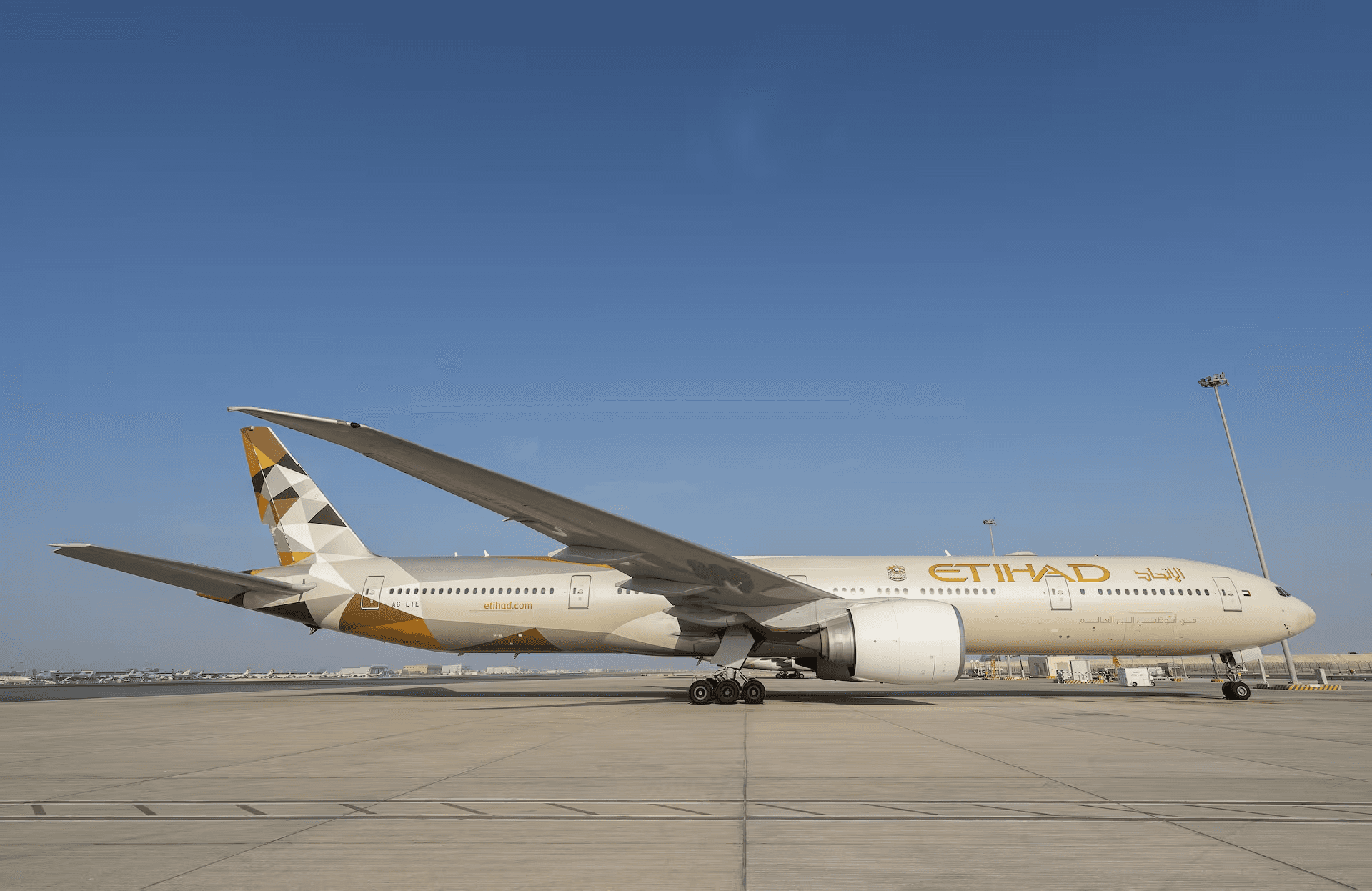
Etihad 777 Seat Guide (2026) | Cabin
TL;DR
Etihad 777 typically seats 8–14 First (1-2-1), 42–52 Business (1-2-1 reverse herringbone), and 310–330 Economy (3-3-3). Book Business Class window seats in rows 21–28 for direct aisle access and privacy doors; avoid every middle seat and any Economy seat aft of row 65. Best Economy window: rows 40–50 (forward of the wing, quieter). Worst move: rows 70–72 (no windows, no recline, turbulence magnet). Surprising insight: Etihad's older 777s lack the cabin humidity and window dimming of newer Dreamliners, making 13–14 hour flights feel longer than they should.
Etihad's 777-300ER carries 370–400 passengers across three cabins, with First Class suites on select routes and Business Class reverse-herringbone seating in a 1-2-1 configuration. Avoid the rear Economy rows 69–72 entirely — they're windowless, non-reclining, and positioned directly above the wing where turbulence is felt most acutely. The 777's twin-engine efficiency and newer cabin pressurization make it smooth, but seat selection is everything on ultra-long routes like Abu Dhabi to New York.
Quick specs
Cabin | Layout | Seats | Pitch | Width | IFE |
|---|---|---|---|---|---|
First Class | 1-2-1 | 8–14 | 78" | 21" | 23" Panasonic eX3 |
Business Class | 1-2-1 Reverse Herringbone | 42–52 | 76–78" | 20.5" | 16–17" Panasonic eX2 |
Economy Class | 3-3-3 | 310–330 | 32" | 17.2" | 10.6–13.3" Panasonic |
First Class
Etihad's First Class operates on limited routes (primarily Abu Dhabi to London, New York, Los Angeles) in a forward-facing 1-2-1 configuration with fully enclosed suites on newer aircraft. Rows 1–7 vary by aircraft age; newest 777s (post-2015 retrofit) feature sliding doors, direct-aisle access from every seat, and 23-inch IFE screens. Avoid middle seats (centre column) if travelling solo — they face backward and lack the same prestige. Best seats: 1A, 1K (forward row, premium service first).
Business Class
Reverse-herringbone 1-2-1 across rows 8–28. Window seats (A, K columns) are premium — angled toward the window with direct aisle access and privacy from the centre pair (D, J). Centre seats (D, J) are acceptable only if paired with a travelling companion; they face inward and require passing by one person to reach the aisle. Rows 21–28 are the sweet spot: far enough aft to avoid galley noise, close enough to forward lavatory. Avoid rows 8–12 (galley noise, crew movement, longer service queue). Non-recline rows: none in Business Class on 777 (all lie flat to 180° or near-horizontal).
Economy Class
Standard 3-3-3 layout across rows 29–72 (count varies by configuration). Exit row: rows 40 and 48 have 32–34" pitch but fixed armrests and no recline. Windows: A, K columns (rows 29–39, 49–68 are best — forward of the wing quieter acoustic zone). Avoid rows 69–72 entirely: no windows, minimal recline, positioned over the wing engines with maximum vibration and turbulence sensation. Last lavatory sits between rows 67–68; rows 65–68 experience constant queue noise and odours. Rows 50–60 offer good balance of space, service speed, and peace.
Best seats
Seat | Cabin | Why |
|---|---|---|
1A, 1K | First Class | Forward row, earliest meal service, priority disembark, full suite access |
21A, 21K | Business Class | Reverse-herringbone window with direct aisle, privacy door, away from galley, optimal service timing |
45A, 45K | Economy | Exit row window (32" pitch), forward of wing acoustic sweet spot, quick boarding and deplaning |
55D, 55E, 55F | Economy | Centre block behind engines, quieter than forward rows, good turbulence damping, mid-cabin lavatory access without queue stress |
Seats to avoid
Seat | Cabin | Why |
|---|---|---|
8D, 8J | Business Class | Centre seats directly adjacent to forward galley, crew noise and movement, last to be served |
40D, 40E, 40F | Economy | Exit row centre block — no window, fixed armrests, reduced legroom benefit vs window seats, no recline |
65–72 (all seats) | Economy | Non-reclining, minimal windows, positioned over engines (maximum turbulence), lavatory odour drift, crew rarely service this far aft |
✈️ Version Lottery
Etihad operates two distinct 777 configurations in active service, and the difference matters significantly for Business Class passengers. The airline's older 777-300ER fleet (approximately 30 aircraft) features the original Apartment suites with sliding doors — fully enclosed pods with direct aisle access, individual closets, and privacy that rivals First Class on competing carriers. The newer 777-300ER retrofit aircraft and the 777-200LR variants introduced from 2015 onwards carry the updated New Apartment suites without sliding doors, which retain excellent bed length and recline but sacrifice the enclosed cabin feel; these use a curtain-and-divider system instead.
A passenger can identify which version operates their flight by checking the Etihad seat map on the airline's website at the time of booking — the graphic will show either solid cabin walls (door version) or open partitions (curtain version). Alternatively, entering your flight number into ExpertFlyer or Seatguru will display the exact aircraft registration, and cross-referencing against Etihad's published fleet list reveals the cabin generation. For overnight flights from Abu Dhabi to London, New York, or Toronto, the door version is genuinely worth rerouting to secure — the ability to fully close your suite, dim personal lighting, and control the microclimate without affecting neighbours creates a markedly superior sleep environment on a 14+ hour sector. The curtain version is acceptable for regional Gulf hops or daytime connections but loses its premium justification on intercontinental overnight routes where privacy directly translates to rest quality.
🏆 Competitive Verdict
On the Abu Dhabi–London and Abu Dhabi–New York routes where Etihad 777 competes most directly with British Airways 747 and United 777 from their respective hubs, Etihad with door-equipped suites wins outright for solo overnight travellers and couples — the enclosed privacy, the 76-inch bed, and Etihad's catering reputation simply outclass BA's aging 747 suites and United's smaller 777 offerings. For tall passengers over 6 feet, Etihad's full-flat bed (76 inches) and wider seat pitch (41 inches) beats United's narrower products and matches BA's best, but only if you secure the door version; the non-door retrofit feels cramped by comparison due to the visual openness creating discomfort. For work-focused business travellers prioritising inflight productivity, United 777 and Qatar 777X actually win — larger IFE screens, more reliable Wi-Fi, and a more open cabin that doesn't feel isolating during working hours. The honest assessment: book Etihad 777 if you value sleep and privacy on a red-eye; book BA or United if you want to work comfortably or prefer a social cabin environment.
🛁 Lounge & Ground Experience
Etihad's primary hub is Abu Dhabi International Airport (AUH), and Business Class passengers access the Etihad Airways First & Business Lounge — a 60,000 sq. metre facility spanning the Midfield Terminal. Key amenities include six dedicated shower suites with premium toiletries and robes, an à la carte dining restaurant serving Arabic and international cuisine prepared to order, a full-service spa offering 30-minute treatments (massage, facials), private work pods with direct phone lines, a self-service bar, and separate day-bed rest rooms with blackout curtains and fresh linens — available for 60-minute bookings.
Access is tier-based: all Business Class passengers (any fare) gain entry, plus Diamond and Platinum frequent flyer members travelling in Economy. Gold members on Business fares also qualify; Gold on Economy does not. Etihad's ground experience is genuinely competitive — the lounge quality and shower-plus-treatment offering rivals Singapore Airlines' KrisFlyer lounge at Changi — but the routing advantage depends on your origin. If you're travelling from London or European cities, adding 4–6 hours via Abu Dhabi rather than flying direct BA to New York only makes sense if you're booking a premium Etihad Business fare that includes a complimentary lounge stay; a bargain Etihad Economy ticket negates the hub advantage. For passengers originating in the Gulf or South Asia, Abu Dhabi is a natural routing, and the lounge experience significantly enhances the value proposition versus flying direct on competing Gulf carriers with smaller lounge offerings.
🌙 Overnight Formula
For the best overnight experience on Etihad 777, book 1A or 1K — the forward Business Class window suites with the earliest access to the flight deck corridor, minimal foot traffic during the cabin's sleep window, and full control over cabin lighting without affecting central cabin sightlines. If the door-equipped version operates your flight, the privacy gain is decisive; if it's the non-door retrofit, the aisle-adjacent view still offers better ambient control than rear-cabin pairs at rows 5–7, which experience crew activity and lavatory traffic during overnight hours.
Skip the meal service outright on overnight flights. Politely decline when the crew offers the five-course dinner immediately after takeoff. Instead, request the light snack (typically cheese, fruit, and nuts) and a herbal tea, consume it 90 minutes after departure, then set your watch to Abu Dhabi time and commit to sleep. Accepting the full dinner creates a 90-minute eating cycle that misaligns your circadian adjustment and delays onset sleep by 2–3 hours — a critical loss on a 13-hour flight. Etihad crew are experienced with this pattern and will not pressure you; they respect overnight sleep prioritisation.
Bring two specific items: a silk pillowcase (the cabin humidity is excellent, but synthetic pillowcases create static and discomfort during repositioning), and noise-isolating earplugs (even in door-equipped suites, the cabin ambient noise and occasional service calls warrant passive noise reduction — aim for 20-25dB attenuation). Skip neck pillows; the fully flat bed and Etihad's Egyptian cotton bedding make external pillows redundant.
To optimise arrival: Set your alarm for 90 minutes before landing — this gives you time to shower in the suite (Etihad provides complimentary amenity kits with premium skincare), change into fresh clothes, and mentally transition before crew announcements. Request the pre-arrival service when the cabin lights come up; crew will offer a light breakfast and coffee service 45 minutes before touch-down. Accept only the fruit plate and black coffee — this resets your appetite signalling without causing landing-time grogginess. Do not attempt to sleep in the final 90 minutes; the ambient noise and cabin activity will fragment your rest. Instead, dim your personal lighting, review your first few meetings, and use the final descent as a productive transition into business-day mode.
Does Etihad 777 have lie-flat seats?
Yes, in First and Business Class. First Class suites recline fully to 180° (true flat bed, 78" pitch). Business Class seats recline 76–180° depending on retrofit generation; pre-2010 aircraft may feature 170° recline instead of full flat. All Economy seats recline 6–7 inches only; rows 65–72 do not recline at all.
Best seat for sleeping on Etihad 777?
Book 21A or 21K in Business Class — window herringbone with direct aisle access, no mid-cabin noise, and isolation from crew and galley traffic. If flying Economy, rows 55–60 offer the best combination of quietness and recline (avoid the non-reclining rear). Rows 55–60 sit over the wing where turbulence is dampest, aiding sleep quality on overnight routes.
Does Etihad 777 have WiFi?
Yes. Etihad 777 is equipped with satellite-based Viasat or newer Intelsat systems depending on retrofit date. First and Business Class receive complimentary unlimited streaming; Economy gets 1GB free or paid hourly/monthly plans. Coverage is continuous over oceans (unlike earlier ATG systems). Speeds average 10–30 Mbps downstream — adequate for email and light browsing, not reliable for 4K video.
Is Etihad 777 Economy worth it long-haul?
Etihad 777 Economy at 32" pitch is competitive with Middle Eastern and Asian carriers on 13–16 hour routes to London, New York, and Bangkok, but inferior to European full-service carriers (Lufthansa 350: 32" pitch, newer cabin tech). The 777's older cabin (pre-2020 retrofit) lacks modern humidity systems and automated window dimming — expect more fatigue on ultra-long flights. Hallmark: Etihad's service remains exceptional even in Economy, with quality catering and attentive crew. Verdict: Good value for comfort-conscious travellers on Arab Gulf routes; upgrade to Business if budget allows for routes longer than 14 hours.
etihad, boeing 777, seat guide, 2026, business class, first class, economy class, best seats, seats to avoid, long haul, middle east