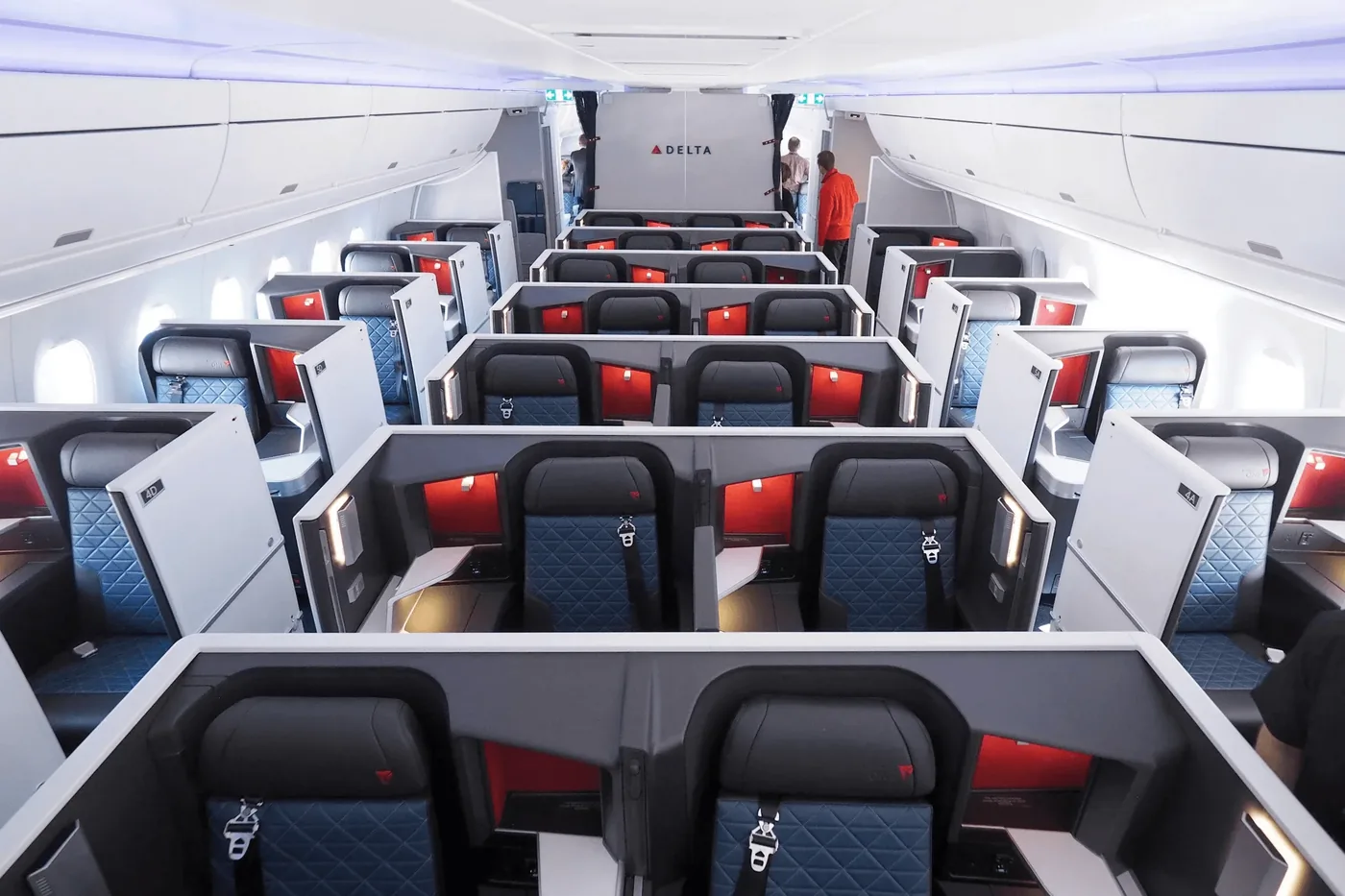
Delta One on the A350-900 is the best Business Class product Delta has ever flown - fully enclosed suites with sliding doors, a 1-2-1 layout, and a flat bed at 79 inches. The version question matters: check your seat map before booking to confirm you're on the door-equipped aircraft.
TL;DR
Delta One Suites on the A350-900 use a 1-2-1 layout with 32 seats across 8 rows. Every suite has a full-height sliding door, a flat bed at 79 inches, and direct aisle access. The best seats for solo travelers are the true window positions in odd-numbered rows (1A, 3A, 5A, 7A and the K equivalents) - flush against the fuselage with the door providing near-complete enclosure. The seats to avoid are even-numbered window positions facing the aisle, and row 9 for galley noise. Confirm you're on the Suite-configured aircraft before booking - some A350-900s are ex-LATAM variants with an open 2-2-2 layout and no doors.
Delta One on the A350-900 represents the high-water mark of Delta's long-haul Business Class evolution. The product launched on the A350 before moving to the A330-900neo, and the A350 version remains the reference standard - more rows, more suite depth, and the acoustic advantages of the A350's composite fuselage that the A330 can't fully replicate.
The version question - check before you book
Delta operates two meaningfully different A350-900 configurations. The primary version has 32 Delta One Suites in a 1-2-1 layout with full-height sliding doors. A secondary version - ex-LATAM aircraft acquired through Delta's partnership - has an open 2-2-2 Business Class layout without doors. Both are designated as A350-900 in booking systems. The definitive check: if your seat map shows a 1-2-1 Business layout, you have the Suites. If it shows 2-2-2 or the middle seats are paired without a door icon, you are on the open cabin version. The 1-2-1 Suite product is worth specifically seeking out - the open version is a good seat but an entirely different experience.
The odd/even row rule
Delta One Suites use a staggered reverse herringbone layout. This creates a critical distinction between odd and even-numbered rows. In odd-numbered rows (1, 3, 5, 7), window seats (A and K positions) are flush against the fuselage wall. When the suite door closes, the window-side wall and the door create near-complete enclosure - the most private sleep environment in Delta's fleet. In even-numbered rows (2, 4, 6, 8), window seats face the aisle. The door still closes and provides visual privacy, but you are oriented toward the cabin rather than toward the window, and the footwell points toward the aisle rather than toward the fuselage. For solo travelers on overnight flights, odd-numbered window seats are the correct choice by a significant margin.
Bulkhead suites (row 1)
Row 1 is the bulkhead - no seat structure ahead of the footwell, which means the footwell is wider and longer than in any other row. For tall travelers or side-sleepers who move around during long flights, this is meaningful. Row 1A and 1K are the standout picks on the aircraft. The tradeoff is proximity to the forward galley and crew rest area - on very long flights (Atlanta to Tokyo, for example), early morning activity in the forward galley can be audible from row 1. Most passengers consider this a fair trade for the extra footwell space.
Center suites for couples
The center D and G seats in odd-numbered rows face each other with a deployable privacy divider between them. For couples, these are the correct configuration - close enough for conversation, with the option to raise the divider for sleep. In even-numbered rows, the center seats face away from each other, which makes conversation awkward and compromises the couples-travel use case.
Row 9 - the galley adjacency problem
Row 9 (or the equivalent last row of Delta One on your specific aircraft) sits directly against the forward galley of the Premium Select cabin. On Delta's longest A350 routes, the Premium Select meal service runs approximately 2 hours after departure - which overlaps with when Business passengers are trying to sleep. Light and noise from the galley behind row 9 is the most consistent complaint in Delta One passenger reports. Avoid this row on any overnight flight.
The door mechanics
Delta One's sliding door is a full-height panel that closes to approximately the level of your head when reclined. It is not a floor-to-ceiling wall - the top 15-20cm remains open. In practice, this provides complete visual privacy from the aisle and significantly reduces ambient light during sleep. It does not provide acoustic isolation - you will hear the cabin, but at a meaningfully reduced level. Passengers who are sensitive to light during sleep should treat the door as excellent light blocking rather than complete sensory isolation, and bring an eye mask for the residual gap at the top.
💻 Workspace audit
The Delta One Suite tray table deploys from the side console and slides forward - you can stand up from the seat without stowing your laptop. It handles a 16-inch screen with room for a notepad. Delta uses Viasat satellite Wi-Fi on the A350-900 fleet - speeds consistently support video calls and large file transfers on most routes, making this one of the more reliable inflight work environments in US carrier Business Class. Every suite has an international AC outlet and a 60W USB-C port. The 18-inch IFE screen supports Bluetooth audio pairing - no adapter needed for AirPods or Sony headphones.
🚪 Deplaning intelligence
Delta uses Door L2 as the primary deplaning exit on the A350-900. This exit is positioned between Delta One and Premium Select, meaning the rear rows of Delta One (rows 7-9) are actually closest to the exit and deplane before the front rows. If you have a tight connection at Atlanta or Detroit, rows 7-8 in Delta One offer the fastest exit despite being at the back of the premium cabin. Row 1 passengers exit last from Business - a counterintuitive fact worth knowing if your connection is under 60 minutes.
Best seats
Seat
Why
1A & 1K
Bulkhead window suites. Widest footwells on the aircraft. Best for tall travelers and side-sleepers. Odd-row privacy orientation.
3A, 5A, 7A (and K equivalents)
Odd-row window suites. Fuselage wall plus closed door creates the most enclosed sleep environment in Delta One. True window seats.
Odd-row D & G
Facing center suites with divider. Best couples configuration - close enough for conversation, divider raises for sleep.
7A & 7K
Last odd-row window suites, closest to Door L2. Fast deplaning on tight connections without sacrificing suite quality.
Seats to avoid
Seat
Why
Even-row A & K (2A, 4A, 6A, 8A)
Window seats face the aisle, not the fuselage. Less enclosed. Footwell points toward the cabin rather than the window wall.
Row 9 A-K (last row)
Galley directly behind. Light and noise during Premium Select service window. Avoid on overnight routes.
FAQ
How do I know if my Delta A350-900 has the Delta One Suites with doors?
Check the seat map during booking or in Manage My Booking. If Business Class shows a 1-2-1 layout with suite icons, you have the door-equipped product. If it shows 2-2-2, you are on an ex-LATAM aircraft with an open Business Class cabin and no doors.
Does the Delta One Suite door close completely?
The door closes to approximately head height when reclined, leaving a 15-20cm gap at the top. It provides complete visual privacy from the aisle and significantly reduces ambient light and noise. It is not a floor-to-ceiling wall.
Is Delta One A350-900 better than Delta One A330-900neo?
The suite product is identical. The A350's composite fuselage provides a quieter cabin environment and lower cabin altitude (6,000 feet vs approximately 7,000 feet on the A330neo), which translates to marginally less fatigue on very long flights. On routes under 10 hours, the difference is minimal. On 14+ hour routes, the A350's environmental advantages are measurable.
What is the bed length in Delta One on the A350?
79 inches fully flat. The bulkhead suites (row 1) have wider footwells, making them more comfortable for tall travelers even though the nominal bed length is the same across all rows.