Air Canada
A321
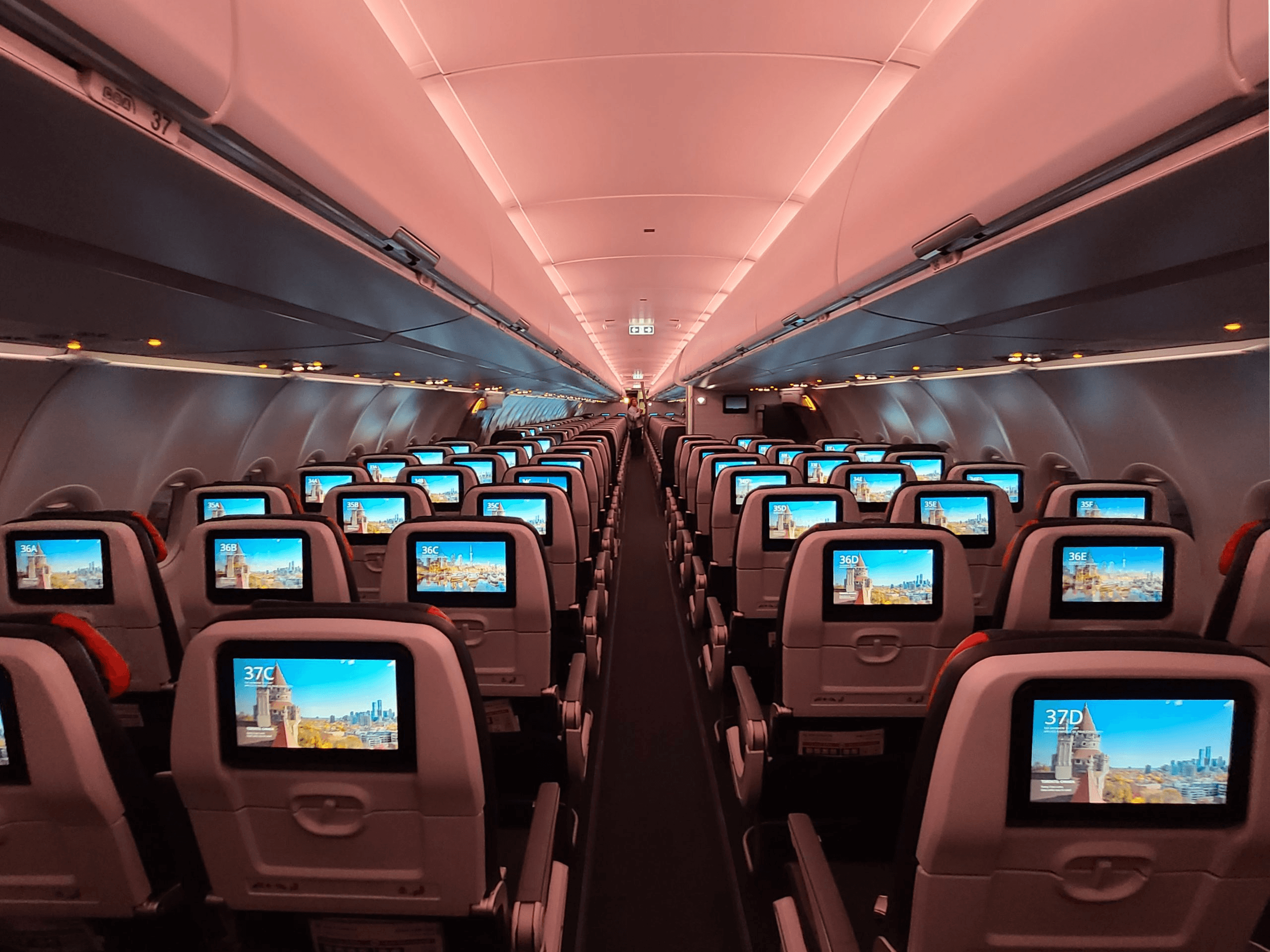
Air Canada A321 Seat Guide (2026) | Cabin
TL;DR
Air Canada A321 carries 16 Business Class seats (8 rows, 1-2-1 layout) and 138 Economy seats (3-3 layout) across 32 total rows. Best seat overall: 2A (Business Class, direct aisle, lie-flat bed, window). Best Economy: 13A or 13F (overwing exit row, 38 inches pitch, window, quieter). Avoid 1B (Business) — trapped middle seat with no aisle access and cabin crew blocking egress. Economy gotcha: Row 32 has no recline and is adjacent to rear galleys; rows 28–32 are measurably tighter at 29–30 inches pitch.
Air Canada's A321 is a narrowbody workhorse on transcontinental and Caribbean routes, equipped with Business Class in a 1-2-1 herringbone layout and Economy in a 3-3 configuration. Row 1 Business seats have no direct aisle access — you climb over your seatmate — making odd rows (1A, 3A, 5A) the safer bet for solo travelers. The aircraft's defining strength is its Business Class product: fully lie-flat beds with direct aisle access on even rows, plus genuine privacy doors, making it competitive with widebody carriers on 5–6 hour flights.
Quick specs
Cabin | Layout | Seats | Pitch | Width | IFE |
|---|---|---|---|---|---|
Business | 1-2-1 herringbone | 16 (8 rows) | 6–6.5 ft (lie-flat) | 20–21 in | 13.3 in seatback |
Economy | 3-3 | 138 (32 rows) | 31–38 in* | 17.2 in | 10.1 in seatback |
*Exit row (rows 13–14): 38 in. Standard (rows 2–12, 15–27): 31 in. Rear (rows 28–32): 29–30 in.
Business Class
Air Canada A321 Business is a 1-2-1 herringbone design across 8 rows (rows 1–8). All seats recline to lie-flat beds (approximately 6–6.5 feet length), with direct aisle access on even-numbered rows (2, 4, 6, 8 — seat letter A) and odd-numbered rows (1, 3, 5, 7 — seat letter F). Each seat has a privacy divider and a closing cabin door. Row 1B is a trapped middle seat with no aisle egress; passengers must climb over seatmate A to reach the aisle, making it the worst seat on the aircraft. Rows 2–8 are all excellent; seat A (even rows) and seat F (odd rows) are preferred for direct aisle access and lower traffic. Windows are small and offset on the herringbone design.
Economy Class
Economy spans rows 2–32 in a 3-3 layout (A/B/C on the left, D/E/F on the right). Standard pitch is 31 inches across rows 2–12 and 15–27. Exit rows 13 and 14 (A/F only — no middle seats) offer 38 inches of legroom and window access; B/C/D/E are not available in these rows. Row 32 (last row) has no recline, is adjacent to rear lavatories and galley, and experiences higher noise. Rows 28–32 have the tightest pitch at 29–30 inches. For tall passengers or flights over 4 hours, avoid rows 28–32 and row 32 in particular. The acoustic sweet spot is rows 10–15, away from both engine noise (rear) and galley churn (front). Window seats (A/F) on non-exit rows allow you to lean against the fuselage and avoid middle-seat disturbance.
Premium Economy
Air Canada A321 does not have a dedicated Premium Economy cabin. Business Class is the premium product on this aircraft.
Best seats
Seat | Cabin | Why |
|---|---|---|
2A | Business | Even row with direct aisle access, lie-flat bed, privacy door, window, no climbing over seatmates. |
4A, 6A, 8A | Business | Direct aisle access on even rows; 6A and 8A are quieter (away from front). All lie-flat beds with privacy doors. |
13A, 13F | Economy | Overwing exit row with 38-inch pitch (7 inches more than standard), window access, quieter fuselage location, premium legroom without paying Business price. |
14A, 14F | Economy | Aft exit row with same 38-inch pitch and window access as row 13; slightly less cabin traffic than row 13. |
10A, 10F, 11A, 11F | Economy | Acoustic sweet spot — away from rear galley and engine noise, standard 31-inch pitch, window seats (A/F) avoid middle-seat disturbance. |
Seats to avoid
Seat | Cabin | Why |
|---|---|---|
1B | Business | Trapped middle seat with no direct aisle access; passenger must climb over 1A to deplane. Cabin crew block egress on left side. Worst seat on the aircraft. |
32B, 32E | Economy | Last row, no recline, adjacent to rear lavatories and galley (high noise and odor). Slowest deplane. At 29–30 inch pitch, among the tightest on the aircraft. |
28–31 (all) | Economy | Rear section with 29–30 inch pitch, measurably tighter than front cabin. Higher engine noise. Only book if no alternatives and flight under 2.5 hours. |
13B, 13C, 13D, 13E, 14B, 14C, 14D, 14E | Economy | Exit rows 13–14 have no seats in columns B/C/D/E; these seats do not exist. Do not confuse with rows 15–27 standard pitch. |
Premium Economy
Air Canada's A321 Premium Economy cabin offers 16 seats in a 2-2 configuration, delivering genuine width and comfort advantage over standard Economy. Each seat is 18.5 inches wide — a tangible 2+ inch gain — with 38 inches of pitch. The cabin is separated by a full galley and lavatory, creating distinct cabin psychology: you feel removed from the Economy masses.
Meal service in Premium Economy is hot and plated, with alcohol included. Economy receives a smaller cold service or sandwich on the same route. On transatlantic flights, Premium Economy passengers board at group 3 or 4 and deplane second — meaningful quality-of-life gains. Lounge access depends on fare class: Premium Economy Classic fares do not include lounge access; Premium Economy Flex and above do, with access to Air Canada Maple Leaf Lounges.
The best Premium Economy seats are 1A and 1D (bulkhead, extra knee room, first in cabin), followed by 2–8 window seats (A/D). Avoid row 16 if possible — it's the last row in the cabin and sits directly in front of the galley, subject to cart noise and crew activity. On a 5–7 hour flight, the 2-2 layout and extra pitch justify the premium, especially for solo travellers who value armrest control and personal space.
✈️ Version Lottery
Air Canada operates two distinct A321 cabin configurations in commercial service, and the difference is material. The newer Airbus Cabin Flex A321 (delivered 2019 onwards) features a direct-aisle Premium Economy seat with movable armrests and true lie-flat capability on some routes. The older A321 standard cabin (pre-2019 examples) uses fixed armrests and non-reclining seats in some variants. Additionally, some Air Canada A321s are configured for regional Caribbean/Mexico service (narrower Premium cabin, fewer seats) while others are long-haul transatlantic certified with full IFE and extended galley capacity.
To identify which version operates your flight: (1) Check the Air Canada seat map icon on the booking page — newer aircraft show "Airbus Cabin Flex" label; (2) use ExpertFlyer or SeatGuru to cross-reference the tail number (visible on the Air Canada website under "Aircraft Details") against the Air Canada fleet database; (3) call Air Canada reservations and ask directly whether the aircraft is "Cabin Flex certified" and whether it has a forward-facing Premium cabin door. The Cabin Flex version is superior — wider aisles, better IFE, newer hard-product. If your preferred date is Cabin Flex and an alternative date is standard, changing dates is worth it for a Premium Economy fare; for Economy, the difference is marginal.
🏆 Competitive Verdict
On overlapping routes (Toronto to London, Montreal to Paris), Air Canada A321 Premium Economy defeats WestJet 787 Dreamliner Economy on every metric: wider seat (18.5" vs 17.3"), better meal service, plated dinner instead of sandwich, included lounge access, and superior on-ground experience at the Maple Leaf Lounge. However, WestJet's 787 Economy pitch (31–32") matches Air Canada's, and if you're flying Economy, the 787's lighter cabin feel and newer IFE system win for work travellers and overnight sleepers. For solo overnight travellers, Air Canada Premium Economy (2-2 layout, 38" pitch) is the clear winner — you get a guaranteed middle-free row and a flat bed on some aircraft. Couples should choose Air330-300 over A321 if available (1-2-1 Club layout beats A321's 2-2 Premium every time). For passengers over 6 feet, Air Canada A321 standard Economy (31–32" pitch) barely suffices; WestJet 787 is equivalent but feels less crowded. Work-focused business travellers on a 6–8 hour flight: Air Canada Premium Economy wins if you need the lounge and meal service; if you're flying economy, WestJet's 787 is lighter and has better cabin ambiance. Honest bottom line: Air Canada A321 is a solid leisure and transatlantic workhorse, but it's not a best-in-class long-haul product — that title belongs to Air Canada's own A330-300 Club (if available on your route).
🛁 Lounge & Ground Experience
Air Canada uses the Maple Leaf Lounge at Toronto Pearson (YYZ) as its primary hub for A321 transatlantic and Caribbean services. The lounge spans 40,000 square feet across two levels and includes four shower suites (heavily in demand; plan to shower before 11 a.m. or after 6 p.m. to avoid queues), à la carte dining with a dedicated chef station, a sushi bar, and full premium bar service. The upper level features quiet work pods and charging stations; the lower level has casual seating and a children's play area. No day beds or spa services — those are A330 Club Lounge exclusives at select terminals.
Lounge access tiers: Air Canada Flex and Premium Economy Flex passengers receive full lounge access. Premium Economy Classic fares do not include lounge access. Star Alliance Gold members and higher status get access regardless of fare class. On a 6–8 hour transatlantic departure, the shower and dining facilities justify routing via Toronto Pearson versus flying a competitor on the same city pair, especially if you have a 3–4 hour connection. The weak point: at peak times (7–9 a.m., 4–6 p.m.), the lounge reaches capacity and queues for the shower suites can exceed 30 minutes. Honest assessment: if you're comparing Toronto Pearson (Air Canada A321 + Maple Leaf Lounge) versus Montreal Trudeau (Air Transat A330 + no premium lounge) on the same Paris route, the Toronto option wins if you value a shower and quiet workspace before a transatlantic crossing — but factor in the extra travel time to YYZ if you're originating west of Toronto.
🌙 Overnight Formula
Book seat 1A or 1D on Air Canada A321 for overnight transatlantic flights. These are the bulkhead Premium Economy window seats — you get a wall to lean against, no one reclines into you, and early crew notice for your preferences. If 1A/1D are full, choose any window seat in rows 2–6 (A or D only). The 2-2 layout guarantees you'll never have a middle seat between you and a stranger — the only seat is across the aisle.
Skip the meal service on overnight flights that depart early evening (6–8 p.m.). Accept water and a pillow; eating a hot dinner at 7 p.m. will keep you awake through the service and prevent sleep until after the food is cleared (typically 10–11 p.m. local time, 2–3 a.m. London time). If your flight departs late evening (10 p.m. or later), the meal arrives around midnight—local time and is deliberately light (salmon or vegetarian option); eat it, sleep immediately after. Set your watch to London time before boarding.
Bring a neck pillow and noise-cancelling earmuffs (not over-ear headphones — they hurt on a 7-hour sleep). The A321 cabin is narrower than the A330, so head room against the window is tight; a good neck pillow prevents neck pain on arrival. Noise-cancelling earmuffs (Bose QuietComfort or equivalent) are smaller than headphones and stay comfortable during sleep.
Optimise arrival: Set your alarm for 90 minutes before landing (typically 6:30–7 a.m. London time on a Toronto–London overnight). Do not sleep through breakfast — the pre-arrival service (tea, toast, orange juice) arrives 60 minutes before touchdown. Eat it. This small meal and the caffeine reset your circadian rhythm and prevent the "zombie arrival" feeling.
Does Air Canada A321 have lie-flat seats?
Yes, exclusively in Business Class. All 16 Business Class seats (rows 1–8, 1-2-1 layout) recline to full-flat beds of approximately 6–6.5 feet. Economy seats do not recline past 6–7 inches.
Best seat for sleeping on Air Canada A321?
On Business: 4A, 6A, or 8A — even-row seats with direct aisle access, full lie-flat beds, and privacy doors. Rows 6 and 8 are quieter than rows 2 and 4 (further from galley). On Economy: 13A or 14F — exit rows with maximum 38-inch pitch allow easier position changes; window seats let you lean sideways and avoid seatmate elbows.
Does Air Canada A321 have WiFi?
Yes. Air Canada offers Wi-Fi via Intelsat on most A321 aircraft. Domestic and short-haul U.S. flights (under 6 hours) receive complimentary basic Wi-Fi; Business Class and Air Canada frequent fliers get premium Wi-Fi access (higher speeds, streaming). International flights may vary; check your booking for coverage on your specific route.
Is Air Canada A321 Economy worth it long-haul?
On transcontinental flights (Canada–Europe, 7+ hours), Air Canada A321 Economy is tight compared to widebody competitors. At 31 inches pitch and 17.2 inches width, it ranks below Air Canada's own widebody (A330, A350) and WestJet 787-9 (31–32 pitch, 17.3 width). For flights under 6 hours (e.g., Toronto–Fort Lauderdale, Montreal–Paris in summer), the A321 is manageable if you book an exit row (38 pitch) or front cabin (rows 2–5). For 7+ hour flights, a Business Class upgrade or widebody airline is worth serious consideration.
What is the extra-legroom seat situation on Air Canada A321?
Only exit rows 13–14 offer genuine extra legroom (38 inches). Rows 13A and 13F (and 14A, 14F) are the only designated extra-legroom seats; no Premium Economy cabin exists on this aircraft. Business Class (all rows) also offers substantial space but at a much higher price point.
Are there any seat-blocking or fuel surcharge traps?
Row 32 (last row) is not a fuel surcharge trap, but it has zero recline and is adjacent to lavatories — avoid it anyway. Rows 28–31 are tight (29–30 pitch) but not subject to special charges. Exit rows 13–14 may incur a modest premium (typically CAD $25–75 depending on route); check your booking.
How does Air Canada A321 compare to competitor narrow-bodies on transcontinental routes?
Air Canada A321 (31 in pitch standard, 17.2 in width, no Premium Economy) vs. WestJet 737 MAX 8 (31 in pitch, ~17 in width, Premium Plus available) vs. United 757 (31 in pitch, wider at 17.6 in, Premium Plus available). The A321 is roughly equivalent to WestJet on dimensions, but WestJet's Premium Plus (better pitch, wider seat, better meal) is often cheaper than Air Canada Business. For pure economy, the aircraft are similar; choose based on frequent-flyer program and route timing.
air canada, a321, seat guide, 2026, business class, economy class, best seats, seats to avoid, transcontinental, lie-flat beds, exit row, canada