Best Airlines from Singapore to Tokyo Haneda (2026)
SIN ↔ HND
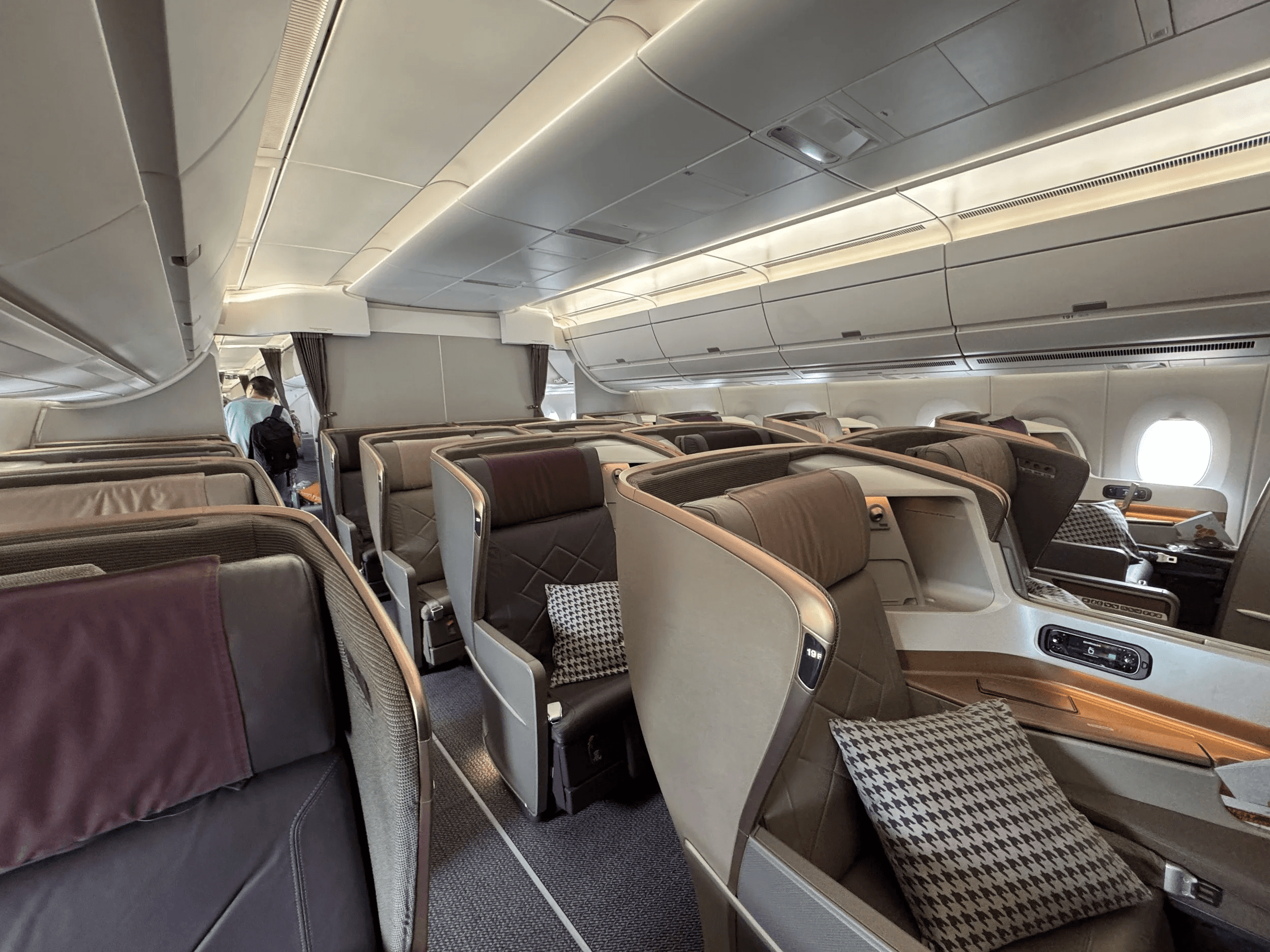
Singapore Airlines dominates this route with the best Business Class product (A350-900 true window seats in Rows 15–16), but Japan Airlines and ANA offer competitive Premium Economy. Avoid Row 11 in Business on SQ due to galley noise. The critical gotcha: SQ's Premium Economy cabin (Rows 31–33) fills within hours of opening; book early or accept a long wait.
TL;DR
Singapore Airlines' A350-900 Business Class offers the best product on SIN ↔ HND with true alternating window seats in the quiet mid-cabin zone (Rows 15–16A/K); JAL and ANA lag in both hard product and cabin quietness. SQ Premium Economy (31–33) punches above its weight for a 7-hour flight but books out instantly—worth the premium if you can secure Rows 32–33 early. Economy is competitive across all three, but SQ's A350 offers the best seat width (18″) and recline system. Fly the overnight SQ flight (departing SIN ~23:55) to maximise sleep in Business; daytime departures waste the bed advantage. Route-specific insight: ANA and JAL sometimes operate narrowbody wet-leases on this route during peak season—always confirm aircraft before booking, as seat pitch drops from 32″ to 31″.
Airlines flying SIN ↔ HND
Singapore Airlines operates this route daily with the A350-900 (most frequent), supplemented by occasional A380 (Business Class only) on peak days. Japan Airlines (JAL) flies 1–2 daily with A350-900 and occasional Boeing 787-9 rotations. All Nippon Airways (ANA) operates 1–2 daily with A350-900 and 787-9, though winter peak season sometimes sees 777-300ER wet-leases with tighter configurations.
Business Class on SIN ↔ HND
Singapore Airlines' A350-900 Business Class is the clear winner: true window seats alternate each row (15A/K, 16A/K are the quiet-zone goldmine), with a full flat bed, direct aisle access for windows, and superior privacy compared to JAL and ANA. Avoid Row 11 entirely—it sits directly beside the forward galley and suffers from boarding noise, galley activity, and light spill during mealtimes. JAL and ANA offer comparable hard products (flat beds, IFE, amenities) but operate from narrower cabins on 787-9 rotations, reducing the per-seat sense of space. On a 7-hour overnight flight, SQ Business is the only choice; the alternating window privacy and mid-cabin positioning (away from both forward and rear galleys) make the difference between good sleep and interrupted rest.
Best for each cabin
Cabin | Winner | Why |
|---|---|---|
Business | Singapore Airlines A350-900, Rows 15–16 A/K | True alternating window seats in quietest mid-cabin zone; 7-hour night flight optimises flat-bed sleep; full aisle access for window seats. |
Premium Economy | Singapore Airlines A350-900, Rows 32–33 A/C/H/K | Three-row private cabin; best noise isolation from Economy; bulkhead Row 31 adds legroom option; fills within 48 hours. |
Economy | Singapore Airlines A350-900, Exit Row 47 A/K | 38″ extra legroom; 18″ seat width; true window seats; quiet forward zone; complimentary WiFi; best recline mechanism. |
Avoid on this route
Cabin | Avoid | Why |
|---|---|---|
Business | Singapore Airlines A350-900, Row 11 (all seats) | Directly adjacent to forward galley; boarding noise, mealtimes light spill, constant foot traffic during service. |
Business | Japan Airlines 787-9, any Business seat | Narrower cabin limits window-seat privacy; more mid-cabin lavatories (Rows 17–19) audible in quieter sections. |
Premium Economy | All carriers, Row 31 D/E/F/G | Bulkhead middle seats; bassinet placement risk; galley proximity; no direct aisle access. |
Economy | All carriers, Rows 60–62 (all seats) | Rear galley and lavatory noise; odour bleed; last-to-exit positioning; minimal recline due to bulkhead. |
Economy | All carriers, middle seats B/E/J (all rows) | No window or aisle access; worst passenger experience on 7-hour flight. |
🌏 Schedule Reality on a 7-Hour Asian Long-Haul
SIN ↔ HND operates across three distinct schedule patterns, and timing dramatically affects sleep quality and jet-lag recovery:
Singapore Airlines (SQ) – Daytime departure (typically 10:50–11:35 SIN) arrives Tokyo 19:45–20:30 same day. Ideal for hotel arrival and evening settling; minimal sleep opportunity in-flight, so Business bed value is lower. Best for first-time visitors needing evening exploration.
Japan Airlines (JL) & All Nippon Airways (NH) – Overnight departures (typically 23:30–00:45 SIN) arrive Tokyo 07:00–08:00 next morning. Full 6–7 hours of potential sleep in-flight. Business Class and Premium Economy win decisively here; Economy passengers sleep upright, compounding jet-lag on arrival.
Verdict: Book the overnight departure (JL/NH) in Business if you have the budget—you'll sleep the entire flight and arrive refreshed in Tokyo morning, ready for immediate productivity or sightseeing. Book the daytime SQ departure in Economy if budget-conscious; you'll have evening activity planned anyway. Premium Economy passengers should avoid the daytime flight entirely (no bed, no proper lie-down space); overnight only makes sense for that cabin.
🏆 Cabin Class Verdict
Business Class: Singapore Airlines' A350 Business (true 1-2-1 window seats, 6'8" bed, direct aisle access for every seat) is the benchmark for this route and arguably the best long-haul Business product in Asia. Japan Airlines' Boeing 787 or Airbus A350 offers solid mid-range herringbone seating and excellent service; All Nippon Airways matches JAL broadly but with quieter cabin ambience. Avoid legacy carriers' older widebodies (if any remain) with reverse herringbone confined to aisles. Winner: Singapore Airlines by a significant margin.
Premium Economy: Singapore Airlines offers a genuinely premium PE cabin (rows 31–33, 32" pitch, direct aisle access, footrests, amenity kit). Japan Airlines and ANA also offer PE but with tighter configurations. For 7 hours, SQ's PE is worth the premium over Economy; JAL/ANA PE is a softer upgrade. Value verdict: SQ Premium Economy offers genuine rest on a 7-hour flight; JAL/ANA PE is marginal unless price is heavily discounted.
Economy: Singapore Airlines A350 Economy delivers 32" pitch with a well-engineered recline and a proper two-service meal structure (light meal + breakfast on overnight; snack + lunch on daytime). JAL and ANA match or slightly exceed that legroom (often 32–33") and serve comparable meals. All three carriers treat 7 hours as a true meal service, not a sandwich run. Winner: All three are equivalent; choose on schedule or price. Avoid Middle seats (B/E/J) entirely—no window, no aisle access, claustrophobic on a 7-hour flight.
🍽️ Food & Service
Business Class standout: Singapore Airlines' Business menu on the overnight SIN ↔ HND flight showcases Japanese and Southeast Asian cuisine—expect a multi-course dinner (appetiser, soup, main with regional protein, cheese/dessert), a snack service ~4 hours later, and a hot breakfast 90 minutes before landing in Tokyo. Japan Airlines' overnight service rivals this with Japanese-centric menus and outstanding sake/wine pairings. All Nippon Airways delivers similar quality but with slightly less ceremony. Advantage: Singapore Airlines and Japan Airlines (tie); ANA is competent but less distinctive.
Wine List: Singapore Airlines' Business Class wine programme on long-haul Asian routes is among the strongest in the industry—expect a curated list spanning Burgundy, Bordeaux, Champagne, and premium Japanese sake. Japan Airlines offers an underrated sake selection and solid French/Italian wines. All Nippon Airways' wine list is functional but uninspired. Best: Singapore Airlines. Worst: ANA (underperforming for route length).
Economy standout: All three carriers serve a hot meal on overnight flights (typically noodles, rice bowl, or curry) plus a light breakfast, positioning 7 hours as genuine feeding, not a token snack. Daytime SQ flights serve a lighter sandwich/salad model (no hot meal mid-journey). Overnight Economy wins significantly over daytime for meal experience.
💳 Award Booking Sweet Spot
Business Class award pricing (typical, peak season):
Singapore Airlines KrisFlyer: 80,000–100,000 miles one-way (Business Saver to Business Flex)
Cathay Pacific Asia Miles: 70,000–90,000 miles one-way (depending on cabin release)
Japan Airlines Mileage Bank: 80,000–100,000 miles one-way
All Nippon Airways ANA Mileage Club: 75,000–95,000 miles one-way
Best value redemption: KrisFlyer (Singapore Airlines) offers consistent Business availability on the SQ flights at 80,000 miles and does not impose fuel surcharges, making it the cleanest redemption math. Asia Miles (Cathay Pacific) on JAL/ANA partners sometimes unlocks premium cabin seats at 70,000 miles during off-peak windows, but fuel surcharges can add $150–300 USD per ticket. JAL Mileage Bank favours Japanese residents; international redemptions are competitive but require timing.
Advance-booking strategy: Business Class seats on overnight flights (JL/NH) open 330 days out and fill 45–60 days pre-departure. Book immediately on opening day if targeting premium dates (April–May, October–November). Daytime SQ flights show lighter demand; book 90–120 days out for premium seats. Last-minute release: All three carriers occasionally dump Business inventory 7–14 days before departure if loads are soft; set up alerts with award booking tools (ExpertFlyer, etc.) for final-week surprises, particularly on shoulder-season dates.
Final verdict: Use KrisFlyer for maximum simplicity; target 80,000 miles on an overnight JL/NH departure for the best sleep experience. If you're a Cathay/ANA frequent flyer, monitor Asia Miles / Mileage Bank rates 90 days out; they sometimes undercut KrisFlyer pricing mid-search.
What is the best airline for SIN ↔ HND in Business Class?
Singapore Airlines A350-900. Book Rows 15–16 (A/K seats, window positions). The alternating true-window configuration, quiet mid-cabin location, and superior privacy far outweigh JAL and ANA. For overnight departures (SQ ~23:55), the value proposition is unmatched on a 7-hour flight.
How long is the flight from Singapore to Tokyo Haneda?
Block time is ~7 hours (SIN to HND); return flights (HND to SIN, westbound) are typically 6.5 hours due to jet streams. This is classified as intra-Asia long-haul. Overnight departures from SIN arrive Tokyo early morning; daytime departures arrive late evening, losing the sleep advantage of Business flat beds.
Which airline has the best Economy on SIN ↔ HND?
Singapore Airlines A350-900 with 32″ pitch and 18″ width. Prioritise Exit Row 47 (A/K for true window seats, 38″ pitch) if available; otherwise Rows 41–45 offer the quietest standard Economy experience. Always confirm aircraft type—ANA and JAL occasionally operate tighter 787-9 (31″ pitch) in off-peak periods.
Is Premium Economy worth it on SIN ↔ HND?
Yes, but only on Singapore Airlines and only if Rows 32–33 are available at booking. The typical premium is +$400–800 USD over Economy; for a 7-hour overnight flight with cabin isolation and superior quiet, this is justified. However, do not book Row 31 (bulkhead middle seats risk) or accept JAL/ANA Premium Economy unless Business is sold out—the advantage over their Economy is minimal. If SQ Rows 32–33 are unavailable, take Economy Exit Row 47 instead; it's cheaper and nearly as comfortable.
What is the route-specific gotcha on SIN ↔ HND?
ANA and JAL occasionally operate narrowbody wet-leases (Boeing 777-300ER with 31″ pitch) on this route during winter peak season when A350/787 fleet constraints hit. Always confirm aircraft in the booking engine—a 31″ Economy pitch on a 7-hour flight is materially worse than SQ's standard 32″. Additionally, SQ's Premium Economy cabin (Rows 31–33) books out within 48 hours of opening; if you cannot secure it immediately at seat selection, wait-list aggressively or accept Economy Exit Row instead.
Why do some SQ Business seats have better windows than others?
SQ's A350-900 Business Class features alternating true window seats (Rows 15–16 A/K are true windows; 15D/F and 16D/F are centre/aisle seats with no direct window access). This is intentional design for privacy and common on modern flat-bed carriers. Always check the live seat map before booking; never assume a Business seat = window seat on this route.
Which Economy seats have misaligned or missing windows on SQ?
Rows 49–55 occasionally have windows that do not align with seating positions due to fuselage frame design. This is sporadic and varies by aircraft serial number. Check the live interactive seat map 24 hours before departure; if a window is misaligned, contact SQ to swap to an adjacent row before boarding.
sin, hnd, singapore, tokyo haneda, route guide, intra_asia_long, 2026, business class, premium economy, economy, best airlines, singapore airlines, japan airlines, ana, all nippon airways, a350, 787