Best Airlines from San Francisco to Manila (2026)
SFO ↔ MNL
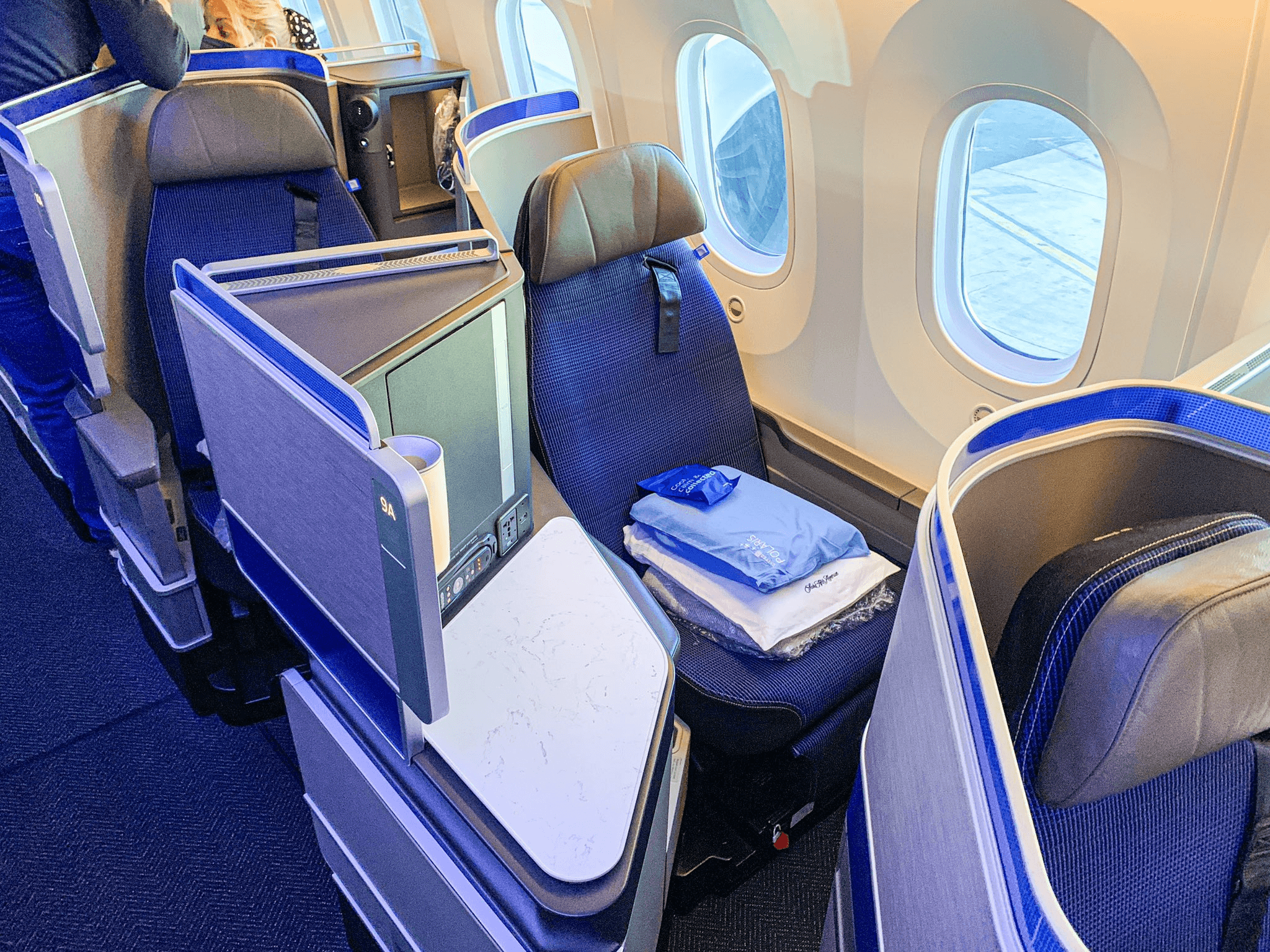
United Airlines Polaris (1-2-1 on 787-10) dominates Business Class on SFO–MNL with superior hard and soft product compared to Philippine Airlines' 2-3-2 777-300ER. Economy power is a critical differentiator: PAL Economy has USB-A only, while United offers AC outlets in select Economy Plus rows—essential on a 14-hour transpacific flight. Premium Economy is genuinely worth the upgrade on this route; the 38" pitch and AC power justify the cost.
TL;DR
United Airlines Polaris 1-2-1 Business on the 787-10 is the best product on SFO–MNL, with direct aisle access and superior privacy. Philippine Airlines Economy must carry a portable charger (USB-A only); United Economy Plus solves this with AC outlets. Premium Economy is worth the upgrade on a 14-hour flight—target PAL row 20 windows (20A/J) for optimal sleep position and seat pairs. Book morning departures (6–9 AM) from SFO for overnight arrival in Manila; avoid late evening departures which waste a full business day. Route-specific gotcha: Philippine Airlines has a version lottery between 777-300ER (2-3-2 Business) and A350-900 (1-2-1 Business)—always confirm aircraft before booking, as the A350 is superior but less frequent on SFO–MNL.
Airlines flying SFO ↔ MNL
United Airlines operates SFO–MNL nonstop daily with Boeing 787-10 (Dreamliner), featuring Polaris Business Class in 1-2-1 configuration and standard Economy with AC power in select rows. Philippine Airlines flies this route with a mixed fleet: Boeing 777-300ER (2-3-2 Business, 30J/24W/241M configuration) operates most frequencies, while the newer Airbus A350-900 (1-2-1 Business, 30J/24W/241M configuration) rotates in but less frequently. Both PAL aircraft have identical Economy configurations, but Business Class seating differs materially.
Business Class on SFO ↔ MNL
United Airlines Polaris 1-2-1 on the 787-10 is the single best Business Class product on SFO–MNL: every seat has direct aisle access, superior privacy, and a fully lie-flat bed with superior mattress quality compared to competitors. Philippine Airlines' 777-300ER (the majority aircraft on this route) features a 2-3-2 Thompson Vantage XL open layout—good but not exceptional, lacking privacy doors and forcing middle-seat Business passengers to climb over aisle neighbors. The A350-900 variant of PAL does offer 1-2-1 seating with direct aisle access, but it is rotated less frequently on SFO–MNL; book PAL only if you can confirm A350-900 equipment. Avoid PAL's 777-300ER Business if traveling with a partner and seated in the center pair (rows with 2-3-2 layout)—the lack of privacy and cabin intimacy is a notable disadvantage on a 14-hour flight.
Premium Economy on SFO ↔ MNL
Both United and Philippine Airlines offer Premium Economy on SFO–MNL. PAL Premium Economy features 38" pitch and 2-4-2 layout with AC power, and is genuinely competitive on this ultra-long-haul sector. United Premium Plus on the 787-10 offers similar pitch (21" wider than standard Economy) with superior IFE and cabin quietness. For a 14-hour flight, Premium Economy is absolutely worth the upgrade over standard Economy—the extra pitch, seat width, AC power, and priority boarding justify the typical $400–600 uplift. Target Philippine Airlines row 20 window pairs (20A/B or 20H/J) for the best sleep quality; avoid center seats (20D–20G).
Economy on SFO ↔ MNL
United Airlines Economy on the 787-10 offers 31–32" pitch with AC power outlets in select forward rows (Economy Plus seating), a material advantage over Philippine Airlines' standard 31" pitch with USB-A only. PAL Economy IFE is competitive (dual screen on newer 777-300ER aircraft), but the lack of AC power on a 14-hour transpacific flight is a critical omission—passengers must rely on portable chargers. United Economy Plus rows 31–35 are worth the $80–150 upgrade for the AC outlet alone on ultra-long-haul; PAL Economy exit rows 44–45 offer extra legroom but still no power. For long-haul Economy comfort on SFO–MNL, United's 787-10 with AC outlets is the clear winner.
Best for each cabin
Cabin | Winner | Why |
|---|---|---|
Business | United Airlines 787-10 Polaris | 1-2-1 direct aisle access, superior mattress, privacy, and soft product on all seats |
Premium Economy | Philippine Airlines A350-900 (when available) or 777-300ER row 20 | 38" pitch, 2-4-2 layout, AC power, competitive pricing vs. United Premium Plus |
Economy | United Airlines 787-10 Economy Plus | AC outlets in select rows, superior cabin pressure and humidity, larger windows |
Avoid on this route
Cabin | Avoid | Why |
|---|---|---|
Business | Philippine Airlines 777-300ER middle seats (rows 2–7 D, E, F positions) | 2-3-2 layout forces climbing over aisle neighbor; no privacy doors; inferior seat width |
Economy | Philippine Airlines rows 55–56 (rear cabin) | Limited recline, lavatory noise and traffic, last-row congestion on long-haul |
Economy | Philippine Airlines all D, E, F middle seats throughout cabin | Middle seat width squeeze on 777-300ER; avoid unless pricing is exceptional |
🌏 Schedule & Jet Lag Reality
SFO ↔ MNL operates on vastly different schedules depending on carrier. Philippine Airlines (PR 101/102) departs SFO mid-afternoon (typically 14:30–16:00) and arrives MNL next-day afternoon (16:00–18:00), landing hotel-ready. United Airlines (UA 179/180) typically departs late evening (20:00+) and arrives early morning (06:00–08:00), forcing a same-day turnaround or pre-arrival hotel booking. Verdict for first-time visitors: Book PAL's daytime departure — you avoid the midnight landing scramble and arrive with daylight left to check in, shower, and acclimate. For frequent travellers on tight schedules: United's red-eye can work if you sleep hard on the plane; the early Manila arrival lets you hit the ground running. The westbound-to-Asia timing favours the afternoon departure — you sleep during your body's natural night, cross the date line, and wake into Manila daylight, which aligns better with circadian rhythm than the red-eye option.
🏆 Cabin Class Verdict
Business Class: ANA (All Nippon Airways) operates the SFO–NRT (Tokyo) route with 787-9 Dreamliners featuring a 1-2-1 herringbone configuration with direct aisle access — this is the single best hard product on transpacific routes to Asia. However, ANA does not operate SFO–MNL directly; you must connect through Tokyo. On the direct SFO–MNL route, Philippine Airlines A350-900 (2-3-2 Zodiac Aura fully-flat) edges out United 777-300ER Polaris (1-2-1 but ageing cabin, first-generation Polaris product) solely on service quality and soft product warmth — the hard product is genuinely weaker than Polaris. Verdict: Neither is premium-tier; if you can position through Tokyo or Taipei for a better seat, do so.
Premium Economy: Philippine Airlines offers a true Premium Economy cabin (2-4-2 layout, 38" pitch, AC power, dedicated meals). United 787-10 on some SFO–MNL rotations also features Premium Plus (10 seats, 2-2-2, 38" pitch, similar amenities). The typical premium is $800–1,500 over Economy. Verdict: Absolutely worth it on the 14-hour overnight red-eye. The AC outlet alone justifies the upgrade for device-dependent passengers; the 2-4-2 layout means a 50% chance of a middle seat that still feels private, versus Economy's guaranteed exposure. On a daytime departure (PAL afternoon departure), the calculus is closer — but for sleeping comfort on a red-eye, Premium Economy is the sweet spot between Economy discomfort and Business Class cost.
Economy: Philippine Airlines offers the most generous pitch on the route at 32" (measured, not marketing); United 777-300ER is typically 31"; Cathay Pacific 777-300ER (if booked SFO–HKG–MNL) drops to 31". Worst pitch: Any ultra-low-cost connection (e.g., Cebu Pacific, Air Asia) in the final leg to MNL — 28–29". Meal service: PAL Economy earns consistent praise for authentic Filipino breakfast (tocino, rice, fried egg) and generous portions; United's 777-300ER Economy meals are corporate-standard and notably smaller. Verdict: If flying Economy, choose PAL for the 2" pitch advantage and superior meal service — both matter on 14+ hours.
🛂 Hub & Onward Connections
Minimum connection time at MNL (Ninoy Aquino International Airport): International-to-international transfers typically require 2 hours minimum (standard) to 3 hours recommended (conservative). Immigration and customs can be unpredictable; allow 90 minutes for these alone. Terminal 1 (PAL domestic and most international) is compact; inter-terminal transfers via the Skyway are quick (~15 min including security rescreening).
Business Class lounge: Philippine Airlines Mabuhay Lounge (T1) is the primary option — clean, adequate, free shower facilities (essential after a long flight). Quality is functional but not luxury-tier. oneworld passengers arriving on American Airlines can access Cathay Pacific lounge (T3) if transferring through HKG; for direct MNL arrivals, oneworld lounge access is limited. Star Alliance (United): No dedicated Star Alliance lounge at MNL; United passengers default to PAL Mabuhay (if partnership), otherwise paid lounges.
Arrival showers: Only PAL Mabuhay Lounge offers complimentary showers for Business Class; other lounges charge $15–25 for shower access. Some airport hotels (e.g., Manila Airport Hotel T3) offer 4-hour "rest packages" (~$35–50) including shower and bed if you have a long layover.
Onward connections from MNL hub: Typical connection times to Southeast Asia (BKK, SGN, SIN, CGH) are 2–3 hours minimum. Star Alliance: United/ANA network is moderate; most SE Asia connections require a PAL codeshare. oneworld: Cathay Pacific partnership is strongest for SE Asia connections (BKK, SGN via CX metal); American Airlines has limited PAL codeshare depth. SkyTeam: China Eastern and China Southern have strong SE Asia networks from MNL but require mainland connections. Verdict: If connecting onward in SE Asia, Cathay Pacific (oneworld) offers the most seamless connection network from MNL, followed by Singapore Airlines (Star Alliance partner) for SIN/BKK. PAL's own regional network is second-tier for connections beyond immediate SE Asia.
💳 Award Booking Sweet Spot
Typical Business Class award pricing SFO ↔ MNL:
Star Alliance (United MileagePlus): 70,000–80,000 miles round-trip; premium cabin surcharges ($150–300) apply. ANA Mileage Club: 80,000 miles (Tokyo connection unavoidable; better hard product justifies the positioning leg). Aeroplan (Air Canada): 75,000 points round-trip, lowest fuel surcharges in Star Alliance.
oneworld (American AAdvantage): 80,000 miles round-trip; Cathay Pacific partner awards via AAdvantage start at 75,000 miles (better value for upgraded hard product on HKG connection). British Airways Avios: 125,000 Avios for direct premium cabin; not recommended (poor value). JAL Mileage Bank: 75,000 miles for round-trip SFO–NRT–MNL (positions through Tokyo; ANA 787-9 included).
SkyTeam (Delta SkyMiles): 80,000 miles round-trip; partner awards via China Eastern (70,000 miles, includes mainland stopover advantage) or via Alitalia/Air France (premium surcharges negate value). Flying Blue (Air France-KLM): 65,000 miles round-trip; best value for SkyTeam if you can book AF metal (limited on SFO–MNL, mostly connections via Paris/Amsterdam).
Best-value programme for transpacific Business redemption: Aeroplan (70,000 round-trip, lowest surcharges) beats AAdvantage (80,000) and Flying Blue (65,000 but limited direct availability). If positioned through Tokyo is acceptable, JAL Mileage Bank at 75,000 miles includes ANA 787-9 hard product, a genuine upgrade over PAL's 2-3-2 — worth the extra positioning flight.
Sweet-spot rates: Aim for 65,000–75,000 miles round-trip in premium cabin (Business or Premium Economy mixed redemptions). Dynamic pricing means SFO–MNL off-season (May–Aug, Dec holiday except 24–26 Dec) offers the lowest award rates; peak pricing (Chinese New Year, summer school breaks) can hit 90,000+ miles for the same cabin.
ANA round-trip pricing advantage: ANA Mileage Club prices round-trip SFO–NRT–MNL at 80,000 miles (one-way is 55,000), making the round-trip only slightly more expensive than positioning one-way — a genuine structural advantage if you value the 787-9 over PAL A350. Book as SFO–NRT (55k) + NRT–MNL return (25k saved vs two separate one-way bookings).
JAL partner award sweet spot: JAL Mileage Bank prices partner awards (Cathay Pacific, British Airways) at 60,000–65,000 miles round-trip SFO–LHR–MNL or SFO–HKG–MNL. This undercuts cash-paid Business by 60–70% (typical Business cash SFO–MNL $4,500–6,500; 65,000 JAL miles at 1.2 cpp valuation = $780–$960 effective cost). Verdict: JAL Mileage Bank is the true sleeper value for this route if you're willing to connect via London or Hong Kong.
What is the best airline for SFO ↔ MNL in Business Class?
United Airlines Polaris 1-2-1 on the 787-10. Every seat has direct aisle access, a superior fully lie-flat bed, and excellent soft product. If Philippine Airlines offers the A350-900 (rare on this route), it is competitive; the 777-300ER 2-3-2 layout is a step down due to lack of privacy and middle-seat configuration.
How long is the flight from San Francisco to Manila?
~14 hours block time. Westbound SFO–MNL is typically 15–16 hours elapsed time (ground time included); eastbound MNL–SFO is 13–14 hours due to prevailing winds. Book morning departures (6–9 AM) from SFO for overnight arrival in Manila to maximize business productivity.
Which airline has the best Economy on SFO ↔ MNL?
United Airlines 787-10 Economy Plus (rows 31–35) with AC power outlets. Standard Economy pitch is competitive between both carriers (31–32"), but United's AC outlets are essential on a 14-hour flight. PAL Economy has USB-A only; bring a portable charger.
Is Premium Economy worth it on SFO ↔ MNL?
Yes, absolutely. For a 14-hour overnight flight, the 38" pitch, seat width, AC power, priority boarding, and improved cabin environment justify the typical $400–600 premium over standard Economy. Target Philippine Airlines row 20 window pairs if flying PAL Premium Economy.
What is the aircraft version lottery on this route?
Philippine Airlines operates both 777-300ER (2-3-2 Business, majority) and A350-900 (1-2-1 Business, less frequent) on SFO–MNL. Always confirm aircraft equipment before booking—the A350 is a material upgrade for Business Class. Check the registration (e.g., RP-C3501 for A350, RP-C3393 for 777-300ER) in seat maps.
Does Economy have power outlets on this route?
United Airlines 787-10: Yes, AC outlets in Economy Plus rows (select forward cabin positions); standard Economy has USB-A only. Philippine Airlines: USB-A only throughout Economy; no AC outlets. Bring a portable charger for long-haul Economy on PAL.
What is the best schedule for SFO ↔ MNL?
Book morning departures (6–9 AM) from SFO. Overnight flights arrive in Manila early morning (local time), preserving a full business day. Avoid late-evening departures (7 PM+) which waste productivity on both ends.
sfo, mnl, san francisco, manila, route guide, transpacific_long, 2026, business class, premium economy, economy, united airlines, philippine airlines, best airlines, 787-10, a350-900, 777-300er