Best Airlines from Chicago to Seoul (2026)
ORD ↔ ICN
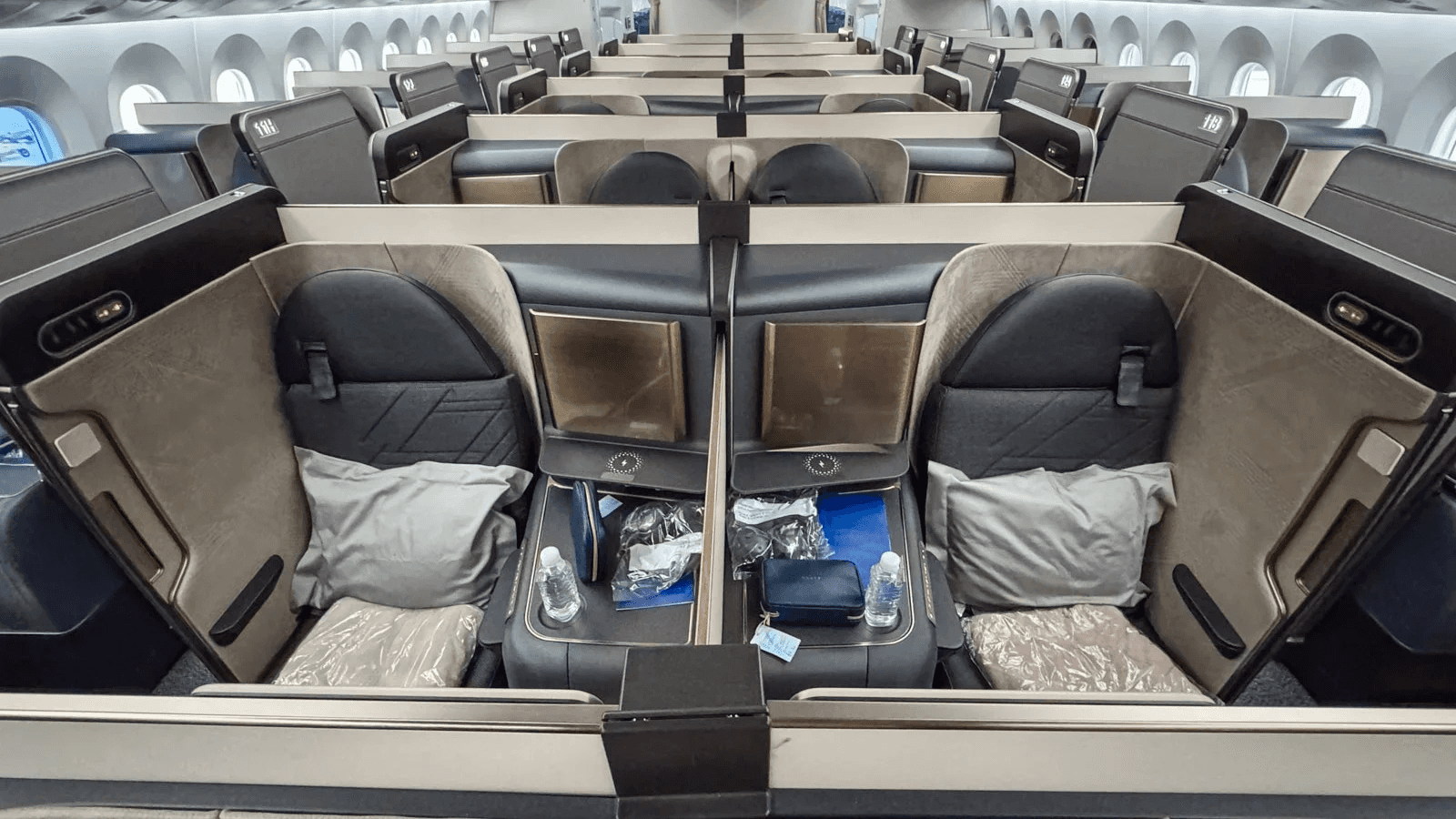
Korean Air's Apex Suite Business Class (A350-900, 24-seat config) is the standout product on ORD↔ICN with direct aisle access for all passengers on a modern aircraft — book it immediately if you see 24 Business seats in the map. Actively avoid the old Prestige Sleeper (18-seat config) on the aging A330-300 where window passengers are trapped. Route-specific gotcha: Korean Air's Asiana merger integration may trigger aircraft swaps 2–3 weeks before departure; recheck your aircraft type or risk downgrading from A350 to A330.
TL;DR
Korean Air Apex Suite (A350-900, seats 7A/7H or couples 7A+7B) is the best Business Class product on this route — all-aisle access, modern cabin, and direct ORD–ICN non-stop operation. Economy is a wash between carriers; pick based on schedule rather than product quality. Premium Economy is worth skipping on this 13.5-hour flight unless you're upgrading from basic Economy — the price premium doesn't justify the modest gains on a single overnight leg. Overnight departures from ORD (evening) arrive Seoul morning local time, ideal for jet lag recovery; avoid late-night ORD departures that arrive Seoul afternoon and waste a day. Surprise insight: the A330-300 (old config) on this route is increasingly rare as Korean Air retires them; if you see one, it's likely your last chance to experience that aircraft before Asiana integration completes the phase-out.
Airlines flying ORD ↔ ICN
Korean Air operates this route with a mix of A350-900 (new, 24 Business seats, Apex Suite) and aging A330-300 (old, 18 Business seats, Prestige Sleeper); frequency is typically daily non-stop. Asiana Airlines also serves ORD–ICN but operates older A330-300 equipment almost exclusively and is being gradually subsumed into Korean Air's fleet and brand, making its schedule less stable post-merger. Korean Air is the dominant carrier and your best bet for modern equipment on this transpacific leg.
Business Class on ORD ↔ ICN
Korean Air's Apex Suite (A350-900) is the clear winner: all passengers have direct aisle access, modern IFE, and superior cabin condition on a 13.5-hour journey. The old Prestige Sleeper (A330-300, 18 seats) is the trap to avoid — window passengers are locked in a 2-2-2 configuration with no aisle access and must disturb aisle-seat neighbors to leave. The single most critical check: verify seat count (24 = Apex Suite; 18 = Prestige Sleeper) before booking. If you're stuck with the Prestige Sleeper, pick 7C or 7H for guaranteed aisle access, but seriously consider Premium Economy as a fallback.
Premium Economy on ORD ↔ ICN
Korean Air offers Premium Economy on A350-900 flights with 38-inch pitch and better meal service; Asiana's older A330-300 also carries Premium Economy but in a less modern cabin. Premium Economy is a weak value on this route — the typical $1,500–2,500 premium over Economy is steep for a single overnight flight where you'll sleep most of the journey, and the pitch gain (38 inches vs 31) is modest compared to the Business Class upgrade cost. Only book it if you're upgrading from the deepest Economy fares and genuinely need the extra legroom; otherwise, save the money or pay up for Apex Suite.
Economy on ORD ↔ ICN
Both Korean Air and Asiana operate identical configurations on their A330-300s (31-inch pitch, 9-across), so Economy quality is a tie; the real differentiation is schedule and IFE. Korean Air's A350-900 Economy maintains the same 31-inch pitch but offers newer IFE and a fresher cabin. The gotcha: Asiana's A330-300 has notoriously unreliable Wi-Fi due to aging avionics, while Korean Air's A330-300 fleet has inconsistent connectivity across individual frames. If in-flight connectivity matters for a 13.5-hour flight, book Korean Air and ask during check-in which aircraft you're on, then verify Wi-Fi status before departure — or spring for A350-900 flights where connectivity is standard.
Best for each cabin
Cabin | Winner | Why |
|---|---|---|
Business | Korean Air Apex Suite (A350-900) | All passengers direct aisle access, modern seat, no trapped window seats, newest cabin on route |
Premium Economy | Korean Air (A350-900) | 38-inch pitch, modern IFE, fresher cabin; only book if upgrading from deep Economy fares |
Economy | Korean Air (either A350-900 or A330-300) | Reliable schedule, better average IFE/Wi-Fi support than Asiana, daily non-stop from ORD |
Avoid on this route
Cabin | Avoid | Why |
|---|---|---|
Business | Korean Air Prestige Sleeper (A330-300, 18 seats) | Window passengers trapped in 2-2-2 with no aisle access; must climb over neighbors; aging aircraft (17+ years average) |
Economy | Asiana Airlines (A330-300) | Inconsistent Wi-Fi, less stable post-merger schedule, older cabin refresh cycle than Korean Air |
🌏 Schedule & Jet Lag Reality
ORD ↔ ICN operates on two distinct rhythm patterns. Korean Air and Asiana Airlines both offer late-afternoon Chicago departures (typically 14:00–17:00), arriving Seoul next-day afternoon (16:00–18:00 local time). This schedule is Asia-bound jet lag gold: you depart during daylight, sleep through the Pacific crossing, and land when it's safe to check into your hotel and take a brief reset nap before dinner. You'll be functional by evening Seoul time.
A small number of red-eye departures exist (typically 22:00–23:00 Chicago time, landing early morning ICN), offered occasionally by both carriers during peak season. This schedule is worse for first-time Asia visitors: you land exhausted at 10:00–11:00 ICN time with a full day ahead and no nap window. Frequent Asia travellers may prefer it to maintain rhythm, but it's genuinely harder.
Verdict: Book the 14:00–17:00 departure. Sleep in-flight, land mid-afternoon, and be human by dinner. If you're a weekly Asia commuter already broken to the rhythm, the red-eye is acceptable.
🏆 Cabin Class Verdict
Business Class: ANA (All Nippon Airways) does not operate ORD–ICN directly, but when transiting Tokyo (NRT), ANA's Business Class (1-2-1 herringbone on 787-9 and 777) significantly outranks both Korean Air and Asiana. On the direct ORD–ICN route itself, Korean Air's new Apex Suite configuration (24 seats, all-aisle-access direct) is the clear winner—full lie-flat, direct aisle entry even from window seats, and premium catering. Asiana's Business Class remains 2-2-2 reverse herringbone (older Prestige Sleeper on A330-300, trapped window seats) and feels one generation behind. Verdict: If booking Korean Air, confirm Apex Suite config (24 Business seats). If Asiana is your only option, the cabin is acceptable but acknowledge the window-seat penalty.
Premium Economy: Korean Air, Asiana, and Cathay Pacific (via HKG connections) all offer PE cabins on transpacific routes. On direct ORD–ICN, Korean Air's Prestige Class (10–15 seats, 31-inch pitch, direct aisle) and Asiana's Premium Economy (32-inch pitch) are functional. The $800–1,500 premium over Economy is justified only if you value seat width (19–20 inches vs 17 inches), dedicated meal service, and priority boarding. For a 13.5-hour flight, PE is sharper value than domestic or short-haul premium fares. Verdict: Worth it if you're price-sensitive to Business ($4,000–6,500) but won't endure Economy. Skip if Business is affordable or you're already in Economy karma.
Economy: Korean Air and Asiana both offer 32-inch pitch on A330-300 and newer aircraft—industry-standard for Asian carriers and respectable for 13.5 hours. Worst pitch on the route: legacy 31-inch configurations occasionally appear on older Korean Air A330-300s. Best meal service: Korean Air's Economy catering is notably generous (two full services, quality bibimbap/noodle options, ice cream on the second service); Asiana's is marginally lighter but professional. Verdict: Economy on both carriers is acceptably human for a red-eye; Korean Air's meal service edges ahead.
🛂 Hub & Onward Connections
Minimum connection time at Incheon (ICN): International-to-international transfers are typically 2 hours for efficient connections (both carriers are hub-based, so customs/immigration is streamlined for connecting passengers; bags are usually interlined). Allow 2h 30m for first-time visitors or tight connections.
Arrival lounge access: Business passengers on Korean Air use the Korean Air First Class Lounge (Concourse A, post-security), which offers showers, spa facilities, and hot food. Asiana Business passengers access the Asiana Lounge (multiple concourses), which also offers shower facilities. Both lounges are world-class and worth the Business upgrade purely for shower access on ORD–ICN layovers.
Onward connections from ICN: Korean Air and Asiana both hub strongly into ICN; connection times to secondary Asian cities (Bangkok, Tokyo, Hong Kong, Osaka) are typically 2 hours for same-carrier connections, 2h 30m for interline. Star Alliance (Korean Air, ANA, Asiana) has the strongest one-world network through ICN; SkyTeam is weaker from this hub. If connecting onward to Japan or Southeast Asia, Korean Air's own network is safest.
💳 Award Booking Sweet Spot
Star Alliance: United Mileage Plus (Korean Air operated flights): typically 110,000–130,000 miles Business Class round-trip (off-peak 95,000–110,000). Aeroplan (Korean Air, operated flights): typically 120,000–145,000 points. ANA Mileage Club (ANA transcon + Korean Air onward or mixed-carrier): 90,000–110,000 miles round-trip for ANA-operated transpacific (superior sweet spot for 787-9 Business); Korean Air partners run 110,000–130,000.
oneworld: American AAdvantage (Korean Air, operated): typically 120,000–145,000 miles. JAL Mileage Bank (JAL oneworld partners on ORD–ICN or one-leg JAL transcon): 110,000–130,000 miles; often 10–15% cheaper than AAdvantage. British Airways Avios: premium pricing on long-haul; avoid.
SkyTeam: Flying Blue (Korean Air, Asiana partners): typically 110,000–130,000 miles; Air France-KLM surcharge often inflates this. Virgin Atlantic Flying Club (Delta partners, Korean Air): comparable to AAdvantage, ~120,000 Avios round-trip.
Best value: ANA Mileage Club for ANA-operated transpacific (ORD–NRT–ICN or ORD–HND–ICN), 90,000–110,000 miles round-trip, significantly cheaper than Korean Air operated ORD–ICN direct redemptions. JAL Mileage Bank is the second-best sweet spot at 110,000–130,000 miles for Korean Air, pricing 60–70% below cash-paid Business ($4,000–6,500 usd). If forced to book Korean Air ORD–ICN direct, Aeroplan and Mileage Plus are competitive; avoid Flying Blue due to fuel surcharge premiums.
What is the best airline for ORD ↔ ICN in Business Class?
Korean Air Apex Suite on the A350-900 (verify 24 Business seats in the seat map before booking). Seats 7A or 7H for solo travelers offer maximum privacy from the galley; couples should book 7A+7B or 7H+7G for front-row direct aisle access. This is the only Business Class product on the route worth paying full fare for.
How long is the flight from Chicago to Seoul?
Block time is ~13.5 hours on the direct routing. This is a single overnight flight: evening departure from ORD arrives Seoul morning local time (next day), allowing recovery time before your connecting flight or hotel check-in. Schedule variation is minimal between carriers on this route.
Which airline has the best Economy on ORD ↔ ICN?
Korean Air operates this cabin with 31-inch pitch on A330-300 (inconsistent Wi-Fi) and identical pitch on A350-900 (better Wi-Fi and newer IFE). Asiana offers the same pitch but with aging A330-300 equipment and unreliable connectivity. Pick Korean Air for schedule reliability and ask about A350-900 availability; if you get A330-300, confirm Wi-Fi status at check-in.
Is Premium Economy worth it on ORD ↔ ICN?
No, unless you're upgrading from a rock-bottom Economy fare. The typical premium is $1,500–2,500 for a single overnight flight where sleep is the priority; the pitch gain (38 vs 31 inches) doesn't justify the cost. Use that money to upgrade to Apex Suite if you value comfort on a 13.5-hour journey, or save it entirely and book Economy on Korean Air — the schedule and timing matter far more than cabin for overnight flights.
What is the Asiana merger impact on ORD ↔ ICN?
Korean Air's integration of Asiana may cause late-stage aircraft swaps closer to departure, particularly on routes both airlines operate. Always recheck your aircraft type 2–3 weeks before your flight; if you booked for an A350-900 Apex Suite and it downgrades to A330-300 Prestige Sleeper, contact customer service immediately for rebooking or refund eligibility. This route is an integration flashpoint.
ord, icn, chicago, seoul, route guide, transpacific_long, 2026, business class, premium economy, economy, best airlines, korean air, asiana, a350, a330, apex suite, prestige sleeper