Best Airlines from London to Rome (2026)
LHR ↔ FCO
ITA Airways operates this short-haul with their A320 family and offers no Business Class on the route—only Economy and Premium Economy. British Airways flies LHR–FCO daily with A320/A321 aircraft, also without a premium cabin product. On a 2.75-hour flight, neither airline justifies Premium Economy; Economy is the rational choice, and schedule matters more than carrier.
TL;DR
There is no Business Class product on the LHR–FCO route; both British Airways and ITA Airways operate short-haul A320-family aircraft with only Economy and Premium Economy cabins. For a 2.75-hour flight, Premium Economy carries a 40–60% markup that is not justified by the brief flight duration or modest cabin improvements. British Airways Economy offers marginally better pitch (32 inches) than ITA Airways (31 inches) on comparable aircraft. Book an early morning departure to maximize daylight arrival in Rome; avoid late evening departures that arrive after 23:00 local time. The route-specific gotcha: both carriers occasionally swap aircraft on short notice, and A320 vs A321 configurations differ materially in seat density and comfort—confirm your exact aircraft type 48 hours before departure.
Airlines flying LHR ↔ FCO
British Airways operates this route with Airbus A320 and A321 aircraft, typically 2–3 daily frequencies (morning, midday, and evening departures). ITA Airways (formerly Alitalia) operates 1–2 daily flights using A320-200 and A321-200 aircraft, with typical mid-morning and late-afternoon slots. Neither airline offers Business Class on this intra-European route; both compete purely on Economy and Premium Economy products.
Business Class on LHR ↔ FCO
There is no Business Class cabin on the LHR–FCO route. Both British Airways and ITA Airways operate short-haul A320-family narrowbody aircraft, which are not configured with premium hard-product seats on this 2.75-hour stage length. Passengers requiring premium seating must upgrade via points or cash to Premium Economy, which offers wider seats, extra legroom, and a separate cabin but no lie-flat or business-class-level amenities.
Premium Economy on LHR ↔ FCO
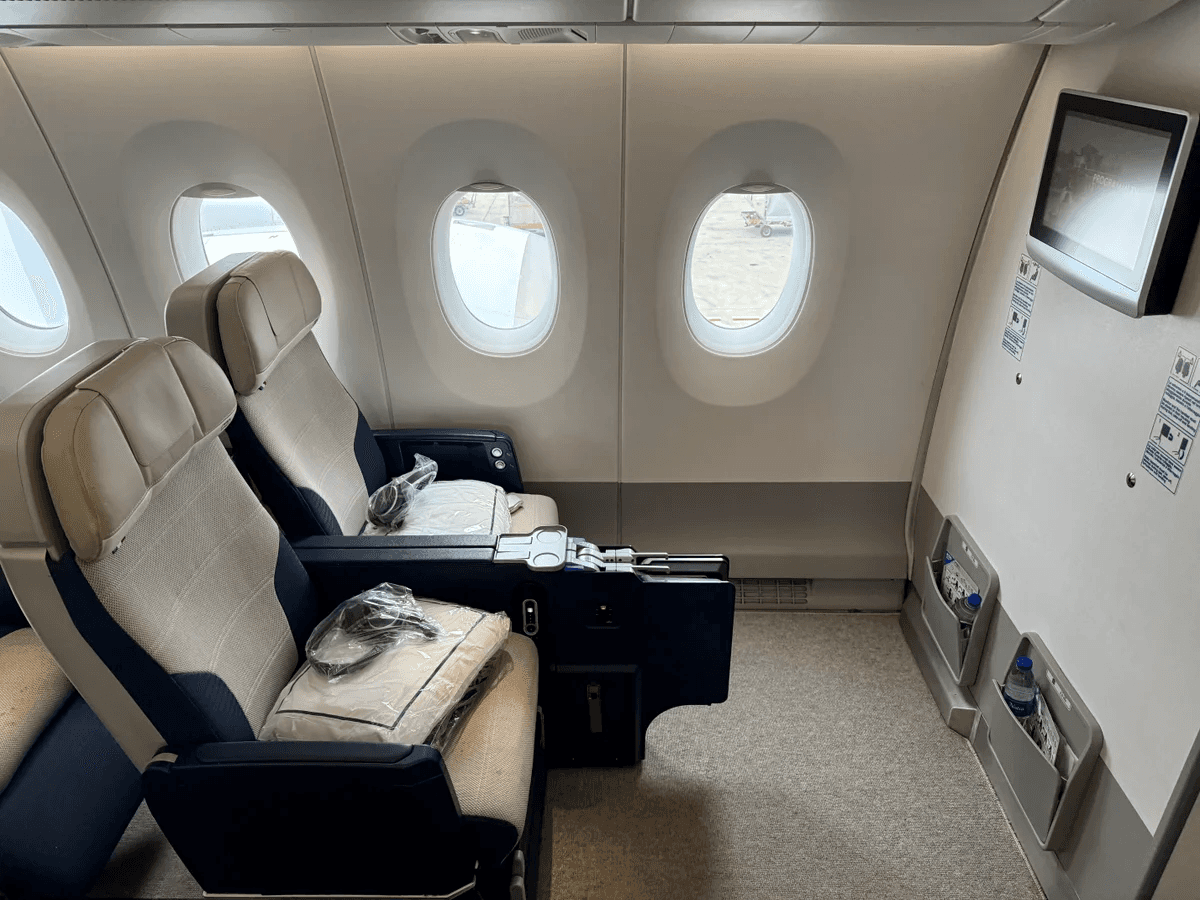
Both British Airways and ITA Airways offer Premium Economy on this route. British Airways Premium Economy on the A321 includes 38-inch pitch, direct-aisle seats (depending on configuration), and a dedicated cabin. ITA Airways Premium Economy offers comparable pitch and slightly wider seats (18.5 inches vs 17.3 inches Economy). For a 2.75-hour flight, Premium Economy is not justified unless you value the separate cabin experience or have premium points to burn; the cost premium (typically €100–200 one-way) far exceeds the marginal comfort gain over standard Economy on such a short flight.
Economy on LHR ↔ FCO
British Airways offers 32-inch seat pitch on A320/A321 configurations, while ITA Airways typically operates 31-inch pitch on comparable aircraft—a negligible but measurable difference on a flight of this length. British Airways A321 configurations are generally less dense (162 seats) than ITA's A321 (190+ seats), giving a marginally roomier experience. Both airlines offer identical IFE/WiFi: lightweight on-demand video systems and paid WiFi at €5–7 for the flight duration. For a 2.75-hour flight, neither airline's IFE library justifies seat selection; instead, prioritize departure time (early morning to maximize Roman daylight) and aircraft configuration (A321 over A320 if available).
Best for each cabin
Cabin | Winner | Why |
|---|---|---|
Premium Economy | British Airways A321 | 38-inch pitch, dedicated cabin, slightly lower density than ITA; not cost-justified for 2.75 hours but best option if premium economy is your choice |
Economy | British Airways A321 | 32-inch pitch, lower seat density (~162 seats vs ITA's 190+), better for a short-haul flight with modest comfort premium at no extra cost |
Avoid on this route
Cabin | Avoid | Why |
|---|---|---|
Premium Economy | ITA Airways Premium Economy | Marginally better seat width (18.5 vs 17.3 inches) does not justify premium on a 2.75-hour flight; cost-to-comfort ratio is poor |
Economy | ITA Airways A321 (190+ seat configuration) | High density (~190 seats), 31-inch pitch, more crowded cabin. Acceptable for Economy but less comfortable than British Airways equivalent |
📐 The Intra-Europe Business Class Reality
On LHR ↔ FCO, Business Class is the European short-haul product: same Economy seat width, middle seat blocked, slightly better food service, and lounge access. There is no flat bed on this route. Both British Airways and ITA Airways operate Business Class on this 2 hour 45 minute flight, but you are paying for seat comfort (extra legroom via seat blocking), priority boarding, and lounge access — not a premium cabin experience.
What you actually get:
British Airways Business: Typical European premium economy (extra legroom, 38-inch pitch), lounge access, checked bag included, meal service with wine, priority boarding and baggage. Typical fare premium over Economy: €80–140.
ITA Airways Business: Similar pitch and amenities, lounge access, meal service, priority boarding. Typical fare premium: €100–160.
The honest verdict: On a 2.75-hour flight, Business Class is not worth the premium unless you have status or are expensing it. The time in the air is too short to justify €100–160 extra. Instead: book Economy, purchase a fast-track or lounge pass separately (€30–50), and select a good Economy seat (aisle for easy exit, or window for sleep). You will arrive rested, have spent less, and avoided the Business cabin's marginal comfort gain. Exception: if your employer books Business or you hold elite frequent-flyer status, the lounge access and priority boarding add genuine value to your airport experience.
💰 LCC vs Flag Carrier Honest Cost
LHR ↔ FCO is heavily served by both low-cost carriers and flag carriers. Here is the true total cost once you add all fees:
Low-Cost Carriers (easyJet, Ryanair, Vueling, Wizz Air):
Base fare: €25–60 one-way.
Carry-on: Free (with size restrictions — see carry-on section below).
Checked bag: €15–25 (Ryanair, Wizz Air most aggressive with fees).
Seat selection: €8–15 for a decent seat; €0 for random assignment.
Food/beverage: €6–12 if purchased onboard (overpriced).
Airport: easyJet and Ryanair often use secondary airports (Stansted, Luton, Ciampino near Rome), adding 30–60 minutes ground time and taxi costs.
Total cost (economy, 1 checked bag, no seat selection, no food): €50–100.
Flag Carriers (British Airways, ITA Airways):
Base fare: €80–180 one-way.
Carry-on: Free.
Checked bag: Free (Economy with BA; first bag free with ITA).
Seat selection: Free (standard seat); €10–25 for premium seats.
Food/beverage: Included (decent quality on short-haul).
Lounge access: Not included (Economy), but fast-track can be purchased for €15–25.
Airport: LHR and FCO main terminals — primary hubs, less ground time.
Total cost (economy, 1 checked bag, no extras): €80–180.
Best LCC on LHR ↔ FCO: easyJet. Uses Gatwick or Luton (Gatwick is better connected to central London), has reasonable carry-on enforcement, and published fares are typically lowest and most transparent. Avoid Ryanair for this route — gate-checks the most bags, uses Ciampino (45 km south of Rome), and ancillary fees are highest.
Honest verdict: If you are a single passenger with only carry-on luggage and flexible airport times, LCC saves €40–80 total. If you have a checked bag, need primary airports, want included meals, or value connection time, the flag carrier's €100–150 premium is worth paying. Business travellers and groups should book BA or ITA; leisure solo travellers with light luggage should book easyJet from Gatwick.
🧳 Carry-On Strategy
Carry-on limits on LHR ↔ FCO:
British Airways (Economy): 1 cabin bag max 56 × 45 × 25 cm, 23 kg max. 1 small personal item (e.g. backpack, laptop bag) free. Strictly enforced at the gate on short-haul flights.
ITA Airways (Economy): 1 carry-on bag 55 × 40 × 20 cm, 10 kg max. 1 small personal item free. Less strict than BA but boarding group assignment influences enforcement.
easyJet (standard): 1 carry-on bag 56 × 45 × 25 cm, 15 kg. Enforced strictly at gate; oversized bags are gate-checked without warning. Priority boarding adds a larger trolley bag allowance (but costs €20–30).
Ryanair: 1 small personal item 40 × 20 × 25 cm free. 1 carry-on trolley (55 × 40 × 20 cm) only if Priority Boarding purchased (€5–10). Gate-checks the most overhead bags on London-Rome due to aircraft size (Boeing 737) and load factors.
Vueling, Wizz Air: Similar to easyJet; 1 carry-on + 1 personal item. Enforcement varies by aircraft.
Most strictly enforced on LHR ↔ FCO: Ryanair and easyJet both have reputations for aggressive gate-checking. BA is strict but fair. ITA is the most lenient.
The carry-on hack that works:
Buy Priority Boarding (€5–25 depending on airline). Boards you first or early, guaranteeing overhead bin space. Works on Ryanair, easyJet, and Wizz Air. On LHR ↔ FCO with high load factors, this is the single most effective protection against gate-checking.
Use a 22-inch rolling carry-on (48 × 32 × 23 cm) instead of a full 24-inch. Fits all airline limits with margin, looks smaller to gate agents, and unlikely to be flagged.
Pack a small second bag (15 × 25 × 45 cm backpack or tote) inside or compressed. Most airlines allow a "personal item" in addition to your cabin bag. Gate agents rarely count a soft backpack as a second carry-on if stowed under the seat or inside the cabin bag until boarding is done.
Board as early as possible, even without paid priority. On LHR ↔ FCO's high frequencies, overhead bins fill quickly. Gate arrival 30 minutes before departure (Economy) gives you a high chance of bin space even without priority.
Specific to Ryanair: Do not risk carry-on without Priority Boarding. The airline consistently gate-checks even small trolleys on this route due to 737 cabin density. If you must fly Ryanair without Priority, check a bag or use only a personal item.
🛂 Hub Connection Reality
Minimum connection times on LHR ↔ FCO:
London Heathrow (LHR): Minimum connection time 60 minutes for same-terminal transfers (domestic → domestic, or within the international terminal complex). If you change terminals (e.g. Terminal 3 to Terminal 5 for BA), add 20–30 minutes for terminal train/bus. High-risk window: 75 minutes or less, especially in peak hours (07:00–10:00, 16:00–19:00).
Rome Fiumicino (FCO): Minimum connection time 50 minutes for schengen-to-schengen transfers (e.g. EU flight to EU flight). FCO's layout is simpler than LHR; terminals are close. Low-risk window: 50–60 minutes is viable. High-risk window: 40 minutes or less.
The better connection hub: Rome Fiumicino (FCO) is the easier connection. The airport is smaller, terminals are well-signposted, walking distances are shorter (10 minutes from gate to gate in the main terminal), and immigration/customs for intra-Schengen flights is minimal. Heathrow is larger, terminal transfers are slower, and immigration queues are longer — especially post-Brexit for non-UK residents. If your onward flight is with ITA Airways (based at FCO), connections are even smoother (shared terminal, baggage integration).
Workable vs hopeless connection times:
LHR: ✅ 90 minutes or more = workable, even in peak. ⚠️ 75–90 minutes = feasible but tight if same terminal, risky if terminal change. ❌ 60 minutes or less = hopeless unless you have status/fast-track and the connecting flight is delayed.
FCO: ✅ 60 minutes or more = workable. ⚠️ 50–60 minutes = tight but possible. ❌ 40 minutes or less = hopeless.
Lounge access for transit passengers:
London Heathrow: BA Lounges (for BA/oneworld/StarAlliance premium cabin passengers and status holders) are plentiful and excellent quality, but open only to premium cabin or elite passengers. Economy passengers with a 90-minute connection have little lounge access unless purchased (Priority Pass, lounge day pass €30–50). Fast-track security (Priority Pass or paid service) costs €15–25 and is more valuable on LHR than lounge access.
Rome Fiumicino: Fewer lounges overall. ITA Airways lounge (Alitalia Club) is available to Business Class or frequent-flyer elite only. No-frills lounge access for Economy passengers is limited. Schengen transit usually skips security, so fast-track is irrelevant.
Terminal walks:
LHR: Terminal 3 to Terminal 5 (BA hub) = 20–30 minutes via baggage-drop transit train. T3 to T2 = 10–15 minutes. Worst-case walk within same terminal: 15 minutes. Impact on tight connections: severe.
FCO: Terminal A to Terminal C (main + satellite) = 8–10 minutes walk. All major carriers (ITA, BA, easyJet, Ryanair domestic) use Terminal 1 or adjacent terminals. Typical gate-to-gate walk: 5–10 minutes. Impact on tight connections: minimal.
Bottom line: Book FCO as your connection hub if possible. If you must connect at LHR, allow at least 90 minutes for domestic-to-international or 120 minutes for terminal changes. On FCO, 60 minutes is safe if the incoming flight is on-time.
What is the best airline for LHR ↔ FCO in Business Class?
Neither airline offers Business Class on this route. Both British Airways and ITA Airways operate short-haul A320-family aircraft configured for Economy and Premium Economy only. For premium travel on LHR–FCO, your only option is Premium Economy (British Airways is marginally better), or consider booking a higher-fare Economy ticket that may include priority boarding and seat selection.
How long is the flight from London to Rome?
Block time is 2.75 hours (westbound) to 2.85 hours (eastbound, headwind). This is a short-haul flight; the brief duration makes premium cabin upgrades (Premium Economy, Business Class if available) poor value. Schedule choice (early morning vs evening) has a far greater impact on your Rome experience than cabin selection.
Which airline has the best Economy on LHR ↔ FCO?
British Airways A321 offers 32-inch seat pitch and typically lower seat density (~162 seats) compared to ITA Airways A321 (190+ seats). British Airways also operates A320 aircraft on some flights (31-inch pitch, ~180 seats); confirm your aircraft type 48 hours before departure. For Economy, British Airways is marginally superior due to lower density, but the difference is modest on a 2.75-hour stage.
Is Premium Economy worth it on LHR ↔ FCO?
No. Premium Economy costs €100–200 more than Economy one-way on LHR–FCO and offers 6 extra inches of legroom (38 vs 32 inches) and slightly wider seats (17.7 vs 17.3 inches) in a separate cabin. For a 2.75-hour flight, this premium is not justified unless you have elite frequent-flyer points to burn or place exceptional value on cabin separation. Spend the cash on a good hotel in Rome instead.
lhr,fco,london,rome,route guide,intra_europe,2026,economy,premium economy,british airways,ita airways,a320,a321,short haul