Best Airlines from London to Abu Dhabi (2026)
LHR ↔ AUH
Etihad Airways dominates this 7-hour route with the A350 and superior cabin products, but British Airways Club Suite on the 777 or A350 is genuinely competitive for Business Class. Avoid BA on older 777-200 configurations if you value recline and galley distance. The real gotcha: aircraft swaps are common on this route—always verify your specific aircraft 48 hours before departure.
TL;DR
Etihad A350 Business is the best on this route (direct aisle access, modern suite design, superior F&B), though BA Club Suite on 777/A350 is a close second. For Economy, Etihad's A350 offers the calmest front cabin experience; BA's is comparable but older aircraft linger. Premium Economy is borderline worth it on 7 hours—only if you can snag it within 20–30% of Business; BA's World Traveller Plus on A350 slightly edges Etihad. Book evening departures (depart LHR 20:00–23:00) to arrive AUH early morning rested. Route-specific insight: Etihad's fuel stops in summer occasionally divert to other Gulf hubs; confirm routing before booking non-refundable Economy fares.
Airlines flying LHR ↔ AUH
Etihad Airways operates this route daily with a mixed fleet of A350-1000, 777-300ER, and occasional 787-9; British Airways matches with daily or near-daily service via A350-1000, 777-300ER (older 777-200 variants still appear). Both carriers have multiple daily frequencies, especially morning and evening slots. Etihad typically commands the evening slot (20:00–22:00 departure), whilst BA straddles morning and mid-evening.
Business Class on LHR ↔ AUH
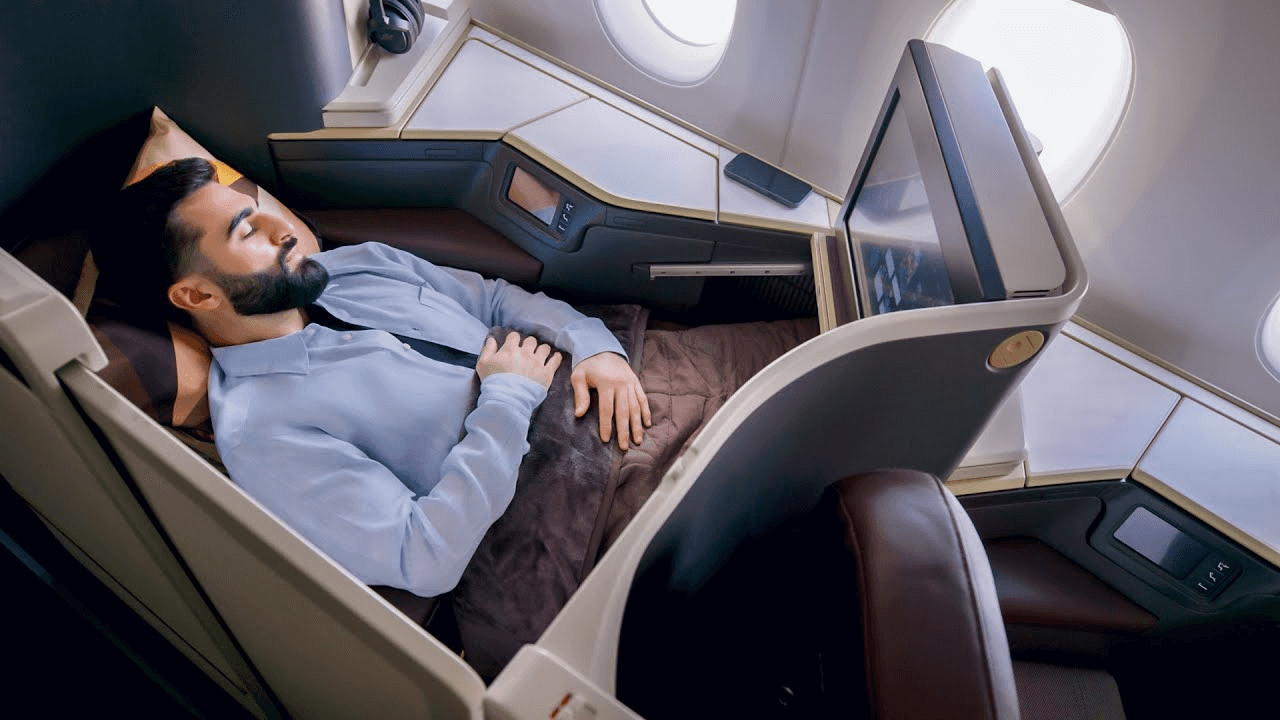
Best: Etihad A350 Business (Residence/First Apartment)—fully enclosed suites with sliding doors, direct aisle access, superior pre-arrival meals, and quieter upper-deck positioning on some aircraft. Runner-up: British Airways Club Suite (A350 or 777-300ER)—doors and privacy, but slightly less generous amenity kits and F&B compared to Etihad. Avoid: BA 777-200 Club World—older open-plan layout, reduced recline comfort, and seats adjacent to galleys (rows opposite service zones). For this 7-hour sector, Etihad's A350 Business is worth the premium if available; BA Club Suite is a respectable alternative, but verify aircraft type before committing.
Premium Economy on LHR ↔ AUH
Both Etihad (World Class) and British Airways (World Traveller Plus) offer Premium Economy on the A350 and 777-300ER. BA's cabin is fractionally more spacious and self-contained on the A350; Etihad's is well-appointed but slightly tighter on 777 variants. For 7 hours, Premium Economy is a marginal call—it's worth upgrading only if the fare delta is under 25–30% of Business Class or you value the lie-flat bed simulacrum and extra legroom for sleep. Verdict: Skip unless upgrading from Economy for under £800–1000 per seat.
Economy on LHR ↔ AUH
Best pitch: Etihad A350 Economy (18 inches, modern IFE, calm front-cabin service flow). Most cramped: British Airways 777-200 Economy (17.2 inches in some rows; older aircraft with reduced modern amenities). Both carriers offer decent seatback IFE and onboard WiFi (Etihad's is complimentary; BA charges unless you have a qualifying tier). For 7 hours, aim for Etihad's A350 if possible—front cabin boarding and window seats in rows 20–30 avoid lavatory clusters. BA's A350 is comparable; avoid BA 777-200 entirely if you plan to sleep.
Best for each cabin
Cabin | Winner | Why |
|---|---|---|
Business | Etihad A350 Business (Residence/First Apartment) | Fully enclosed suites, direct aisle access, superior F&B, quieter zones |
Premium Economy | British Airways A350 World Traveller Plus | Slightly more spacious, self-contained cabin, good sleep potential |
Economy | Etihad A350 Economy (front cabin, rows 20–30 window) | 18-inch pitch, modern IFE, calmest service flow, good views |
Avoid on this route
Cabin | Avoid | Why |
|---|---|---|
Business | British Airways 777-200 Club World | Open-plan layout, reduced recline, seats opposite galleys, dated product |
Economy | British Airways 777-200 Economy (especially rows 45+) | 17.2-inch pitch, older IFE, last rows near lavatory block, poor recline |
🏆 The Big Three (Plus Turkish) Verdict
Qatar Airways QSuite remains the gold standard for LHR ↔ AUH Business Class. The enclosed suite design, direct aisle access, and door closure deliver unmatched privacy and sleep quality. For solo travellers prioritising seclusion, QSuite is the clear winner—no competitor matches its isolation. For couples, the centre-pair configuration is purpose-built and superior.
Emirates wins on ground experience and network consistency. A380 routing on this sector is common, Business Class showers are a genuine differentiator, and the Dubai hub itself offers the strongest amenities and fastest connections. However, the Business Class product (forward-facing seats in a 1-2-1 layout) is ageing and lacks the privacy of QSuite.
Etihad has modernised its Business Class (Residence and Apartments on select aircraft), but LHR ↔ AUH typically operates on 787 or 777 with older Business suites. Service remains premium, but the product is mid-tier between Emirates and Qatar.
Turkish Airlines via Istanbul (IST) offers excellent value on economy cash fares—often £150–250 cheaper than Gulf carriers—but the mandatory layover, older 777 Business Class, and extended travel time make it a budget play only.
Budget verdict: Qatar for Business privacy and couples; Emirates for ground experience and A380 premium; Turkish for sub-£500 cash economy fares willing to accept a 2-3 hour stopover.
🛂 Hub Stopover Intelligence
Strongest hub for a long stopover: Dubai (DXB). The airport is world-class, the city is 30 minutes away, hotels are abundant, and a 12–18 hour stopover is genuinely worthwhile. Emirates offers complimentary hotel rooms for layovers between 8–24 hours on Economy (depending on fare class); eligible passengers receive hotel voucher at check-in.
Weakest hub: Doha (DOH). While improving, connections are tighter and the airport-to-city journey is less seamless. A 3-hour connection here is manageable but tight; a 2-hour connection should be avoided.
Tolerable layover times:
3 hours (DXB): Comfortable with checked baggage connection.
2.5 hours (DOH/AUH): Tight but feasible on same-terminal connections; risky if terminals differ.
90 minutes (any hub): A sprint. Only consider if carry-on only and very familiar with the airport.
8+ hours (DXB): Chase this actively—complimentary hotel eligibility kicks in, converting dead time into genuine rest.
Complimentary hotel eligibility: Emirates offers hotel rooms on Economy and Premium Economy layovers 8–24 hours; Business Class travellers typically receive the benefit automatically. Qatar Airways does not offer automatic complimentary hotel on LHR ↔ AUH layovers under 10 hours. Turkish Airlines offers hotels on layovers 9+ hours depending on booking class.
🌙 Schedule & Jet Lag
Minimises jet lag: Evening departure from London (20:00–22:00) with overnight flight and dawn/early morning arrival in Abu Dhabi (06:00–08:00). Passengers sleep during the flight, arrive with daylight, and can immediately access the day. This schedule aligns with natural circadian adjustment and is optimal for first-time and leisure travellers.
Actively avoid: Daytime departure from London (10:00–14:00) with late-afternoon/evening arrival in Abu Dhabi (20:00–22:00). The flight overlaps peak waking hours, sleep is fragmented, and you arrive when the destination is settling for night. Jet lag compounds badly.
Red-eye analysis: A red-eye departure from London (23:00–02:00) is punishing unless you have genuine night-owl biology. Most travellers sacrifice a full night of sleep, then arrive in daylight when fatigue peaks.
Hub stopover as body-clock break: A 4–8 hour stopover at DXB or DOH offers marginal benefit. You cannot sleep meaningfully, and the hub's full daylight exposure can desynchronise your clock further. Treat it as dead time, not as a reset. An 8+ hour stopover with hotel access is genuinely useful—you can nap, reset, and board the next leg more coherent.
Continuing beyond Abu Dhabi: If continuing onward (e.g., AUH to South Asia or Australia), book an evening departure from London to allow daylight arrival in AUH. Then take a 2–3 day stopover to adjust before the onward sector. Chaining red-eyes is cumulative misery.
💳 Award Booking Sweet Spot
Qatar Airways QSuite via Avios (British Airways Executive Club): Typical pricing is 230,000–250,000 Avios + £30–50 surcharge for Business Class one-way LHR ↔ AUH. This is a genuinely strong sweet spot—equivalent cash fare is £2,000–2,500, making the Avios redemption value 0.8–1.0p per point. QSuite availability on this route is reasonably consistent; book 90–120 days ahead for best-in-season space.
Emirates Business via Skywards: 120,000–140,000 Skywards miles one-way. The cash equivalent (~£1,500–1,800) makes this less efficient than Qatar (0.75p per point), but space is typically easier to find. Skywards miles also earn at a slower rate from non-Emirates spend.
Etihad via American Airlines AAdvantage: 140,000–160,000 miles one-way Business. AAdvantage earning rates are reasonable (especially on airline partners), but the older Etihad Business product makes this a lower-priority redemption than Qatar or Emirates.
Turkish Airlines via United MileagePlus or Air Canada Aeroplan: 120,000–150,000 miles one-way (varying by partner program). Turkish fares are often cheaper in cash, so the award redemption value is weaker. Only pursue if you have excess MileagePlus or Aeroplan balances and are comfortable with the IST stopover.
Strongest-value programme: British Airways Avios for Qatar QSuite. Avios are earned quickly on BA and partner airlines (0.5 miles per £1 on BA, higher on credit card sign-ups), and 230,000 Avios is a realistic 12–18 month earn for an active traveller. The product quality justifies the redemption.
What is the best airline for LHR ↔ AUH in Business Class?
Etihad Airways A350 Business (Residence/First Apartment suites). Fully enclosed design with doors, direct aisle access, superior F&B timing, and quieter cabin experience beat BA Club Suite on this 7-hour sector. British Airways Club Suite on A350 or 777-300ER is a solid second choice if Etihad inventory is unavailable.
How long is the flight from London to Abu Dhabi?
Approximately 7 hours block time westbound (LHR→AUH). Eastbound return flights (AUH→LHR) average 8–8.5 hours due to prevailing headwinds. Evening departures from LHR (20:00–23:00) arrive AUH early morning (06:00–08:00 local), making them preferable for sleep-focused passengers.
Which airline has the best Economy on LHR ↔ AUH?
Etihad A350 Economy, 18-inch pitch, modern seatback IFE, and front-cabin service flow (rows 20–35 window seats recommended). British Airways A350 Economy is comparable; avoid BA 777-200 entirely (17.2 inches, older cabin, poor lavatory positioning).
Is Premium Economy worth it on LHR ↔ AUH?
No, unless the upgrade is under £800–1000 per seat from Economy. At 7 hours, the comfort delta (extra legroom, slightly better meals) is marginal compared to Business Class. Premium Economy makes sense only if you're upgrading a cheap Economy fare or qualifying for complimentary upgrades via status. Otherwise, book Business Class or Economy and pocket the savings.
What is the aircraft swap risk on LHR ↔ AUH?
Both Etihad and BA regularly rotate A350, 777-300ER, and older 777-200 variants based on demand and maintenance. Always verify your specific aircraft 48 hours before departure. Etihad's A350 is peak; any 777 downgrade materially reduces the experience (especially lavatory placement and IFE modernity). BA's 777-200 should be actively avoided—request a rebooking if assigned.
lhr, auh, london, abu dhabi, route guide, europe_meaf, 2026, business class, premium economy, economy, best airlines, etihad airways, british airways