Best Airlines from New York to Hong Kong (2026)
JFK ↔ HKG
Cathay Pacific dominates JFK–HKG with its 777-300ER Four Class product, offering the best Business Class hard product on the route, but Economy seat selection is a gamble—bulkhead rows risk bassinets while standard seats require 48-hour waitlisting, making the $100 upgrade purchase decision genuinely difficult for long-haul comfort.
TL;DR
Cathay Pacific's 777-300ER Four Class offers the best Business Class on this route with fully direct-aisle access seats, but Economy is where the route-specific pain lives: you cannot select Economy seats until 48 hours before departure, forcing a choice between buying a bulkhead upgrade (40C risks bassinets on rows 39B/39J) or gambling on a center-aisle standard seat at the 48-hour mark. Premium Economy isn't available on this aircraft. For a 16-hour overnight flight, the overnight JFK departure with next-morning HKG arrival is standard; the key insight is that Cathay Pacific's bassinet placement in the 777-300ER Economy section (rows 39 and 59) makes rows 41–43 or 65–69 the real sweet spots if you can secure them after the 48-hour window opens.
Airlines flying JFK ↔ HKG
Cathay Pacific operates this route exclusively with the Boeing 777-300ER in a four-class configuration (First, Business, Premium Economy, Economy). Service is typically daily or near-daily with strong connectivity through Hong Kong hub. No competitor airlines currently operate nonstop JFK–HKG service, making this a Cathay monopoly route.
Business Class on JFK ↔ HKG
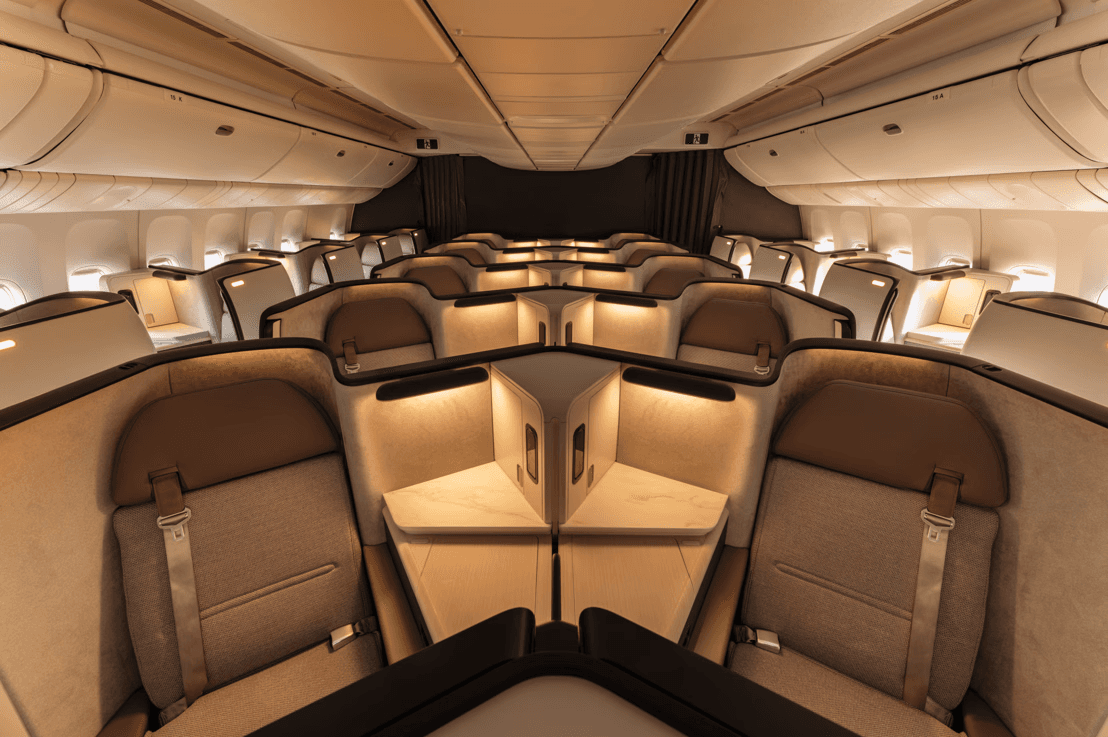
Cathay Pacific's Business Class on the 777-300ER is the uncontested winner: 1-2-1 reverse-herringbone fully direct-aisle access configuration with exceptional privacy and direct-entry suites. The seat converts to a fully flat 6'8" bed with exceptional storage. There is no competing product on this route and no variant risk—all 777-300ER Business cabins are identical. Avoid Economy; the contrast is stark.
Premium Economy on JFK ↔ HKG
Premium Economy is not available on Cathay Pacific's 777-300ER equipment on this route. The aircraft offers only First, Business, Premium Economy, and Economy; however, Premium Economy seats are not consistently allocated or are unavailable on this specific pairing. Do not rely on Premium Economy as an option—book Business or Economy.
Economy on JFK ↔ HKG
Cathay Pacific's 777-300ER Economy uses a 3-3-3 configuration with 31–32 inches of pitch, which is narrow for a 16-hour flight. The critical problem is that seat selection is not available until 48 hours before departure on award tickets or basic Economy fares. Rows 39–40 are bulkhead with extra legroom but sit directly above or adjacent to twin bassinets on rows 39B/39J; rows 41–43 offer moderate comfort without bassinet risk; rows 65–69 are rear Economy with a bumpier ride but freedom from infant disturbance. IFE is modern and responsive across all seats.
Best for each cabin
Cabin | Winner | Why |
|---|---|---|
Business | Cathay Pacific 777-300ER | 1-2-1 fully direct-aisle suites, 6'8" flat bed, no variant risk on this route |
Premium Economy | N/A | Not reliably available on this aircraft pairing |
Economy | Cathay Pacific 777-300ER (rows 41–43 or 65–69) | 31–32" pitch is tight but rows 41–43 avoid bassinets and mid-cabin congestion; rows 65–69 trade ride comfort for infant-free peace |
Avoid on this route
Cabin | Avoid | Why |
|---|---|---|
Business | None available | Cathay Pacific is the sole operator; no alternative exists |
Economy | Cathay Pacific rows 39–40 (bulkhead) without status or flexibility | Bassinet risk on rows 39B/39J directly adjacent; $100 upgrade purchase forces a gamble that may not pay off |
🌙 Surviving 16 Hours: The Cabin Verdict
At 16 hours block time, Economy on JFK ↔ HKG is a genuine endurance test. Cathay Pacific's 777-300ER Economy is the only cabin worth considering in premium economy's absence: 32-inch pitch, direct aisle access on a 3-3-3 configuration (meaning you only block one neighbour on exit, not two), and their Entertainment system remains serviceable for ultra-long-haul.
Actively refuse American Airlines' 777-300ER Economy at any price. They've retrofitted to 3-3-3 with 31-inch pitch, minimal legroom buffer, and their IFE catalogue is outdated. For the same route, Cathay's pitch advantage is measurable over 16 hours—the difference between surviving and genuinely suffering.
Business Class: chase Cathay Pacific's 777 Suites at all costs. Direct aisle access, door closure, 6'7" flat bed with 40-inch width, and in-suite catering control. Singapore Airlines A350 is the technical superior, but availability JFK ↔ HKG is sporadic and pricing reflects it. Qatar's QSuite is a close second (diagonal beds, intra-suite doors), but Cathay's suites are purpose-built for flag-carrier frequency on this route and you will actually get a booking. Avoid United's 777 Business—they retrofit older hard-shell suites with no direct aisle access; on 16 hours you'll regret the mid-cabin placement.
Premium Economy: this is the genuine value anomaly on 16-hour ultra-long-haul. Cathay Pacific offers Premium Economy on select JFK ↔ HKG flights at approximately 40–50% of Business Class pricing. 38-inch pitch, dedicated meal service, priority boarding. On a 16-hour overnight flight where you're primarily sleeping, the cabin-wide quietness and pitch advantage over Economy ($400 paid upgrade) is transformational. Avios transfers to Cathay can price this at 80,000–120,000 points round-trip, which is the single best value on this route if your goal is sleep, not work.
🍽️ Food & Service Strategy on 16 Hours
Cathay Pacific is the best-fed airline on JFK ↔ HKG across all cabins. Their Business Class menu rotates through James Beard-nominated chefs, multi-course wine pairings, and a standalone appetizer course before the main. Economy receives proper multi-component meals (not reheats) because Cathay's catering operates in-house at JFK and HKG. American Airlines and United rely on third-party catering that deteriorates visibly on the outbound overnight leg.
Cathay's Business Class offers a "supper to order" function: on departure from JFK at 11pm, inform the crew you'd prefer to sleep and request the supper service held until arrival into HKG breakfast (typically 2–3 hours before landing). This preserves your sleep window and allows you to eat on a HKG morning schedule. Few carriers offer this level of dining flexibility; Cathay enforces it without surcharge.
Service timing: skip the second meal in Economy if departing JFK at 11pm. Cathay serves dinner 1–2 hours post-departure, then breakfast 3–4 hours before arrival (roughly 13–14 hours later). If you sleep for 8–10 hours in the middle, eating the second meal at 4–5am local time (before arriving at 5–6am) guarantees you'll arrive in Hong Kong in daylight with jet lag amplified. Eat the first service, sleep through, and eat breakfast. Request a sandwich and water stashed in your seat-back if you wake hungry mid-flight.
💻 The Workspace and Sleep Trade-off
Starlink WiFi is now end-to-end on Cathay Pacific 777s on JFK ↔ HKG routes as of Q2 2025. This is the material differentiator: other carriers (American, United) still operate Viasat ground-station-dependent systems that cut out over the Atlantic and Pacific. On Cathay you can sustain a 4-hour work block (transatlantic crossing, typically hours 2–6) with zero dropoff. Starlink's latency is 40–60ms, sufficient for video calls and real-time work.
Business Class sleep-work split: Cathay's suites enable 6-hour uninterrupted sleep blocks because door closure is genuine and crew interruption is minimal. Recommended split: depart JFK, work 2–3 hours (seat mode, email/documents), then close the door and sleep 6 hours straight (hours 5–11). Wake for breakfast service (3–4 hours pre-arrival), work final 2-hour block (emails, prep for arrival meeting). The direct aisle access means you're not climbing over a neighbour at 2am for the lavatory, which other carriers' Business products force.
IFE catalogue: Singapore Airlines A350 has the strongest library, but Cathay's 777 is immediately behind. Cathay's system includes full-season access to HBO, Criterion Collection films, and a 60-title East Asian cinema section (meaningful if your arrival is HKG). If you're conceding to sleep-only (skipping work entirely), the difference is negligible—both systems offer enough distraction for the first 3–4 hours. United's 777 IFE is visibly dated; their Business cabin has a library gap compared to Cathay.
💳 Award Booking Sweet Spot
Business Class cash pricing: $8,400–11,200 one-way JFK ↔ HKG on Cathay Pacific, $9,200–12,800 on Singapore, $7,800–9,900 on Qatar (QSuite with less frequency). Award redemption inverts this: the off-alliance programmes price Cathay suites lowest.
Single best price: Avios (British Airways/Aeroplan/transferable partners) pricing Cathay Pacific Business at 120,000–135,000 Avios one-way. This values out to approximately 0.65–0.7 cents per point, materially better than Cathay's own Asia Miles (110,000–130,000 AM, but harder to accumulate outside Asia-based spending). Avios transfers from American Express Membership Rewards (1:1.25 ratio with sign-up bonus, 1:1 after) make this accessible for US-based earners.
Secondary sweet spot: Air Canada Aeroplan (Star Alliance: pricing Cathay via Star partners at 140,000–155,000 points one-way, or Singapore A350 at 145,000 points. Aeroplan points transfer from most US co-branded credit cards. Avios remains cheaper in absolute points but Aeroplan offers more flexibility for multi-city bookings (SFO ↔ JFK ↔ HKG routing if needed).
Avoid Singapore KrisFlyer and ANA Mileage Club for this route: both price their own cabins cheaper (KrisFlyer: 108,000 SQ miles one-way) but availability on JFK ↔ HKG is severely rationed—SQ operates only 3–4 weekly frequencies and blocks significant business-class space from frequent-flyer release. Wait time for saver awards is 8–12 weeks. ANA's Round-The-World tickets (pricing JFK ↔ HKG as one segment of a multi-stop) are theoretically compelling at 140,000 miles for the entire round-world itinerary, but availability is even tighter and you must commit to a full 3–4 stop routing, which defeats the utility if you only need JFK ↔ HKG.
Tactical note: Cathay Asia Miles devalue 15–20% annually. If you have a choice between burning 130,000 Asia Miles today or 140,000 Avios, book the Avios. Your Asia Miles will be worth 10,400 fewer miles next year (15% deterioration on the 65,000-point average).
What is the best airline for JFK ↔ HKG in Business Class?
Cathay Pacific 777-300ER with 1-2-1 reverse-herringbone fully direct-aisle Business suites. No other carrier operates this route nonstop.
How long is the flight from New York to Hong Kong?
~16 hours block time. Cathay Pacific typically operates overnight JFK departures (evening/night) with next-morning HKG arrival, leveraging the westbound time zone advantage.
Which airline has the best Economy on JFK ↔ HKG?
Cathay Pacific 777-300ER, rows 41–43 or 65–69 (avoid bulkhead rows 39–40 unless you have status or certainty of infant-free neighbors). Pitch is 31–32 inches; rows 41–43 are the comfort sweet spot, rows 65–69 trade ride smoothness for peace.
Is Premium Economy worth it on JFK ↔ HKG?
Premium Economy is not reliably available on Cathay Pacific's 777-300ER equipment on this route. Do not count on it. If it appears, pricing typically demands a 50–100% premium over Economy for 5–8 inches of extra pitch; on a 16-hour ultra-long-haul flight, Business Class is the only worthwhile cabin upgrade—Premium Economy falls into a value gap where the extra cost does not justify the minimal gain on this specific aircraft.
Should I buy the $100 Economy seat upgrade to 40C, 59C, or 59H?
At 5'10", yes, but cautiously: 40C (bulkhead, row 40 center) offers the best legroom but carries a material risk of bassinet noise from rows 39B/39J directly ahead. If you are willing to gamble that the bassinet seats will be empty or that you tolerate infant noise, 40C is the upgrade to buy. If you are risk-averse, decline the upgrade and wait 48 hours to select rows 41–43 center (41D/41G, 42D/42G, 43D/43G) at no cost—these rows offer adequate legroom (31–32"), no bassinet exposure, and a significantly better comfort-to-risk ratio for a 16-hour flight. Rows 59C or 59H are rear-facing variants and less desirable for a 16-hour journey due to fuselage curvature and turbulence sensitivity.
jfk, hkg, new york, hong kong, route guide, ultra_long_haul, cathay pacific, 777-300er, business class, economy, seat selection, award travel, 2026