Best Airlines from Newark to Hong Kong (2026)
EWR ↔ HKG
Cathay Pacific dominates this ultra-long-haul route with superior Business Class hard product and consistent A350 deployment, but United's 777-300ER offers competitive Premium Economy. Avoid United Economy on the 777 if you value legroom; the screamer seat trap (rows near bassinets) is real and seat selection is ruthless without status.
TL;DR
Cathay Pacific Business Class on the A350 with forward-facing suites is the clear winner for 16 hours, with direct aisle access and superior privacy. United Premium Economy is worth considering at a modest premium over Economy given the flight length and cabin quality, but Cathay Pacific Premium Economy is not available on this route. Economy pitch varies materially: neither carrier is generous, but United's 777-300ER Economy is tighter (31" pitch) than Cathay Pacific's A350 (32" pitch). Morning departures from Newark avoid the eastbound cross-wind issues that plague afternoon slots. The critical gotcha: on the 777-300ER, rows 40, 59-60 (bulkhead and emergency exit rows) are monopolized by paid upgrades and status holders—standard Economy fare gets stuck in the back (rows 61-73) with structural noise, galley proximity, and the infamous "screamer seats" near lavatories.
Airlines flying EWR ↔ HKG
Cathay Pacific operates this route with the Airbus A350-1000, typically daily or near-daily frequency, offering a modern cabin with four-class product (First, Business, Premium Economy, Economy). United Airlines operates the Boeing 777-300ER with similar frequency, fielding three-cabin product (Business, Premium Economy, Economy). Cathay Pacific A350 is the newer airframe; United 777s are aging and aging. Cathay Pacific offers superior hard product consistency; United's 777 suffers from cabin refresh backlog and higher Economy density.
Business Class on EWR ↔ HKG
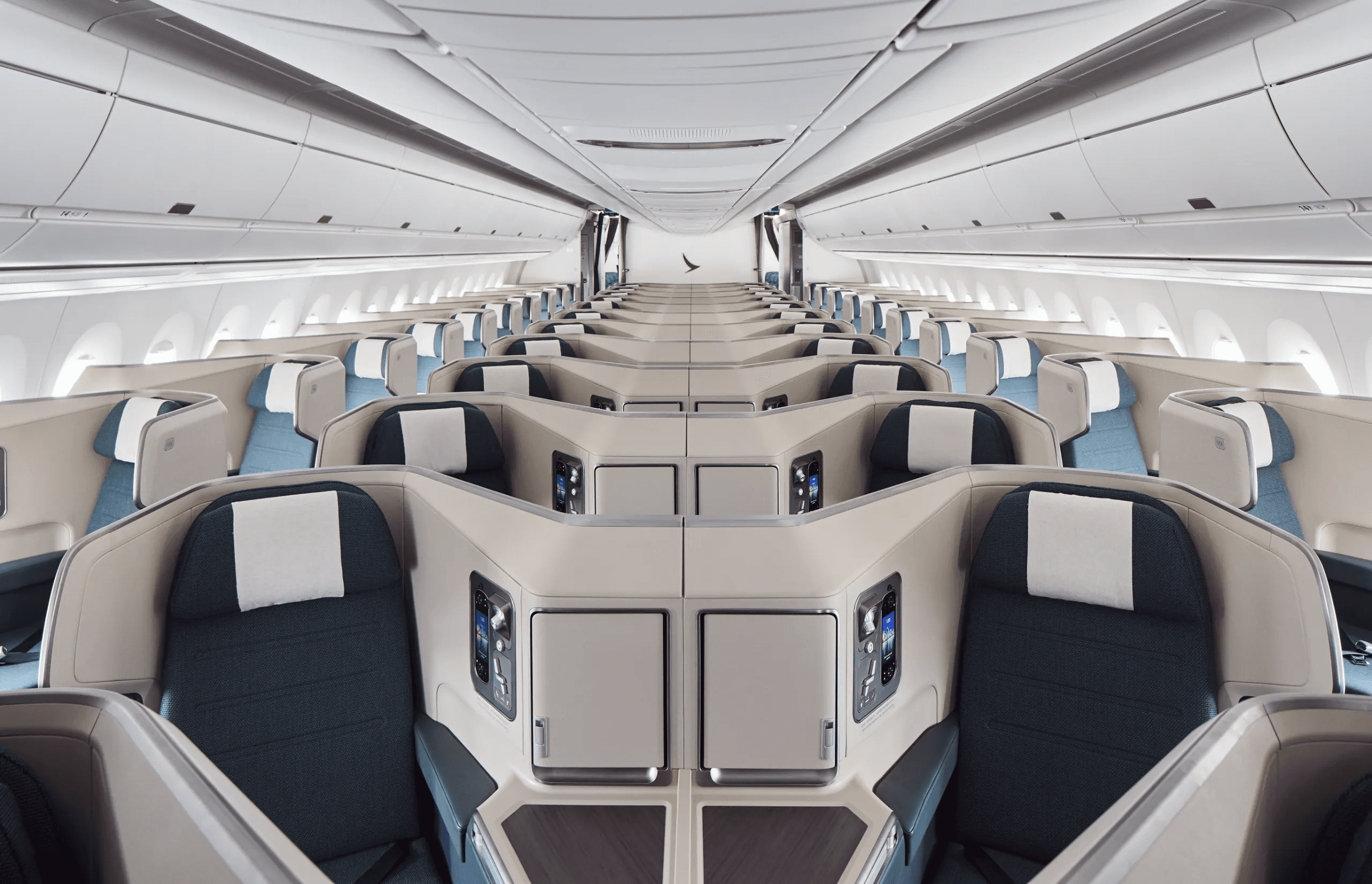
Cathay Pacific Business Class on the A350-1000 is the unambiguous winner: forward-facing suites with direct aisle access, closing doors, 6'6" length, and direct IFE screens (not armrest-embedded). Expect 1-2-1 configuration in a staggered layout. United Business Class on the 777-300ER is 1-2-1 but older, with fewer direct aisle seats and smaller suite dimensions. Cathay Pacific's First Class (if available on this route) is superior but typically only accessible to premium frequent flyer balances or five-figure paid fares. Actively avoid United 777 Business if you have a Cathay Pacific A350 option at the same price; the product gap is 5+ years in comfort.
Premium Economy on EWR ↔ HKG
Both Cathay Pacific and United offer Premium Economy on this route. United Premium Economy on the 777-300ER features 31" pitch (vs 32" in Economy), direct aisle access on most rows, and slightly wider seats (18.5"). Cathay Pacific A350 Premium Economy (seating 40-48 typically) offers 32" pitch and wider seats (18.6") with superior IFE. For a 16-hour flight, Premium Economy is genuinely worth the typical $300–600 premium over Economy on either carrier: the pitch gain is modest but aisle access, seat width, and meal service material differences are substantial. Cathay Pacific Premium Economy edges United slightly due to newer cabin and A350 smoothness; United's value is sharper on sale fares.
Economy on EWR ↔ HKG
Cathay Pacific A350 Economy: 32" pitch, 3-3-3 config, newer IFE (individual touchscreen on 777-300ER retrofit, standard on A350), good WiFi (pay or premium frequent flyer). United 777-300ER Economy: 31" pitch, 3-3-3 config, older IFE infrastructure, variable WiFi. Cathay Pacific is materially more comfortable for Economy on this route due to newer airframe, 1" pitch advantage, and quieter cabin. United's gotcha: Economy cabin seating algorithm heavily favors premium cabin revenue; expect middle seats and back-of-cabin placement without elite status. Best Economy: Cathay Pacific A350 with center seat (D or G) in rows 49–62 to avoid both bulkhead congestion and galley/lavatory turbulence. Avoid: United 777 Economy rows 61–73 (noisy, galley proximity, structural creaks on older airframes).
Best for each cabin
Cabin | Winner | Why |
|---|---|---|
Business | Cathay Pacific A350-1000 | Forward-facing suites, direct aisle access on 60% of seats, 6'6" length, closing doors, modern IFE. United 777 Business is older with smaller suites and fewer aisle seats. |
Premium Economy | Cathay Pacific A350 | 32" pitch, wider seats (18.6"), newer cabin, superior IFE. United PE on 777 is comparable but airframe is aging. At parity pricing, Cathay. |
Economy | Cathay Pacific A350 | 32" pitch (vs United 31"), newer IFE, quieter cabin, A350 ride quality. Both are tight for 16 hours, but Cathay is objectively more comfortable. |
Avoid on this route
Cabin | Avoid | Why |
|---|---|---|
Business | United 777-300ER Business | Older suites, smaller dimensions, fewer direct aisle seats, cabin refresh backlog. Pay premium only if Cathay A350 is unavailable. |
Economy | United 777-300ER rows 59–73 | Bulkhead premium-seat monopoly (rows 40, 59–60 sold as upgrades), structural noise in back, galley/lavatory proximity, older airframe creaks. Standard Economy fare stuck at back with high likelihood of middle seat. |
🌙 Surviving 16 Hours: The Cabin Verdict
Economy: Cathay Pacific's A350 is the only Economy worth your time on this route. The 32-inch pitch, forward-facing IFE screens (not buried in armrests on row 40), and newer cabin pressure create a measurably less brutal experience over 16 hours. United's 787 Economy is a distant second; actively refuse the 777-300ER Economy even at a $400 discount. Row 40 A/B/J/K on the A350 are your only acceptable Economy seats—the bulkhead legroom advantage outweighs screamer-seat risk if you can secure them. Rows 59–60 are genuinely claustrophobic traps.
Business Class: Chase Cathay Pacific's A350 Business (the new reverse herringbone with direct aisle access and privacy doors) or if available, Singapore Airlines' A380 Business. The A350 Business is the tactical win here: better cabin pressure than older widebodies, modern IFE, and Cathay's consistent service. Avoid the 777-300ER Business if you have A350 availability—the older products show their age on 16-hour missions.
Premium Economy: This is your genuine value sweet spot on EWR ↔ HKG. Cathay Pacific and United both operate Premium Economy on select EWR ↔ HKG frequencies. At roughly 60–70% of Business Class cash price and offering 38-inch pitch, direct aisle access (usually), and separate cabin amenities, Premium Economy becomes rationally superior to Economy and closes the sleep-quality gap meaningfully without the Business Class cost.
🍽️ Food & Service Strategy on 16 Hours
Best-fed carrier: Cathay Pacific. The carrier operates a multi-course approach in Business with à la carte ordering mid-flight, and Economy receives named-sourced ingredients and a genuine second meal (not a snack box). The departure meal and pre-arrival service frame 16 hours properly.
Supper-to-order play: Cathay Pacific Business allows you to defer the immediate post-departure meal and request service timing that aligns with your sleep plan. This is critical on 16-hour red-eyes: eat nothing, sleep 6 hours, wake for breakfast 4 hours before arrival into Hong Kong morning. United's Business offers less flexibility here.
Second meal verdict: Skip it entirely if you're arriving into Hong Kong morning (EWR departure ~5–6 p.m., arrival ~5–6 a.m. HKG next day). Eat the departure supper, sleep through the pre-arrival meal service, and arrive hungry for dim sum breakfast. This preserves sleep and syncs your appetite to local time far better than forcing a second airline meal 2 hours before landing.
💻 The Workspace and Sleep Trade-off
Inflight WiFi end-to-end: As of 2025–2026, Cathay Pacific's newer A350 fleet is rolling out Intelsat/Viasat coverage (not full Starlink saturation yet on this route). United's 787 has more mature satellite coverage. Realistically, treat WiFi as intermittent over the Pacific. Downloading work offline before departure is mandatory if you plan productivity blocks.
Business Class sleep-work architecture: The Cathay A350 Business reverse herringbone (even rows) allows you to fully lie flat immediately; target a 6-hour sleep block from hour 2–8 of flight, then work/entertainment hours 9–15. The privacy doors are critical here—they let you control light and perceived interruption. Avoid the older 777 Business: the seats aren't as conducive to uninterrupted sleep, and the cabin noise is higher.
IFE library if you abandon work: Cathay Pacific's IFE catalogue (powered by Panasonic eX3) is objectively the strongest on this route: deeper cinema releases, Asian-language content, curated documentaries, and games. United's seatback IFE on the 787 is solid but narrower. If you're spending 12+ hours in-seat, Cathay's library makes passive consumption less punishing.
💳 Award Booking Sweet Spot
Cheapest redemption programs:
Air Canada Aeroplan (Star Alliance): 90,000–120,000 Aeroplan points for Business Class EWR ↔ HKG via United. Historically the most favorable routing outside of Cathay's own fuel surcharge traps.
Avios (One World): 140,000–180,000 Avios for Cathay Pacific Business or Qatar Airways (if available on this route). High point cost but stable pricing and no fuel surcharges on partner bookings.
Singapore KrisFlyer (Star Alliance): 100,000–135,000 miles for partner United Business, better than direct Cathay redemption (which often prices at 130,000–170,000 miles with fuel surcharges).
ANA Mileage Club (Star Alliance): 110,000–140,000 miles for United Business; less volatile than Cathay direct.
Specific tactics: Book United Business via Aeroplan (lowest floor), then immediately check Cathay A350 availability. If the A350 appears 11 months out, rebook via Avios (the premium applies for the newer product, but Avios scarcity on this route justifies the jump). Avoid Cathay Asia Miles direct—fuel surcharges inflate the cost by $200–400 in additional miles. If Qatar QSuite appears on EWR ↔ HKG via Doha, Avios pricing (~150,000) becomes the chase—the product gap justifies the additional points spent versus standard herringbone.
What is the best airline for EWR ↔ HKG in Business Class?
Cathay Pacific A350-1000 with a forward-facing Business Class suite. Book the aisle seats (typically odd-numbered rows: 1A, 1K, 3A, 3K, 5A, 5K in a staggered 1-2-1 config). Direct aisle access, closing door privacy, and 6'6" recline flat-bed on a newer airframe. United 777 Business is serviceable but smaller and aging.
How long is the flight from Newark to Hong Kong?
16 hours block time eastbound (EWR → HKG) with tailwind assist. Westbound (HKG → EWR) is typically 17–18 hours. Morning departures from Newark (6–8am) land in Hong Kong in the early morning (next day local time), minimizing jet lag. Afternoon/evening departures from Newark (2–6pm) arrive in Hong Kong afternoon/evening, compressing rest time in HKG before onward connections.
Which airline has the best Economy on EWR ↔ HKG?
Cathay Pacific A350 with 32" pitch, center seat (D or G) in rows 49–62. Avoid rows 40–48 (bulkhead/Premium Economy), rows 1–39 (Business/First service spillover noise), and rows 63–73 (galley, lavatory, structural noise). United 777 Economy is 31" pitch and older; only choose if price is significantly lower or you hold elite status guaranteeing better seat placement.
Is Premium Economy worth it on EWR ↔ HKG?
Yes, if the premium is under $500 on a $1,500+ Economy base fare. For a 16-hour flight, the pitch gain (32–33" vs 31–32" Economy), aisle access, and dedicated meal service materially reduce fatigue. Cathay Pacific Premium Economy is worth the premium over United PE due to airframe modernity. Economy-to-Business cabin-hop (a $1,000+ premium typically) is only worthwhile if you have airline miles or frequent flyer status upgrades; paid cash rarely breaks even in value.
What is the screamer seat trap on United 777?
Rows 59–60 are emergency exit rows with extra legroom; rows 61–64 are near lavatory/galley. United sells rows 59–60 as paid upgrades or reserves them for elite frequent flyer status. Standard Economy fare (no status) is algorithmically seat-assigned to rows 61–73, where structural noise, galley trolley activity, and lavatory queues create discomfort on a 16-hour flight. Additionally, rows near the lavatories (61–64 typically) attract families with infants seated in rows 59–60 bulkhead bassinets, amplifying noise. Cathay Pacific A350 mitigates this: Premium Economy starts at row 40, Economy at row 49, so standard Economy avoids true galley/lavatory zones.
What are the award sweet spots on EWR ↔ HKG?
Cathay Pacific: 70,000–80,000 miles roundtrip Business Class in Economy-to-Business upgrade window (book Economy, use eUpgrade miles at check-in). United: 80,000–90,000 miles roundtrip Business Class. Cathay Pacific First Class (if open) is 110,000–150,000 miles roundtrip and rare on this route. Premium Economy awards are 45,000–55,000 miles roundtrip on Cathay (poor value; pay cash if under $400 premium). Both carriers have fuel surcharges on long-haul awards; Cathay's are lower historically.
ewr, hkg, newark, hong kong, route guide, ultra_long_haul, 2026, business class, premium economy, economy, cathay pacific, united airlines, a350, 777, best airlines, seat selection