Turkish Airlines Business Class Review (2026)
Turkish Airlines
TL;DR
Turkish Airlines Business Class launched in 2017 and comes in three configurations: the modern 1-2-1 reverse herringbone on A350-900 and 787-9 (direct aisle access, all seats equal), and the aging 2-3-2 on 777-300ER (middle seats with no window and no aisle access). Book the A350-900 or 787-9 on long-haul routes to North America, Asia, or Africa; avoid the 777 if possible. The product suits couples and solo sleepers on those modern aircraft, but the fleet lottery is frustrating — you might book what you think is a premium 1-2-1 and land in a 2-3-2 middle seat. Turkish edges out most Middle Eastern carriers on soft product (food, service) and beats economy-plus competitors, but Lufthansa Allegris Business Class is the superior choice if both are available on your route: Allegris has doors, newer hardware, and zero configuration guesswork.
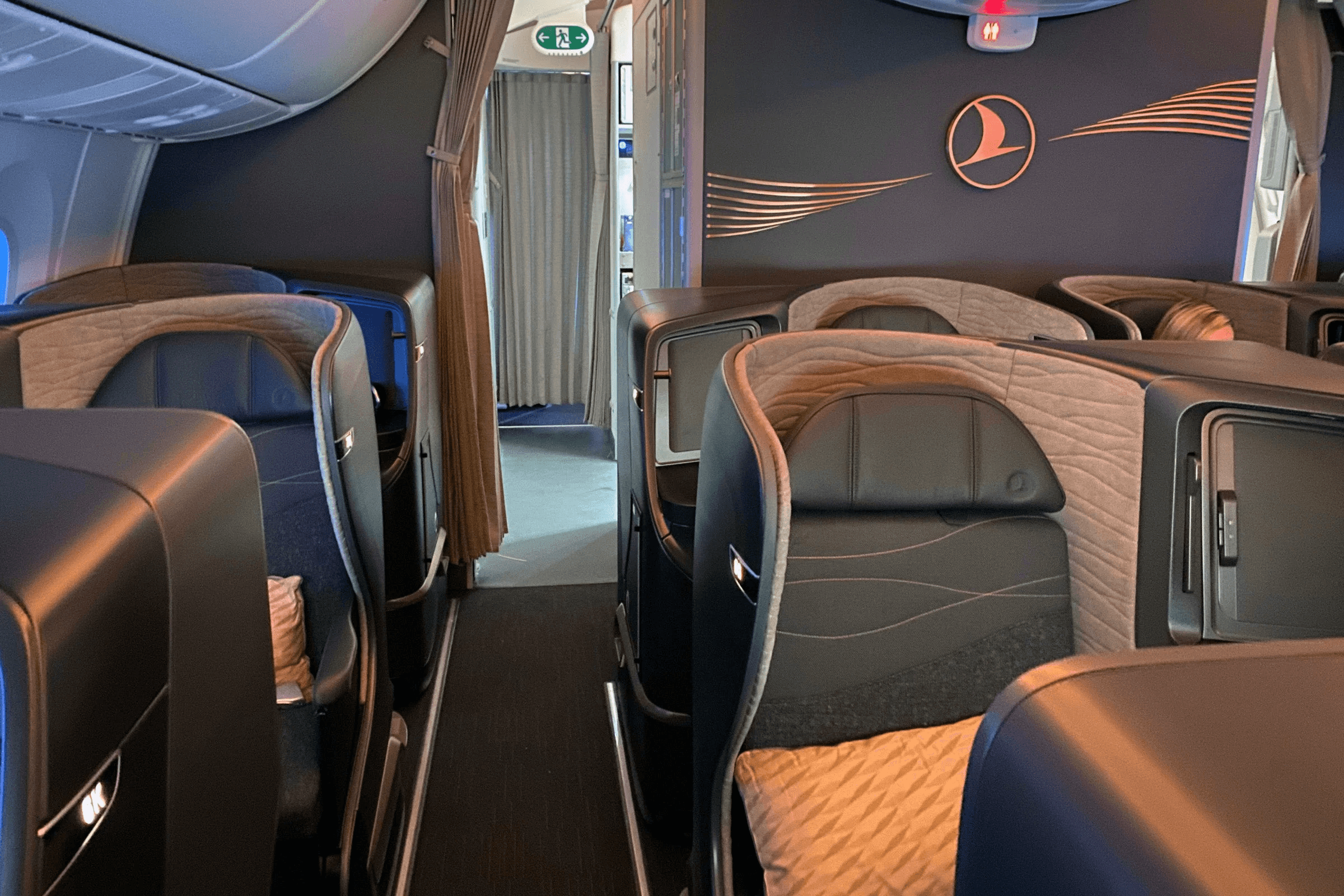
What Turkish Airlines Business Class actually is
Turkish Airlines Business Class debuted in 2017 as a direct-aisle-access refresh to compete with Gulf carriers and European legacy airlines. It represents a mid-tier premium positioning — better than the airline's former upper-deck 2-2-2 products, but launched just as the industry pivoted to herringbone and centre-suite layouts. The product combines award-winning catering (Turkish chef onboard on long-haul flights) with variable hardware, making it a soft-product strength undermined by hard-product inconsistency. On the right aircraft (A350-900, 787-9), it is genuinely competitive; on the 777-300ER, it feels dated.
Seat Hardware
Business Class dimensions are consistent across all aircraft: 78-inch pitch, 21-inch width, and a fully flat 76-inch bed (2 inches longer than some competitors' reverse herringbone offerings). On the A350-900 and 787-9, the 1-2-1 reverse herringbone layout guarantees direct aisle access to every seat, with staggered positioning so no seat is directly across from another — you have visual privacy and no climbing over neighbours to leave your seat. The 777-300ER retains a 2-3-2 layout: window seats and aisle seats (A, B, J, K) have direct access, but centre seats (D, E, G) have no window and require climbing over or asking neighbours to move, which is unacceptable for a 13+ hour flight. Seat hardware varies by aircraft: the A350 uses a Stelia Symphony or Collins Horizon; the 787-9 uses a staggered herringbone (likely Safran or Collins derivative); the 777 uses a Zodiac Aura Lite designed before privacy and direct access were standard. All seats include a small privacy divider between neighbours on the 1-2-1 aircraft (no door), underseat storage for a carry-on, and aisle-side console with amenity controls.
Cabin & IFE
The cabin is split into forward (Rows 1–4, 28 seats) and rear (Rows 5–7, 21 seats) sections, with the rear cabin notably smaller and quieter. Mood lighting on newer aircraft (A350, 787) uses dynamic sequences during meal service and descent; the 777 has standard ceiling lights. The 15.4-inch Panasonic eX2 touchscreen is sharp but not cutting-edge (no 4K OLED); it includes Bluetooth audio pairing and a decent on-demand film library with strong Turkish and European content. Complimentary WiFi offers 1GB for all Business Class passengers (unlimited for Miles & Smiles Elite members), a competitive threshold. The cabin pressure on the 787 and A350 is lower (6,000-foot equivalent) than the 777, which means less fatigue and better sleep — a meaningful advantage on 14+ hour flights.
Where to find it
Aircraft | Business Layout | Status | Sample Routes |
|---|---|---|---|
A350-900 | 1-2-1 reverse herringbone | Fleet-wide deployment; preferred aircraft | Istanbul–New York (JFK), Istanbul–Los Angeles, Istanbul–Singapore, Istanbul–Tokyo |
787-9 | 1-2-1 staggered herringbone | 10+ aircraft; growing allocation | Istanbul–San Francisco, Istanbul–Toronto, Istanbul–Chicago |
777-300ER | 2-3-2 (legacy) | 33 aircraft; being phased out but still common | Istanbul–New York (EWR), Istanbul–Bangkok, Istanbul–Johannesburg, Istanbul–Singapore |
A330-300 | 2-2-2 (older Business Class) | Regional long-haul; minimal Business Class seats | Secondary routes to Europe and Middle East |
Who it suits / who it doesn't
Profile | Verdict (A350/787) | Verdict (777-300ER) | Reasoning |
|---|---|---|---|
Solo overnight | Strong — best in class | Pass | 1-2-1 window seats (2A, 2K, 3A, 3K) offer maximum privacy and distance from galleys; 777 middle seats eliminate this advantage entirely |
Couples | Excellent | Weak | A350/787 allow paired window seats (2A/2B, 2J/2K) with visual privacy and shared armrest; 777 forces middle-seat compromise |
Tall (over 6ft) | Good | Acceptable | 76-inch bed is solid (not exceptional); pitch of 78 inches is competitive. Fully flat on all aircraft. Feet cubby on 1-2-1 is deeper due to staggered layout |
Work-focused | Moderate | Weak | Tray table is functional but compact; no centre-console desk or dedicated work surface. Power is universal AC + USB-A. 777 middle seats have awkward tray angles |
Light sleepers | Very good | Poor | A350/787 offer quieter rear cabin (Rows 6–7 away from mid-galley); 777 has no escape from galley noise and aisle traffic |
Which Turkish Airlines aircraft have the best Business Class seats?
The A350-900 and 787-9 feature the modern 1-2-1 reverse herringbone layout with direct aisle access to all seats, making them significantly superior to the 777-300ER's aging 2-3-2 configuration. Book these newer aircraft on long-haul routes to North America, Asia, and Africa whenever possible. The 777-300ER's middle seats lack both window and aisle access, creating a genuinely inferior experience that you should actively avoid.
How do I make sure I don't get stuck in a 777-300ER middle seat?
Turkish Airlines' fleet lottery is a real problem — the airline doesn't always specify which aircraft operates your route at booking, so you may reserve what you expect to be a premium 1-2-1 seat only to discover you're in a cramped 2-3-2 middle configuration. Check the equipment assignment 3–4 weeks before departure and contact the airline to reposition your seat or switch flights if you're assigned a 777. Always verify your specific aircraft and seat map before finalizing your purchase.
Where should I avoid sitting in Turkish Airlines Business Class?
On all aircraft, avoid seats near the galley and lavatory areas, which generate noise and foot traffic throughout the flight. On the A350-900 and 787-9, the forward and aft bulkhead rows are prime real estate but seats in rows immediately behind them can experience galley activity. Request a mid-cabin seat in the quieter rows when selecting your seat, and double-check the seatmap for proximity to service zones before boarding.
How does Turkish Airlines Business Class compare to Lufthansa Allegris Business Class?
Lufthansa Allegris is the superior choice if both carriers operate your route: it features enclosed suite doors for genuine privacy, newer hardware across the entire fleet, and zero configuration guesswork since all Allegris aircraft are identical. Turkish Airlines edges out most Middle Eastern carriers on soft product (onboard Turkish chef, award-winning catering) but Allegris's hard-product advantages — privacy doors and fleet consistency — make it the safer premium bet. Turkish only wins if you prioritize cuisine and service ritual over seat hardware and privacy.