Qantas Premium Economy Review (2026)
Qantas
TL;DR
Qantas Premium Economy is a genuine mid-cabin product launched in 2008 with 38-inch pitch, 20-inch wide seats, a calf rest, and dedicated meal service across the A380 and 787-9. The A380 offers the better experience—book it on SYD–LHR or LAX routes if you can. The 787-9's mixed seating layout is a real gotcha: window and aisle seats are excellent, but centre-block D/E/F seats trap you between four strangers with no direct aisle access. Best for couples on the A380 or solo travellers willing to cherry-pick seat rows 11A/K or 14A/K on the 787-9. Skip it if you're sensitive to cabin noise—the 787 is noisier than the A350 competitor. Verdict: beats Singapore Airlines Premium Economy on legroom and meal quality, but loses on cabin consistency and refinement. Worth the upgrade for overnight flights; consider a competitor airline if the 787-9 is your only option.
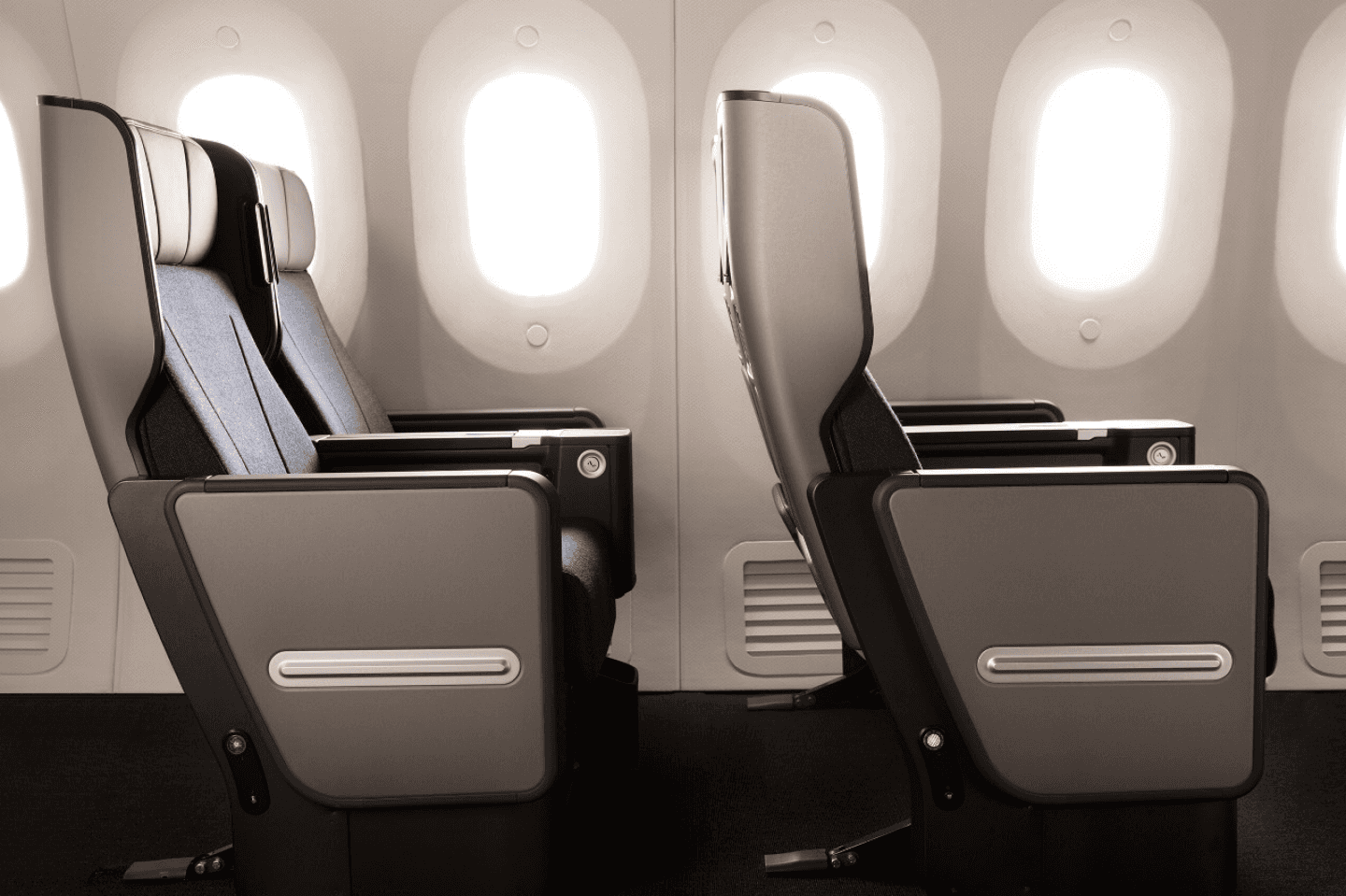
What Qantas Premium Economy actually is
Launched in 2008, Qantas Premium Economy sits between Business and Economy as a genuine cabin separation with dedicated crew, bulkhead-style privacy from Economy, and consistent meal service. It replaced pure cattle-class upgrade options and positioned Qantas as a three-cabin competitor to Singapore Airlines and Cathay Pacific on ultra-long-haul. The product is intentionally designed for overnight travellers who need more than Economy legroom but can't justify Business Class spend.
Seat Hardware
All Premium Economy seats feature 38-inch pitch (vs Economy's 31–32 inches) and a 20-inch width with an 8-inch recline and integrated calf rest—not a lie-flat, but genuinely comfortable for sleep. On the A380, seats are arranged in a 2-4-2 layout: window pairs (A/B and J/K) offer direct aisle access, while the centre block (D/E/F/G/H) is four across. The 787-9 uses a mixed 2-3-2/2-4-2 layout depending on row: window pairs are 2-across, centre varies between 3 and 4 seats, creating an awkward geometry where middle-seat passengers in the 4-seat block have no direct aisle access. Both aircraft feature bi-fold tray tables, wall-mounted footrests (row 20 on A380, row 11 on 787), 12-inch HD inflight screens, and USB power outlets. The A380 cabin is visually wider and feels more spacious; the 787-9 feels narrower due to the fuselage diameter and mixed seating density.
Cabin & IFE
The A380 Premium Economy cabin has a contemporary grey/blue colour scheme with LED mood lighting and feels genuinely separated from Economy. The 787-9 uses similar styling but suffers from smaller windows and electronic dimmers that can be sluggish—bring an eye mask. Both offer 12-inch HD seatback screens with on-demand entertainment, Bluetooth audio pairing, and USB power. WiFi is available on most long-haul 787-9 services (packages vary by route); the A380 does not offer WiFi on all routes. Cabin crew in Premium Economy are dedicated and noticeably attentive compared to Economy, with complimentary bar service, premium bedding, and multi-course meals.
Where to find it
Aircraft | Status | Sample routes | Layout notes |
|---|---|---|---|
A380 | Fleet-wide (all active aircraft) | SYD–LHR, LAX–SYD, HKG–MEL, SIN–SYD | 2-4-2; rows 20–23; 20 seats total |
787-9 | 3-class only (2-class variant has no PE) | SYD–DFW, MEL–LAX, PER–LHR | Mixed 2-3-2/2-4-2; rows 11–18; 35 seats total |
Who it suits / who it doesn't
Profile | Verdict | Why |
|---|---|---|
Solo overnight (8+ hours) | Strong—book A380 if possible | 38-inch pitch and calf rest enable real sleep; A380 window seats feel genuinely private |
Couples | Best in class on A380; mixed on 787-9 | A380 centre-block pairs (D-G rows) allow couples to sit together with one middle aisle; 787-9 centre blocks trap the middle seat with no direct aisle (avoid D/E/F centre) |
Tall travellers (6ft+) | Adequate; not generous | 38-inch pitch is a real step up from Economy but calf rests are wall-mounted and foot cubby is tight; direct aisle access is essential for leg extension |
Work-focused | Pass | Bi-fold tray is functional but small; no personal device holder; bulkhead rows lack a seat-back pocket (tray only) |
Sensitive to noise | Pass on 787-9; acceptable on A380 | 787 cabin noise is notably higher than A350 competitors; A380 is quieter due to size and engine distance |
Which aircraft has Qantas Premium Economy?
A380 (all active aircraft) and 787-9 (3-class variant only). The 787-9 comes in both 2-class (Business + Economy, no PE) and 3-class (Business + Premium Economy + Economy) configurations—check the seat map when booking. A380 is more consistently available on flagship routes (SYD–LHR, LAX–SYD); 787-9 operates secondary long-haul routes (DFW, secondary European stations).
What is the worst seat in Qantas Premium Economy?
On the 787-9: any centre-block middle seat (D, E, or F in the 4-seat rows). You'll be sandwiched between four passengers with no direct aisle or window access and will need to climb over a neighbour to reach the aisle. On the A380: row 23 is closest to the Economy galley and slightly noisier.
What are the best seats in Qantas Premium Economy?
A380: rows 20–21 window seats (A/B or J/K) offer bulkhead legroom and natural light with only one neighbour. 787-9: row 11A/K (bulkhead window) or row 14A/K (exit row, if available) for maximum legroom; avoid the centre block entirely.
Is Qantas Premium Economy better than Singapore Airlines Premium Economy?
Mixed verdict. Qantas Premium Economy wins on seat width (20 inches vs SIA's 18.7 inches), pitch consistency (38 inches across both aircraft), and meal quality (multi-course, premium bar). Singapore Airlines wins on cabin quietness (A350 is noticeably quieter than 787-9), seat recline (10 inches vs Qantas's 8), and product consistency (no aircraft lottery or mixed layouts). If you're on the A380, Qantas is the stronger choice; if you're facing the 787-9, seriously consider Singapore Airlines A350 if the route allows it. On overnight flights longer than 10 hours, the cabin noise penalty on Qantas 787-9 is real.
Does Qantas Premium Economy have direct aisle access on the 787-9?
Window seats (A, C, H, K) and aisle seats (C, H on the 3-seat rows; D, G on the 4-seat rows) have direct aisle access. Middle seats in the 4-seat blocks (E, F) do not and should be avoided entirely.
How do I book Qantas Premium Economy with points?
Qantas Frequent Flyer is the strongest redemption—typically 57,500 points (off-peak) to 72,500 points (peak) for domestic Premium Economy and 100,000–150,000 points for international. American Airlines AAdvantage allows bookings on Qantas and offers similar or slightly better value on off-peak dates. Transfer partners (British Airways Avios, etc.) rarely offer good PE value on Qantas.
Why is my 787-9 Premium Economy seat map showing different layouts in different rows?
Qantas uses a mixed 2-3-2/2-4-2 layout on the 787-9 to maximize Premium Economy seat count (35 total) while fitting the cabin between Business and Economy. Some rows are two-aisle pairs (2-3-2: A/B–D/E/F–H/K), others are a four-aisle centre block (2-4-2: A/B–D/E/F/G–H/K). Always check the specific seat map before booking to avoid centre-block middle seats.
Does Qantas Premium Economy have WiFi?
WiFi is available on most long-haul 787-9 services but varies by route and is typically a paid add-on (hourly or monthly pass). The A380 does not have WiFi on all routes—check your specific flight. Frequent Flyer members often get complimentary access on selected services.