Air Canada Signature Class Review (2026)
Air Canada
TL;DR
Signature Class is a Collins Super Diamond reverse-herringbone business seat in a 1-2-1 layout with 80-inch fully flat beds and no sliding door — present on 787-8, 787-9, 777-300ER, and A330-300. The 787-9 is the only aircraft worth booking deliberately; A330 and 777 are acceptable but ageing. Best on longer routes from Canada to Europe and Asia where the modern aircraft are scheduled. Signature Class suits solo sleepers, couples in centre pairs, and anyone prioritizing bed comfort over cabin finesse. Skip it if you're booking 777 or A330 widebody; take Polaris instead on US routes. Versus United Polaris: Signature Class wins on bed width and privacy, Polaris wins on food, service tempo, and cabin design language — Polaris is the stronger product overall.
What Air Canada Signature Class actually is
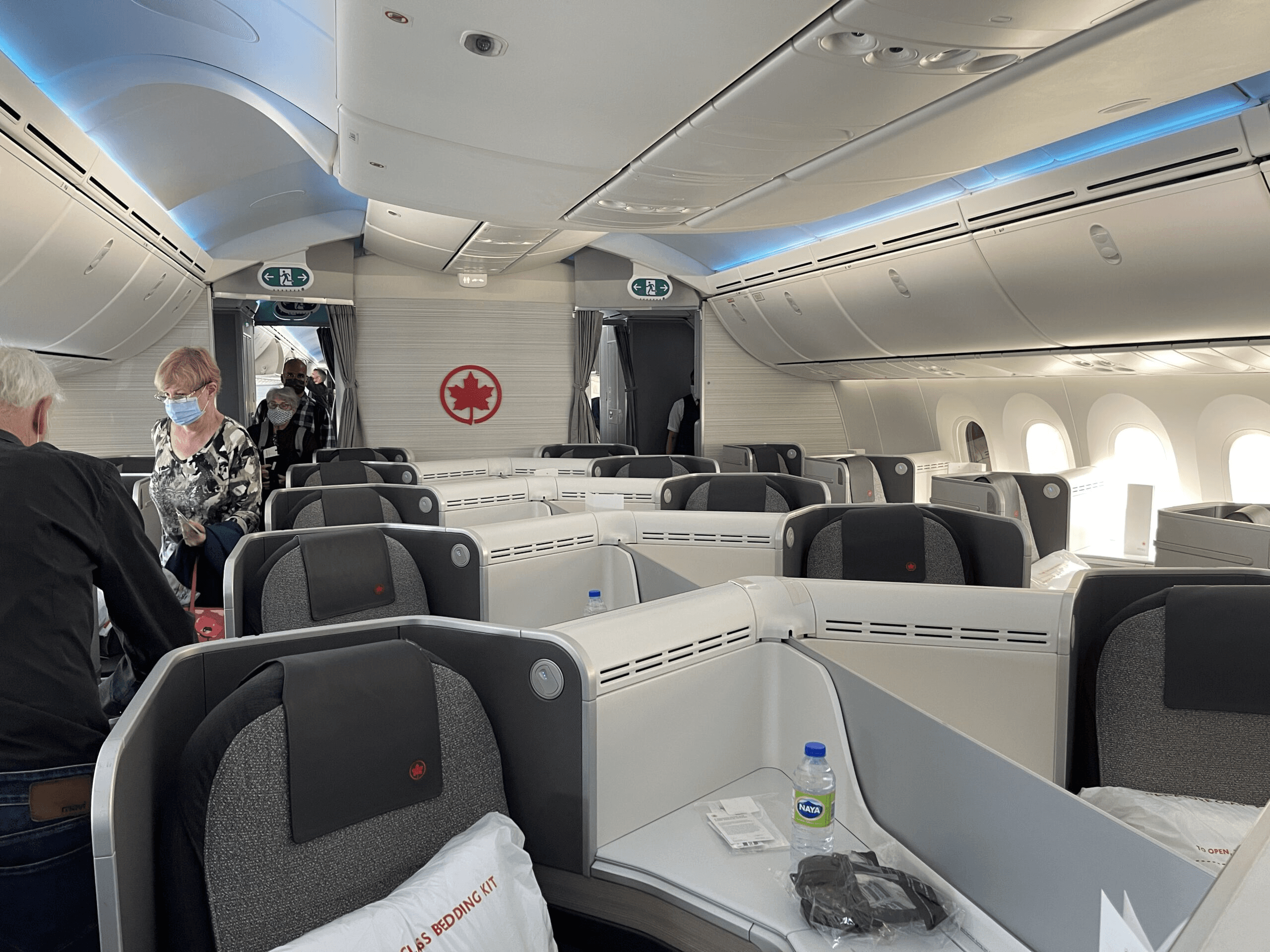
Launched in 2017, Air Canada Signature Class replaced the airline's older flat-bed business product with a modern, Collins-built reverse-herringbone design. It sits as Air Canada's sole international business offering across its widebody fleet, positioned to compete directly with United Polaris, Lufthansa First Class (in concept, not price), and the legacy business products of European carriers. The product is standardized across four aircraft types, but aircraft selection dramatically affects actual experience quality.
Seat Hardware
Signature Class uses Collins Aerospace Super Diamond seats in a 1-2-1 reverse-herringbone configuration with genuine all-aisle access — both outboard seats (A/K) and both centre seats (D/G) have direct aisle availability. Bed length is 80 inches fully flat (tighter than Polaris's 81 inches, but functional), seat width is 21 inches between armrests, and the seat features an enclosed footwell, side-mounted storage counter, and small overhead cupboard. Critically, there is no sliding privacy door on any Air Canada Signature Class seat; passengers depend on the herringbone angle and high seatback design for visual separation. The mattress pad is airline-provided and reasonably thick. Power includes both 110V AC and USB-A (USB-C rolled out to 787 fleet in 2023–2024).
Cabin & IFE
Cabin design is functional rather than premium: mood lighting exists but is less dramatic than Polaris or Lufthansa First Class. IFE is a Panasonic eX3 HD touchscreen (approximately 18 inches), responsive and well-stocked with content, but not as sharp as newer OLED systems on competing airlines. Bluetooth audio pairing is available. WiFi is Intelsat 2Ku satellite, adequate for messaging but not streaming. The 787s benefit from the aircraft's lower cabin altitude (6,000 feet simulated), higher humidity, and larger windows with electronic dimming, making the experience noticeably more comfortable on 14+ hour flights; the 777 and A330 are conventional-cabin pressure with standard portholes, making them feel more domestic.
Where to find it
Aircraft | Status | Sample routes |
|---|---|---|
787-9 | Fleet-wide, preferred assignment | YYZ–LHR, YVR–NRT, YYJ–CDG, YYZ–FCO |
787-8 | Partial fleet, older airframes | YYZ–BRU, YYZ–ZRH, YVR–IAD |
777-300ER | Ageing, increasingly rare on Signature routes | YYZ–DEL, YYZ–BKK (intermittent) |
A330-300 | Legacy widebody, phasing out | YYZ–GRU, YVR–MEL (seasonal) |
Who it suits / who it doesn't
Profile | Verdict | Why |
|---|---|---|
Solo overnight sleeper | Strong | All-aisle access means zero climbing over seatmates; 80-inch bed is adequate; herringbone privacy works. Avoid row 1 (galley proximity) and row 8–11 Mini Cabin on 787-9 (galley behind). |
Couples on same booking | Very strong | Centre-pair seats (3D/3G, 4D/4G, 5D/5G on main cabin) face inward and are just 2–3 feet apart, allowing conversation and intimacy. No sliding door is irrelevant here. |
Tall sleeper (over 6'2") | Adequate | 80-inch bed forces feet into the semi-enclosed footwell at an angle; workable but not luxurious. Seat pitch is deep enough that recline never feels confined. |
Work-focused daytime | Moderate | Tray table is reasonably large for a laptop; AC power and USB are standard. However, reclined-bed mode is the product's strength, not working upright. Polaris's lie-flat-and-work capability is better. |
Frequent short-haul upgraders | Pass | Signature Class is domestic-only on select routes (YYZ–YVR) but not bookable as an upgrade; only accessible via redemption or premium cabin booking. Skip. |
✈️ Fleet Rollout Status
Air Canada Signature Class has been rolling out across the airline's widebody fleet since 2017, beginning with the Boeing 787-9. As of early 2024, Signature Class is confirmed on:
Boeing 787-9: Majority of the fleet (all new deliveries since ~2018)
Boeing 787-8: Retrofitted aircraft; some earlier examples may retain older 2-2-2 angled-flat product
Boeing 777-300ER: Phased rollout in progress; mixed fleet with both Signature Class and legacy 2-2-2 yin-yang seating
Airbus A330-300: Retrofit programme underway; significant portion still operates the older reverse-herringbone layout (similar pitch but different aesthetics and slightly smaller footwells)
Air Canada's legacy Business Class product — a 2-2-2 angled-flat or yin-yang configuration with 6–8 ft pitch and no direct aisle access — remains on some 777-300ER and A330-300 aircraft and will continue to operate through 2025–2026 as the Signature Class retrofit accelerates.
Practical implication: A booking confirmation showing "Air Canada Business Class" does not guarantee Signature Class. You may be assigned a 777-300ER or A330-300 configured with the older product, which offers markedly inferior privacy and sleep ergonomics.
How to confirm before booking:
Use the Air Canada seat map at time of booking or seat selection. Filter by aircraft type in the booking engine.
Look for the 1-2-1 reverse-herringbone layout with all seats showing direct aisle access. The older 2-2-2 product shows two centre seats (rows of four total) with no aisle door between them.
On the route confirmation, prioritize 787-9 and 787-8 flights. If the system assigns a 777-300ER or A330-300, request aircraft change to a 787 before final commitment.
Check the IATA aircraft code in your email itinerary: 788 (787-8), 789 (787-9), 77W (777-300ER), 333 (A330-300).
As of Q4 2024, Air Canada has committed to completing the Signature Class retrofit by 2027, but fleet delays and supply-chain issues may push this forward.
🆚 Air Canada's Older Product
Air Canada's legacy Business Class (primarily on older 777-300ER and A330-300 aircraft) uses a reverse-herringbone or yin-yang 2-2-2 layout with side-by-side or angled-flat seating and no direct aisle access for centre seats.
Signature Class vs Legacy Product:
Attribute | Signature Class (1-2-1) | Legacy (2-2-2 / Yin-Yang) | Winner |
|---|---|---|---|
Pitch | 6'8" (80") | 6'2"–6'6" (74"–78") | Signature Class (+4–6") |
Bed Length | 79" fully flat | 75–77" fully flat or angled | Signature Class (+2–4") |
Seat Width | 21" (between armrests) | 20–21" (angled, shared armrests on centre pairs) | Signature Class (dedicated width) |
Privacy (Window Seats) | Direct aisle access, enclosed footwell, high enclosure | Shared aisle with two other seats (centre pair), lower privacy | Signature Class (no comparison) |
Privacy (Centre Seats) | 100% direct aisle access, face-inward design | No aisle access; must climb over neighbour or aisle-facing seat with zero privacy | Signature Class (decisive) |
IFE Screen | 18" HD touchscreen | 16–17" widescreen | Signature Class (larger + responsive) |
Door / Enclosure | No sliding door, but tall dividers and high sidewalls provide strong visual privacy | Open cabin layout, minimal enclosure on most legacy aircraft | Signature Class (high visual separation) |
Storage | Dedicated cupboard + side counter space | Overhead bins + seat-back pouches | Signature Class (more accessible) |
Recline Smoothness | Collins Diamond: smooth, quiet, 6.5–7 second deployment | Varies; older Vinyls or Zodiac mechanisms can be noisier and slower | Signature Class |
Sleep & Work: Signature Class is objectively superior for sleep. The extra bed length, wider pitch, enclosed footwell, and direct aisle access eliminate middle-of-the-night bathroom trips that disturb neighbours. For work, the larger IFE screen and more stable surface (no shared armrest with neighbour) make Signature Class the clear choice.
Should you pay extra to route via Signature Class aircraft? Yes. The difference in sleep quality and privacy between a 1-2-1 reverse-herringbone and a legacy 2-2-2 configuration is one of the largest within a single airline's Business Class. If booking a 10+ hour flight (e.g., Toronto–London or Vancouver–Tokyo), paying an additional USD 100–300 to confirm a 787-9 or freshly retrofitted 777-300ER is justified. For shorter routes (4–6 hours), the advantage diminishes but privacy gains remain significant for centre-seat bookings.
🍽️ Food & Service Reality
Air Canada Signature Class offers a solid mid-to-upper-tier soft product, though the dining experience does not fully match the sophistication of the hard product.
Meal Service:
Pre-order system: Air Canada allows meal pre-selection up to 24 hours before departure on flights over 7 hours via the airline's website or mobile app. Main cabin meal choices typically include a signature entrée, alternative protein (vegetarian, kosher, halal, low-sodium), and light meal options.
Service style: Course-by-course tray service. Predeparture service includes champagne and hot canapés. On longer flights (10+ hours), the meal sequence follows: appetiser, soup, salad, main, and dessert or cheese course, with beverages between each course.
Wine list: Air Canada's wine programme on Signature Class is respectable but not extensive. The list typically features 6–8 reds, 4–5 whites, and 2–3 rosés, with a focus on Canadian, French, and California producers. No sommelier-level pairing or rare vintages; selections are accessible and food-friendly.
Catering quality: Main dishes are prepared with care and taste considerably better than legacy carriers' airline food. Chef-driven menus (especially on long-haul routes like YVR–NRT, YYZ–LHR) show genuine culinary effort. Bread is freshly baked onboard.
Service style: Flight attendants are professional and attentive, but service pace can lag on busy flights. Requests for additional beverages or meal courses are met promptly, and crew accommodation of dietary preferences is reliable.
Competitive comparison: On the Toronto–London route, Air Canada Signature Class service sits between British Airways Club World (stronger wine list, more formal service) and Lufthansa First Class on 747-400 (superior catering, tablecloth dining). Compared to United Polaris on the same route, Air Canada's wine and catering are comparable, though United's Polaris Lounge access and lie-flat seats are equivalent. On Pacific routes (YVR–NRT), Air Canada's Japanese meal options are solid but less refined than ANA First Class.
Honest assessment: Air Canada's service and dining on Signature Class do not undermine the hard product — they complement it respectably. The weakness is not in execution but in ambition: the airline does not offer surprise-and-delight touches (e.g., sommelier consultations, chef's specials not on the printed menu) that would elevate Signature Class to world-leading status. Passengers flying Signature Class should expect professional, attentive service and solid food that matches the bed quality; they should not expect the white-glove theatre of a premium European or Asian long-haul carrier.
💳 Award Sweet Spot
Aeroplan (Air Canada's own loyalty programme):
Signature Class redemption: 85,000–110,000 Aeroplan points for one-way long-haul (e.g., Toronto–London, Vancouver–Tokyo), depending on season and demand. Taxes and fees: ~CAD 150–300.
Pricing reality: Aeroplan uses dynamic pricing for Signature Class; peak summer and holiday windows command the 110,000-point ceiling. Shoulder seasons (April–May, September–October) typically drop to 90,000–100,000 points.
Which aircraft has Air Canada Signature Class?
787-9 (newest, 30 seats Signature Class per aircraft), 787-8 (20 seats), 777-300ER (older, 28 seats), and A330-300 (ageing widebody, 28 seats). 787-9 is the only aircraft you should deliberately book around; if you see 777 or A330, check seat maps for Premium Economy or Economy premium redemption options instead.
Does Air Canada Signature Class have a sliding privacy door?
No. Signature Class has no sliding or partition door on any aircraft type. Privacy relies entirely on the herringbone angle, high seatback, and window/aisle positioning. Outboard seats (A/K) have superior visual privacy; centre seats (D/G) are more exposed to aisle foot traffic.
Is Air Canada Signature Class better than United Polaris?
No — Polaris is the stronger product. Polaris wins on: cabin design language (more premium aesthetics), meal quality and service tempo (noticeably more attentive), IFE (larger screens on newer aircraft), and door privacy (sliding door standard on 787 Polaris). Signature Class wins on: seat width (21" vs Polaris's tighter geometry on some aircraft), centre-pair intimacy (Polaris's centre seats are less well-positioned for couples), and bed comfort for solos. On a Canada–US route, book Polaris. On a Canada–Europe or Canada–Asia route, Signature Class is your only North American business option; take it on 787-9, pass on 777 or A330.
How do I book Air Canada Signature Class with miles?
Aeroplan (Air Canada's loyalty program) is the strongest value: expect 70,000–90,000 Aeroplan points for a one-way business redemption to Europe (off-peak 60,000, peak 100,000). Alternatively, transfer partners like Amex (US) to Aeroplan, or use American AAdvantage miles to book Air Canada via interline (expect 57,500–75,000 miles). Aeroplan is the best-value path with frequent low-bucket availability.
Which seats should I avoid?
Row 1 (1A, 1D, 1G, 1K) — directly forward of front galley and lavatory, expect crew and passenger foot traffic throughout the flight. Row 7 on 787-8/777 (only 2 seats, 7A/7K) and row 8 on 787-9 Mini Cabin — galley just forward. Rows 8–11 on 787-9 (Mini Cabin behind galley) are quieter but feel segregated; acceptable if you want isolation, poor if you want main-cabin energy. Avoid row 11 (last business row on some aircraft) — Premium Economy directly behind, reduced privacy. Best seats are rows 3–6 on main cabin (away from galley, centre of cabin, strongest herringbone angles).
Is the Mini Cabin (rows 8–11 on 787-9) worth choosing?
Only if you prioritize absolute quiet and minimal foot traffic over cabin energy and accessibility. The Mini Cabin has a dedicated lavatory and feels intimate, but it's smaller and sometimes slower on service. Main cabin rows 4–5 are superior for most passengers.
How does Signature Class compare to BA Club World or Lufthansa First Class?
Signature Class is a tier below both in cabin design and service. Club World on 787-9 has a sliding door and superior meal quality; Lufthansa First Class on A380 is a separate cabin with shower spas. Signature Class is competitive with Air France La Première (on narrower aircraft) and Swiss Business, not against Club World or First Class. On value for transatlantic routes, Signature Class redemption is excellent; on paid fares, it undercuts Polaris and Club World by 10–15%.