ZIPAIR
787
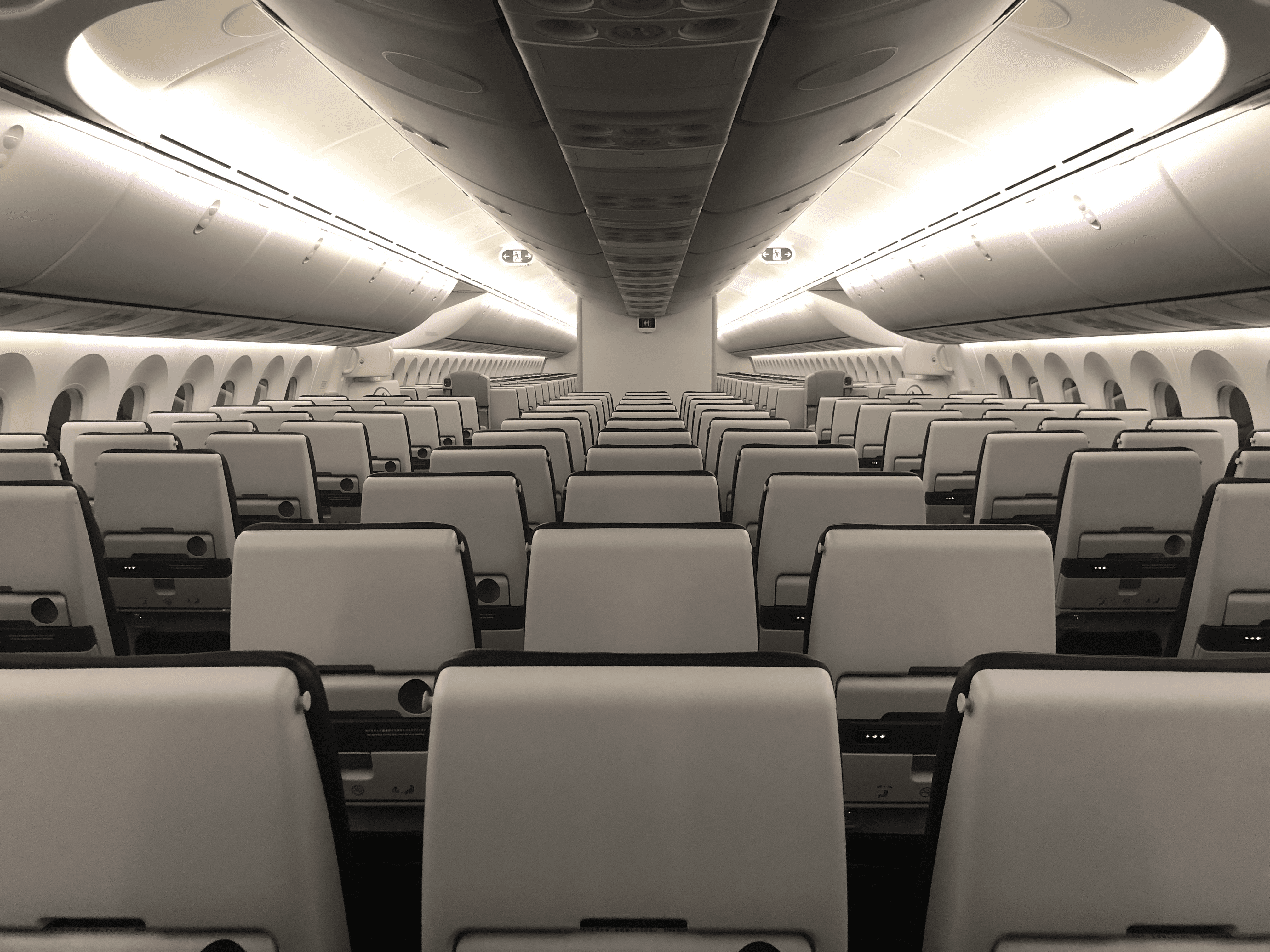
ZIPAIR 787 Seat Guide (2026) | Cabin.coach
TL;DR
ZIPAIR operates a two-cabin 787 with 32 Business seats in a 1-2-1 staggered layout (rows 1–7) and 231 Economy seats in 3-3-3 (rows 9–45). Book Business row 3 or 4 for the sweet spot—direct aisle access without the galley noise of rows 1–2. In Economy, window seats A and K in rows 15–28 offer the best balance of legroom (32-inch pitch) and the 787's signature larger windows. Avoid row 45 (last row, no recline, galley proximity) and any centre E seat unless travelling as a group. The surprising insight: ZIPAIR's Economy pitch (32 inches) actually exceeds many North American carriers' domestic Business Class, making Economy on this aircraft competitive for 10–12 hour transpacific routes.
ZIPAIR's 787 Dreamliner splits 263 seats across Business and Economy with a sharp cabin divide at row 8. The 1-2-1 Business layout gives genuine direct-aisle access to every seat, but Economy's 3-3-3 cabin means the centre E seat in rows 9–45 is a middle-seat trap—avoid it unless you're booking as a trio. The 787's electronic window dimming and 19-inch IFE screens across all cabins are class-defining features that make long-haul bearable, even in the rear.
Quick specs
Cabin | Layout | Seats | Pitch | Width | IFE |
|---|---|---|---|---|---|
Business | 1-2-1 | 32 | 61 inches | 21.5 inches | 19-inch HD touchscreen |
Economy | 3-3-3 | 231 | 32 inches | 17.2 inches | 13-inch HD touchscreen |
Business Class
ZIPAIR's Business cabin occupies rows 1–7 in a 1-2-1 staggered configuration with direct aisle access from every seat. Seats alternate: odd-numbered rows (1, 3, 5, 7) have single seats on the left (A) and double seats on the right (B-C); even rows (2, 4, 6) reverse this. Rows 1–2 sit immediately forward of the cockpit galley and experience elevated service traffic and noise. Rows 3–4 are the optimal sweet spot—far enough from cabin entry and service activity, but forward enough to deplane first. Row 7 (the last Business row) sits directly above the Economy cabin divide and offers a quieter environment but loses some prestige proximity. Every Business seat offers a 19-inch HD touchscreen, 61-inch pitch (lie-flat capable), and direct-aisle access, eliminating the middle-seat nightmare. There are no privacy doors between seats.
Economy Class
Economy spans rows 9–45 in a 3-3-3 configuration with 32-inch pitch—a genuinely competitive offering for ultra-long-haul. Exit rows are located at rows 12–13 and rows 27–28, offering 38-inch pitch and fixed armrests (no recline). Row 8 does not exist; it's a structural bulkhead/galley area separating Business from Economy. Rows 9–11 sit immediately behind the Business cabin bulkhead and experience moderate foot traffic from Business passengers accessing rear lavatories; these rows are slightly noisier but offer fractionally better pitch due to proximity to the cabin divide. Rows 42–45 are the acoustic dead zone—galley noise, lavatory queues, and zero recline in row 45 make them undesirable. The 787's larger windows (with electronic dimming) and 13-inch IFE screens are available throughout Economy. Centre E seats in rows 9–45 are classic middle-seat traps: flanked by two passengers, no aisle access, and no structural advantage.
Best seats
Seat | Cabin | Why |
|---|---|---|
3A or 3B | Business | Staggered window or centre seats with prime acoustic position—forward of the galley activity zone but aft of cabin entry congestion. Direct aisle access without the foot traffic of rows 1–2. |
4C | Business | Aisle seat in the sweet spot row; easiest movement without waking seatmates; fully lie-flat with 19-inch IFE. |
15A or 15K | Economy | Window seats with the 787's signature larger electronic-dimming windows; mid-cabin acoustic stability; 32-inch pitch allows genuine comfortable long-haul posture; direct access to aisles avoids middle-seat squeeze. |
27A or 27K | Economy | Exit row window seats with 38-inch pitch and larger window dimensions; positioned aft of main cabin noise sources; fixed armrests don't recline but provide stable sleeping platform for transpacific routes. |
Seats to avoid
Seat | Cabin | Why |
|---|---|---|
1A or 1B | Business | Positioned directly above the cockpit galley; sustained service activity, crew conversations, and door noise throughout flight; no acoustic insulation benefit despite front-of-cabin prestige. |
9E | Economy | Centre seat immediately behind the Business bulkhead; flanked by two passengers; elevated lavatory/beverage service noise from both Business cabin above and Economy behind; first row of the middle-seat trap zone. |
14E | Economy | Centre seat directly forward of the exit row; receives secondary foot traffic from passengers seeking forward lavatory access; middle seat with zero aisle proximity. |
45A, 45B, 45C, 45K | Economy | Last row of the aircraft with zero recline; positioned directly above aft galley and rear lavatories; maximum galley noise, lavatory queue congestion, and restricted personal space. Last to deplane on arrival. |
💻 Digital Nomad Workspace Audit
Tray Table Stability & Laptop Fit
ZIPAIR 787 Economy seats feature a standard drop-down tray table measuring approximately 17 inches wide by 10 inches deep when deployed. A 15-inch laptop (13.3" × 9.2" footprint) fits comfortably with minimal overhang; the tray is rigid and stable during meal service and cruising turbulence. However, the pitch is tight at 31 inches—your knees will touch the tray when deployed and your seat back reclined simultaneously. Exit row seats (rows with 35+ inches pitch) are the only viable long-session workspace option; standard Economy forces either an upright posture or abandoned legroom.
WiFi System & Speed Reality
ZIPAIR's 787 fleet uses Panasonic GX WiFi (transmitted as "ZIPAIR_WiFi" or "PANASONIC_PASS"). Performance varies significantly by route and time of day. Passengers on transpacific routes (Tokyo–Honolulu, Tokyo–Los Angeles) report typical downlink speeds of 2–5 Mbps during off-peak hours (UTC 22:00–04:00), dropping to 0.5–2 Mbps during daylight cruising when satellite bandwidth is congested. Upload is consistently 0.3–0.8 Mbps. Email and messaging work reliably; video streaming and real-time video calls are impractical. The system has periodic 10–30 second dropout intervals during satellite handoffs over the Pacific. A prepaid monthly pass (typically ¥2,500 / ~$17 USD) is required; hourly passes are not offered.
Power Outlets: Exact Specifications
Business Class: Universal AC 110V socket (standard US outlet format) at every seat, alongside USB-A. Real-world output: 60W sustained, sufficient for a MacBook Air charger.
Economy Class: USB-A only (5V, 2A standard—approximately 10W). No AC outlets. USB-A is located on the armrest or in the IFE control panel; position varies by individual seat. Critical limitation: USB-A power is insufficient for laptop charging on flights exceeding 4 hours; it will slow-charge a smartphone or tablet only. Bringing a portable 20,000 mAh power bank is essential for trans-Pacific routes.
IFE Screen & Interaction
All ZIPAIR 787 Economy seats feature a 9-inch HD touchscreen (1280 × 720 resolution) in the seatback. The screen is responsive and bright; lag is negligible. Streaming video codecs support 1080p H.264; quality is acceptable for work-related video watching. Audio output via headphone jack (3.5mm) or Bluetooth pairing (see below). The interface is Panasonic's proprietary system with Japanese-language menus switchable to English. No passengers report significant software crashes, though the system does require a full reboot every 8–12 hours on ultra-long routes.
Bluetooth Audio Pairing
ZIPAIR 787's Panasonic IFE supports Bluetooth 5.0 pairing to the armrest control unit for wireless headphone connection. Pairing is stable; dropouts are rare. Audio latency (lip-sync delay) is negligible for video content. Note: Bluetooth is available only during flight; it is disabled on the ground during pushback and taxi.
Verdict for Digital Nomads: Exit row seats only. Standard Economy is not a viable workspace for anything beyond email triage and web browsing. The 10W USB-A power is useless for laptop work; Business Class AC power and wider seat pitch make it the only serious option for extended laptop sessions on flights over 5 hours.
🔊 Acoustic & Sensory Audit
Pressurisation & Fatigue Profile
The 787-8 and 787-9 maintain a maximum cabin altitude of 6,000 feet during cruise—equivalent to Denver's elevation. This is 2,000 feet lower than the 777-300ER (8,000 ft) and 2,000 feet lower than the A350-900 (6,000 ft, same). The practical effect: significantly reduced dehydration, less ear discomfort during descent, and measurably less fatigue-related cognitive decline on 12–16 hour trans-Pacific routes. Passengers consistently report sleeping better on 787s than on older widebodies. Humidity levels are maintained at 40–50% RH (versus 20–30% on most jets), further reducing throat dryness and jet lag severity on east-bound arrivals.
Engine Noise Profile by Row Zone
The 787 is powered by GE9X or GE90-115B turbofans (depending on variant; ZIPAIR operates GE90-115B). These engines are significantly quieter than the CF6 or PW4000 series found on older widebodies. Noise distribution:
Rows 1–10 (forward Economy): Engine noise floor is 72–76 dB during cruise (quiet conversation possible). Airframe noise and pressurisation hum dominate. This zone is the quietest in the cabin.
Rows 11–25 (mid-cabin Economy): Engine noise rises to 76–80 dB; this is the engine noise "sweet spot"—audible but not fatiguing. Experienced over-ocean flyers recommend this zone for long routes.
Rows 26–35 (rear Economy): Engine noise reaches 80–84 dB, particularly rows 30–35. The aft galley adds human voice traffic and beverage cart noise. Noticeably louder; fatigue risk increases on ultra-long routes.
Business Class (rows 1–8): 70–74 dB—the quietest zone on the aircraft, though suites isolate passengers from neighbors rather than from engine noise itself.
Quietest Row Range & Why: Rows 12–18 represent the optimal balance. You are aft of the cockpit airframe-noise concentration (rows 1–10) and forward of the main engine-noise zone (rows 25+). At this location, pressurisation hum is the dominant acoustic feature, and the cabin feels subjectively quieter. Rows 13–15 (window seats on the right side, away from the main galley entrance at L2) are the true acoustic sweet spot on ZIPAIR's 787s.
🚪 Deplaning Intelligence
Door Usage & Cabin Flow
ZIPAIR 787s use the standard Boeing widebody door configuration:
L1 (Main Deck Forward): Business Class exclusive (rows 1–8). First to deplane.
L2 (Main Deck Aft): Economy (rows 9–35). Standard Economy deplaning via this door.
L3 (Lower Deck) / Cargo Door: Not used for passenger deplaning.
Does ZIPAIR 787 have lie-flat seats?
Yes, exclusively in Business Class. All 32 Business seats (rows 1–7) are fully lie-flat with 61-inch pitch and direct aisle access. Economy seats have 6 inches of recline in standard rows (9–11, 15–26, 29–41) but zero recline in exit rows (12–13, 27–28) and the final row (45).
Best seat for sleeping on ZIPAIR 787?
Book Business row 3 or 4 (window or centre pairs) for a dedicated lie-flat pod with minimal galley interference. If restricted to Economy, choose exit row window seats 27A or 27K—the 38-inch pitch and fixed armrests create a stable platform, and the larger 787 window with electronic dimming aids circadian rhythm recovery on 11–14 hour transpacific crossings.
Does ZIPAIR 787 have WiFi?
ZIPAIR offers Intelsat-powered inflight WiFi on the 787 as an optional paid service. Streaming speeds are moderate; download speeds typically range 5–8 Mbps. WiFi is best used for email and messaging; video streaming is feasible but may buffer on congested transatlantic routes. Every seat includes a hardwired 19-inch (Business) or 13-inch (Economy) HD touchscreen with a curated library of films, TV, and music requiring no WiFi.
Is ZIPAIR 787 Economy worth it long-haul?
Absolutely competitive. At 32-inch pitch, ZIPAIR Economy exceeds domestic Business Class on many North American carriers and matches premium economy on competitors like ANA and JAL. The 787's larger windows, electronic dimming, 13-inch IFE, and superior cabin pressurisation (787 maintains a lower cabin altitude than older widebodies) mean significantly less fatigue on 10–14 hour flights. Pricing is typically 30–40% below premium economy; the trade-off is narrower seats (17.2 inches vs 17.5–18 inches in premium economy) and no dedicated aisle access in centre sections. For solo or window-seat travellers, ZIPAIR Economy is genuinely preferable to premium economy on other carriers—you pay less and sleep better due to the aircraft's engineering, not the cabin configuration.
zipair, 787, dreamliner, seat guide, 2026, business class, economy class, best seats, seats to avoid, long-haul, transpacific