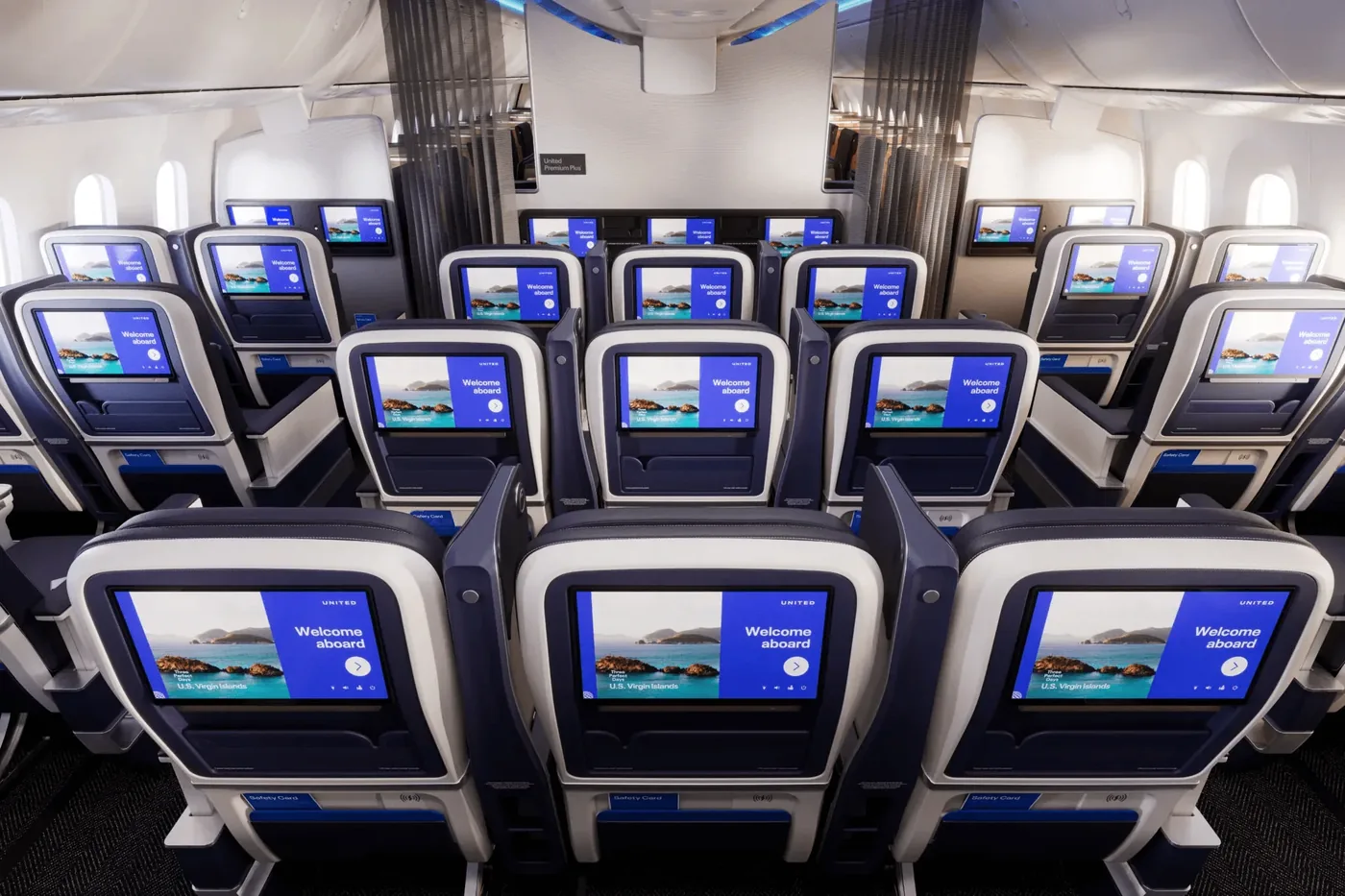
The United 787 is a long-haul workhorse with staggered Business Class suites (1-2-1 layout) that actually deliver privacy, but Economy rows 31-32 are brutally tight before the rear galley wall. The 787's defining feature is its larger windows and cabin pressure that makes long flights less painful than older widebodies.
TL;DR
United's 787 seats 242-290 passengers: 48-60 Business, 52-64 Premium Economy, 120-170 Economy. Business is 1-2-1 staggered seating with direct aisle access for every seat - game-changing for privacy. Best seat: 2A or 2K (nose Business, maximum quiet before cabin noise). Worst seat: 32E (last Economy before galley, no recline, lavatory traffic all flight). The real winner: rows 24-27 Economy offer perfect pitch without upcharge, sitting just far enough from engines to dodge serious noise.
Quick specs
Cabin
Layout
Seats
Pitch
Width
IFE
Business
1-2-1
48-60
6'8"
6'1" wide
10.6" touchscreen
Premium Economy
2-3-2
52-64
38"
18.5"
10.6" touchscreen
Economy
3-3-3
120-170
31-32"
17.2"
10.1" touchscreen
Business Class
Staggered 1-2-1 layout with every seat having direct aisle access - no climbing over partners. Rows 1-5 are First Class premium seating on most routes (limited availability). Rows 6-14 are standard Business with identical suites. Privacy doors on all suites. Avoid rows 13-14 (near Economy galley, some noise bleed). Best rows: 2-5 (quietest, maximum forward location away from engine vibration). Odd-numbered rows (1, 3, 5, etc.) on left, even (2, 4, 6, etc.) on right - pick based on light preference, not revenue loss.
Premium Economy
2-3-2 layout in rows 15-27. True middle seats (C and D) on 3-wide section sit between Economy and Business noise. 38" pitch is genuinely comfortable on 11+ hour flights. Rows 15-18 are quieter (forward location). Rows 24-27 are acoustic sweet spot without premium price if you snag Economy upgrade. Worth the upgrade on trans-Pacific routes over 12 hours; less compelling on 7-8 hour transatlantic flights where Economy 31-32" is barely survivable.
Economy Class
3-3-3 layout in rows 28-48 (varies by config). Rows 28-30: exit row with 38" pitch and no recline - absolute best Economy seats if you don't need to sleep. Rows 31-32: non-recline section due to galley proximity; these are the genuine trap seats despite 32" pitch. Rows 33-48: standard seating, 31-32" pitch. Rows 36-39: acoustic sweet spot, far enough back that engine noise is white noise instead of assault. Rows 47-48: last two rows, always full of families and crying babies. Lavatory proximity in rows 30-35 is brutal during meal service.
Best seats
Seat
Cabin
Why
2A or 2K
Business
Staggered forward position with private suite door and zero cabin churn; maximum sleep advantage on 14+ hour flights
1A or 1K
Business
If available (First Class suites on select routes): nose position eliminates all engine vibration and back-of-cabin noise
28A/D/G
Economy
Exit row with 38" pitch (10" extra legroom), no recline seat in front, and early lavatory access without sacrificing comfort
37E or 37F
Economy
Center of cabin, balanced distance from galley chaos and engines, acoustic white-noise zone where engine rumble becomes ambient
16A or 16F
Premium Economy
Forward Premium rows with quieter cabin and direct boarding without waiting; aisle seats avoid middle-seat purgatory
Seats to avoid
Seat
Cabin
Why
31E, 32C, 32D
Economy
Non-recline zone directly adjacent to galley with constant crew and lavatory traffic; 31-32" pitch feels like a cell; structural dead zone
47A-47J, 48A-48J
Economy
Last two rows: always overbooked with families, nearest to rear lavatories creating perpetual line, zero quiet hours
13L or 14K
Business
Last Business rows experience spillover noise from Economy galley and lavatory below; noticeable vibration increase vs. forward suites
30L or 30K
Economy
Exit row aisle seats with constant armrest jabbing and crew blocking for emergency equipment checks; no actual legroom benefit
💺 Premium Economy
Cabin Layout & Pitch: United's 787 Premium Economy features a 2 - 3 - 2 configuration with 17.3 inches of seat width and 38 inches of pitch. Seats recline to 6.5 inches and include a dedicated ottoman, direct-aisle access on the side seats, and a sliding door partition that separates the cabin from Economy.
Dedicated Galley: Premium Economy has its own forward galley with dedicated catering stock, separate from Economy. Cabin crew prioritize Premium Economy beverage and meal service before Economy boarding completes.
Meal Service Quality vs Economy: Premium Economy receives hot meals on routes over 6 hours, wine and spirits complimentary (vs. paid in Economy), a premium amenity kit with noise-canceling earbuds, Saks Fifth Avenue amenities, and larger pillows and blankets. Meals are sourced from premium catering vendors and plated service is offered on long-haul flights. Economy receives a sandwich or light meal and limited beverage selection on the same routes.
Lounge Access: Premium Economy passengers do not receive automatic lounge access on United. Only elite frequent flyer members (Silver or above) or those with premium credit cards gain access. Day passes are available for purchase.
Best Rows in Premium Economy:Rows 21 - 26 are optimal. Rows 21 - 23 are closest to the galley and receive faster service. Row 26 is the last row and avoids rear-cabin noise but sacrifices service speed. Avoid Row 30 (if present on your aircraft configuration) as it borders the Economy cabin and receives noise bleed. For window sleepers on overnight flights, Rows 24 - 25 window seats offer the best balance of isolation and galley proximity without being trapped by the partition.
💻 Digital Nomad Workspace Audit
Tray Table Stability & Dimensions: Premium Economy and Economy tray tables measure approximately 17 inches wide × 9 inches deep when fully extended. The table is hinged at the armrest and exhibits moderate flex under keyboard pressure; a 15-inch laptop sits with ~1 inch of clearance on either side. Economy tray tables are less stable than Business Class and show noticeable wobble during typing; Premium Economy tables are marginally sturdier due to reinforced hinges.
WiFi System & Provider: United 787 aircraft are equipped with Viasat IFC (In-Flight Connectivity) under the "United_WiFi" SSID. A small number of older 787s retain Panasonic GX, but new deliveries use Viasat exclusively. The system is satellite-based and integrated with United's app for automatic connection.
Real-World Speeds on Typical Routes: Passengers report 5 - 12 Mbps download speeds on transatlantic routes (Newark - London, Chicago - Frankfurt), with occasional spikes to 15 Mbps in cruise at altitude. Upload speeds average 1 - 3 Mbps. Speeds degrade near continental coastlines and during peak traffic hours. Transcontinental domestic routes (SFO - Boston, Los Angeles - JFK) show slightly better performance (8 - 15 Mbps) due to denser Viasat coverage. Video streaming is feasible; Zoom calls are unreliable.
Power Outlets by Cabin:
Business Class: One AC outlet (110V, 60Hz) per seat with ~200W capacity. Charging a MacBook Air to 80% takes ~90 minutes.
Premium Economy: One USB-A port and one USB-C port per seat (5V, 2A each). AC sockets are not available; USB charging is slow for larger devices.
Economy Standard Rows: Alternating USB-A ports (every other seat) shared on armrest. No AC power.
Economy Exit Rows: No power in most configurations due to structural constraints.
IFE Screen Size & Responsiveness: 787 Economy and Premium Economy feature 10.6-inch touchscreen displays (Boeing's newest generation). The screen is responsive to touch, supports Bluetooth pairing, and streams 4K content. Response time is acceptable for menu navigation but not gaming. Brightness is adequate for daytime viewing but reduced cabin lighting on night flights helps. Business Class has 23-inch screens with superior responsiveness.
Bluetooth Audio Pairing: All cabins support Bluetooth pairing to the IFE system. Pairing is straightforward via the Settings menu. Audio latency is negligible for music and podcasts; video is synced. United does not broadcast an in-cabin Bluetooth network for other uses (e.g., connecting a personal hotspot to the plane's network is not possible).
🔊 Acoustic & Sensory Audit
Pressurization Altitude: The 787 cabin is pressurized to an equivalent altitude of 6,000 feet, lower than the 8,000-foot standard on aircraft like the 777 and A380. This reduced differential improves oxygen saturation and reduces fatigue on flights over 7 hours. Passengers report less headache and sleep disruption, especially on transatlantic overnight flights.
Humidity Levels: The 787 maintains cabin humidity at 40 - 60% relative humidity, significantly higher than older widebodies (15 - 25%). This reduces dry skin, sinus irritation, and dehydration-related fatigue. The cabin air is also more comfortable during descent.
Engine Noise Profile by Row Zone:
Rows 1 - 10 (Business Class, forward cabin): Minimal engine noise; primary acoustic stress is landing gear and hydraulic pump during descent. Quietest zone on the aircraft.
Rows 11 - 20 (Premium Economy): Very low engine noise; positioned forward of wing-mounted engines. Noise level ~72 - 74 dB during cruise.
Rows 21 - 35 (forward/mid Economy): Moderate engine noise from GE9X or Rolls-Royce Trent 1000 engines mounted aft of these rows. Noise peaks at ~76 - 78 dB during cruise power.
Rows 36 - 50 (rear Economy, near engines): High engine noise, especially over ocean on transatlantic routes where GE9X noise is pronounced at cruise power. Noise reaches ~80 - 82 dB. Vibration is also detectable in seats near the wing root.
Rows 51+ (rear cabin, if present): Maximum engine noise and landing gear/aerodynamic noise during descent. Avoided by noise-sensitive passengers.
Quietest Row Range & Why:Rows 11 - 15 are the quietest on the 787 (excluding Business Class), achieving ~70 - 72 dB during cruise. These rows are positioned forward of the wing-box and engines, benefiting from the fuselage's natural sound dampening. The 787's composite airframe absorbs more vibrational energy than aluminum, further reducing cabin noise in this zone. Window seats in Rows 12 - 14 (if Premium Economy configuration allows) offer the best balance of quiet environment and cabin amenities.
FAQ
Does United 787 have lie-flat seats?
Yes, Business Class features full lie-flat suites with direct aisle access in 1-2-1 staggered configuration. Beds are 6'8" long and 6'1" wide - genuinely flat, not angled. All 48-60 Business seats recline fully; premium forward rows (1-5) may have slightly wider suite configuration on select aircraft.
Best seat for sleeping on United 787?
Seat 2A or 2K (Business Class, forward staggered position). The nose location eliminates engine vibration felt in rows 10+, cabin pressure is most stable, and your suite door provides acoustic isolation. If Budget-constrained: 28A or 28D (Economy exit row with 38" pitch and no seat reclining in front) - you'll actually sleep sitting upright without someone's seat crushing your knees.
Does United 787 have WiFi?
Yes, Intelsat/Viasat-powered Panasonic eX2 system on most 787s. Business and Premium Economy get complimentary unlimited WiFi. Economy gets 1-hour passes free, then $7 for day pass or $70/month subscription. Speeds are genuinely usable (4-8 Mbps download) on most routes; performance degrades near poles (polar routes) and over oceans at cruise altitude.
Is United 787 Economy worth it long-haul?
Depends on route length. Under 7 hours (transatlantic): 31-32" pitch is survivable if you're under 5'10" and book exit rows. Over 10 hours (Pacific): Economy becomes psychological torture - the 787 cabin pressure helps with fatigue, but 31" pitch destroys sleep. Premium Economy (38" pitch) is worth $300-500 upgrade on Pacific routes; Business is worth $1,500+ uplift on 14+ hour flights where lie-flat actually saves your return-to-work sanity.
How much wider is the 787 cabin?
The 787 fuselage is 20 inches wider than 777, creating noticeably more elbow room in middle seats and aisles that don't feel claustrophobic. Economy seats are still 17.2" wide (unchanged from 777), but the cabin space psychology feels roomier. Windows are 30% larger, making the cabin feel less dungeon-like on 14+ hour flights.
Do all United 787s have the same seat configuration?
No. United operates 787-9 and 787-10 variants with different total seat counts (242-290 range). Some Business Class sections are 48 seats (6 rows), others 60 (10 rows). Premium Economy varies 52-64. Always check your specific aircraft tail number on SeatGuru before booking, as configuration affects galley position and lavatory proximity.