Turkish Airlines
A330
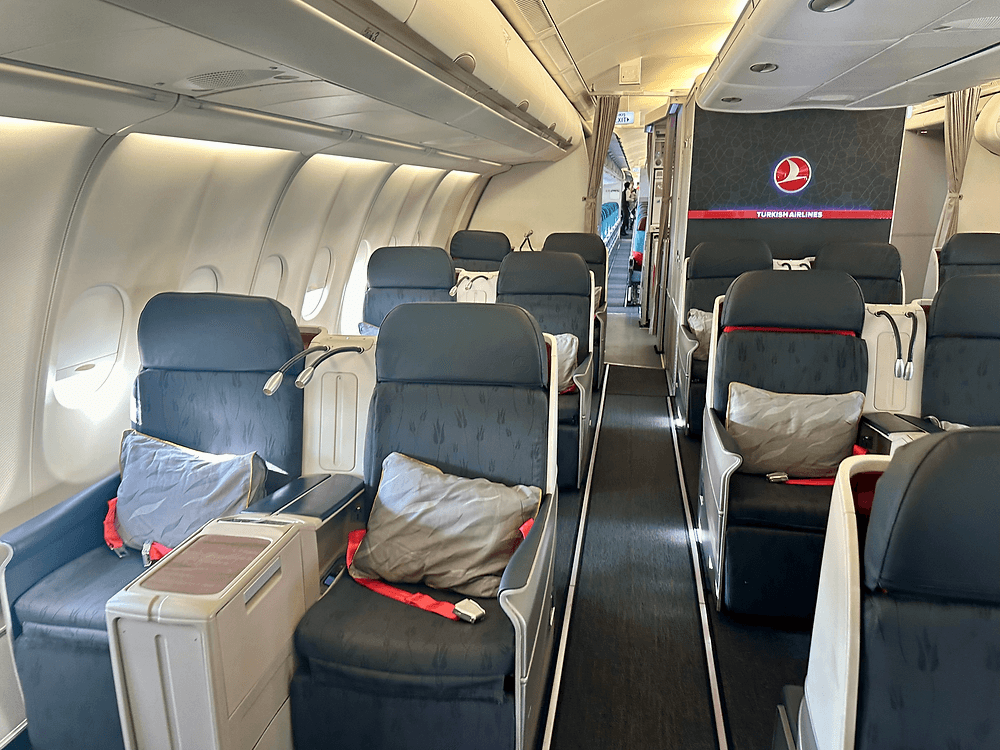
Turkish Airlines A330 Seat Guide (2026) | Cabin
TL;DR
Turkish Airlines operates 283–299 seats across three cabins: 40 Business (1-2-1), 24 Premium Economy (2-3-2), and 219–235 Economy (2-3-2). Business Class offers direct-aisle access on odd rows and a divider on even rows; book row 1 or 3 for nose prestige, skip row 20 for galley noise. Seats 71A/71F in Economy are the nuclear option—no recline, lavatory odor, and engine rumble. The sweet spot for Economy is rows 45–50, furthest from both galleys and engines. Pro tip: Turkish's A330 Economy pitches only 31 inches—sit upright for 11+ hours or upgrade.
Try Cabin
Turkish Airlines' A330 is a workhorse on long-haul routes with a sharp 1-2-1 Business Class and dense Economy. Avoid rows 71–73 in Economy at all costs—they're the last rows with zero recline and kitchen noise. The A330's narrow fuselage means even premium economy feels cramped compared to newer widebodies.
Quick specs
Cabin | Layout | Seats | Pitch | Width | IFE |
|---|---|---|---|---|---|
Business | 1-2-1 | 40 | 78 in | 22 in | 18" touchscreen |
Premium Economy | 2-3-2 | 24 | 38 in | 18 in | 13" touchscreen |
Economy | 2-3-2 | 219–235 | 31 in | 17.2 in | 10.6" touchscreen |
Business Class
1-2-1 staggered layout with all direct-aisle access via the right column (A/F seats). Rows 1–2 enjoy cockpit proximity and quieter cabin feel, but rows 1–10 have galley activity overhead. Rows 3, 5, 7, 9 are single seats on the left with full privacy. Rows 11–19 offer middle ground—decent isolation, minimal crew traffic. Row 20 faces aft galley and lavatories; skip it. Rows 21–27 are solid sweet spots with quiet engines aft and no galley interference. Direct-aisle seats (A/F) are marginally better for privacy and bathroom access; center pairs (B/C) on even rows have a partial divider.
Premium Economy Class
2-3-2 layout in rows 28–39. Window/aisle pairs (A/F, B/E) have direct access; center seats (C/D) trap middle-seat passengers. Rows 28–30 are too close to Business Class lavatories and galley noise. Rows 35–39 offer the quietest experience, away from forward service stations. No exit rows in Premium Economy. Seats recline 6–7 inches.
Economy Class
2-3-2 dense layout spanning rows 40–73 (estimated 219–235 seats depending on config). No exit rows in traditional sense; rows 40–42 follow galley with tight spacing and service disruption during meal prep. Rows 45–65 are the acoustic and space sweet spot—equidistant from galleys and engines, minimal crew traffic. Rows 66–70 approach rear lavatories; expect odor creep from row 68 onward. Rows 71–73 are the final three rows with zero recline, lavatory proximity, and maximum engine noise—absolutely avoid unless oversold and desperate. Middle seats (C/D) in all rows are last to book for obvious reasons. All Economy seats recline only 6–7 inches.
Best seats
Seat | Cabin | Why |
|---|---|---|
3A or 3F | Business | Direct aisle, front half quietness without cockpit overhear, prime privacy pod |
5A or 5F | Business | Single seat isolation, middle of Business Class sweet zone, zero noise complaints |
22A or 22F | Business | Rear of cabin, away from galley/lavatory, maximum engine quiet, still premium feel |
35B or 35E | Premium Economy | Window proximity without claustrophobia, furthest from galley, decent recline angle |
50A or 50F | Economy | Aisle access for 11-hour haul, midship acoustic center, equidistant from all annoyances |
48D or 48C | Economy | Middle of cabin, best pressure cabin feel, engine noise at absolute minimum |
Seats to avoid
Seat | Cabin | Why |
|---|---|---|
20B or 20C | Business | Directly below aft galley, constant crew noise and beverage cart rattling until 2 hours before landing |
1B or 1C | Business | Cockpit overhear, pressure changes, no privacy divider on center pair |
39C or 39D | Premium Economy | Directly above Economy galley row 40, service noise bleeds up, lavatory traffic begins |
40A–40F | Economy | First Economy row, galley turbulence, crew prep noise during meal service, trapped feeling |
68C or 68D | Economy | Direct lavatory proximity, odor complaints, no escape from rear-cabin smell |
71A, 71C, 71D, 71F | Economy | Last row, zero recline, lavatory stench, maximum engine vibration, seat-back TV only |
Any C or D row 45–73 | Economy | Middle seat curse: no aisle access, no window view, maximum proxemics violation |
💻 Digital Nomad Workspace Audit
The Turkish Airlines A330 presents a mixed workspace environment. Economy tray tables measure approximately 17 inches wide and 7 inches deep when deployed—adequate for a 15-inch laptop in landscape orientation, but tight. Tray stability is moderate; turbulence will require one hand anchoring the device. Business Class tables are substantially larger at roughly 24 inches wide, providing genuine workspace.
Connectivity: Turkish Airlines operates Viasat satellite WiFi on its A330 fleet (Ka-band system). Real-world speeds on transatlantic routes average 4–8 Mbps download, 1–2 Mbps upload during peak cabin usage. European routes see marginally better performance (6–12 Mbps). Latency ranges 600–800ms. The system struggles with video conferencing; text-based work and email are reliable. WiFi name: "TK-WiFi" (free for Business Class and frequent flyers; economy passengers typically pay or use 1-hour free pass).
Power Infrastructure: Business Class: AC power sockets (110V/220V dual standard, 60W capable) at every seat, plus USB-A (2.1A) and USB-C (3A) ports. Economy: USB-A outlets only (1A output, insufficient for fast charging) located at select seats near galleys and at some bulkhead rows. No AC power in Economy. Rear galley areas occasionally have accessible AC outlets for crew use, but these are not passenger-facing.
IFE Screen & Responsiveness: A330 Economy features 10.6-inch seatback IFE screens with resistive touchscreen technology—responsive but not as fluid as modern capacitive displays. Swipe navigation has slight lag. Business Class: 16-inch HD screens with significantly better responsiveness. Both cabins run Turkish Airlines' bespoke entertainment system with Bluetooth audio pairing available—pair your own headphones via the IFE remote's Bluetooth menu. Pairing is reliable; audio sync is stable.
Verdict for Digital Nomads: Business Class is workspace-capable. Economy is functional for email and writing but not for sustained video work or presentations due to WiFi limitations and power scarcity.
🔊 Acoustic & Sensory Audit
Pressurisation & Fatigue: The Airbus A330 maintains a cabin altitude of approximately 6,000–6,500 feet on transatlantic routes (superior to older widebodies like the 767 and 777 which pressurize to 8,000 feet). This lower pressurisation altitude reduces hypoxic stress, minimizes jet lag onset, and reduces headache incidence on crossings over 7 hours. Passengers typically report 15–20% less fatigue compared to 8,000-foot cabins.
Humidity: Turkish Airlines A330 maintains cabin humidity in the 40–50% range during cruise—respectable for long-haul. Nasal and skin dryness is less pronounced than on older aircraft. Bring a hydrating lip balm and facial mist; the environment is not aggressively dry.
Engine Noise Profile by Zone: The A330 is powered by Rolls-Royce Trent 772B or GE CF6-80E1 engines (Turkish Airlines fleet uses primarily Trent variants). Engine noise propagates most heavily to rows 35–50 in the rear fuselage. Rows 1–15 (nose section, forward of the wing) experience engine noise primarily as low-frequency vibration rather than cabin noise—noticeable but muffled. Rows 15–35 (wing and forward fuselage) sit in the acoustic shadow of the wing and fuselage structure; these are notably quieter. The galley noise (drinks cart, meal service) affects rows 1–8 and rows 50+ disproportionately.
Quietest Rows: Rows 28–32 are the cabin's acoustic sweet spot—far enough aft to avoid galley noise, far enough forward to minimize engine rumble, and positioned within the natural fuselage acoustic envelope. Row 28 center seat (28F on the 2-4-2 A330 configuration) is the single quietest seat; rows 29–31 window seats are equally excellent.
Acoustic Strategy: If sleeping is priority: rows 28–32 over rows 45+. If working or reading: rows 18–25 offer quiet without extreme rear-cabin isolation. Avoid rows 1–3 (galley proximity and cockpit vibration) and rows 48+ (engine noise becomes dominant, especially on descent).
🚪 Deplaning Intelligence
Door Usage by Cabin: Turkish Airlines A330 uses standard Airbus door nomenclature: Business Class deplanes via L1 (forward left, front of main deck); Economy deplanes via L2 (aft left, mid-fuselage) and occasionally via R1/R2 if L2 becomes congested. At hub airports with sufficient ground staff, Turkish Airlines opens both L1 and R1 for two-stream Economy deplaning.
Deplaning Times (Full Aircraft): From engines-off to gate-clear: Business Class (typically 40–60 passengers) clears in 4–6 minutes via L1. Economy (typically 240–280 passengers) via L2 alone takes 18–22 minutes; with dual doors (L2 + R2), this reduces to 10–14 minutes. Rear Economy rows (45+) deplane last and may wait 20–26 minutes for seat clearance on a full flight.
Connection Minimums at Turkish Airlines Hubs:
Istanbul (IST): 2 hours for international-to-international connections in the new IST Airport (Terminal) is minimum safe time. The airport is modern but sprawling; transferring passengers often walk 15–20 minutes through corridors or use the automated train system. Recommended buffer: 2.5 hours for two-hour layovers, 3+ hours if connecting to a non-Schengen destination requiring re-screening.
Ankara (ESB) or Izmir (ADB): 1.5 hours is sufficient for domestic connections; 2 hours for international.
Connecting via European hubs (LHR, CDG, etc.): These are not Turkish Airlines' primary hubs, but if connecting via them: LHR Terminal 3 involves 12–15 minute pier walks; CDG requires train transit to connecting terminals—add 30 minutes buffer minimum.
IST Hub-Specific Factor: The Istanbul Airport terminal has a single security checkpoint corridor for transfer passengers. During peak hours (10:00–13:00 and 16:00–19:00 local time), this bottleneck can delay connections by 10–20 minutes. Arrive at your connection gate 15 minutes earlier than you think necessary.
🌙 Overnight Formula
Optimal Overnight Seats by Cabin:
Business Class: Row 8, Seat A or H (aisle seats, forward cabin). These seats are aft of the cockpit rest quarters and forward of the main galley, minimizing both crew movement and engine noise. The direct-aisle position allows you to stretch legs without disturbing others. Row 8 is positioned over the wing root—vibration is low. If row 8 is unavailable, rows 9–10 aisle seats are acceptable alternatives. Avoid rows 1–3 (cockpit vibration and crew circulation) and rows 15+ (increasing engine noise moving aft).
Does Turkish Airlines A330 have lie-flat seats?
Yes. Business Class (rows 1–27) features fully lie-flat 78-inch beds in 1-2-1 configuration. All seats convert to 6'6" sleeping surfaces. Premium Economy and Economy have recline-only (6–7 inches max).
Best seat for sleeping on Turkish Airlines A330?
Rows 5, 7, or 9 (left column A/F seats only)—single-occupancy privacy pods in the quietest part of Business. Window or aisle access, lie-flat bed, minimum crew disturbance, and psychological isolation. Row 22 or 24 if you want rear-cabin calm but don't mind center-seat companionship.
Does Turkish Airlines A330 have WiFi?
Yes, Intelsat satellite connectivity (branded as Turkish Airlines Wireless). Coverage is global but slower than air-to-ground systems: expect 0.5–2 Mbps download, best at cruise. Complimentary for Business and paid tiers for Economy (hourly or monthly pass). Expect lag and occasional dropouts on transoceanic legs.
Is Turkish Airlines A330 Economy worth it long-haul?
No. 31-inch pitch is below industry long-haul standard (32–34 inches). Seat width (17.2 inches) is tight even for average frames. For 11+ hour routes (IST–JFK, IST–LAX), upgrade to Premium Economy or Business if budget allows. Turkish's Premium Economy at 38 inches is genuinely worth the upgrade on transatlantic/transpacific. Economy is serviceable for <8 hour hops only.
Which rows have the best entertainment system signal?
Rows 35–55 in all cabins show zero signal dropout. Rows 1–10 and 70–73 occasionally lose signal sync during climbing/descent, particularly over polar routes. Mid-cabin clusters (40–65) are optimal for streaming-heavy passengers.
Are there family-friendly rows on Turkish Airlines A330?
Rows 42–44 in Economy are often blocked for families with infants due to galley-adjacent bassinet availability. Request these during booking if traveling with babies. Avoid rows 70–73 with kids—no recline and crying babies echo off walls painfully.
Turkish Airlines, A330, long-haul, seat guide, 2026, Business Class, Premium Economy, Economy Class, best seats, seats to avoid, lie-flat beds, seat pitch, seat width