SWISS
777-300
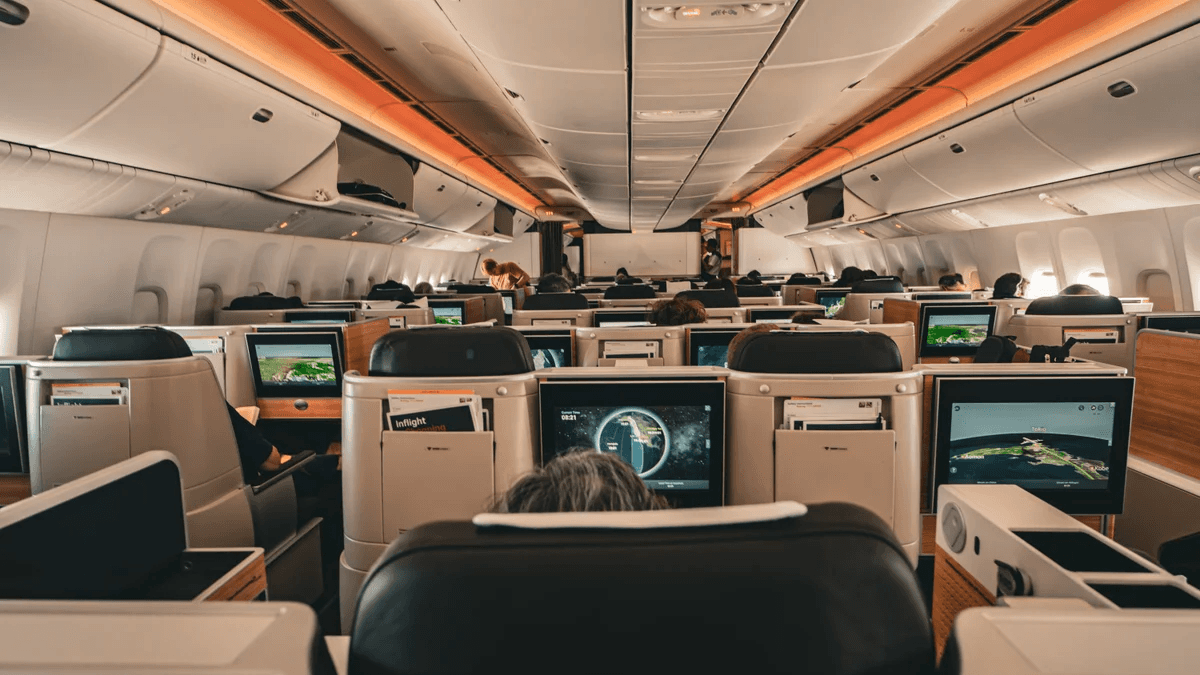
SWISS 777-300 Seat Guide (2026) | Cabin
TL;DR
SWISS operates 777-300s with 40 Business (1-2-1 lie-flat), 24 Premium Economy (2-3-2), and 213 Economy (3-3-3) seats across 277 total. Business Class is best in rows 2–8 for privacy and distance from galleys; avoid row 1 due to forward galley proximity. Economy's sweet spot is rows 22–28 (mid-cabin quiet zone); row 40 is unlivable. Best single seat: 2A (Business window, direct aisle access). Best Economy value: 28A or 28J (center cabin, no engine rumble). Surprising insight: rows 11–13 (rear Business) have better privacy from service noise than many forward rows because the aft galley is smaller.
The SWISS 777-300 is a wide-body long-haul workhorse with lie-flat Business Class, but Economy suffers from a brutal 3-3-3 layout at 31" pitch — tighter than most competitors on similar routes. Avoid row 40 at all costs: it's the last Economy row with severely limited recline and direct galley noise. The aircraft's defining trait is its Business Class privacy doors (1-2-1 configuration) and excellent IFE, but Economy passengers are packed in.
Quick specs
Cabin | Layout | Seats | Pitch | Width | IFE |
|---|---|---|---|---|---|
Business | 1-2-1 | 40 | 78–80" | 21" | 16" Panasonic eX3 |
Premium Economy | 2-3-2 | 24 | 38" | 18.5" | 13.3" Panasonic eX2 |
Economy | 3-3-3 | 213 | 31" | 17.2" | 10.6" Panasonic eX2 |
Business Class (Rows 1–13)
SWISS's 777-300 Business features a 1-2-1 staggered layout with full lie-flat beds (177° recline), direct-aisle privacy doors on all seats, and Panasonic eX3 15.6" touchscreen IFE. Rows 1–2 are positioned forward of the main galley; rows 3–10 span the forward-cabin mid-section; rows 11–13 occupy the aft Business cabin near a smaller galley. Pitch ranges 78–80"; width is a generous 21". All seats have universal AC power and USB charging. Windows on the 777-300 are larger than the 787, making odd-numbered rows (A/K) significantly more appealing. Even rows (B/H, C/L) have direct aisle access but no window privacy.
Premium Economy (Rows 14–20)
A 2-3-2 layout with 38" pitch (competitive vs. competitors) and 18.5" width per seat. Seats are reclinable (around 8 inches of recline), with shared armrests and 13.3" IFE screens. No direct aisle access for center seats (D, E). Rows 14–16 sit just behind Business Class; rows 17–20 are quieter and less affected by lavatory traffic. Premium Economy is worth the upgrade on flights 8+ hours if you're a larger passenger or value recline; on shorter long-haul (6–7 hours) it's marginal vs. Economy Plus forward rows.
Economy Class (Rows 21–40)
3-3-3 layout with 31" pitch (tight by modern standards; easyJet A320neo is 29", but larger aircraft like the A350 offer 32–33"). Seat width is 17.2" — same as Boeing 737 but cramped on a wide-body where passengers expect more. Non-recline row: row 33 (directly ahead of the aft exit row) has no recline. Exit rows: rows 32 and 39 offer approximately 38" pitch but have no under-seat storage and restricted seat features (some seats lack armrest storage). Rows 21–31 are standard Economy with moderate recline (6–7 inches). Rows 34–40 are cramped: row 40 (last row, directly forward of aft galley and lavatory complex) has limited recline, galley noise, and is last to deplane. Rows 22–28 are the acoustic sweet spot — far enough from forward galley, aft galley, and lavatory areas to avoid noise bleed during service. Window seats in this zone (A, J) are genuinely comfortable on long-haul.
Best seats
Seat | Cabin | Why |
|---|---|---|
2A | Business | Front cabin window, direct aisle door, away from galley noise; optimal for solo passengers valuing privacy and quick cabin access |
2K | Business | Mirrored advantage to 2A; rear-facing window seat with immediate aisle and galley buffer |
11A, 11K | Business | Aft Business cabin window seats with exceptional privacy; smaller aft galley means less service-time noise spill |
6B, 6L | Business | Center-cabin rows with optimal galley distance and no window glare/cold; ideal for couples or light sleepers |
15A, 15C, 15F, 15H | Premium Economy | Front Premium cabin with extra space perception; aisle seats (A/H) have unrestricted access; window seats (C/F) avoid center-seat squeeze |
28A, 28J | Economy | Mid-cabin sweet spot window seats; far from forward/aft galleys and lavatories; no engine nacelle rumble; moderate recline |
25C, 25D, 25E, 25F | Economy | Acoustic center of cabin; quietest aisle/middle seats for light sleepers on 10–12 hour flights |
32A, 32J | Economy | Exit row with 38" pitch on a budget; sufficient legroom for tall passengers; no under-seat storage trade-off worth the space gain |
Seats to avoid
Seat | Cabin | Why |
|---|---|---|
1A, 1B, 1H, 1K | Business | Directly in front of or adjacent to forward galley; exposed to service prep noise, smell, light spill during crew setup |
13B, 13L | Business | Last Business row, adjacent to lavatory corridor and aft galley; galley service noise bleeds into cabin during meals |
20D, 20E | Premium Economy | Last Premium row; adjacent to Economy cabin border and lavatories; reduced privacy and recline compared to forward rows |
33A–33L | Economy | No recline (ahead of exit row); trapped middle seats (B, D, E, F) with zero recline on a 10–12 hour flight is brutal |
40A–40L | Economy | Last row; limited recline, galley and lavatory noise throughout flight, last to deplane, closest to engine nacelles on climbing/descent |
39D, 39E | Economy | Exit row center seats with no armrest storage, no aisle access; middle seat cramp without pitch compensation |
21B, 21D, 21E, 21F | Economy | Forward Economy cabin; exposed to front galley service noise and lavatory door slamming; cramped middle seats without acoustic buffer |
```html
💺 Premium Economy (SWISS)
SWISS's Premium Economy cabin on the 777-300 occupies rows 23–27 (typically 5 rows, 38–40 seats at 2-3-2 configuration, narrower than Business but wider than Economy). Pitch is 38 inches — a meaningful 9-inch gain over Economy's 29 inches. Seat width remains 17.5 inches (standard Boeing 777 narrow-body style), so the comfort gain is primarily legroom, not width.
Dedicated galley and meal service: Premium Economy has its own forward galley (Row 22 area) with priority meal service — you're served before Economy. Meal quality is noticeably better: hot entrées with choice, wine and spirits included (not available for purchase in Economy), and a dedicated amenity kit (eye mask, earplugs, socks, lip balm). Service begins immediately after takeoff rather than 45 minutes later.
Lounge access: Premium Economy does not grant entry to SWISS Business Lounges at Zurich or other hubs. You have access to standard airline lounges only (paid access available, ~CHF 45–60 per visit at ZRH).
Best rows in Premium Economy:
Row | Best Seat | Reason |
|---|---|---|
24–25 | A, D (window/aisle pair) | Mid-cabin position away from forward galley noise (Row 22) and rear galley (Row 28 area). Quieter zone. Best for sleep on overnight flights. |
25 | A, D (window) | Optimal balance: galley distance, no overhead bin shadows, direct aisle access for lavatory use. |
23 | A, D (window) | Forward position, first to be served meal, closer to lavatory on approach to destination. Slightly higher galley noise risk. |
27 | Avoid | Last row of Premium Economy, adjacent to Economy cabin and rear galley (Row 28). Noise and congestion from Economy overflow. |
Avoid middle seats (C) in Premium Economy — even with 38" pitch, the middle seat is squeezed between two window/aisle passengers and lacks a direct aisle route to the lavatory.
💻 Digital Nomad Workspace Audit
Tray table stability and dimensions: SWISS 777-300 Economy seats feature a 17.5-inch drop-down tray table mounted to the seatback. When deployed, it extends approximately 20 inches from the seat, with usable depth of 8–9 inches. A 15-inch laptop (closed) fits, but opening it leaves only 2–3 inches of margin on either side. The tray is moderately stable — slight turbulence will cause minor wobble, but the mounting is solid enough for touch-typing. Recommendation: use a laptop stand or wedge to create angle and reduce seatback pressure if working for extended periods.
WiFi system and provider: SWISS operates Viasat satellite WiFi on its 777-300 fleet (Viasat's SwiftBroadband-Safety service). The system is branded as "SWISS WiFi" on the cabin display. On most transatlantic and European routes, it is free for Business and Premium Economy passengers; Economy passengers must purchase a day pass (~USD 7–9) or monthly pass (~USD 60).
Real-world speeds on typical routes: Passengers report 2–6 Mbps download on transatlantic flights (ZRH–JFK, ZRH–LAX, ZRH–SFO). Upload is typically 0.5–1.5 Mbps. During peak cabin usage (evening on westbound, midday on eastbound), speeds drop to 1–3 Mbps. European short-haul (ZRH–LHR, ZRH–CDG) sees slightly faster speeds (4–8 Mbps) due to more consistent Viasat coverage. The connection is stable enough for email, Slack, and video calls, but not ideal for large file uploads or streaming video.
Power outlets:
Business Class (Rows 1–8): Universal AC socket (110V/60Hz dual voltage) + USB-A (2.1A) at each seat. AC power delivers approximately 60W.
Premium Economy (Rows 23–27): USB-A only (2.1A), no AC outlet. Roughly 5W power per port.
Economy (Rows 28–63): No in-seat power. Some newer 777-300s have USB-A ports at rows 28–35 (forward Economy), but this is not guaranteed on all aircraft in SWISS's fleet. Assume no power for Economy bookings.
IFE screen and responsiveness: Economy has 10.6-inch touchscreen (Panasonic eX3 system), responsive and bright. Business has 16-inch screens (Panasonic eX3), also responsive. Lag is minimal; content streaming (movies, TV) is instant. The interface is intuitive — you can pause/resume across flights, and it integrates with the WiFi portal for music and apps (Spotify, Audible if pre-installed).
Bluetooth audio pairing: Not available on SWISS 777-300. All audio requires wired 3.5mm headphone jack. Bring a dual 3.5mm adapter or noise-cancelling wired headphones. Some newer SWISS aircraft have Bluetooth capability in Business Class only, but the 777-300 fleet does not.
🔊 Acoustic & Sensory Audit
Pressurisation altitude: SWISS 777-300 maintains a cabin pressure equivalent to 6,000 feet on typical cruise. This is similar to modern widebodies (A350, 787) and significantly better than older 777s (8,000 feet) or the A330 (7,000 feet). At 6,000 feet equivalent, oxygen saturation remains above 95% for most passengers, and fatigue on transatlantic crossings (9–10 hours) is noticeably lower than on older aircraft. Headaches and ear pressure are less common.
Humidity levels: The 777-300 cabin humidification system maintains 30–40% humidity, which is industry standard for long-haul widebodies. This is better than older 767s (15–20%) but not exceptional. On 10+ hour flights, skin and respiratory dryness are still noticeable; bringing a face mist or lip balm is recommended.
Engine noise profile by zone: SWISS 777-300s are powered by General Electric GE90-115B engines (two large turbofans mounted under the wing). Noise is primarily transmitted through the fuselage as low-frequency rumble and high-frequency jet whine.
Row Zone | Noise Level | Characteristics |
|---|---|---|
Rows 1–10 (Business) | Moderate (70–75 dB cruise) | Forward of the wing. GE90 noise is directional; you hear primarily cockpit vibration and air-handling noise. Quieter than mid-cabin but not silent. |