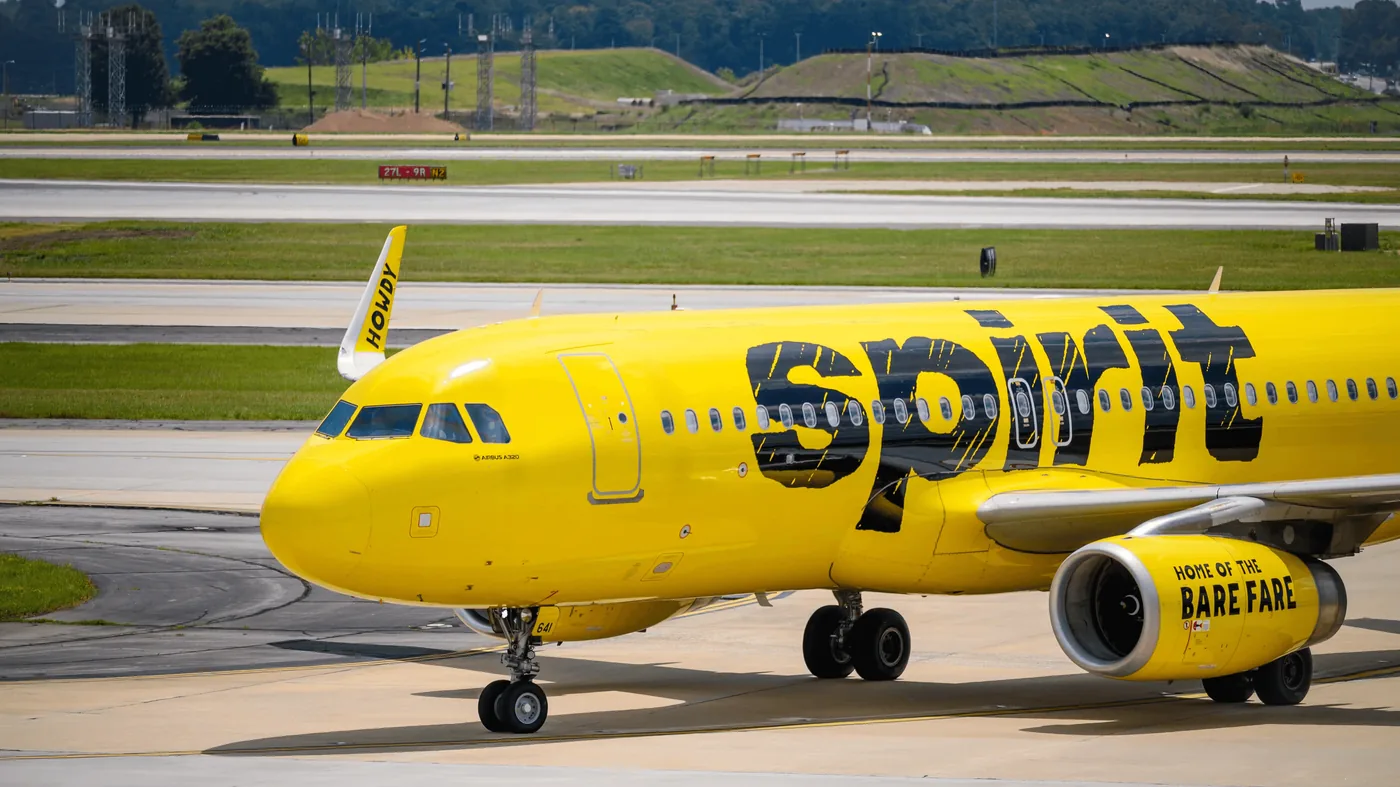
Spirit's A320 is a ruthless economy-only machine with 180 seats in a brutal 3-3 configuration and 28-inch pitch - the tightest in North America. Rows 1 - 2 are premium extra-legroom seats you'll pay dearly for; skip row 12 entirely due to galley noise and lavatory odor. This is budget flying stripped to its core: no frills, no business class, just dollar-per-mile efficiency.
TL;DR
Spirit packs 180 economy seats into a 3-3 layout with 28-inch pitch (the industry's worst). Best seats are 1A/1F and 2A/2F if you can stomach the upcharge for extra legroom; worst is row 12 due to galley proximity and lavatory stench. Exit rows (rows 16, 17) offer 32 inches but limited recline. Rows 3 - 11 are the acoustic sweet spot away from galleys and engines. No lie-flat, no WiFi, no IFE - this bird is built for point-to-point budget routes under 5 hours.
Quick specs
Cabin
Layout
Seats
Pitch
Width
IFE
Economy
3-3
180
28 inches
17.2 inches
None
Economy Class
All 180 seats are standard economy in a 3-3 configuration. Rows 1 - 2 are Spirit's "Big Front Seats" with extra legroom (32 inches) and are the only premium cabin product; expect to pay $15 - 40 per flight segment. Exit row seats are rows 16 and 17 with 32-inch pitch but limited or no recline. Row 12 sits directly aft of the forward galley and lavatories - avoid for noise, odor, and traffic. Rows 13 - 15 sit forward of the rear galley. Rows 3 - 11 and 18 - 30 are the acoustic sweet spots, though rows 27 - 30 suffer from rear fuselage engine noise and proximity to rear lavatories. Standard seat width is 17.2 inches; no extra-wide economy on this variant.
Best seats
Seat
Cabin
Why
1A or 1F
Economy
Extra-legroom premium seats (32 inches); front of cabin means first off; minimal cabin noise
2A or 2F
Economy
Second row extra-legroom option; still forward galley access; better than standard economy pitch
5C
Economy
Center seat in row 5 balances distance from galley noise and engine rumble; middle rows quietest
8A or 8F
Economy
Window seats in acoustic sweet spot (row 8); away from galleys, lavatories, and engines
16C or 17C
Economy
Exit row center seats offer 32-inch pitch if recline limitation acceptable; emergency-exit-row legroom boost
Seats to avoid
Seat
Cabin
Why
12A, 12B, 12C
Economy
Directly aft of forward galley and lavatories; constant crew noise, slamming doors, lavatory odor
11C or 13C
Economy
Flanking row 12; secondary galley/lavatory noise and traffic spillover
28A, 28B, 28C
Economy
Last row before rear galley/lavatory cluster; engine rumble, lavatory odor, zero recline on many A320s
29C or 30C
Economy
Absolute rear row; maximum engine noise, lavatory queue congestion, seat may not recline
Preferred seats (rows 7 - 9, perceived extra legroom): $8 - $12 USD per segment
What is worth paying for: Exit row seats offer genuine knee room (up to 5 inches additional pitch) and are worth $10 - $15 if you are taller than 5'10" or making a flight over 3 hours. Front rows deliver only marginally more space but cost 50% more and lock you in early deplaning, which can slow ground operations.
What is not worth paying for: "Preferred" rows 7 - 9 offer no measurable advantage over standard economy - airlines use this labeling to justify $8 - $12 fees for identical seat pitch and width. Skip this tier entirely.
Door-to-door cost comparison: A typical Spirit flight (e.g., Fort Lauderdale to Newark, 3 hours) costs $79 - $119 base. Adding checked bag ($25 - $35), seat selection ($10), and carry-on overage ($30 if needed) pushes the real cost to $144 - $184 USD per person one-way. A comparable legacy carrier (United, American) on the same route typically costs $149 - $199 with bag and seat included. Spirit saves money only when you travel with one personal item and no bag; a family of four with luggage often pays nearly the same total as a legacy carrier due to ancillary fees.
📐 Space Reality
Seat pitch (row-to-row distance) on Spirit A320: 28 inches in standard economy. Exit row seats offer 31 - 32 inches.
What this means in practice: For an average-height male (5'9"), the 28-inch pitch feels noticeably tight on flights over 2 hours; knees may graze the seat in front if that passenger reclines (which Spirit rarely restricts). For passengers 5'11" and above, exit rows become functionally necessary for comfort. The 17.2-inch width is genuinely narrow - a person of average build (32 - 34 inch waist) will feel one armrest pressure point for the full flight duration.
Competitor comparison: Southwest Airlines, operating similar A320s, offers 32 - 34 inch pitch in the same class, and seats measure 17.8 inches wide. On a Miami - Denver route (4 hours), Southwest passengers report comfort levels one to two notches higher than Spirit despite identical aircraft. The difference is not the plane; it is the seating density.
Tray table reality: Spirit's tray tables fold down from the seat back and measure approximately 7 inches deep by 15 inches wide. A 13-inch MacBook Air will fit, but with zero margin for a drink, snacks, or papers. A full-size 15-inch laptop cannot be opened in use; you will be working with the screen tilted toward your face or using your lap. For any work-focused trip over 90 minutes, bring a tablet instead.
⚡ Power & Connectivity
USB ports on Spirit A320: Standard economy seats have zero USB-A or USB-C charging ports. Exit row and front row seats are also unpowered. Spirit does not offer individual seat power anywhere on this aircraft type.
WiFi availability: Spirit does not currently offer in-flight WiFi on any of its A320 aircraft, including transatlantic routes. This is not a technical limitation - the airline has chosen not to install or contract satellite/ground connectivity systems to reduce costs and weight.
Recommendation: Bring a fully charged 20,000 mAh power bank for any flight 2 hours or longer. This will add a full charge cycle to a smartphone (roughly 4 - 5 hours of use) or a tablet (2 - 3 hours). Lithium power banks up to 100 Wh are TSA-permitted in carry-on baggage. Charge the power bank itself during your airport layover, not during flight.
Real-world scenario: A Miami - Fort Lauderdale commuter on a 1.5-hour morning Spirit flight will arrive with adequate phone battery. A transcontinental coast-to-coast flight (5+ hours) without power will drain any phone to 20% battery by landing; passengers frequently report silent frustration and inability to use navigation or rideshare apps upon arrival.
🏃 Boarding & Exit Strategy
Spirit boarding groups: Spirit uses six boarding groups, boarding front-to-back:
Group 1 (earliest): First Class (rare on Spirit), elite frequent flyers, and passengers with disabilities
Groups 2 - 3: Checked bag purchasers and seat selection purchasers (rows 1 - 12)
Groups 4 - 5: Standard economy passengers, split arbitrarily by the airline
Group 6 (latest): Oversized carry-on and standby passengers
Buying a front-row seat ($15 - $25) boards you in Group 2 automatically, 20 - 25 minutes before standard economy. This does matter for overhead bin space on full flights.
Fastest deplane seats on A320: Seats 1 - 3 (rows over the front door) exit first, followed by rows 10 - 12 (over-wing exit row). Seats in rows 15 - 20 (center cabin, far from both doors) depopulate last and take 7 - 10 minutes to clear. Rows 26 - 30 (rear) clear second-fastest if the rear door opens (see below).
Single vs. dual-door deplane: Spirit uses the front door (L1, forward left) on 100% of flights for passenger disembarkation. The rear door (L2) is used for crew exit or cargo loading, never for passenger deplane. Expect single-file exit even at major airports, which extends deplane time to 12 - 18 minutes on a full flight.
Tight connection strategy (under 45 minutes): Book seat 2A or 2B if available (front row, aisle). These seats disembark in the first 10 passengers and will give you a 5 - 8 minute buffer before the cabin is fully empty. Gate-to-gate time of 45 minutes is survivable only if you have (a) no checked bag, (b) a direct onward flight at the same airport, and (c) the front-row seat. Any other configuration adds unacceptable risk. If the onward flight is on a different airline or airport (e.g., Miami airport to nearby Fort Lauderdale airport), do not book a 45-minute connection on Spirit; it is not feasible.
FAQ
Does Spirit Airlines Airbus A320 have lie-flat seats?
No. Spirit operates an all-economy A320 with zero business-class or premium cabin products. The 28-inch pitch standard economy is the tightest in North America; no seat reclines more than 6 - 7 inches on most rows.
Best seat for sleeping on Spirit Airlines Airbus A320?
Row 8A or 8F (window seats in the acoustic sweet spot). The window gives you a wall to lean against, and rows 5 - 10 are farthest from galley noise, engine rumble, and lavatory traffic. Expect minimal sleep comfort on any sub-4-hour flight; bring a neck pillow and expect your knees to touch the seat in front.
Does Spirit Airlines Airbus A320 have WiFi?
No. Spirit does not offer WiFi, seatback IFE, power outlets, or USB charging on its A320 fleet. This is a bare-bones, no-frills operation. Download entertainment before boarding.
Is Spirit Airlines Airbus A320 Economy worth it long-haul?
Absolutely not. At 28-inch pitch and no recline on standard rows, Spirit's A320 economy is brutal beyond 3 hours. Competitors like Frontier and Southwest offer 31 - 32 inches as baseline. For anything over 4 hours, pay extra for exit rows (row 16 - 17, 32 inches) or upgrade to Big Front Seats (rows 1 - 2). For 5+ hour routes, consider a legacy carrier's basic economy or low-cost alternative; the savings aren't worth the physical pain.