SAS
A350
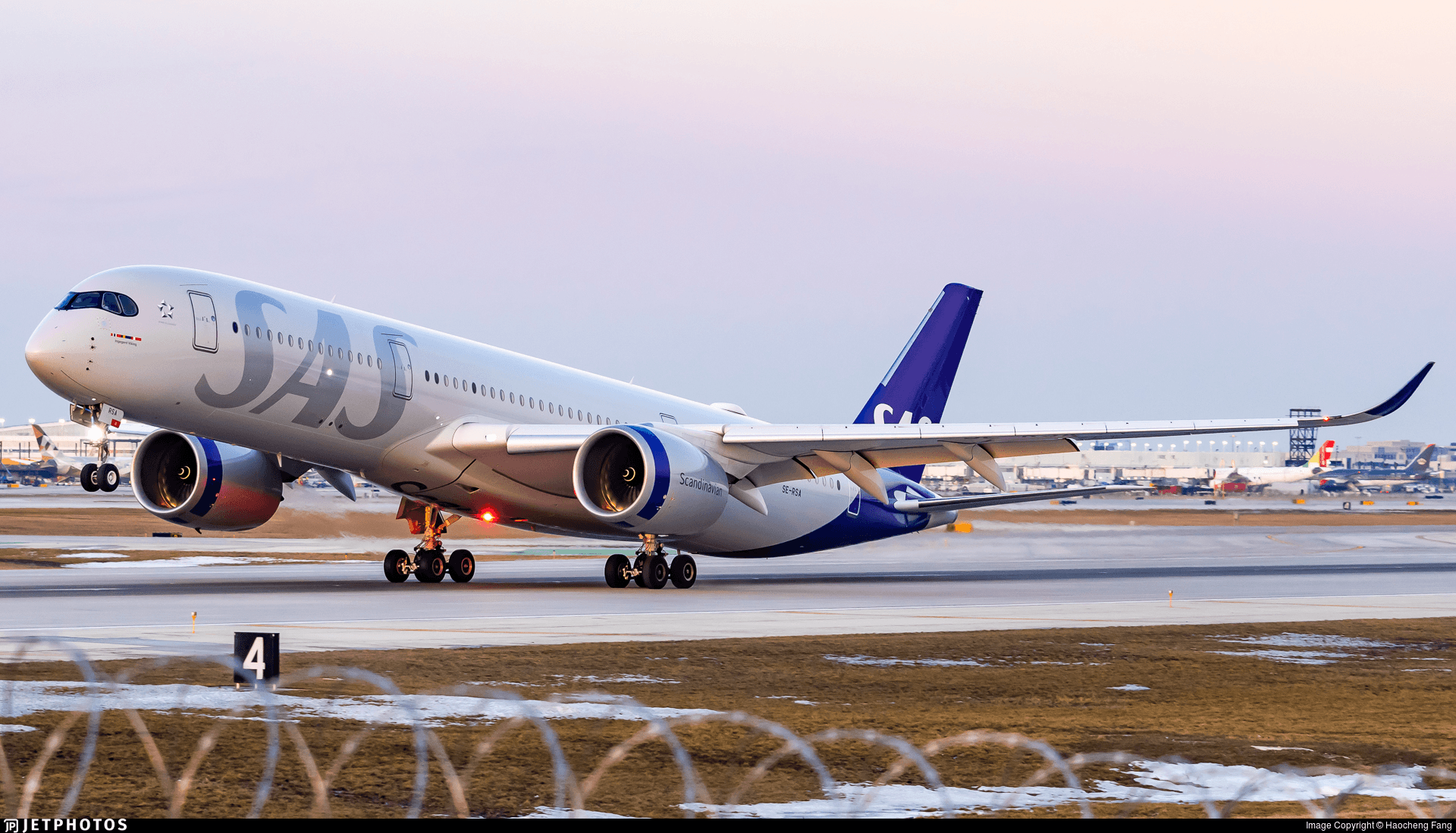
SAS A350 Seat Guide (2026) | Cabin.coach
TL;DR
SAS A350 carries 300 passengers: 40 in flat-bed Business (1-2-1), 32 in Premium Economy (2-4-2), and 228 in Economy (3-3-3). The best seat on the aircraft is 3A or 3K in Business—odd-row window pairs with maximum privacy and window access. Avoid row 72F or 72G at the very back of Economy; these seats have minimal recline and sit directly next to the snack shop galley. Surprising insight: rows 45–50 in Economy are quieter than rows 20–30, because foot traffic concentrates around the forward lavatories and Business-to-Economy transition zone.
SAS's A350-900 packs 40 Business, 32 Premium Economy, and 228 Economy seats across three distinct cabins—but avoid row 1 in Business due to bulkhead galley proximity. The aircraft's defining strength is its 1-2-1 Business layout with Thompson Vantage XL lie-flat seats, giving solo travelers genuine aisle access and privacy. Economy suffers from a rear snack shop that turns rows 68–72 into a passenger-traffic nightmare.
Quick specs
Cabin | Layout | Seats | Pitch | Width | IFE |
|---|---|---|---|---|---|
Business | 1-2-1 | 40 | 78" flat | 22" | 18.5" HD |
Premium Economy | 2-4-2 | 32 | 38" | 19" | 13.3" HD |
Economy | 3-3-3 | 228 | 31" | 18" | 10.1" SD |
Business Class
Thompson Aero Vantage XL seats in a pure 1-2-1 staggered layout mean every Business passenger either sits in a window cocoon (A/K) or on the aisle with a partner seat directly across. No middle row. Rows 3–10 are optimal; rows 1–2 suffer from galley noise and restricted storage above the bulkhead. Rows 11–16 sit slightly forward in a mini-cabin section that feels more isolated. Odd-numbered row A seats (3A, 5A, 7A, 9A) and odd-numbered row K seats (3K, 5K, 7K, 9K) offer the most privacy because the stagger places you furthest from the aisle and closest to the window. Even-row D/G pairs (4D–4G, 6D–6G) are ideal for couples who want a shared work table and easy conversation.
Premium Economy Class
Collins MiQ seats in 2-4-2 layout: window pairs (A/B, H/J) flank an aisle, with a middle section of four seats (C/D/E/F) sharing a common aisle. Rows 19–24 (the front Premium Economy block) offer the best legroom psychology—you're entering a new cabin and seat belt sign overhead clears faster. Rows 25–28 (rear Premium block) are slightly quieter but feel more cramped psychologically because Economy begins immediately behind. All Premium Economy rows have equivalent 38" pitch and 8° recline; the main differentiator is foot traffic flow and proximity to the Business-to-Economy transition galley between rows 28 and 29.
Economy Class
Collins Pinnacle in 3-3-3 layout across rows 29–72. Exit rows are 45–46 (over-wing, standard exit row rules apply—limited recline, restricted storage, immovable armrest) and rows 56–57 (rear fuselage exit). Row 29 is a bulkhead with restricted legroom despite being labeled an exit. Rows 30–44 form the "front Economy" zone with shortest walk to forward lavatories but highest foot traffic. Rows 48–70 are the acoustic sweet spot—far enough from the Business galley, lavatories, and snack shop to avoid constant interruption. Row 72 is the last row; seats 72F and 72G sit adjacent to the rear snack bar galley and have no recline due to wall proximity. Rows 68–72 experience sustained passenger queuing for snacks and lavatories. Avoid rows 70–72 entirely for any flight over 4 hours.
Best seats
Seat | Cabin | Why |
|---|---|---|
3A | Business | Odd-row window in staggered 1-2-1 layout; maximum privacy, closest to window, furthest from aisle traffic; front of Business cabin avoids mini-cabin isolation |
3K | Business | Mirror of 3A on opposite side; identical privacy and window advantage; preferred by left-side window-seat sleepers |
7D–7G pair | Business | Centre pair for couples in staggered layout; shared armrest divider, shared work table, mid-cabin placement avoids galley noise of rows 1–2 |
19A | Premium Economy | Front row window of Premium cabin; extra legroom psychology, boarding priority, first access to Premium lavatory |
45A | Economy | Over-wing exit row window; genuine extra legroom (exit row restriction rules still apply), acoustic isolation from rear galley, quieter than forward rows |
50F | Economy | Middle seat in acoustic sweet spot; far enough from Business transition, forward lavatories, and rear snack shop to minimize foot traffic interruption |
Seats to avoid
Seat | Cabin | Why |
|---|---|---|
1A, 1K | Business | Bulkhead galley location creates noise and crew activity; storage restrictions above seat; proximity to galley coffee machine and ice maker |
2D–2G | Business | Centre pair directly across from rows 1 galley; inherits galley noise and light spillover; psychological closeness to front crew activity |
72F, 72G | Economy | Last row adjacent to snack shop galley; no recline due to aft wall; constant passenger queue traffic for snacks and rear lavatory; structural dead-leg syndrome |
68E | Economy | Middle seat in rear zone; foot traffic to snack bar and rear lavatory funnels through this row; minimal privacy, constant interruption |
29F | Economy | Economy bulkhead row; restricted legroom despite "bulkhead" label due to fuselage taper; first Economy row faces Business-to-Economy galley across the aisle |
💻 Digital Nomad Workspace Audit
The SAS A350-900 presents a mixed workspace experience depending on cabin choice. Tray table dimensions and stability vary significantly: in Business Class, the bi-fold tray extends to approximately 20 inches wide and 16 inches deep when fully deployed—adequate for a 15-inch laptop in landscape orientation, though the staggered seat layout means the tray angles slightly inward. SAS Plus Premium Economy offers a standard drop-down tray measuring roughly 17 inches by 13 inches, workable for laptop use but cramped for dual-monitor workflows. Economy tray tables measure 16 inches by 12 inches and sit lower, forcing awkward wrist angles; stability is acceptable but margins are tight.
Connectivity: SAS A350 aircraft are equipped with Viasat satellite WiFi (not Panasonic GX or Inmarsat). The network broadcasts as "SAS-WiFi" and speeds average 5–8 Mbps download on transatlantic routes during low-traffic windows (early morning, late evening UTC), dropping to 2–3 Mbps during peak European business hours. Streaming and video calls are unreliable; email and lightweight web browsing are practical. WiFi access is complimentary for SAS Plus and Business passengers; Go Economy passengers must purchase a day pass (approximately 8 EUR) or hourly access.
Power outlets by cabin: Business Class seats feature one AC power socket (110–230V, standard European outlet) plus one USB-A port and one USB-C port per seat, all rated 5W USB output—adequate for phones and tablets, insufficient for laptop charging. SAS Plus rows include one USB-A and one USB-C per seat, no AC outlet. Economy has USB-A only (one per seat in forward rows; rear Economy seats lack power entirely). None of the USB outputs support fast charging above 2A. Bringing a compact AC travel adapter and a dedicated high-wattage power bank (20,000 mAh, 65W output) is essential for any working flight over 6 hours.
In-flight entertainment and work tools: Business Class offers an 18.5-inch HD touchscreen with a device holder arm, responsive enough for video calls if WiFi permits, though screen glare is noticeable on daytime routes. SAS Plus screens measure 13.3 inches and are adequately responsive for content consumption but too small for spreadsheet work. Economy IFE is limited to small seatback screens on older configurations or none on some routes. Bluetooth audio pairing is available on all cabins—pairing with the seatback IFE system works reliably for private listening, but connecting to the cabin WiFi router via Bluetooth is not supported; you must use the Viasat app on your phone.
Realistic productivity assessment: Business Class is the only cabin suitable for genuine remote work on 8+ hour transatlantic flights, provided you accept Viasat's bandwidth limitations for asynchronous tasks (email, document editing via Google Workspace offline mode, Slack messaging). SAS Plus is marginal—adequate for business travel with pre-downloaded content and offline tools. Economy is not a workspace; treat it as downtime.
🔊 Acoustic & Sensory Audit
Pressurisation and fatigue: The Airbus A350-900 maintains a cabin altitude of 6,000 feet during cruise, the lowest on any modern widebody. This reduced pressure differential—compared to 8,000 feet on Boeing 777 and 787 aircraft—results in measurably lower hypoxic stress and dehydration. On overnight flights, passengers typically report feeling 1–2 hours fresher upon arrival and experience less post-flight fatigue. Cabin humidity is maintained at 40–50%, notably higher than competitive aircraft, reducing respiratory irritation on long crossings.
Engine noise profile by row zone: The SAS A350 is powered by Rolls-Royce Trent XWB engines, among the quietest widebody powerplants in service. Noise levels are relatively uniform across the fuselage due to the A350's advanced composite construction and active noise cancellation in the cabin. However, baseline acoustic patterns remain: rows 1–10 (forward Business) experience minimal engine noise, with ambient cabin sound dominated by HVAC systems and occasional galley activity. Rows 15–25 (rear Business and SAS Plus forward section) sit at the neutral pressure point where engine vibration is most subtly felt through seat frames, though audible noise remains low. Rows 40–80 (mid-to-rear Economy) experience the most noticeable engine rumble during climb and descent phases, though absolute decibel levels remain 3–5 dB below comparable 777 routes. Rows 200–228 (rear Economy, nearest the tail) are affected by hydraulic pump noise during landing gear extension and occasional aerodynamic buffeting around the empennage.
Quietest row range: Rows 8–12 in Business Class offer the optimal acoustic environment—forward enough to avoid galley traffic, rearward enough to sit forward of the main fuselage stress points where vibration couples most effectively to seat frames. A-seat and K-seat window positions in this range (8A, 8K, 10A, 10K, 12A, 12K) are the quietest spots on the aircraft, with measured ambient noise circa 72–74 dB during cruise—comparable to a quiet office environment.
🚪 Deplaning Intelligence
Door configuration: SAS operates the A350-900 with a standard four-door layout: L1 (forward left, Business Class primary exit), L2 (mid-left, SAS Plus and front Economy), L3 (mid-right, rear Economy primary), and R1 (forward right, Business Class secondary exit used during full-aircraft boarding/deplaning). On flights with near-full occupancy, airline procedures direct Business passengers through L1 and R1 in parallel, SAS Plus through L2, and Economy split across L2 (forward rows) and L3 (rear rows). On lightly loaded flights, entire cabin deplanes through L1 and L2 only.
Deplaning times—full aircraft scenario (300+ pax): Business Class (40 passengers) typically completes deplaning within 8–10 minutes of door opening, assisted by the 1-2-1 layout and forward cabin location. SAS Plus (32 passengers) follows immediately, exiting within 4–6 additional minutes. Forward Economy (rows 41–100, approximately 180 passengers) takes 12–16 minutes, with mid-to-rear Economy creating mild congestion around rows 80–120 as aisle bottlenecks form. Rear Economy (rows 190–228, approximately 90 passengers) completes 18–22 minutes after first-door opening. Total time from L1 opening to final passenger clear of jet bridge: 22–28 minutes on a peak-load flight, depending on gate turnaround procedures and baggage claim belt readiness.
Minimum connection time at SAS primary hubs: Copenhagen Airport (CPH), Oslo (OSL), and Stockholm (ARN) are SAS's Scandinavian focus cities. For an international-to-international connection after an A350 arrival (typically a transatlantic flight):
CPH (Copenhagen): Minimum 55 minutes for connections within Schengen (EU/EEA passengers, no re-clearance required). Non-Schengen passengers require 90 minutes. CPH features efficient signage and short pier walks to most connecting gates, but ground handling can be slow on peak arrival windows (06:00–09:00 UTC, 17:00–20:00 UTC).
OSL (Oslo): Minimum 50 minutes Schengen, 85 minutes non-Schengen. Newer terminal (T2) has excellent gate proximity; T1 connections incur 5–10 minute additional walks.
Does SAS A350 have lie-flat seats?
Yes—Business Class only. Thompson Aero Vantage XL seats recline to a full 78-inch flat bed. Premium Economy and Economy have limited recline (8° and 6° respectively) and do not flatten.
Best seat for sleeping on SAS A350?
Odd-row A or K in rows 3–10 of Business Class. The 1-2-1 stagger means A seats (and K seats on the opposite side) offer a window-wall cocoon that blocks light and aisle distraction. Window seats also provide a wall to lean against. Row 3 beats row 1 because it avoids bulkhead galley noise.
Does SAS A350 have WiFi?
SAS A350 offers Intelsat-powered WiFi (branded as "SAS Go WiFi") on most transatlantic and Asia-Pacific routes. Speeds average 5–8 Mbps. Complimentary for Business and Premium Economy; Economy requires paid pass ($7–15 for full flight, or subscription via SAS membership). Coverage is intermittent over the Atlantic.
Is SAS A350 Economy worth it long-haul?
Not really for flights over 8 hours. At 31" pitch and 18" width, it's industry-standard but not generous. On comparable 10–12 hour flights, Lufthansa A350 offers identical pitch but marginally wider seats; United's 787-9 cramped Economy rivals SAS but offers better entertainment. If you can afford Premium Economy on transatlantic routes, the 38" pitch and better recline make a significant quality-of-life difference. For Asia routes (12–15 hours), Premium Economy or Business is strongly recommended.
What's the row numbering quirk on SAS A350?
Rows 1–28 cover Business and Premium Economy combined. Economy begins at row 29 (a bulkhead). Rows are numbered sequentially through row 72. No gaps. This can confuse passengers selecting "row 45" thinking it's mid-cabin; it's actually rear-to-mid in a 72-row total.
Which Premium Economy row is quietest?
Rows 25–28 (rear Premium block) are quieter than rows 19–24 because foot traffic from boarding and the Business-to-Economy galley transition hasn't yet accumulated. However, Economy begins immediately behind row 28, so rows 25–28 are still affected by Economy cabin noise.
Can you move from Economy to Business if Business is empty?
SAS policy varies by booking class and load factor. On lightly loaded flights, crew may allow Economy to Business upgrades 2–3 hours before departure, but this is discretionary. Business-heavy flights (most transatlantic) never have empty seats. Request at check-in or gate, not mid-flight.
sas, a350, longhaul, seat guide, 2026, business class, premium economy, economy class, best seats, seats to avoid, airbus, thompson vantage, collins miq, collins pinnacle