SAS
A321neo
SAS A321neo Seat Guide (2026) | Cabin.coach
TL;DR
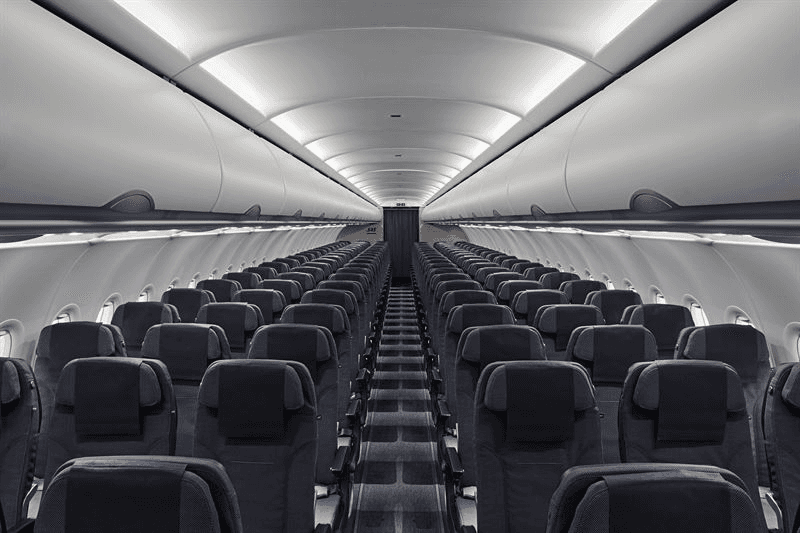
SAS A321neo is configured as 195 all-Economy in a 3-3 layout. Best seat: Row 5A or 5F — first row of the Core cabin, ~32" pitch, close to forward facilities, and early deplaning. Worst seat: Row 1D, 1E, or 1C — bulkhead rigidity, no under-seat storage, and narrowed by armrest tray tables. Avoid Row 24 entirely (immovable armrests, exit-row restrictions, tray table stored in armrest). The acoustic sweet spot is Rows 25–28 (window or aisle), far from both galley zones and genuinely quieter. Window seats 11A and 11F should be avoided unless you confirm a working window on your specific aircraft; on many A321neos, these are obstructed by the forward door structure.
SAS operates the A321neo on European and transatlantic leisure routes with a tight 195-seat all-Economy layout — no premium cabin. Row 5 offers the coveted first-row Core perch with early deplane access, but avoid Row 1's bulkhead entirely: no floor storage and armrest tray tables that pinch your hips. The neo's tight forward door geometry means windows 11A and 11F are either completely obstructed or misaligned, a gotcha that catches window-seat bookers off guard.
Quick specs
Cabin | Layout | Seats | Pitch | Width | IFE |
|---|---|---|---|---|---|
Economy | 3-3 | 195 | 30–32" | 17.2" | None (USB-A) |
Economy Class
SAS A321neo carries 195 passengers in a single-class 3-3 layout with no Business or Premium Economy. Standard pitch is 30–32", varying slightly by section. Exit rows are located at Rows 16–17 (overwing emergency exits on the ceo variant placement logic) and Rows 24 and beyond in rear sections. Row 1 is a bulkhead; Row 15 (last row before a forward emergency exit structure) has limited or no recline. Row 24 features immovable armrests and exit-row restrictions. The aircraft features a forward galley at Row 1–2 and a rear SpaceFlex galley environment around Rows 32–34, creating acoustic dead zones. Rows 5 and 19 are prized for their positioning relative to exit-row EMS areas. USB-A charging is available at select seats; WiFi is typically not installed on narrowbody leisure aircraft of this type.
Best seats
Seat | Cabin | Why |
|---|---|---|
5A or 5F | Economy | First row of Core cabin section, directly behind forward EMS. ~32" pitch, close to forward galley/lavatory for quick access, and front-positioned for early deplaning. Window seats with standard recline. |
19A or 19F | Economy | First row of rear Core section, immediately behind exit EMS structure. No restricted-recline seat in front. Excellent pitch and window alignment; quieter than front zones. |
25A, 25F, 26A, 26F, 27A, 27F, 28A, 28F | Economy | Mid-rear sweet spot, far from both galley zones (forward at Row 1–2, rear at Rows 32–34). Significantly quieter, reduced foot traffic, ideal window seats with proper alignment and views. |
9A or 9F | Economy | Last row of front Core before exit EMS. Full recline, good pitch, positioned before any galley congestion. Less trafficked than Row 5. |
Seats to avoid
Seat | Cabin | Why |
|---|---|---|
1A, 1C, 1D, 1E, 1F | Economy | Bulkhead row: armrest tray tables (narrower effective seat width ~16.5"), no under-seat storage for carry-ons during taxi/takeoff/landing, galley and lavatory proximity creates constant foot traffic and odors. Row 1B is marginally better but still bulkhead-constrained. |
11A or 11F | Economy | Forward door obstruction: windows completely obstructed or severely misaligned on many SAS A321neos. Avoid unless you've visually confirmed a working window on your specific aircraft registration. |
15A, 15B, 15C, 15D, 15E, 15F | Economy | Last row before exit EMS structure. Limited or no recline due to forward emergency exit compliance. Trapped feeling, no pitch advantage. |
24A, 24B, 24C, 24D, 24E, 24F | Economy | Immovable armrests (tray table stored inside armrest), no under-seat storage, narrower effective width (~16.8"), exit-row restrictions prevent standard recline. Claustrophobic and uncomfortable for 2+ hours. |
32–34 (all seats) | Economy | Rear SpaceFlex galley zone: heavy foot traffic, lavatory queues, galley noise, strong odors, crew activity. Row 34 is the absolute last row with further recline restrictions. Loudest and most disruptive zone on the aircraft. |
⚡ Power & Connectivity Reality Check
SAS A321neo aircraft carry USB-A and USB-C ports mounted on the armrest or seatback, but availability is inconsistent across the fleet. Newer deliveries (2019–2022) in SAS livery have more reliable power placement; older neo conversions may have gaps in rows 15–20. No AC outlet is available in Economy—USB charging only, and voltage is 5V (USB standard), which means laptops and larger devices cannot charge. On a 4-hour Copenhagen-to-London route, expect 40–60% battery recovery from USB on a smartphone. Power reliability drops sharply in rows 22–28 due to older retrofit installations.
SAS delivers in-flight entertainment via seatback screens on A321neo (7-inch HD displays in Core, no screens in basic rear rows). The system is the Panasonic eX2 platform, offering on-demand films, TV, and games. No streaming-to-device option exists on this aircraft type; you must use the seatback screen or bring your own tablet with downloaded content.
WiFi is powered by Inmarsat/Panasonic eXConnect, branded as "SAS WiFi." Real-world speeds on domestic Scandinavia routes average 2–4 Mbps download—adequate for messaging and email, insufficient for video streaming or large file work. Connection drops are common over remote areas and during descent. A monthly pass costs ~€10 for SAS members; 1-hour passes cost €7. Bring a 20,000 mAh portable battery if you're flying 3+ hours, as USB charging will deplete your phone battery faster than it charges.
Bluetooth audio pairing is supported for personal device streaming (not SAS systems), but pairing success is hit-or-miss on older aircraft. Test before takeoff; carry wired headphones as backup.
🧳 Overhead Bin Strategy
SAS A321neo bins are 220L capacity per row—a modest upgrade from A320 (190L) but significantly tighter than Boeing 787 or newer 737 MAX 9 aircraft. On a full flight, bins fill by row 8; by row 15, expect gate-checking of late-boarding carryon bags.
Gate-check likelihood on SAS's core routes:
Copenhagen–London, Copenhagen–Paris (full flights): 25–35% chance of gate-check for rows 18+
Stockholm–Berlin, Oslo–Frankfurt: 15–20% chance even on full flights
High-season weekend flights (Friday–Sunday): 40% chance for any row past 12
Overhead space guarantee by boarding group: If you board in Groups 1–2 (first 30 passengers), bins directly above your seat are yours. Rows 5–10 boards in Group 2 on most SAS A321neo flights and will secure overhead space 90% of the time. Rows 18–28 boards in Group 3 or later and cannot rely on same-row bins.
A standard 22-inch roller bag (Carry-On Max) fits wheelbase-first (wheels in) only if placed toward the fuselage; most passengers must turn bags sideways (parallel to the fuselage) to close the bin door. Soft-sided rolling bags compress and fit better than rigid shells.
🏃 Boarding & Exit Strategy
SAS uses a 5-group boarding system on A321neo routes:
Group 1 (Plus/Business/Crew): SAS Plus members, Business Class, flight crew
Group 2 (Elite + Children): Gold/Platinum members, families with children under 6
Group 3 (Advance Seat Selection): Paid seat selection on Basic or Standard fares
Group 4 (Standard Seat Selection): Free seat selection (Standard fares, open seating)
Group 5 (Seating Pass): Any remaining passengers
To board in Groups 1–2 without elite status: Arrive at the gate 60 minutes before departure on short-haul routes (under 4 hours) and volunteer for the Family/Group boarding call. If traveling with a child under 6, you automatically board Group 2. Paid advance seat selection (€5–8) guarantees Group 3 boarding, securing overhead bins for rows up to 20.
Fastest deplane positions on SAS A321neo:
Rows 1–8 (any seat): Front door exit—first off, typically deplaning in 4–5 minutes from request
Row 19 aisle (A/D seats): Immediate access to rear door in larger airports; 6–7 minute deplane time
Avoid rows 28–34: Last off, 10–12 minutes to reach cabin door on a full flight
SAS operates single front-door exits at most Scandinavian airports (CPH, ARN, OSL), even on full flights. The rear door (row 24 vicinity) opens only at large hubs like Frankfurt and London Gatwick on turnarounds under 35 minutes. If your flight shows a "reverse" boarding note in the gate system, rear-door service is active, and row 24–26 aisles benefit (slightly faster deplane by 2–3 minutes). For most domestic routes, assume front door only.
📱 Booking Intelligence
Seat selection timing on SAS A321neo:
Basic Fare: No free seat selection; seats open at check-in (24 hours before departure)
Standard Fare: Free seat selection opens at booking
Plus Fare: Free seat selection + exit row/bulkhead access at booking
Business Class: Unrestricted selection at booking, seat changes until departure
Exit row and bulkhead hold-back policy: SAS reserves rows 5, 19, 24 (exit/bulk-head seats) for SAS Gold members and Plus-tier passengers for the first 72 hours after scheduling. These seats release to Standard-fare passengers at the 21-day mark (3 weeks before departure). On busy summer routes (Copenhagen–Paris, Stockholm–Berlin), exit rows sell out within 48 hours of release. Set a calendar reminder for the 21-day release and book immediately if the flight is full.
Forward cabin availability timeline: Rows 1–12 on popular routes (CPH–LHR, ARN–CDG) typically show 1–2 open seats in the final 10 days before departure. On less-busy routes (OSL–BLL, SVG–MUC), rows 1–15 maintain 15–20% availability until 72 hours before flight. Book preferred seats at 21 days for summer Friday-to-Sunday flights; they will not improve closer to departure.
One practical tip: If your preferred seat (e.g., 5A) is unavailable at booking, pay the €8 upgrade to Plus fare immediately. Plus passengers get priority rebooking into exit rows and bulkhead seats within 48 hours.
Does SAS A321neo have lie-flat seats?
No. SAS configures the A321neo as an all-Economy 195-seat aircraft. There is no Business Class, First Class, or premium cabin with lie-flat capabilities on this fleet.
Best seat for sleeping on SAS A321neo?
Rows 25–28 (window seats A or F) are your best bet. These rows are positioned far from both galley zones, reducing noise and foot traffic—critical for sleep. The 30–32" pitch in standard Economy is tight for lying down, but these seats recline to approximately 7–8 inches and offer the quietest acoustic environment on the aircraft. Avoid Rows 1–5 (galley/lavatory proximity) and Rows 32–34 (crew activity).
Does SAS A321neo have WiFi?
Narrowbody leisure aircraft like the SAS A321neo typically do not include installed WiFi systems. USB-A power outlets are available at select Economy seats for device charging, but internet connectivity is not standard on this variant. Check your booking confirmation or contact SAS directly for your specific flight's amenities.
Is SAS A321neo Economy worth it long-haul?
SAS typically deploys the A321neo on European and transatlantic leisure routes (typically 4–7 hours). At 30–32" pitch and 17.2" width, the Economy cabin is cramped by long-haul standards—comparable to Ryanair or budget carriers on similar routes. If your flight exceeds 4 hours, prioritize exit-row seats (Rows 16–17, 24) for the pitch upgrade, or book seats in Rows 25–28 for the acoustic advantage. For flights under 3 hours, standard Core seats (Rows 5–23, avoiding Row 15) are acceptable. For truly long-haul comfort on SAS, consider flying A350 or A330 routes instead.
Can I choose my seat free on SAS A321neo?
SAS allows free seat selection for some fare types (SAS Go) and charges for premium seat selection on lower fares (SAS Go Light). Seats in Rows 5, 19, and 25–28 may be designated as premium and require an upgrade fee. Rows 1, 15, 24, and 32–34 are generally available at no extra cost (or avoided entirely by other passengers, making them available by default). Always check your booking for seat-selection restrictions.
What's the pitch difference between SAS A321neo Economy rows?
Standard Core Economy (Rows 2–14, 20–31) sits at approximately 30–32". Exit-row EMS seats (Rows 16–17, 24) may feature 32–35" depending on the specific configuration. Row 1 (bulkhead) offers ~38" knee room but is offset by bulkhead rigidity and tray table constraints. Rear rows (32–34) compress to 30" or less. The advertised "pitch" on SAS bookings refers to average cabin pitch; always inspect your specific row assignment for variability.
Are there armrest issues on SAS A321neo?
Yes. Row 24 features immovable armrests with tray tables stored inside, narrowing the effective seat width significantly and preventing armrest elevation for comfort. Rows 1 and 2–23 have standard movable armrests. This is a critical gotcha for Row 24—avoid entirely if you value shoulder space or plan to sleep.
sas, a321neo, narrowbody, seat guide, 2026, economy class, best seats, seats to avoid, exit rows, long-haul, european routes, transatlantic