Qatar Airways
787
Qatar Airways 787 Seat Guide (2026) | Cabin.coach
TL;DR
Qatar Airways 787-8 carries 240 seats (22 Business, 28 Premium Economy, 190 Economy); the 787-9 adds 40 seats in a stretched hull. Both have forward-facing suites in Business with direct aisle access—avoid Row 1 and Row 12 (bassinet rows) if you prize quiet. Best Business seats are 2A, 4A, 6A (port window) and 2K, 4K, 6K (starboard window) for privacy and no middle-seat climbers. Economy exit rows (21–22 on 787-8, 23–24 on 787-9) offer 32 inches of pitch; avoid the last three rows and the middle seats (D/E/F) in the 3-3-3 Economy layout. One surprise: Qatar's 787 cabin altitude drops to 6,000 feet on some routes, making even standard Economy less fatiguing than you'd expect.
Qatar Airways operates both the 787-8 and 787-9 on long-haul routes from Doha, and both carry direct-aisle Business Class suites—but Economy pitch varies by version. Row 1 Business sits directly above the galley, so noise and light bleed will interrupt sleep on overnight flights. The 787's wider cabin (fuselage) and better cabin pressure make it genuinely more comfortable than the 777, but seat selection still matters enormously.
Quick specs
Cabin | Layout | Seats | Pitch | Width | IFE |
|---|---|---|---|---|---|
Business | 1-2-1 (forward-facing) | 22 (787-8) / 26 (787-9) | 6 ft 8 in | 6 ft 5 in suite | 18.1" HD touchscreen |
Premium Economy | 2-3-2 | 28 | 38 in | 17.3 in | 13.3" HD touchscreen |
Economy | 3-3-3 | 190 (787-8) / 230 (787-9) | 31 in (std) / 32 in (exit) | 17 in | 10.6" HD touchscreen |
Business Class
Qatar Airways 787 Business features forward-facing suites in a 1-2-1 layout across rows 1–11 (787-8) and rows 1–13 (787-9). Every seat has direct aisle access and a closing privacy door; the centre pair (seats D and E, or F and G in odd/even rows) can be converted to a double bed on select routes if booked together. Rows 2, 4, and 6 (port) and rows 2, 4, and 6 (starboard) are optimal: they sit forward of the wing root and far from galley noise. Row 1 is sacrificed by proximity to crew activity—direct light spill and equipment noise make it unsuitable for sleep-focused passengers. Row 12 and 13 (787-9 only) are designated as bassinet rows, which means infant disturbance is common.
Premium Economy Class
28 seats in a 2-3-2 layout across rows 12–16 (787-8) and rows 14–18 (787-9), with 38-inch pitch, direct-aisle seats (A/B and H/J), and an enclosed cabin section with a separate lavatory. Window and aisle seats (A, B, H, J) are universally superior; centre seats (D, E, F, G) force climb-overs or conversation with seatmates. Rows 12–13 (787-8) sit behind Business Class and may experience occasional service noise.
Economy Class
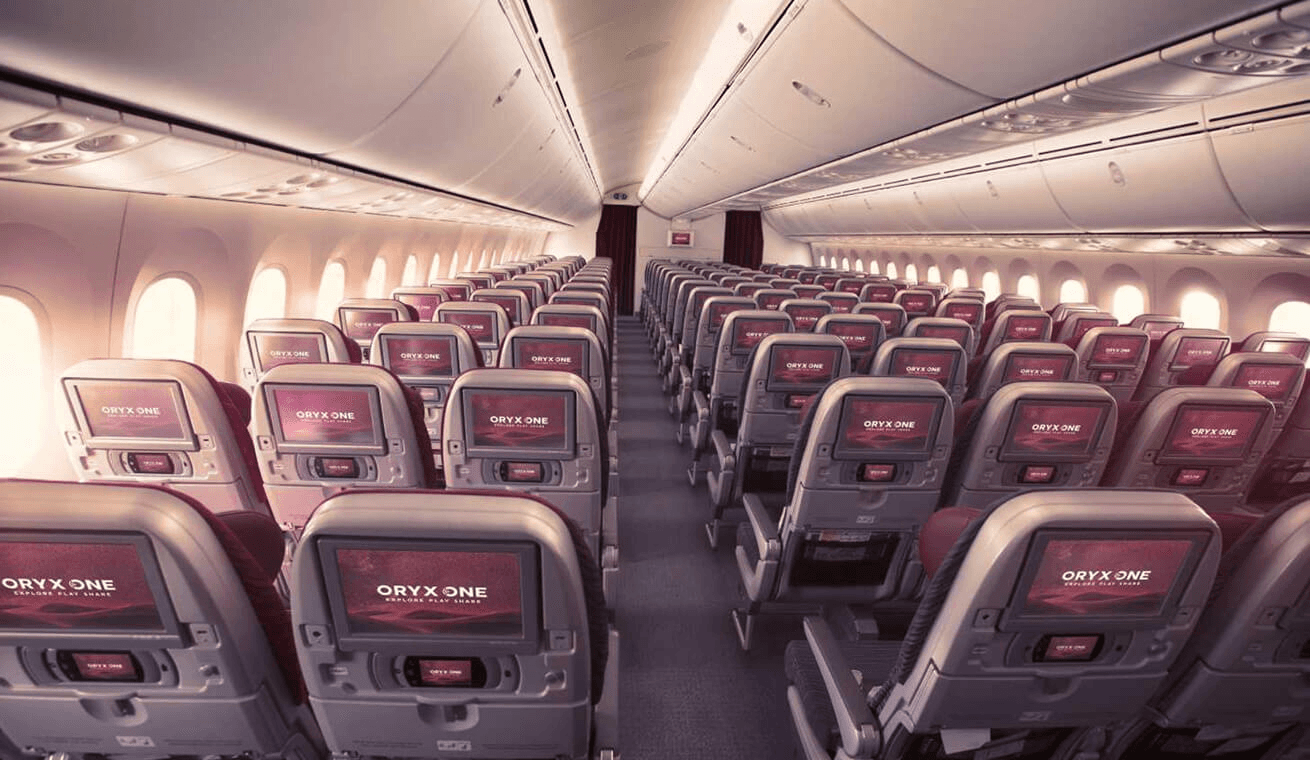
190 seats (787-8) or 230 seats (787-9) in a 3-3-3 layout with 31-inch pitch (standard) and 32-inch pitch in exit rows 21–22 (787-8) or 23–24 (787-9). Last three rows (19–21 on 787-8, 37–39 on 787-9) recline minimally and sit near lavatories; avoid these entirely on overnight flights. Exit-row seats A, B, H, J offer legroom and window access without the climb-over penalty of centre seats. Middle seats D, E, F are the weakest—least privacy, no guaranteed aisle, and no window light.
Best seats
Seat | Cabin | Why |
|---|---|---|
2A, 4A, 6A | Business | Port window; direct aisle; forward of wing; maximum quiet and privacy |
2K, 4K, 6K | Business | Starboard window; direct aisle; forward of wing; symmetrical privacy to 2A/4A/6A |
21A, 21J (787-8) or 23A, 23J (787-9) | Economy | Exit-row window seats; 32-inch pitch; legroom without recline penalty |
12A, 12B, 12H, 12J (787-8) or 14A, 14B, 14H, 14J (787-9) | Premium Economy | Front of cabin; direct aisle access; quieter than rear PE rows |
Seats to avoid
Seat | Cabin | Why |
|---|---|---|
1A, 1D, 1E, 1F, 1G, 1K | Business | Row 1 galley noise, light bleed, crew movement; frequent lavatory use nearby |
12D, 12E, 12F, 12G (787-9 only) / 13D, 13E, 13F, 13G | Business | Bassinet rows; infant crying, nappy changes, and parental footfall throughout flight |
19D, 19E, 19F (787-8) or 37D, 37E, 37F (787-9) | Economy | Last three rows; minimal recline; constant lavatory queue noise and galley proximity |
D, E, F (any row) | Economy | Middle seats; no window; no guaranteed aisle; least privacy in 3-3-3 layout |
✈️ Version Lottery
Qatar Airways operates two distinct 787-9 configurations in its Business cabin. The primary in-service variant features the Qsuite — a fully enclosed 1-2-1 suite with sliding door, direct aisle access, and a centre quad/double bed option in paired rows. A smaller subset of 787-9 aircraft retain the older Business Class 2-2-2 herringbone layout without privacy doors, typically found on regional or lower-density routes.
To identify which version operates your flight, check the seat map on Qatar Airways' website or ExpertFlyer 24–72 hours before departure. Qsuite aircraft display a staggered 1-2-1 pattern with four centre seats (D-E-F-G) and a distinct visual offset. The 2-2-2 herringbone shows a symmetrical pair layout across all rows. The final seat map is often reliable in this window; aircraft swaps do occur, but less frequently once the flight has entered the 72-hour window.
If your flight shows the 2-2-2 configuration and you prefer Qsuite, it is worth checking for alternative flights on the same route within 1–3 days. Qatar has not committed a timeline to eliminate all non-Qsuite 787-9s, so regional variants will persist. Contact Qatar Airways directly if you hold Business Class — they occasionally offer rebooking options if a Qsuite flight exists within a reasonable timeframe. For Economy passengers, the cabin width and seat pitch remain identical across both 787-9 variants, so version choice has minimal impact below the Business deck.
🏆 Competitive Verdict
On Gulf–Europe and Gulf–Asia routes where Qatar Airways 787-9 Qsuite competes directly with Emirates 777-300ER and Etihad Airways 787-9 New Elements, Qatar's Qsuite wins decisively for solo overnight travellers — the privacy door, direct aisle access, and 6'8" lie-flat bed with on-demand lighting make it the category leader. For couples wanting to sit together, Etihad New Elements' quad suites (2-1-2) offer wider side-by-side seating and superior intimacy; Qatar's offset pairs require compromise. For tall passengers over 6 feet, the 787's lower deck height (compared to the 777-300ER's cathedral cabin) is a disadvantage, and the Qsuite's 6'8" bed length is tight for anyone exceeding 6'3"; Emirates' larger 777 suites and Etihad's more spacious New Elements are objectively better. For work-focused business travellers, Qsuite's staggered aisle access and real privacy door beat Emirates' open herringbone, but Etihad's New Elements add larger work surfaces and superior connectivity. Verdict: Qatar wins on solo overnights and privacy; Etihad wins on couples and workspace; Emirates wins on sheer cabin volume for tall passengers. Route-specific scheduling and premium seat availability often matter more than the aircraft itself.
🛁 Lounge & Ground Experience
Qatar Airways' primary hub for 787 operations is Doha Hamad International Airport (HIA). Business Class passengers access the Al Safwa First & Business Lounge, Qatar's flagship facility, which spans 4,800 m² across two floors. Key facilities include:
Shower suites: Nine individual shower rooms with premium amenities and attendant service
À la carte dining: Four live cooking stations (Asian, Mediterranean, Middle Eastern, international) plus a dedicated sushi bar
Spa: Massage, foot reflexology, and facial treatments (advance booking recommended)
Day beds: Eight private rest pods with blackout doors and 30-minute complimentary use for Economy Plus and above
Business Centre: Full office facilities, meeting rooms, and printer/scanner access
Premium bar: Champagne, spirits, and curated wines; sommelier on duty during peak hours
Access tiers: All Business Class passengers (including 787-9) have lounge access. Economy Plus (premium economy) get access only during long layovers (4+ hours); standard Economy does not. Frequent flyer status (Privilege Club Platinum and above) grants access regardless of cabin.
Honest assessment: Al Safwa is genuinely world-class — shower suites, à la carte dining, and spa treatments justify a Doha connection for overnight arrivals or long layovers. However, routing via Doha adds 2–4 hours to most Gulf–Europe or Gulf–Asia journeys compared to direct alternatives on competitor hubs. If your origin and destination are not Doha-optimal (e.g., London to Bangkok), the lounge quality does not offset the schedule penalty. Evaluate the total journey time: if Doha adds more than 3 hours, competitor hubs (Dubai on Emirates, Abu Dhabi on Etihad) may deliver faster connections with comparable or inferior lounges but better overall value. For UK–Middle East or Middle East–Australia routes where Doha is geographically sensible, the lounge experience is a genuine advantage.
🌙 Overnight Formula
For the best overnight sleep on Qatar Airways 787-9 Qsuite: Book an odd-numbered row (1, 3, 5, 7, 9) window-adjacent seat (A or K). If your route supports the double bed configuration, request centre seats E and F in consecutive odd rows (e.g., rows 3 and 5 paired) — confirm the option is available on your specific seat map before purchase. If you are flying solo, row 2A or 2K offers maximum cabin stability and early access to the crew for sleep assistance; avoid row 7 (known crew disturbance from galley proximity) and row 11 (bassinet positions with infant presence).
Meal service strategy: On overnight flights departing in the evening (e.g., 21:00–23:00 from Europe), accept the light dinner service and ask the crew to collect your tray immediately — do not linger over dessert or coffee. Set your watch to destination time upon boarding and avoid the cabin lighting until your arrival day. On ultra-long overnight routes (15+ hours), skip the pre-departure meal entirely; eat a light snack before boarding and request the crew delay breakfast service until 90 minutes before landing. This approach aligns your sleep window with the aircraft's night cycle and reduces circadian disruption.
Sleep accessories to bring: A neck pillow with memory foam (Qsuite's cabin-wide headrest is firm and benefits from additional support) and high-quality earplugs or noise-cancelling earbuds (the 787's cabin pressure changes produce subtle creaks; active noise cancellation masks these). Do not rely on Qatar's supplied pillows — bring your own.
Optimize your arrival: Set your alarm for 90 minutes before landing. Request the pre-arrival hygiene kit and fresh fruit plate (not the full breakfast) about 75 minutes before descent — this gives you time to shower in the lavatory (Qsuite lavatories are cramped but functional), reset your appearance, and avoid the full-service rush. When the crew announces descent, ask for a strong coffee or juice to signal your body to wake; avoid alcohol-heavy drinks, which dehydrate and impair alertness. If your Qsuite has a door, keep it open for the last 30 minutes of flight — cabin lighting and ambient crew activity will naturally align your alertness with the arrival environment.
Does Qatar Airways 787 have lie-flat seats?
Yes. All Business Class suites on the 787-8 and 787-9 recline into fully flat beds (6 ft 8 in length). The centre pair (D–E or F–G) can be booked together on the same row or adjacent rows to form a double bed; confirm at booking or check the interactive seat map 24–72 hours before departure, as final bed configurations are finalized late.
Best seat for sleeping on Qatar Airways 787?
Book seats 2A, 4A, or 6A (or their starboard equivalents 2K, 4K, 6K) in Business Class. These rows are forward of the main cabin noise sources, away from the galley (Row 1) and bassinet activity (Row 12/13). If flying Economy, exit-row window seats (21A or 21J on 787-8, 23A or 23J on 787-9) offer the most legroom and uninterrupted sleep potential, though recline is still limited.
Does Qatar Airways 787 have WiFi?
Yes. Qatar Airways is rolling out high-speed satellite WiFi (Intelsat/Viasat) across its 787 fleet. Coverage and speed vary by aircraft age and software version; newer 787s offer faster connectivity than older units. Complimentary for all passengers in Business and Premium Economy; Economy passengers may see metered or paid options depending on route.
Is Qatar Airways 787 Economy worth it long-haul?
Moderately yes, compared to older wide-bodies. The 787's cabin altitude (6,000 feet on many routes), improved air quality, and larger windows reduce fatigue significantly versus the 777 or A380 Economy. However, 31-inch pitch is standard and identical to competing airlines—it's the cabin environment, not the seat pitch, that sets the 787 apart. For flights over 12 hours, premium economy upgrade or exit-row Economy seats justify the extra spend if available.
Can I book the double bed on Qatar Airways 787?
Yes, on most routes. Centre pairs in the same row (D–E or F–G) or adjacent rows can form a double bed. Confirm the configuration on the seat map during booking; if the option isn't visible, contact Qatar Airways directly. Double-bed eligibility is route- and date-dependent and is not guaranteed on all flights.
What's the difference between Qatar Airways 787-8 and 787-9?
The 787-9 is stretched and carries ~40 more seats. Business Class grows from 22 to 26 seats (Rows 1–13 instead of 1–11); Premium Economy stays at 28 seats but shifts to rows 14–18; Economy expands to 230 seats. Legroom and layouts are identical—the 9 simply has more rows and a slightly longer cabin. Route deployment determines which version you'll fly; check your booking for confirmation.
qatar airways, 787, 787-8, 787-9, seat guide, 2026, business class, premium economy, economy class, best seats, seats to avoid, lie-flat beds, dreamliner