Norse Atlantic Airways
Boeing 787-9 Dreamliner
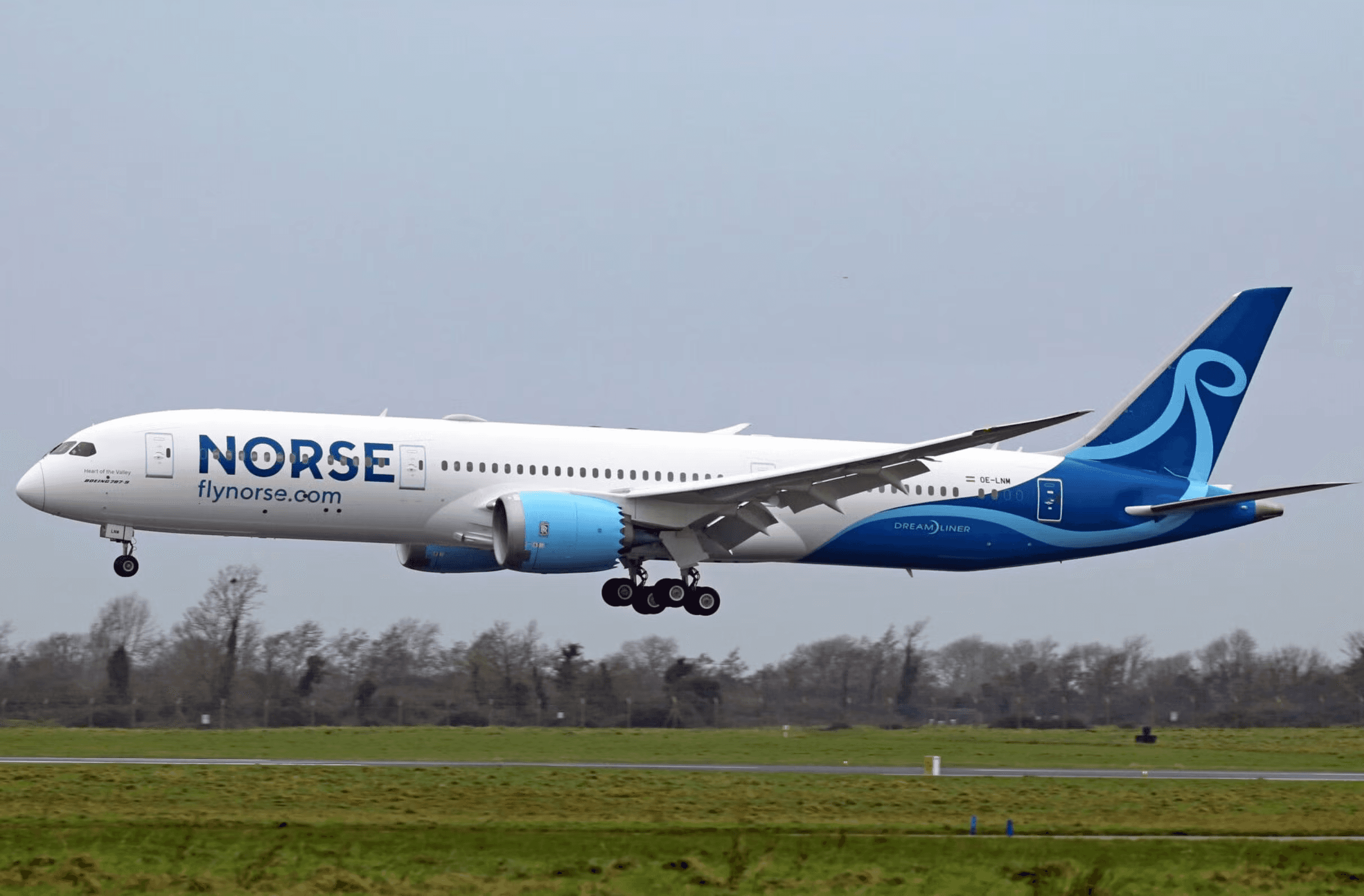
Norse Atlantic 787-9 Seat Guide (2026) | Cabin
TL;DR
Norse Atlantic operates the 787-9 in a two-cabin configuration: Premium (lie-flat, 1-2-1) and Economy (3-3-3). The Premium product is the story - a fully flat bed with direct aisle access at prices that are often 50-70% below legacy Business Class on the same transatlantic routes. Economy is no-frills but the Dreamliner's lower cabin altitude makes the crossing less punishing than a comparable budget long-haul experience on an older aircraft type.
Try Cabin
Norse Atlantic is the most interesting low-cost long-haul carrier currently operating. Its 787-9 offers a genuine Premium cabin with lie-flat seats at prices that sit between economy and traditional business class. The Economy product is straightforward but the Dreamliner's cabin environment makes the crossing more bearable than most LCC alternatives.
Norse Atlantic Airways launched transatlantic 787-9 operations in 2022, connecting Oslo, London Gatwick, and Berlin to New York JFK, Los Angeles, Fort Lauderdale, and Orlando. The airline is the spiritual successor to Norwegian Air's long-haul ambitions, operating from a leaner cost base on the same route network Norwegian pioneered. The 787-9 is the right aircraft for this model - efficient enough to make the economics work at low-cost fares, and comfortable enough that the passenger experience doesn't collapse at long-haul distances.
The defining intelligence for Norse Atlantic is the Premium cabin pricing. Norse prices its lie-flat Premium product at a level that sits between legacy Economy and Business Class - typically USD 600-1,200 on the transatlantic versus USD 2,500-5,000 for legacy Business. For budget-conscious travelers who cannot justify full Business Class but want a flat bed for an overnight Atlantic crossing, this is one of the most practically useful options in the market.
Premium Class
Norse Premium on the 787-9 uses a 1-2-1 reverse herringbone layout with 56 seats — a significantly larger Premium cabin than most full-service carriers fly. Every seat has direct aisle access and reclines to a fully flat 79-inch bed. Seat width is 22 inches with a 15.6-inch IFE screen. There is no privacy door and no dedicated galley - the Premium cabin is served from the same galley as Economy on most configurations, which affects the service quality ceiling.
Odd-numbered window seats (A and K positions) are flush against the fuselage with the console providing partial privacy from the aisle - the better solo sleeping position. Even-numbered window seats face the aisle more directly. The centre D and G seats in odd rows face each other - the best configuration for couples. The large size of the Premium cabin means the product feels less exclusive than legacy Business Class, but the hardware - the flat bed, the direct aisle access, the 22-inch width - is functionally equivalent to products costing three to four times as much. The forward rows of the Premium cabin (rows 1-4) are the quietest, positioned furthest from the galley serving both cabins.
Economy Class
Norse Economy uses a 3-3-3 layout with approximately 283 seats at 31 inches of pitch and 17 inches of width. This is standard LCC long-haul specification - tight by widebody standards, but meaningfully better than the short-haul LCC experience because the Dreamliner's 6,000-foot cabin altitude and higher humidity make a genuine difference over an 8-hour crossing. IFE is available via the seatback screens (9 inches) on newer aircraft; some configurations require passengers to use their own devices connected to the onboard Wi-Fi. Meals and drinks are not included - all food and beverage is purchased separately. Exit rows offer the standard legroom uplift and are the primary target for tall travelers who cannot access Premium.
The honest LCC long-haul assessment
Norse Economy is a no-frills product on a superior aircraft type. The 787-9's environmental advantages - lower cabin altitude, higher humidity, reduced noise - make the Economy experience less fatiguing than it would be on an older widebody. But the absence of included meals, the smaller IFE screens, and the tighter seat pitch are genuine trade-offs relative to legacy Economy on the same routes. For budget-conscious travelers, the calculation is: Norse Economy is cheaper than legacy Economy and less comfortable; Norse Premium is cheaper than legacy Business and comparably comfortable on hardware. The sweet spot for most passengers is Norse Premium.
💻 Digital nomad workspace audit
Premium Class features a stable tray table that handles a 15-inch laptop. Norse uses Viasat satellite Wi-Fi - speeds are adequate for messaging and light browsing, though premium video streaming can be inconsistent on busy transatlantic sectors. Premium seats have AC outlets and USB-A. Economy has USB-A at each seat on most configurations.
🔊 Acoustic and sensory audit
The 787-9's composite fuselage and Trent 1000 engines make it one of the quietest long-haul aircraft types in service. This advantage applies equally in Norse Economy - the crossing is meaningfully less noisy than on comparable older LCC aircraft. The quietest Premium rows are the forward section (rows 1-4). In Economy, rows 60-70 (on the full Norse 283-seat layout) represent the acoustic sweet spot - forward of the aft engine noise and clear of the rear galley.
Best seats
Seat | Cabin | Why |
|---|---|---|
1A & 1K | Premium | Bulkhead. Widest footwells, furthest from the galley, first to deplane. |
Odd-numbered A & K (rows 3-7) | Premium | True window seats with console privacy. Quieter mid-cabin position away from both galleys. |
Forward exit row A or K | Economy | Best Economy legroom. Window position avoids the centre 3-seat block. |
Seats to avoid
Seat | Cabin | Why |
|---|---|---|
Last Premium rows (14A/14K area) | Premium | Closest to the shared galley. More foot traffic and noise than forward rows. |
Last 3 Economy rows | Economy | No recline, rear galley noise, fuselage taper reduces shoulder room. |
Is Norse Atlantic Premium Class worth it?
For overnight transatlantic crossings, yes - if the price differential over legacy Business Class is substantial. At USD 600-1,200 for a flat bed with direct aisle access versus USD 2,500-5,000 on legacy carriers, Norse Premium is one of the most practically compelling value propositions in long-haul aviation. The trade-offs are no lounge access, no included meals in most fare types, and no privacy door.
Does Norse Economy include meals?
No. All food and drink in Economy is purchased separately. Pre-ordering before the flight is cheaper and avoids the risk of popular items selling out. Budget accordingly - a round-trip meal budget of USD 40-60 per person is realistic.
Is Norse Atlantic safe?
Yes. Norse Atlantic operates Boeing 787-9 aircraft maintained to EASA standards and holds a Norwegian Air Operator's Certificate. The airline is regulated to the same safety standards as legacy carriers operating the same routes.
Does Norse have Wi-Fi?
Yes. Viasat satellite Wi-Fi is available with paid packages. Economy passengers can also use their own devices with the onboard entertainment portal on some configurations.
norse atlantic, 787-9, norse premium, budget transatlantic, norse seat guide, low cost long haul