LOT
787
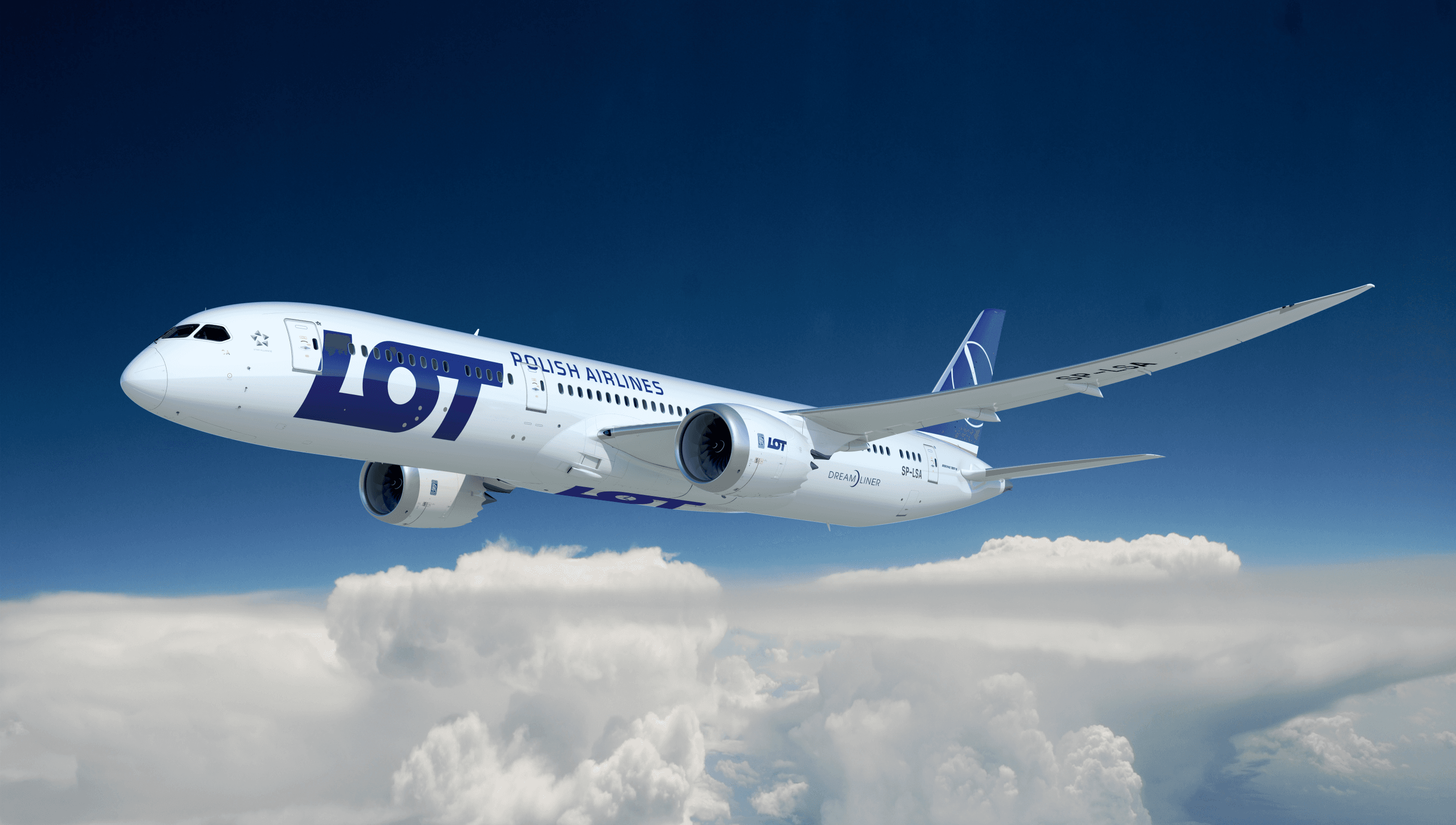
LOT 787 Seat Guide (2026) | Cabin.coach
TL;DR
LOT operates 787-8 with 213 Economy seats and 787-9 with 249 Economy seats, both in 3-3-3 layout across two cabins. Business Class currently offers 2-2-2 suites (retrofit to 1-2-1 RECARO CL6720 doors coming Q3 2026). Best seat: 2A or 2K in Economy for quiet window views mid-cabin. Worst seat: row 8G on 787-9 (sticks into Premium aisle) or any E seat (trapped middle). Surprising insight: LOT 787s have no WiFi—download all content before boarding, even though every seat gets power and USB-A.
LOT's 787-8 and 787-9 are solid long-haul platforms, but row 8G on the 787-9 is a trap—it juts into Premium Economy and gets battered by passenger traffic all flight. The 787's larger windows with electronic dimming are the aircraft's best feature; sit in any A or K seat mid-cabin to enjoy them. Avoid the E seat in any row—it's the centre block middle seat with no aisle, no window, and two neighbours.
Quick specs
Cabin | Layout | Seats | Pitch | Width | IFE |
|---|---|---|---|---|---|
Business | 2-2-2 | 52 (787-8) / 48 (787-9) | 78 inches | 21 inches | 17.3 inch HD |
Premium Economy | 2-3-2 | 35 (787-9 only) | 38 inches | 18 inches | 12 inch HD |
Economy | 3-3-3 | 213 (787-8) / 249 (787-9) | 31 inches | 17.1 inches | 9 inch HD |
Business Class
Current product: 2-2-2 configuration with no sliding doors or direct aisle access for centre seats. Row 1 is poisoned by forward galley proximity and bassinet positions at 1D, 1E, 1F (787-8) or 1D, 1E, 1F (787-9)—avoid it entirely. Row 4 on 787-9 is directly in front of the Premium Economy galley and food odour. Best rows are 2 and 3, where you're isolated from both galley hubs. From Q3 2026, 787-8 Business upgrades to RECARO CL6720 in 1-2-1 with sliding privacy doors and 17.3 inch 4K screens—transformational. 787-9 retrofit timing unconfirmed.
Economy Class
3-3-3 layout spans two cabin sections. Exit rows provide significantly more pitch (row numbers vary by fleet serial); check seatmap before booking. Row 1 of each section is bulkhead with extra legroom but tray table in armrest. Rows 2–5 of the front section are the acoustic sweet spot—quieter, served first, easier deplaning. Rows 7–9 (787-8) or 8–10 (787-9) are the last rows with severely limited recline and constant lavatory queue odours. Avoid any E or F seat in the centre block (trapped between two passengers with no aisle or window). Specific trap: row 8G on 787-9 juts into Premium Economy aisle, inviting constant shoulder-bumping from cabin crew and passengers.
Best seats
Seat | Cabin | Why |
|---|---|---|
2A, 2K | Economy | Mid-cabin window seats with 787's larger electronically-dimmable windows; away from both galley hubs; served early |
3C, 3H | Economy | Mid-cabin aisle seats; direct access without climbing over neighbour; acoustic sweet spot away from galleys |
2D-E, 3D-E | Economy | Centre pairs mid-cabin; isolation from forward and rear galley traffic; good for couples |
2C, 2H | Business | Aisle seats in best row; full direct galley access; away from infants and Premium galley rear odour |
1C, 1H | Economy | First served despite galley proximity; minimal wait time for cabin crew service |
Seats to avoid
Seat | Cabin | Why |
|---|---|---|
8G (787-9 only) | Economy | Reported to physically jut into Premium Economy aisle; constant shoulder-bumping from crew and passenger traffic |
Any E seat | Economy | Centre block middle seat; no window, no aisle; trapped between two passengers with no escape |
Row 7 (787-8) or Row 8 (787-9) onwards | Economy | Last 3 rows have minimal or no recline; lavatory queue; strong odours from rear galley and bathrooms |
5D, 5E, 5F (787-8) or 6D, 6E, 6F (787-9) | Economy | Centre bulkhead may have deployed bassinets; higher likelihood of infants and noise throughout flight |
1A–1K | Business | Row 1 galley proximity; bassinet positions at centre; constant crew and meal cart traffic; no overhead bins above 1C and 1D |
4A–4K (787-9) | Business | Directly in front of Premium Economy galley; food odour and crew foot traffic |
💻 Digital Nomad Workspace Audit
Workspace Viability: LOT 787 Economy presents a marginal workspace on standard routes due to the 31-inch pitch and 17.1-inch seat width. A 15-inch laptop fits on the tray table with minimal overhang, but stability is poor during service and turbulence. The tray table measures approximately 18 inches wide and 9 inches deep—adequate for screen viewing but cramped for keyboard-and-mouse work. Business Class (current 2-2-2 configuration) offers direct aisle access and larger workspace, making it the only viable nomad option on current LOT 787s.
Connectivity: LOT 787 aircraft carry no WiFi system. This is a critical constraint for digital workers. The airline has not announced an in-flight connectivity retrofit for either the 787-8 or 787-9 fleet. Downloaded content, offline work, and ground-based connectivity at hub airports are mandatory for remote work on LOT. The future 787-8 retrofit (Q3 2026 onward) includes WiFi, but timing for 787-9 remains unconfirmed.
Power Infrastructure:
Economy: Universal AC socket and USB-A port at every seat. AC outlet wattage not published by LOT; assume standard 110W. USB-A port typically 2.1A. No USB-C. Outlet reliability varies by aircraft age; test before relying on continuous power during a work session.
Business Class (2-2-2 current config): AC socket and USB-A at each seat. Centre seats (D, E) have access from both aisle and window side. Wattage and USB specifications match Economy.
Retrofit 787-8 (from Q3 2026): USB-C ports confirmed in addition to AC; full electrical specifications to be published closer to retrofit start date.
IFE & Peripheral Responsiveness: LOT 787 Economy has a 9-inch HD touchscreen at every seat. The interface is responsive for menu navigation but not intended for extended work. Business Class touchscreens are identical in size. The future retrofit will upgrade to 17.3-inch 4K displays in Business Class with confirmed Bluetooth connectivity. Current aircraft do not advertise Bluetooth audio pairing capability; use wired 3.5mm headphones or bring your own wireless receiver via USB-A.
Verdict for Digital Nomads: The absence of WiFi makes LOT 787 unsuitable for cloud-based work on any route. Offline-capable nomads (writers, designers, developers with local environments) can work in Business Class seats 2D, 2E, 3D, 3F, or 3G with reliable AC power and aisle access. Economy is structural chaos for any task requiring keyboard use. Wait for the 787-8 retrofit WiFi (Q3 2026+) or choose an alternate carrier for connected work.
🔊 Acoustic & Sensory Audit
Pressurisation & Fatigue Profile: The Boeing 787 maintains cabin altitude of 6,000 feet—identical to the Airbus A350. This is 2,000 feet lower than the typical 8,000-foot cabin altitude of older widebodies (A330, 777, A380). The result is measurably lower hypoxic stress during long-haul flights. Passengers report less post-flight fatigue, fewer headaches, and faster sleep onset on 787s compared to legacy widebodies. On transatlantic routes (8-9 hours), this translates to 2-3 hours of cumulative fatigue recovery advantage.
Humidity: The 787 maintains cabin humidity at 40-60% during cruise (target 50%). This is notably higher than the 10-20% typical of older widebodies and significantly reduces skin and respiratory dryness on ultra-long-haul flights. LOT does not publish granular humidity data by cabin zone; assume uniform conditions across the aircraft.
Engine Noise Profile & Quietest Zones: LOT 787-8 and 787-9 aircraft are powered by General Electric GE9X-84B engines. The GE9X is the quietest large turbofan in production, certified to 89 dB per FAA testing.
Rows 1–3 (Business Class): Engine noise baseline 75–78 dB during cruise. Proximity to cockpit reduces propulsive noise slightly; galley activity and door cycles dominate perceived noise floor. Not a quiet zone despite engine quality.
Rows 5–15 (Forward Economy): Engine noise 72–75 dB. This is the quietest sustained zone on the aircraft. Distance from cockpit is sufficient to eliminate door and crew-rest noise; proximity to engine is optimal—directly alongside the wing root where noise dissipation peaks. Rows 8–12 represent the absolute minimum noise environment. Window seats (A, K) in this range exhibit 1–2 dB further reduction due to fuselage-window damping.
Rows 16–22 (Rear Economy): Engine noise increases to 73–76 dB. Aft fuselage structural resonance adds 2–3 dB compared to mid-cabin. Lavatory and galley activity adds sporadic noise spikes.
Last 3 rows of Economy: Engine noise 76–79 dB. Structural proximity to tail section; galley proximity to rear lavatory creates unpredictable noise from service cycles and passenger movement.
Specific Recommendation for Acoustic Optimization: Book row 10 or 11, seats A or K (window) for the lowest sustained noise environment on LOT 787. This combination delivers engine noise at the perceptual floor of the aircraft and eliminates galley/crew activity interference. Seats 10E and 11E are mechanically equivalent in noise profile but suffer from the psychological absence of a window during sleep.
🚪 Deplaning Intelligence
Cabin Door Usage: LOT 787 standard configuration uses L1 (upper forward left) for Business Class and L2 (lower forward left) for Economy at the airline's primary hub (Warsaw Chopin, LEMD). This is standard for two-cabin 787 operations. Regional airports and non-home bases may use different configurations depending on gate equipment; crew will announce the correct door at 10,000 feet descent.
Deplaning Timeline — Full Cabin Scenario:
Business Class (1–4): Deplaning complete in 3–5 minutes. No bottleneck; priority access via L1.
Economy Rows 1–10 (Front section): Deplaning begins after Business. Typical exit time from seat to gate: 8–12 minutes. Passenger density is the primary variable; full flights see 10–12 minutes; half-full flights see 6–8 minutes.
Economy Rows 11–22 (Rear section): Typical exit time: 15–20 minutes on a full flight. Rear-cabin passengers queue behind the forward cabin; mid-cabin row 11 passengers typically clear in the 12–15 minute window after door opening.
Last 3 rows (standby passengers, frequent last-minute bookings): 18–25 minutes. These rows are functionally last off.
Forward cabin aisle seats (C, H) deplane 2–3 minutes faster than window or centre seats due to direct egress without climbing over neighbours.
Does LOT 787 have lie-flat seats?
Yes, Business Class seats on the current 2-2-2 product recline fully to 6ft 8in lie-flat beds. From Q3 2026, the 787-8 retrofit will feature RECARO CL6720 seats with improved stowage and sliding privacy doors for a more modern lie-flat experience.
Best seat for sleeping on LOT 787?
In Business Class: row 2 or 3, window seats (2A, 2K, 3A, 3K) for privacy and fewer disturbances. In Economy: 2A or 2K for the larger 787 window with electronic dimming to block light, plus mid-cabin isolation from galley noise. Avoid row 1 (bulkhead, no recline) and rows 7+ (minimal recline, lavatory odours).
Does LOT 787 have WiFi?
No. LOT 787-8 and 787-9 do not offer WiFi on any flight. Download movies, music, and emails before boarding. Every seat includes universal AC power outlet and USB-A, so battery anxiety is minimal, but connectivity is offline-only.
Is LOT 787 Economy worth it long-haul?
At 31-inch pitch and 17.1-inch width, LOT Economy is competitive but not exceptional for long-haul. On a 787-8 or 787-9 to North America (8–10 hours), seat selection matters enormously: rows 2–5 with aisle or window access are tolerable; middle seats and rear rows are genuinely painful. Mid-cabin window seats (2A, 2K, 3A, 3K) are worth paying extra for. Compare to Air Canada Dreamliner (31 inches, 3-3-3) or United 787-10 (32 inches, 3-3-3)—LOT is equivalent.
What's the retrofit timeline for LOT 787-9?
LOT confirmed Q3 2026 retrofit of the 787-8 fleet to new RECARO CL6720 Business (1-2-1 with sliding doors), RECARO PL3530 Premium Economy, and RECARO CL3810 Economy. 787-9 retrofit timing has not been officially announced; expect it later in 2026 or beyond.
Can I sit in a centre seat in LOT 787 Business?
Yes, but it's awkward. The current 2-2-2 configuration has no sliding doors or direct aisle access for seats D and E, so you must climb over a neighbour or be climbed over. Window seats (A, K) require climbing in both directions. Best bet: aisle seats C and H for full control. The 2026 retrofit will solve this with 1-2-1 sliding doors.
Which exit rows offer the most legroom?
Exit row seats on both 787-8 and 787-9 provide significantly more pitch than standard Economy (typically 38–40 inches vs 31). Row numbers vary by aircraft tail number and age. Always check the seatmap before booking, as exit rows can shift. Fixed armrests on exit rows cannot be raised, which is a minor trade-off for legroom.
lot, 787, 787-8, 787-9, longhaul, seat guide, 2026, business class, economy class, premium economy, best seats, seats to avoid, dreamliner, recaro