Japan Airlines
777-300
Japan Airlines 777-300 Seat Guide (2026) | Cabin.coach
TL;DR
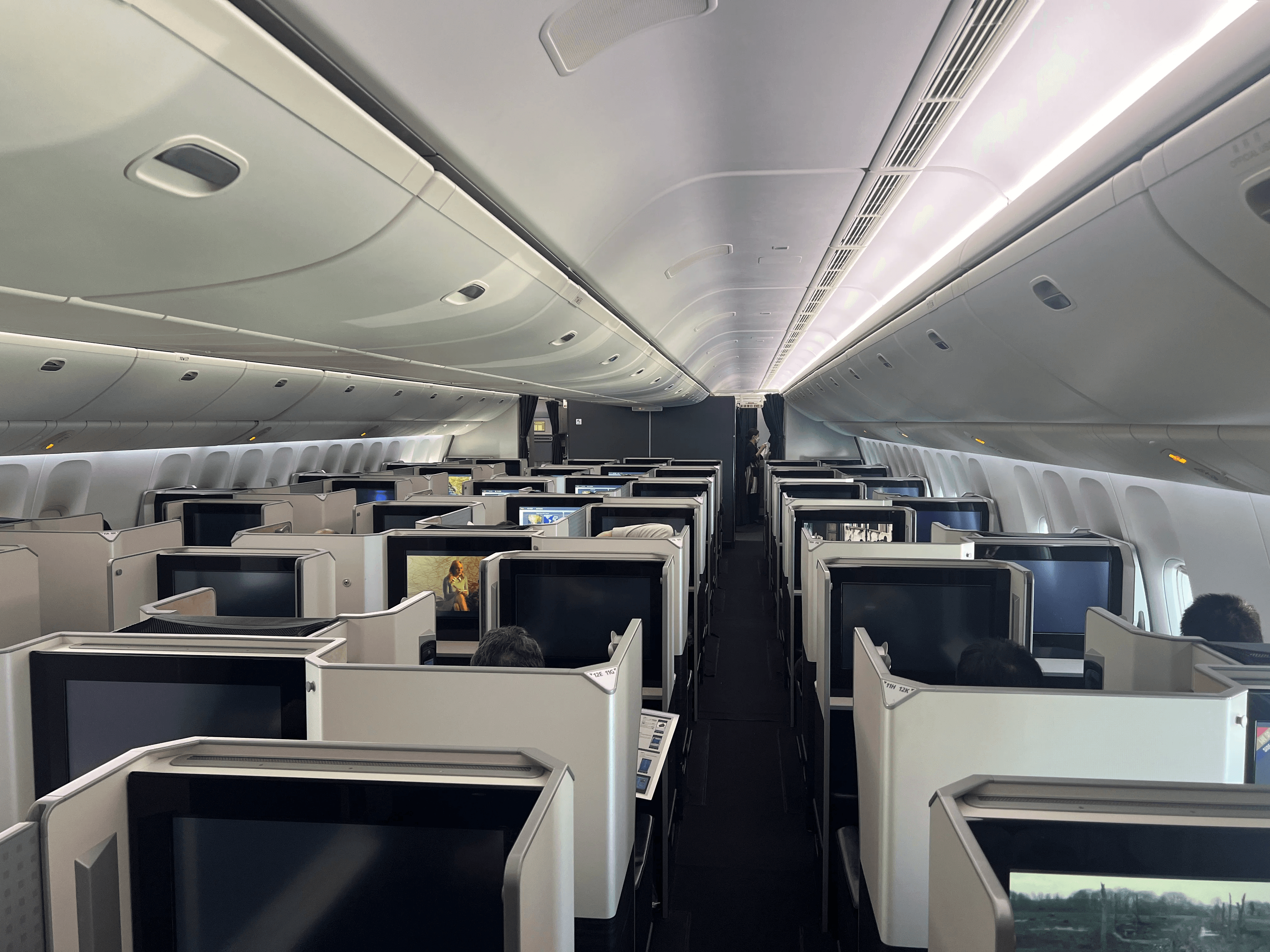
Japan Airlines 777-300 carries approximately 374 passengers: 54 in Business (rows 1–8), 60 in Premium Economy (rows 9–15), and 260 in Economy (rows 16–55). Business is a 2-2-2 direct-aisle configuration; Premium Economy is 2-3-2; Economy is 3-3-3 (ten-aisle-wide cabin, the widest in this aircraft's peer group). Best Business seat: 2D or 2K (forward cabin, direct aisle). Best Economy: rows 19–22 (optimal pitch, forward enough to avoid aft noise, aft enough for galley distance). Avoid rows 54–55 entirely—lavatory proximity makes these miserable on 12+ hour flights. Surprising insight: JAL's refusal to densify Economy to 10-across gives you actual shoulder room at no premium, a genuine competitive advantage versus BA, Cathay, or ANA on the same aircraft type.
Japan Airlines operates the 777-300 in a conservative 3-3-3 economy configuration—a rarity in 2026 when most carriers have densified to 3-4-3. The airline's Business Class spans rows 1–8 in a 2-2-2 staggered layout with direct-aisle access for every seat, making even the middle row pairs preferable to competitors' middle seats elsewhere. Avoid rows 54–55 in Economy: they're the last two rows before the galley, plagued by lavatory odors and crew congestion during service.
Quick specs
Cabin | Layout | Seats | Pitch | Width | IFE |
|---|---|---|---|---|---|
Business | 2-2-2 | 54 | 73–76 inches | 6 ft 2 in (seat) | 17-inch seatback |
Premium Economy | 2-3-2 | 60 | 38 inches | 20 inches | 13-inch seatback |
Economy | 3-3-3 | 260 | 31–32 inches | 17 inches | 10-inch seatback |
Business Class
Japan Airlines' Business Class occupies rows 1–8 in a 2-2-2 direct-aisle staggered configuration. Every Business passenger has direct aisle access—no middle-seat penalty. The layout alternates: rows with the left pair (seats A–B) and right pair (seats J–K) closer to the aisle, with a central row pair (seats D–E) offset and recessed. Seats recline to full lie-flat (6 ft 8 in bed length). Best rows: 2, 4, 6, 8 offer the most sense of forward cabin positioning and shortest walk to the cockpit galley. Avoid row 1: minimal under-seat storage, lavatory traffic, and no crew rest overhead. Rows 7–8 sit closest to the galley and take first-service and last-galley-activity noise.
Premium Economy Class
Premium Economy is located in rows 9–15, configured 2-3-2. Seats recline to 7 inches and feature 38-inch pitch—a genuine step up from Economy's 31 inches, though short of Business lie-flat. Best rows: 10–13 (mid-cabin sweet spot, forward galley traffic minimal, aft congestion not yet audible). Avoid row 9 (Business Class noise and crew proximity) and row 15 (border to Economy, galley immediately behind). Seat width (20 inches) is competitive; aisle seats (A, B, J, K) offer the privacy edge. The upgrade is worth it on 11+ hour transpacific flights; on 7–10 hour Asia–Europe routes, the value proposition weakens.
Economy Class
Economy spans rows 16–55 in a 3-3-3 layout—no middle seat is a row 2 or 4 from the aircraft door, so all three columns (A–C, D–F, G–J) are standard Economy. Rows 16–21 are exit-row equivalent (no recline above the wing emergency exit); row 22 is the first fully reclining seat. Best rows: 19–22 (sweet spot: far enough from forward lavatories, close enough to the cabin front that you avoid the aft rumble from engines and galley prep). Avoid rows 54–55 (last two rows before aft galley, lavatory odors, crew standing room, constant traffic). Rows 25–40 are acoustically acceptable but sit directly above the wing (engine noise). Rows 41–53 are quieter but psychologically remote from cabin activity. Aisle seats (A, J) offer egress ease; window seats (C, G) provide rest points; middle seats (D, F) avoid armrest hogging only on less-full flights.
Best seats
Seat | Cabin | Why |
|---|---|---|
2D | Business | Staggered direct-aisle access, forward enough for priority crew attention, central pair avoids the long walk of aft rows. |
4K | Business | Starboard direct aisle, clear egress path, sweet spot of cabin length before aft galley noise. |
12A | Premium Economy | Mid-cabin window, minimal forward galley traffic, no Economy noise creep from row 16, 38-inch pitch ideal for 8–10 hour flights. |
20F | Economy | Center cabin, reclining seat (row 22+), equidistant from forward and aft lavatories (16–21 are exit rows with no recline), acoustic equilibrium, minimal foot traffic. |
32J | Economy | Aisle seat in quiet cabin zone, past engine-noise peak (wing ends by row 30), direct lavatory access without middle-seat blocking, good for 12+ hour flights where bathroom frequency matters. |
Seats to avoid
Seat | Cabin | Why |
|---|---|---|
1A, 1B | Business | Absolute front row: extended lavatory queues (emergency crew galley nearby), minimal under-seat luggage room, cockpit door proximity (crew activity audible), first-service timing longest. |
8D, 8E | Business | Last Business row: aft galley directly behind, Premium Economy cabin noise and crew call-button dings, lavatory proximity for Premium/Economy passengers creates foot traffic. |
9A, 9K | Premium Economy | First Premium Economy row borders Business Class; Business recline causes armrest pressure, Business call-button sounds, crew transition noise continuous. |
15D, 15F | Premium Economy | Last Premium Economy row: Economy cabin immediately behind (Economy lavatory odors, galley prep noise, passenger traffic), no buffer zone. |
16–21 (all seats) | Economy | Exit-row equivalent with no recline: structural ceiling limits head room on sleep, lavatory noise from rows 22–30 above/behind, crew uses these rows as standing area during service. |
54D, 54E, 54F, 55A, 55B, 55C, 55G, 55H, 55J, 55K | Economy | Last two rows: aft galley immediately behind, lavatory traffic constant, odors permeate cabin, zero forward-cabin ambiance, crew rarely ventures here (service last), resets and cleanings happen here (noise 30 min before landing). |
✈️ Premium Economy
Japan Airlines operates its 777-300 aircraft with a dedicated Premium Economy cabin positioned forward of the main deck Economy section. The cabin features a 2-3-2 seat configuration, offering significantly wider personal space than Economy. Seat pitch measures 38 inches, compared to 31 inches in Economy, providing meaningful legroom for medium-haul and long-haul services on JAL's Pacific and Asian routes.
A dedicated galley serves Premium Economy exclusively, ensuring faster meal and beverage service without Economy traffic. The meal service in Premium Economy features multi-course dining with Japanese-inspired menus and premium beverage selections, distinctly superior to the simplified service offered in Economy. Passengers receive amenity kits, pillow upgrades, and extended meal choices unavailable below.
All Premium Economy passengers receive lounge access at Japan Airlines hubs: Haneda (Tokyo), Kansai (Osaka), and Itami (Osaka domestic). Access extends to the JAL First Class Lounge or dedicated Premium Economy lounges depending on the airport. Business class and above passengers naturally receive priority access to premium facilities.
Best Premium Economy rows: Rows 24–27 in the forward section offer optimal galley proximity without rear lavatory proximity issues. Avoid rows 28–30, as these sit adjacent to Economy bulkheads and experience higher traffic noise. Window seats (A and G positions) provide privacy; the centre 2-3-2 layout means the centre pair (D and E) require less seatmate negotiation than Economy's 3-4-3 squeeze.
🛏️ Economy Cabin Layout & Seat Selection
Japan Airlines configures its 777-300 Economy cabin in a 3-4-3 arrangement across rows 31–67 (approximate deck footprint varies by aircraft MSN). This nine-seat width represents the contemporary standard for 777 economy densification; while tighter than the original 3-3-3 specification, it aligns with British Airways, United Airlines, and most legacy carriers operating similar widebody fleets.
Seat pitch measures 31 inches in standard Economy—adequate for flights up to 8 hours but noticeably snug for transpacific routing (10–12 hours) or passengers exceeding 5'10". The middle seat (D and E positions in each row) remains the least desirable; aisle seats (C and F) offer bathroom access without disturbing a seatmate, while window seats (A and G) provide a wall to lean against during sleep.
Best Economy rows for general comfort: Rows 42–50 sit in the heart of the cabin, away from galleys, lavatories, and infant bassinets. These rows offer consistent service flow and minimal ambient noise from crew activity.
Avoid: Rows 31–35 sit directly behind the bulkhead or galley prep area; early meal service carts and crew positioning create sustained noise until service concludes. Rows 60–67 (rear Economy) suffer from lavatory queuing, odour proximity, and reduced galley-service priority—meals and beverages reach these rows last. Row 67, if it exists on your aircraft, is the last row and experiences significant cabin pressure and engine noise transmission.
✈️ Version Lottery
Japan Airlines operates a mixed 777-300 fleet with minimal variation in cabin configuration. The airline has not deployed materially different Economy or Premium Economy layouts across its 777-300s. However, aircraft age introduces secondary variation: earlier builds (approximately pre-2015) feature older IFE hardware and seat foam that may feel less supportive; later builds (2015 onwards) carry newer Panasonic inflight entertainment systems and refreshed seat cushioning.
To identify which version operates your flight: access the JAL website's seat map interface, which displays aircraft equipment codes (e.g., "773" for 777-300). Cross-reference the specific aircraft registration (visible on ExpertFlyer or SeatGuru) against JAL's fleet list on aviation databases. Most current-generation JAL 777-300s are post-2010 builds with comparable modern amenities.
The difference between aircraft age is minimal and does not warrant rebooking. Premium Economy and Economy layout consistency across the fleet makes seat selection strategies portable: your ideal row or position performs equivalently regardless of aircraft serial number. Focus instead on scheduling (early morning vs. evening departure) and route timing (westbound overnight flights align better with sleep architecture than eastbound red-eyes).
🏆 Competitive Verdict
Japan Airlines 777-300 Premium Economy and Economy products face direct competition primarily from All Nippon Airways (ANA) 777-300 and 787-9 aircraft on shared Tokyo-North America and Tokyo-Europe routes. ANA's 777-300 operates a 3-4-3 Economy configuration identical to JAL's; however, ANA's Premium Economy seats 2-4-2 rather than JAL's 2-3-2, meaning ANA's middle four seats receive less privacy and a cramped experience despite identical pitch. JAL wins decisively for couples wanting to sit together in Premium Economy: the 2-3-2 configuration ensures two travellers never face a third seatmate, whereas ANA's 2-4-2 relegates one partner to the exposed centre block. For solo overnight travellers, JAL and ANA tie on pitch (38 inches) but JAL's narrower middle section (three seats vs. four) creates marginally quieter cabin conditions. Tall passengers exceeding 6 feet experience equivalent tight knees in both airlines' Economy; neither aircraft offers extra-legroom standard Economy rows, forcing these passengers to upgrade to Premium or Business. Work-focused business travellers should bypass both 777 products entirely and book JAL or ANA Business Class, where lie-flat seats and aisle-facing workstations eliminate cross-cabin distraction; JAL's 777 Business product (1-2-1 in First, 2-3-2 in Business depending on variant) is more modern and spacious than ANA's aging 777 Business seats, handing the edge to JAL for premium cabin commuters who refuse Economy.
🛁 Lounge & Ground Experience
Japan Airlines operates its primary hub at Haneda Airport (Tokyo, HND), serving as the base for all 777-300 international departures and the majority of long-haul rotations. Premium Economy and above passengers access the JAL First Class Lounge, located in the international terminal and featuring the following facilities:
Shower suites: Four full shower rooms with amenity kits, towel service, and privacy locks—essential for 12+ hour layovers or pre-arrival freshening on overnight arrivals.
À la carte dining: Open-kitchen counter service with Japanese chefs preparing ramen, sushi, tempura, and Western options; no buffet crowding, customisation available.
Spa services: Hand and foot massage treatments available by advance reservation (usually complimentary for First Class, fee-based for Premium Economy in select time windows).
Day beds: Private sleep pods (two units) available on hourly rental for First/Business passengers; not reliably available to Premium Economy passengers without status elite membership.
Quiet zones: Designated seating with soft lighting and minimal noise—suitable for business calls or sleep recovery.
Access tiers: JAL First Class and Business Class receive unrestricted lounge access and spa/shower priority. Premium Economy passengers on international tickets receive shower and dining access but may encounter capacity constraints during peak hours (11:00–15:00 and 18:00–22:00). JAL mileage programme elites (Sapphire and above) receive equivalent Premium Economy lounge access. Economy class passengers do not receive lounge access unless holding elite status (minimum Crystallize tier).
Hub routing verdict: Haneda's First Class Lounge ranks among the world's best in shower availability and dining quality, justifying a Haneda connection over direct flights via competitor hubs (e.g., Singapore Airlines via Singapore Changi, ANA via secondary hubs) if your Premium Economy fare permits a 4–6 hour layover.