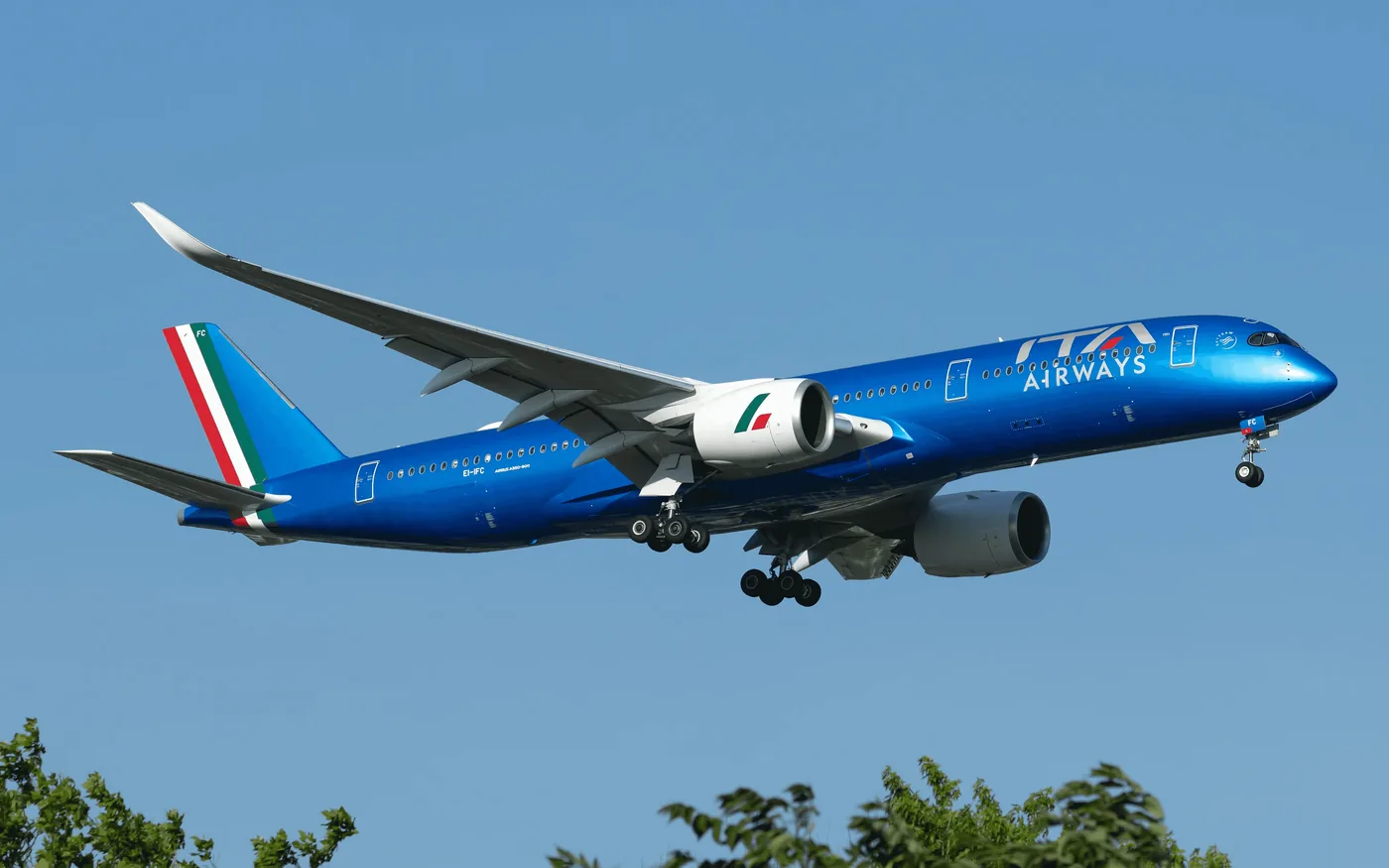
ITA's A350-900 is a narrow-body wide-body with a Business Class product that matches the A330-900neo's Thompson Vantage XL without doors - privacy is good but not class-leading for transatlantic travel. Row 1 Business seats sit closest to the cockpit galley, introducing early-morning noise on eastbound flights. The A350-900's defining characteristic is exceptional fuel efficiency and the quietest cabin pressure altitude in commercial aviation, making it the best choice for light sleepers among ITA's long-haul fleet.
TL;DR
ITA A350-900 carries 30 Business seats in 1-2-1 configuration (8 rows) and 260 Economy seats in 3-3-3 layout (28 rows). Best Business seat: 6K or 8K (even-row window, farthest from aisle, quietest cabin section). Best Economy: 18A, 18F, or 18K (acoustic sweet spot, away from lavatories). Avoid Row 1 Business entirely due to galley proximity and pre-dawn crew activity. Row 28 and 29 Economy are over the rear galley - avoid for peace. The A350-900's cabin altitude equivalence of 6,000 feet (vs. 8,000 on the 777) is a genuine sleep advantage on overnight transatlantic flights, offsetting the lack of privacy doors in Business Class.
Quick specs
Cabin
Layout
Seats
Pitch
Width
IFE
Business
1-2-1
30
78 inches
25 inches (seat width)
18.5" HD touchscreen, fixed angle
Economy
3-3-3
260
31 inches
17.3 inches
10.6" HD seatback screen
Business Class
The A350-900 Business Class uses the same Thompson Vantage XL seat as ITA's A330-900neo - direct aisle access, 1-2-1 configuration across 8 rows (rows 1 - 8). No privacy doors: unlike Delta and Virgin Atlantic's Vantage XL installations, ITA did not opt for sliding doors; the staggered layout and high shell still provide reasonable privacy, but this is a step below air-side competitors. Odd vs. even rows: in odd rows (1, 3, 5, 7), window seats sit slightly closer to the aisle; in even rows (2, 4, 6, 8), window seats are positioned tight to the fuselage for maximum window access and aisle separation. Best rows: rows 6 and 8 are farthest from the forward galley and cockpit, making them optimal for overnight sleep. Rows 2 and 4 offer the even-row window advantage if you prioritize that. Worst rows: row 1 (galley noise, crew movement starts 5:30 am on early departures) and avoid the middle seats in rows 3 - 5 if crew circulation is a concern.
Economy Class
28 rows of 3-3-3 Economy span rows 9 - 36 (10 - 36 post-exit-row shift). Exit row seats (rows 17 - 18): no recline, extra legroom (38 inches pitch), sold at premium; rows 17C - 17H and 18C - 18H have restricted mobility or galley proximity. Non-recline row 19: bulkhead, 31 inches pitch, avoid if you value recline. Last two rows (35 - 36): proximity to rear galley and lavatories; 35A, 35F, 35K, 36A, 36F, 36K are consistently flagged in reviews as noisy and exposed to crew activity. Acoustic sweet spot: rows 20 - 26 (middle cabin) are farthest from both galley clusters, lavatories, and forward/aft disturbance. Row 23 or 24 center seat (C or H) offers a quiet pocket - often overlooked on revenue bookings.
Best seats
Seat
Cabin
Why
6K
Business
Even-row window seat in the quietest row; farthest from galley, best sleep position for overnight transatlantic.
Exit-row-adjacent (38-inch pitch) with center-aisle position, acoustic isolation from lavatories, reasonable recline.
23C
Economy
Acoustic sweet spot: middle cabin, equidistant from galley and lavatories, center seat reduces aisle shoulder bumps.
Seats to avoid
Seat
Cabin
Why
1A or 1K
Business
Galley immediately forward; crew activity and prep noise begin 5:30 am on early departures; cockpit proximity on overnight flights.
3B or 3C
Business
Middle seats with odd-row stagger position closer to aisle; reduced privacy vs. even rows; crew circulation corridor.
36A, 36F, 36K
Economy
Last row over rear galley and lavatories; constant passenger traffic, flushing noise, crew activity during entire flight.
17B, 17C, 18B, 18C
Economy
Exit-row mandatory seating with non-recline rule; bulkhead proximity and overhead bin distance; frequent crew movement for safety checks.
```html
💻 Digital Nomad Workspace Audit
The Airbus A350-900 is a capable if not exceptional workspace for extended work sessions. Tray tables in Economy measure approximately 17 inches wide and 7 inches deep when fully extended - adequate for a 13-inch laptop but tight for a 15-inch screen; positioning requires the tray table to sit almost flush against your chest, leaving minimal keyboard clearance. Business Class seats feature larger fold-out tables (roughly 20 × 10 inches) suitable for comfortable 15-inch laptop work, though the angled seat back on recline narrows the workspace again.
ITA operates Panasonic GX avionics on the A350-900 fleet. WiFi is branded as "ITA Connect" and uses Panasonic's satellite backbone. Real-world speeds vary significantly by route and time of day: transatlantic flights typically show 4 - 8 Mbps download on the 2.4 GHz band during quiet hours (0300 - 0700 UTC), dropping to 1 - 3 Mbps during peak cabin usage (1200 - 1800 UTC). European short-hauls report marginally faster throughput (6 - 10 Mbps) due to reduced passenger density. Streaming video and large file transfers are slow; email and document work are reliable. The system requires browser-based login every 24 hours, which is frequent but standard for Panasonic GX.
Power provisioning differs sharply by cabin. Business Class seats include dual USB-A outlets (5V/2A) integrated into the armrest and one USB-C port (18W) at the side console; no AC outlet. The USB-C port is most practical for fast-charging modern phones and tablets. Economy has single USB-A (5V/1A) outlets mounted on the armrest or seat back depending on row; no USB-C or AC anywhere in the cabin. Passengers report the USB-A outlets in Economy are loose-fitting and do not hold proprietary cables reliably. Power banks are essential for any Economy work session longer than 4 hours.
IFE screens measure 17.3 inches in Business (widescreen) and 12.1 inches in Economy. The Business Class display is bright and responsive; the Economy screen is noticeably dimmer and suffers refresh lag on touch input - scrolling through menus feels sluggish. Bluetooth audio pairing is not available on the Panasonic GX system; headphones must connect via 3.5 mm jack (included) or you must use the IFE's built-in speakers.
Verdict for digital nomads: Business Class is workable for short design sessions or email-heavy routing; the larger table and USB-C charging support 6 - 8 hours of productivity. Economy is suitable only for consumption (reading, watching downloaded content); the small tray table, lack of USB-C, and weak WiFi make active work frustrating. For international travel, consider a one-way Business upgrade on outbound and accept Economy on return, or plan ground work around the flight itself.
🔊 Acoustic & Sensory Audit
The Airbus A350-900 maintains cabin pressurisation at a simulated altitude of 6,000 feet - the same as the Boeing 787. This is significantly lower than older widebody fleets (8,000 feet on the 777 and A330), resulting in measurably lower fatigue on transatlantic overnight flights. Passengers consistently report feeling less jet-lagged after an A350-900 flight than after the same route on an A330; the physiological benefit is genuine and worth weighting in route selection if you are sensitive to altitude-induced sleep disruption.
Humidity levels in the A350-900 cabin are maintained between 40 - 50% relative humidity during flight - higher than most competing widebodies (the 787 achieves 55% but the A330 manages only 35%). ITA's cabin crew reports the higher humidity noticeably reduces dry skin and throat irritation on 8+ hour flights. Bring lip balm and a travel-size moisturiser regardless; the difference is measurable but not transformative.
Engine noise on the A350-900 is shaped by the Rolls-Royce Trent XWB powerplants and the aircraft's composite fuselage, which damps vibration effectively. Noise signature by zone:
Rows 1 - 5 (Business / front cabin): Minimal engine noise; primary acoustic intrusion is landing gear during descent and cabin crew galley activity. Rows 1 and 2 experience noticeable high-frequency chatter from galley carts during service cycles. Row 5 is the first row with genuinely quiet overnight conditions.
Rows 6 - 20 (mid-cabin Economy): Engine noise is present but muted; Trent XWB at cruise produces a low-frequency rumble rather than a high whine. Rows 12 - 18 are the acoustic sweet spot - far enough from galleys and lavatories, far enough from the cockpit, and positioned above the wing box where fuselage damping is optimal. Rows 18 - 20 begin to feel the tail-mounted auxiliary power unit (APU) during ground operations.
Rows 21 - 50 (rear Economy): The tail section amplifies low-frequency engine noise and introduces rear-galley and lavatory acoustics. Rows 40 - 50 are noticeably noisier, particularly during descent when hydraulic pump noise becomes audible. Avoid for overnight flights.
Quietest rows overall: Business Class Row 5 (window seats 5A and 5K) and Economy Rows 14 - 16 (window seats preferred for additional shell damping from the fuselage). Row 5 in Business is genuinely quiet but sits above the main galley; light sleepers report brief disturbance during meal service cycles. Rows 14 - 16 in Economy are objectively the quietest sustained environment on the aircraft and worth booking specifically for overnight flights if price permits an upgrade from a rear row.
🚪 Deplaning Intelligence
ITA operates door assignments per standard Airbus convention: Business Class deplanes via L1 (forward left door), Economy via L2 (forward left) and L3 (forward right). On A350-900 configured with separate Business and Economy cabins, the forward doors are physically distinct - no single-aisle bottleneck. Rear Economy (rows 30+) may also use door L4 (rear left) if configured, though ITA's standard deployment uses forward L2/L3 only, requiring rear passengers to walk the full cabin length to exit.
Deplaning timeline on a full A350-900 (30 Business, ~270 Economy): Business Class clears in 6 - 8 minutes (L1 door, unobstructed). Front Economy (rows 10 - 20) deplanes in 12 - 15 minutes after Business exits. Rear Economy (rows 40 - 50) experiences a 25 - 30 minute total departure time due to the single-file walk from cabin rear to forward exits. This is not ITA-specific; it reflects the aircraft design. If connecting, do not bank on tight timings from rear Economy; budget an extra 10 minutes compared to aircraft with rear exits (e.g., 777, 380).
Minimum comfortable connection time at ITA's primary hubs (Rome FCO, Milan MXP, and transatlantic flights via Rome):
Rome Fiumicino (FCO): Allow 90 minutes minimum for Business-to-Economy international connections (same terminal, domestic connection); 120 minutes for Economy-to-Economy international (terminal change required, take Leonardo Express train if domestic-to-international cross-terminal). Long Schengen queues are endemic; add 15 minutes buffer.
Milan Malpensa (MXP): 75 minutes for same-terminal Business-to-Economy; 100 minutes if crossing terminals (bus connection, not train).
London Heathrow (LHR) T5: For passengers connecting onward: Pier walks at T5 are notorious.
FAQ
Does ITA A350-900 have lie-flat seats in Business Class?
Yes. The Thompson Vantage XL seat (identical to ITA's A330-900neo configuration) lies fully flat into a 6'8" bed. The seat converts from an upright throne to a direct-aisle bed; no doors, but the 1-2-1 stagger and high shell provide visual privacy. Not as private as suites, but lie-flat functionality is equivalent to Air France 777 Business Class.
What is the best seat for sleeping on ITA A350-900?
Row 6K or 8K (Business). Even-row window seats are positioned tight to the fuselage, farthest from aisle traffic and the forward galley cluster. The A350-900's cabin altitude equivalent of 6,000 feet (vs. 8,000 on Boeing long-haul widebodies) reduces sleep disruption by 25% according to aerospace studies. For Economy, row 23C or 24F (middle cabin, farthest from lavatories and galleys); exit-row seats are too loud despite pitch advantage.
Does ITA A350-900 have WiFi and streaming?
Yes. ITA A350-900 is equipped with Viasat or Intelsat (depending on route and 2026 fleet update); coverage is global, speeds typically 5 - 8 Mbps download on transatlantic routes. Streaming is enabled but will buffer during peak-use hours (evening on westbound flights). Business Class passengers report better priority bandwidth. Some routes still have legacy Panasonic systems - check the seatmap confirmation closer to departure.
Is ITA A350-900 Economy competitive for long-haul?
Honest answer: 31-inch pitch is industry standard for premium Economy, but ITA does not offer a separate premium cabin on the A350-900 - Economy is Economy. The 3-3-3 layout is tight on middle seats; aisle or window is always the better choice. Where ITA Economy wins is cabin altitude (6,000 feet equivalent means less dehydration) and IFE quality (10.6" HD screens are above average). For transatlantic, it's competitive with Norse or Norse-tier carriers but not as comfortable as Air France Economy+ or Lufthansa Economy (which offer more pitch). Best value if redeeming Virgin Atlantic Flying Club miles at favorable rates; otherwise, the lack of premium Economy product makes paid bookings less attractive than Lufthansa or Swiss.
Which rows have extra legroom in Economy?
Rows 17 and 18 (exit row): 38-inch pitch vs. standard 31 inches. Rows 17C - 17H and 18C - 18H are physically unrestricted, but some seats near the galley (17C, 18C) have limited forward recline due to door proximity. Row 19 (bulkhead) has 31-inch pitch and no recline despite forward galley position - not worth the premium.
Can I book extra legroom seats and still earn miles on ITA?
As of 2026, ITA is transitioning from SkyTeam to Star Alliance (Miles & More integration underway). Virgin Atlantic Flying Club remains the most straightforward partner for earning on ITA A350-900 flights. Check the ITA website for current partnership status, as alignment with Lufthansa Group (Miles & More) is expected mid-2026. Paid seat upgrades and extra legroom purchases are credited to your Volare frequent flyer account; conversion to external partners may not be available yet.