Iberia
CRJ-1000
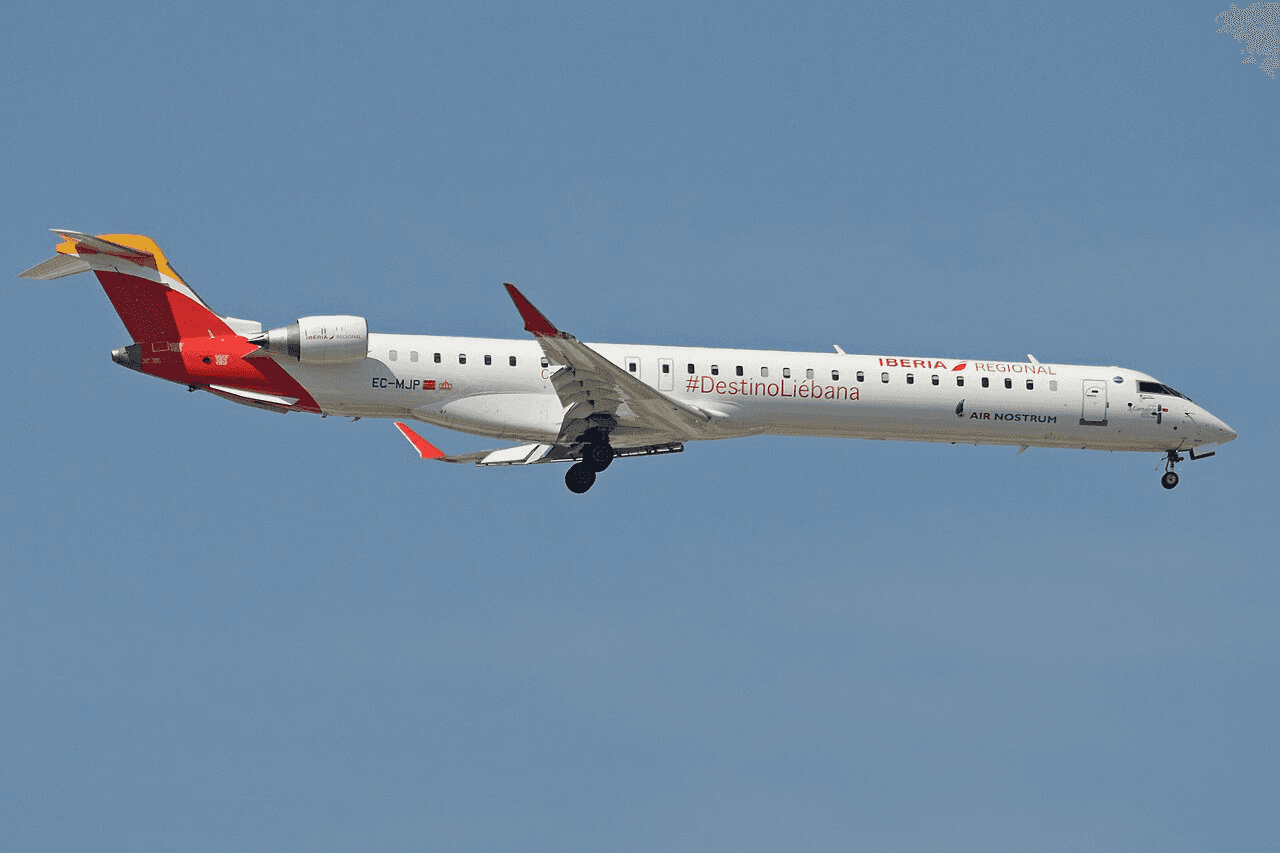
Iberia CRJ-1000 Seat Guide (2026) | Cabin
TL;DR
The CRJ-1000 typically carries 12–16 Business seats and 54–64 Economy seats in a 2-2 cabin layout. Business Class occupies rows 1–7 or 1–8 with 38-inch pitch and 17-inch width; Economy runs 31 inches pitch in rows 8–35. Best seat: any aisle in rows 3–6 of Business Class (exit row, extra legroom, no bulkhead quirks). Worst seat: Row 35C or 35D (aft galley noise, minimal recline, engine roar). One surprise: the CRJ-1000 has no premium economy, and Business Class is barely wider than Economy—the real benefit is the recline, not the space.
The Iberia CRJ-1000 is a 70–76 seat regional jet used on short-haul European and North African routes—not transatlantic. Avoid Row 1 (bulkhead Y-belt and no under-seat storage) and the last two rows (engine noise and minimal recline). The defining characteristic is tight pitch throughout: even Business Class offers only 38 inches, so this aircraft is best suited for flights under 4 hours.
Quick specs
Cabin | Layout | Seats | Pitch | Width | IFE |
|---|---|---|---|---|---|
Business | 2-2 | 12–16 | 38 in. | 17 in. | None (seatback or shared screen) |
Economy | 2-2 | 54–64 | 31 in. | 16.5 in. | None |
Business Class
The CRJ-1000 Business cabin spans rows 1–7 or 1–8 in a 2-2 layout. Row 1 is the bulkhead with a Y-belt (four-point harness), no under-seat stowage, and a narrower seat entry; it's often blocked for infants with bassinets. Rows 2–7 are standard reclining seats with direct aisle access and 38-inch pitch. There are no privacy doors or cabin partitions—this is a regional jet, not a widebody. The oddest quirk: window seats (A and D) have slightly less recline clearance than aisle seats (B and C) due to the cabin wall. Best rows: 3–6 (exit row in some configurations, extra legroom, no bulkhead Y-belt). Row 7 or 8 is the last Business row; it borders Economy and experiences cabin-crew movement noise.
Economy Class
Economy occupies rows 8–35 (or 9–35 if Business extends to row 8) in a 2-2 layout with 31-inch pitch and 16.5-inch seat width. Exit rows vary by configuration but typically include rows 10, 11, and 19 or 20—check the seat map for exact row numbers on your flight. Non-recline or minimal-recline rows are usually rows 33–35 (galley/lav zone). Rows 33–35 are the seats to avoid: they're above or next to the aft galley, experience constant crew movement, have engine noise, and offer minimal or no recline. The acoustic sweet spot for a regional jet is rows 15–25 (mid-cabin, away from engine whine and crew activity). Window seats (A and D) are preferred on short-haul for naps; aisle seats (B and C) offer easier bathroom access on flights over 2 hours.
Premium Economy
The CRJ-1000 does not offer a dedicated Premium Economy cabin. All seating is either Business (2-2, 38-inch pitch, full or near-full recline) or Economy (2-2, 31-inch pitch, no recline). For flights under 4 hours, the pitch difference is tolerable for most passengers; for longer regional runs (e.g., Madrid–London or Madrid–Rome), a Business Class upgrade is the only cabin step up and is worth the fare premium ($100–$250) if you value the recline and slightly wider armrests.
Best seats
Seat | Cabin | Why |
|---|---|---|
4A or 4D | Business | Aisle or window at mid-Business; no bulkhead Y-belt quirks, clear sightline, full recline. |
5B or 5C | Business | Center aisle seats with maximum legroom, full recline, direct crew access. |
18A or 18D | Economy | Mid-cabin window or aisle (row 18 is near the acoustic sweet spot); enough pitch for a short nap without claustrophobia. |
10B or 10C | Economy | Exit row if available (extra legroom in rows 10, 11, or 19/20—check your seat map); aisle seat avoids middle-seat squeeze. |
Seats to avoid
Seat | Cabin | Why |
|---|---|---|
1A, 1B, 1C, 1D | Business | Bulkhead row: Y-belt harness (less comfortable), no under-seat storage, narrower seat entry, often reserved for bassinets. |
7D or 8D | Business or Economy border | Last Business row or first Economy row: exposed to galley noise, crew movement, no privacy between cabins. |
33–35 (any letter) | Economy | Aft galley and lavatory zone: crew noise, engine roar, minimal or no recline, constant foot traffic. |
34B or 34C | Economy | Middle seats in the galley zone; cramped, no aisle access, maximum noise from crew and lavatories. |
⚡ Power & Connectivity Reality Check
Iberia's CRJ-1000 fleet operates with minimal onboard power infrastructure. USB power ports are not standard on this regional aircraft; availability is inconsistent and typically confined to premium cabin areas if present at all. Passengers should expect no AC outlets on Economy seats. Bring a portable battery pack rated for 10,000–20,000 mAh to cover a full day of regional operations, particularly on longer routes like Madrid–London or Madrid–Milan where flight times exceed 2 hours.
Inflight entertainment on Iberia's CRJ-1000 operates via seatback screens rather than streaming to personal devices. The system is proprietary and primarily offers live TV, radio, and basic on-demand movie selections; newer aircraft in the fleet offer marginally faster response times. WiFi is not available on Iberia CRJ-1000 operations; the aircraft lacks the avionics and antenna infrastructure for broadband connectivity. Plan to download content to your phone or tablet before boarding if you intend to work or stream during flight.
Bluetooth audio pairing is not supported on the seatback IFE system; you must use the provided headphone jack or the airline's wired headsets. The audio quality varies by seat location due to cabin noise levels in the aft rows. Passengers in rows 20 and beyond report noticeably higher engine noise that degrades the listening experience; invest in noise-isolating headphones or wireless earbuds charged before departure.
🧳 Overhead Bin Strategy
The Bombardier CRJ-1000 has limited overhead bin capacity compared to larger regional competitors like the ATR 72 or Embraer E190. Bins are segmented by section and measure approximately 16 cubic feet per section across the cabin. On flights with above 80% load factor—common on Madrid–Barcelona, Madrid–Valencia, and Madrid–Málaga routes—overhead bins fill completely by row 10.
A standard 22-inch roller bag fits into bins wheels-in with careful placement, but gates on full flights automatically trigger gate-checking of wheelie bags starting at boarding group 4. This is particularly common at Madrid-Barajas (MAD), Barcelona-El Prat (BCN), and Málaga-Costa del Sol (AGP) during peak morning and evening bank times. Passengers boarding in groups 1–3 (Business, elite frequent flyer, and first Economy boarding) can reliably stow overhead luggage at their seat row. Rows 1–5 benefit from larger forward bins; rows 15–20 experience earlier bin saturation due to pooled capacity with the rear lavatory module.
On Iberia CRJ-1000 flights, gate-checking likelihood exceeds 40% on full flights on routes like MAD–AGP, MAD–BCN, and MAD–SVQ. Carry only a personal item (13–15 inches) if you cannot afford checked baggage fees or delays. If you must carry a roller bag, secure boarding group 1 or 2 status via elite membership or Business class to guarantee overhead access.
🏃 Boarding & Exit Strategy
Iberia uses a six-tier boarding system on CRJ-1000 regional operations:
Group 1: Vueling Plus/Business, elite frequent flyers (Iberia Plus Plata and above), families with infants, passengers requiring assistance
Group 2: Standard Business, Iberia Plus Oro members
Group 3: Preferred Economy (seat-fee holders in rows 1–10), connecting passengers with tight itineraries
Group 4: Main Economy (rows 11–20)
Group 5: Economy+ or Economy with baggage (rows 21–32)
Group 6: Standby and last-minute bookings
To board in groups 1–2 without elite status, purchase Business class or a Preferred Economy seat upgrade ($25–$60). To guarantee group 3 boarding, seat yourself in rows 1–10 via paid seat selection (opens 72 hours before departure for Economy; opens at booking for Business). For general Economy, group 4 boarding begins 20–25 minutes before departure at the gate; arrive 50 minutes early to ensure a position within the first half of your boarding group.
The CRJ-1000 deplanes via a single forward door only. Seats in rows 1–8 deplane in under 45 seconds; rows 9–16 exit within 90 seconds; rows 17–32 typically take 2–3 minutes due to single-file aisle navigation. There is no rear door on this aircraft, so seat location has minimal impact on exit speed relative to a widebody. If minimizing deplaning time is important, prioritize rows 1–8 and arrive at the gate early to board first within your group, securing a seat-row advantage on the ground.
📱 Booking Intelligence
Seat selection timing on Iberia CRJ-1000:
Business class: Seat selection available at booking; premium rows (1–5) are automatically assigned
Preferred Economy (rows 1–10): Paid seat selection opens at booking; prices stabilize 72–96 hours before departure, typically dropping $5–$15 as the flight fills
Standard Economy (rows 11–32): Free seat selection opens 24 hours before online check-in; specific seat assignment may be withheld until check-in to manage load distribution
Exit-row seats (typically rows 12–13 on CRJ-1000) are held exclusively for elite frequent flyers and Business passengers until 48 hours before departure, then released to the general booking pool if not claimed. Bulkhead seats (rows 1, 11, 16) are reserved for Business and elite members until 72 hours prior; they rarely release to Economy because crew reserve them for operational needs (infant bassinets, crew rest, equipment stowage).
On popular routes like MAD–Barcelona (BCN), MAD–Málaga (AGP), and MAD–Bilbao (BIO), forward cabin seats (rows 1–8) typically remain available until 48–72 hours before departure, even on 95%+ full flights. This is because Iberia holds premium inventory for upgrades and elite gift bookings. At the 48-hour mark, a 10–15% release of previously held seats occurs; if your preferred seats remain unsold, this is the optimal moment to purchase. Rows 11–15 (mid-cabin transition) fill last and offer the best availability-to-comfort ratio at 24 hours before departure.
One practical booking tip: On Iberia CRJ-1000, book Business class on point-to-point regional routes (especially MAD–Barcelona, MAD–Málaga, MAD–Valencia) 4–6 weeks before travel. Regional Business fares on this aircraft typically cost only $50–$100 more than Economy after taxes and are frequently discounted to $120–$180 total during carrier sales. The cabin is small and intimate, catering is better than Economy, and you'll enjoy guaranteed boarding, overhead bin access, and a lie-flat-equivalent recline. The CRJ-1000 Business product punches above its weight on short-haul European operations.
Does Iberia CRJ-1000 have lie-flat seats?
No. Business Class seats recline to approximately 120–130 degrees, not fully lie-flat. On a 3–4 hour regional flight, this is adequate for sleep; on longer hauls (5+ hours), you may feel the angle. Iberia does not deploy CRJ-1000 on transatlantic routes where full lie-flat would be expected.
Best seat for sleeping on Iberia CRJ-1000?
Row 4 or 5 in Business Class (aisle or window): full recline, no bulkhead quirks, mid-cabin position away from lavatory and galley noise. If flying Economy, aim for rows 15–22, window seat (A or D), for a side-of-head lean against the cabin wall. The 31-inch pitch makes full sleep unlikely, but a window seat with a pillow helps.
Does Iberia CRJ-1000 have WiFi?
CRJ-1000 aircraft in Iberia's fleet typically do not have onboard WiFi. This is a regional jet operated on short-haul European and North African routes (under 4 hours), so connectivity is a lower priority than on long-haul narrowbodies like the A321XLR. Confirm with Iberia before booking if WiFi is essential for your journey.
Is Iberia CRJ-1000 Economy worth it short-haul?
Yes, if the flight is under 3 hours. At 31 inches of pitch and 16.5 inches of width, Economy on the CRJ-1000 is tighter than on larger aircraft (A320 offers 30–32 inches, A330 offers 32 inches), but the short duration makes it workable. For flights 3–4 hours (e.g., Madrid–London), consider an Economy seat in the mid-cabin (rows 15–22) or upgrade to Business for $100–$250 if you want a real recline and a quieter environment.
iberia, crj-1000, bombardier, regional jet, narrowbody, european routes, seat guide, 2026, business class, economy class, best seats, seats to avoid, short-haul